
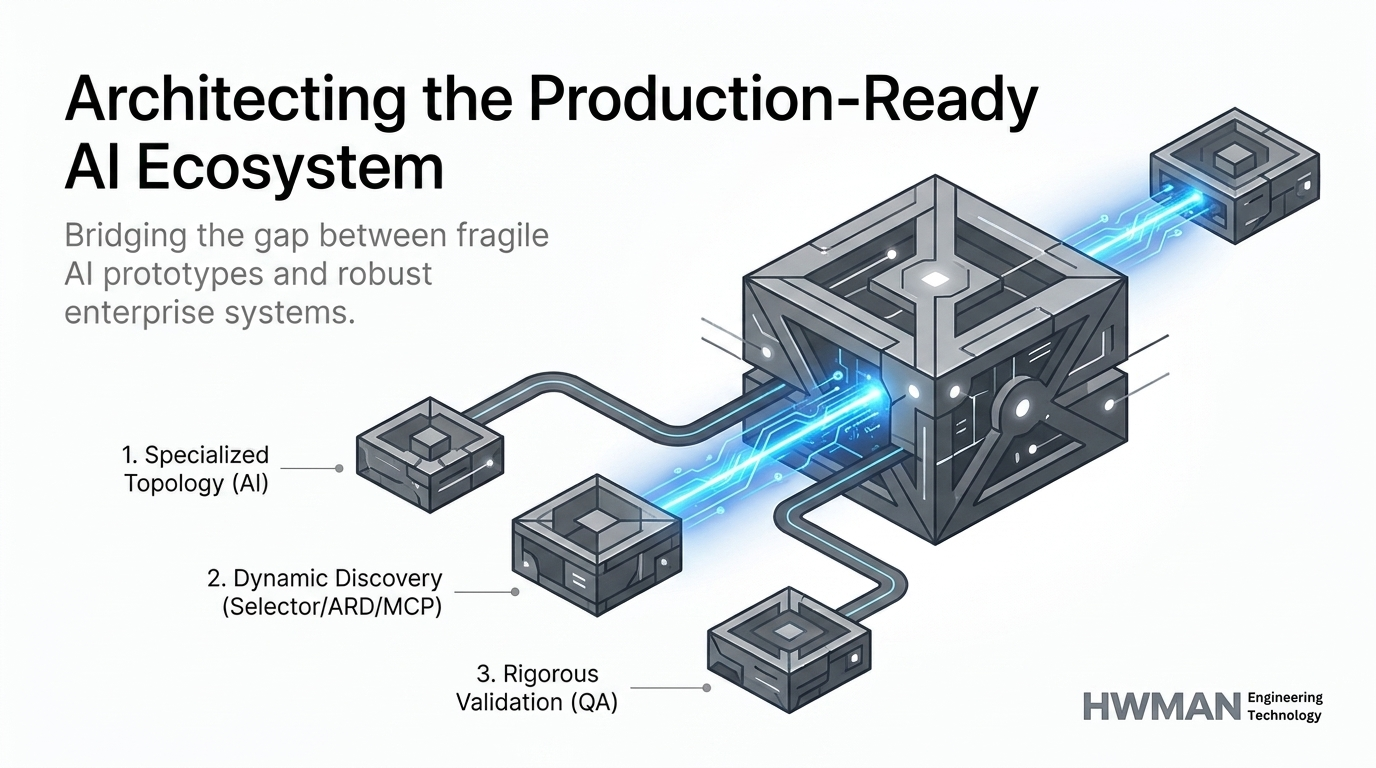
Architecting the Production-Ready AI Ecosystem
The hard part of enterprise AI is rarely getting a model to produce one impressive answer. The hard part is building a system that keeps producing useful outcomes when workflows span multiple tools, failures happen mid-execution, context grows, infrastructure changes, and acceptable outputs cannot be validated with one exact-string assertion.
A production-ready AI platform therefore needs more than a capable model. It needs an architecture that divides responsibility, discovers capabilities dynamically, standardizes how agents connect to external systems, validates non-deterministic behavior, and exposes enough telemetry to understand what happened inside every execution loop.
The blueprint in these diagrams can be summarized as three connected disciplines: specialized architecture, dynamic discovery, and rigorous QA. Each solves a different failure mode, but the system only becomes dependable when the three are engineered together.
1. Divide Responsibilities Before Scaling Intelligence
A monolithic “super agent” appears attractive because it concentrates reasoning, context, tool access, and workflow ownership in one place. That convenience does not scale cleanly. As the agent accumulates sales, support, operations, data ingestion, infrastructure monitoring, market analysis, ticket resolution, and other responsibilities, its context window becomes a shared dumping ground for unrelated concerns.
The alternative is specialization. A sales specialist can own a measurable sales outcome, a support orchestrator can own service workflows, and an operations optimizer can own operational actions. Communication becomes an architectural boundary rather than an accident of prompt construction.
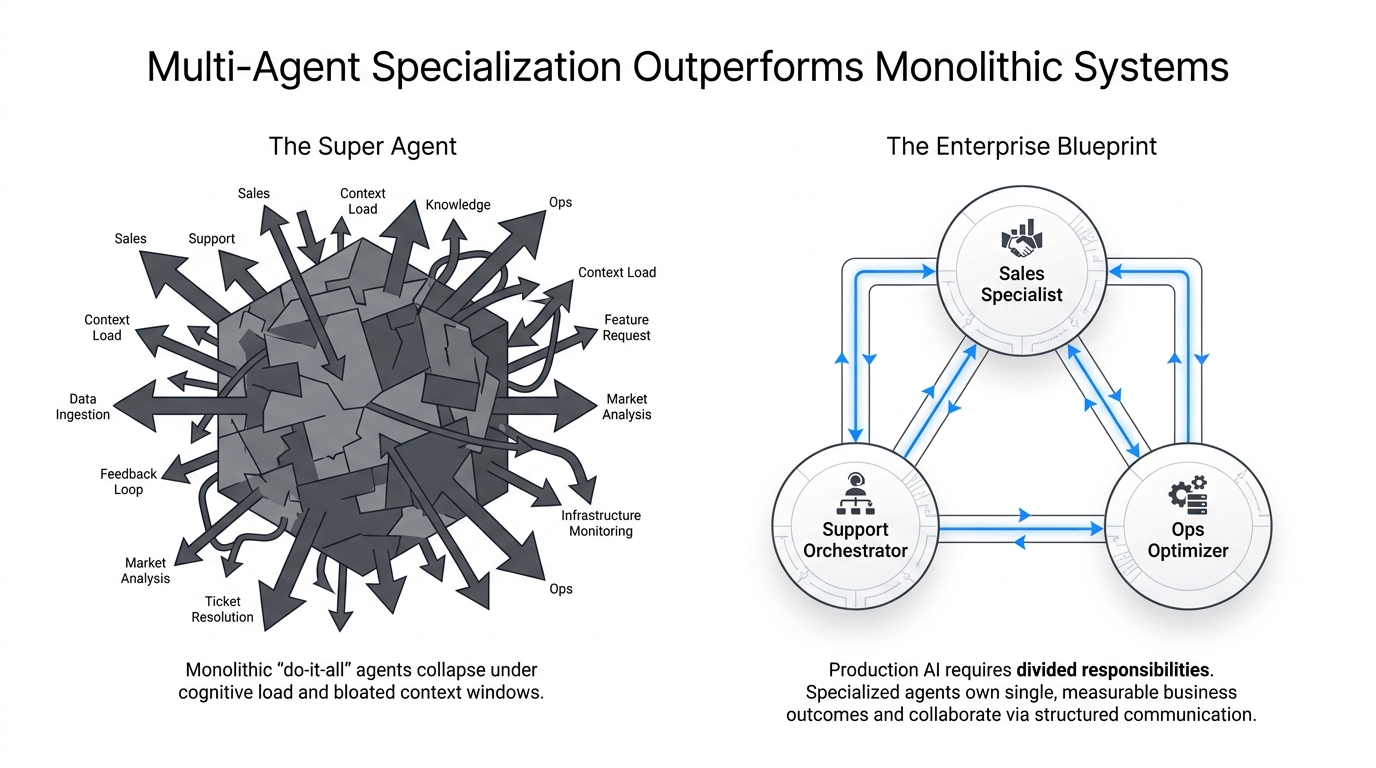
Specialization changes the unit of design. Instead of asking one model to “know everything,” the system defines bounded roles with explicit responsibilities. That improves testability because each role can be evaluated against a narrower contract, and failures can be isolated to the agent or handoff that produced them.
It also creates a clearer operating model. The question is no longer whether one agent can complete an entire enterprise workflow. The questions become: which agent owns each part, what state does it require, and how do collaborating agents exchange information without loading unrelated context into every step?
2. Match the Agent’s Cognitive Loop to the Task
Not every action deserves the same amount of reasoning. A production architecture should select the lightest cognitive loop that still meets the quality requirement.
For simple direct actions, tool use is the shortest path: prompt, tool call, action. This is appropriate when the intent is already known and the operation is straightforward, such as a targeted CRM update.
For multi-step work, ReAct-style reasoning and acting interleaves reasoning with tool calls. That supports research, iterative information gathering, and conditional execution, at the cost of higher token use and latency.
For quality-critical work, reflection adds an explicit self-evaluation loop before finalization. The system generates an output, evaluates it, and can revise before committing the final result.
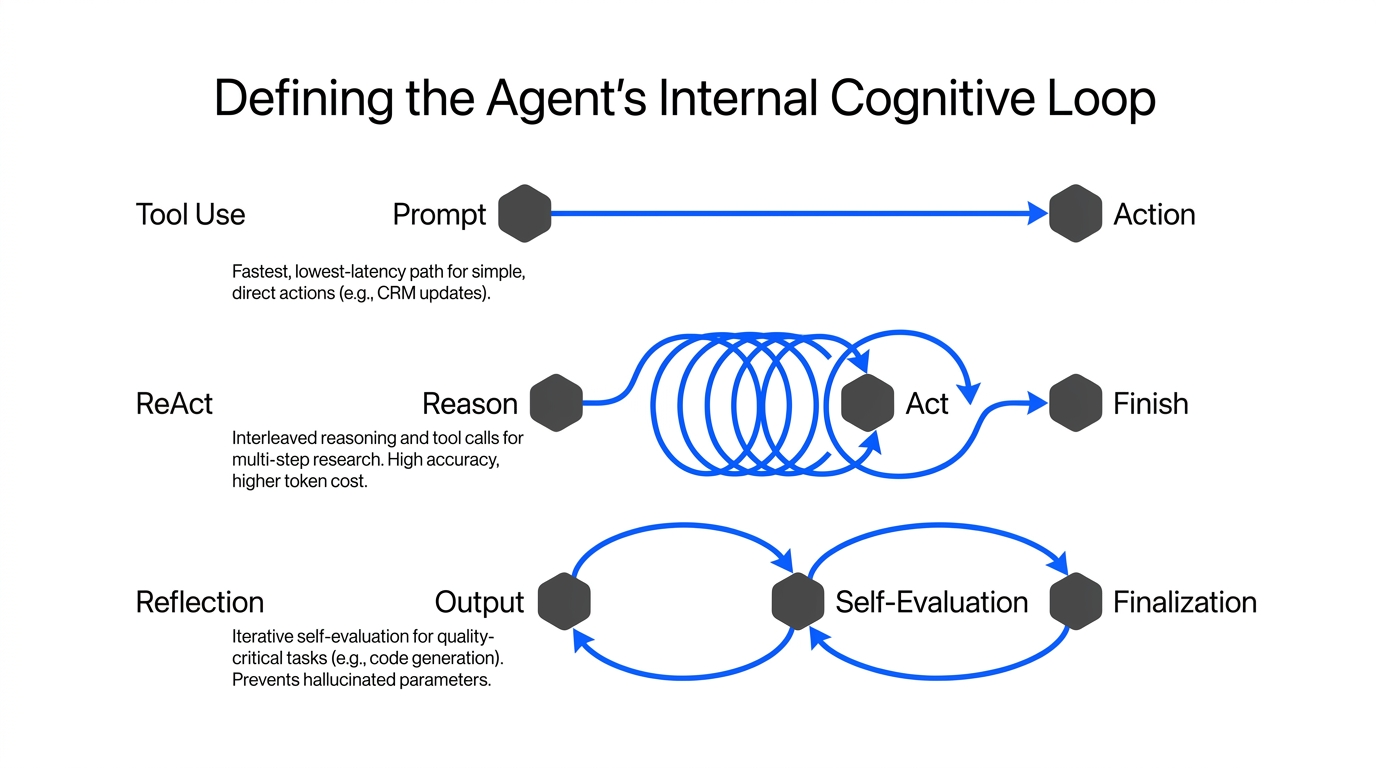
These loops are better treated as execution policies than as fixed agent personalities. A workflow may begin with a direct tool call, escalate to iterative reasoning when new information is required, and invoke reflection before a consequential result is finalized.
The engineering implication is straightforward: reasoning depth should be proportional to task ambiguity and risk. Making every task reflective wastes resources. Making every task direct removes the checks needed for uncertain or multi-step work.
3. Choose a Coordination Topology That Matches the Failure Model
Once responsibility is distributed, the next design problem is topology: how do the agents coordinate?
A sequential topology is easy to understand and useful for predictable pipelines, but early-stage failures can propagate to downstream stages. A parallel topology allows independent executions to run simultaneously, reducing total execution time when tasks do not depend on one another.
A hierarchical topology introduces supervisors and sub-team leaders. It fits larger domains where work can be decomposed and faults isolated within sub-teams. An orchestrator topology centralizes routing through a control node that delegates work to specialized plan, stage, or execution agents.
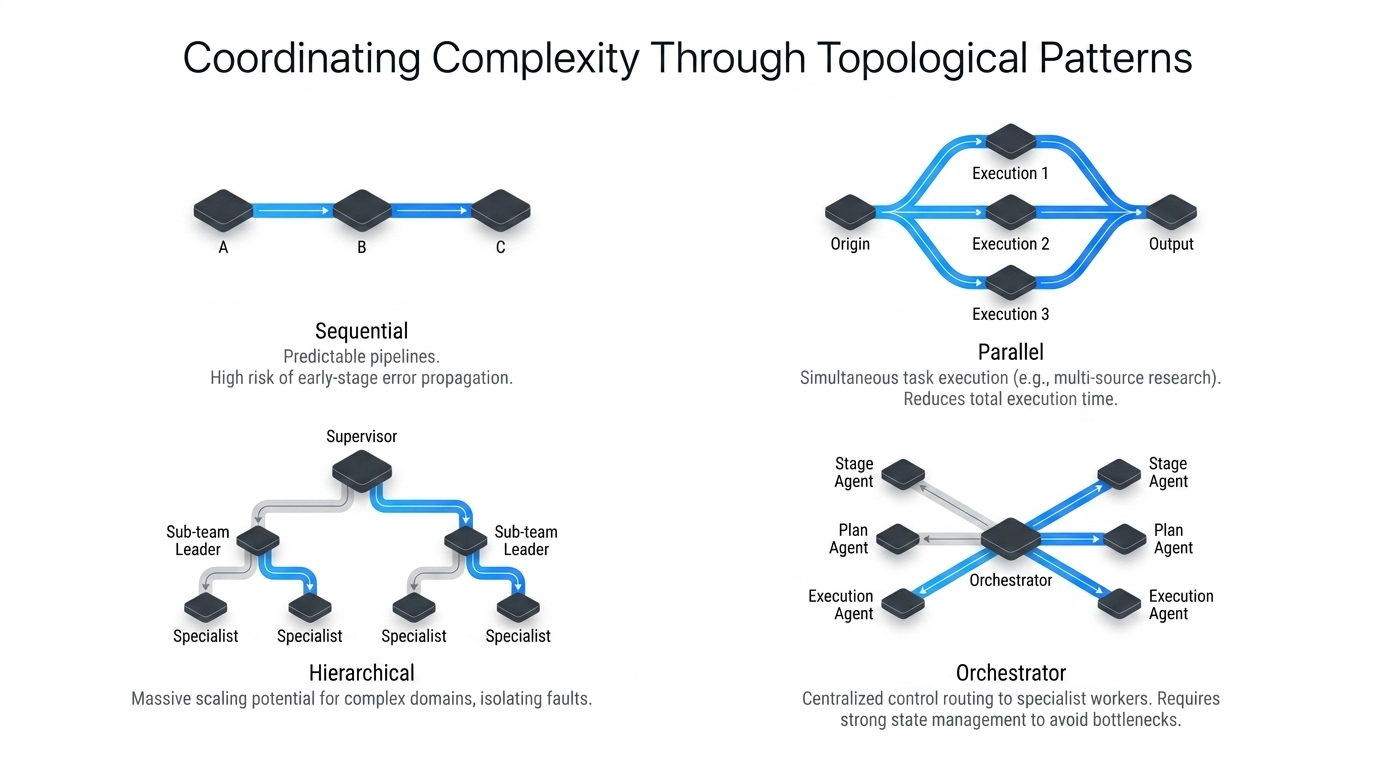
Each topology makes a different trade-off between simplicity, concurrency, scalability, and state-management pressure. The orchestrator pattern is especially useful when the set of possible workers is large, but it also concentrates responsibility for routing and state. The diagram's warning is important: centralized control requires strong state management to avoid becoming a bottleneck.
A production system should treat topology as a workload decision. Stable linear tasks can remain sequential. Independent research tasks can run in parallel. Large domains can use hierarchy. Dynamic specialist routing can use an orchestrator. There is no requirement that the entire platform use one pattern everywhere.
4. Move Tool Selection Out of the Prompt with Agentic Resource Discovery
A specialized agent still needs access to external capabilities. Loading every possible tool into every agent recreates the same problem specialization was meant to solve: unnecessary context and ambiguous selection.
Agentic Resource Discovery (ARD) moves capability selection outside the language model. Organizations publish tools or skills into a federated registry. At runtime, the agent describes what it needs, queries the registry, and receives the specific capability required for the immediate task.
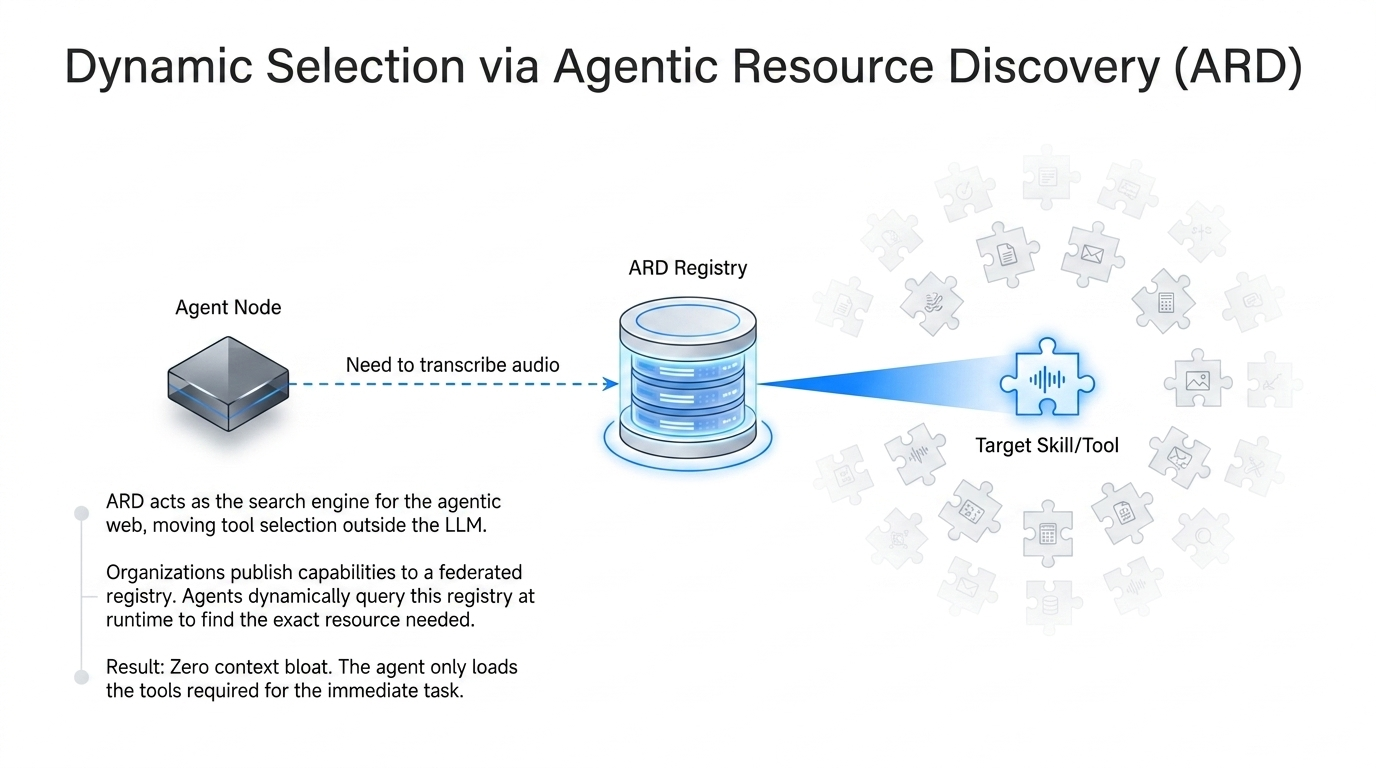
The architectural objective shown here is “zero context bloat”: an agent should not carry a huge static catalog of tools when it only needs a small subset for the current action. Discovery becomes a runtime service instead.
This also changes how capabilities can evolve. New tools can be published to the registry without rebuilding every agent prompt. The agent’s responsibility is to express the needed capability; the registry’s responsibility is to resolve that need to an available resource.
The important separation is selection versus execution. ARD answers what capability should be used. A separate protocol should answer how the selected capability is invoked consistently.
5. Standardize Execution with the Model Context Protocol
Dynamic discovery is only useful if the selected capability can be connected to predictably. The Model Context Protocol (MCP) supplies that standardization layer between an agent client and an enterprise server.
In the presented architecture, MCP removes the need for a bespoke integration path for every new backend. Capabilities are exposed through a common connection model, with resources, tools, and prompts available through the protocol.
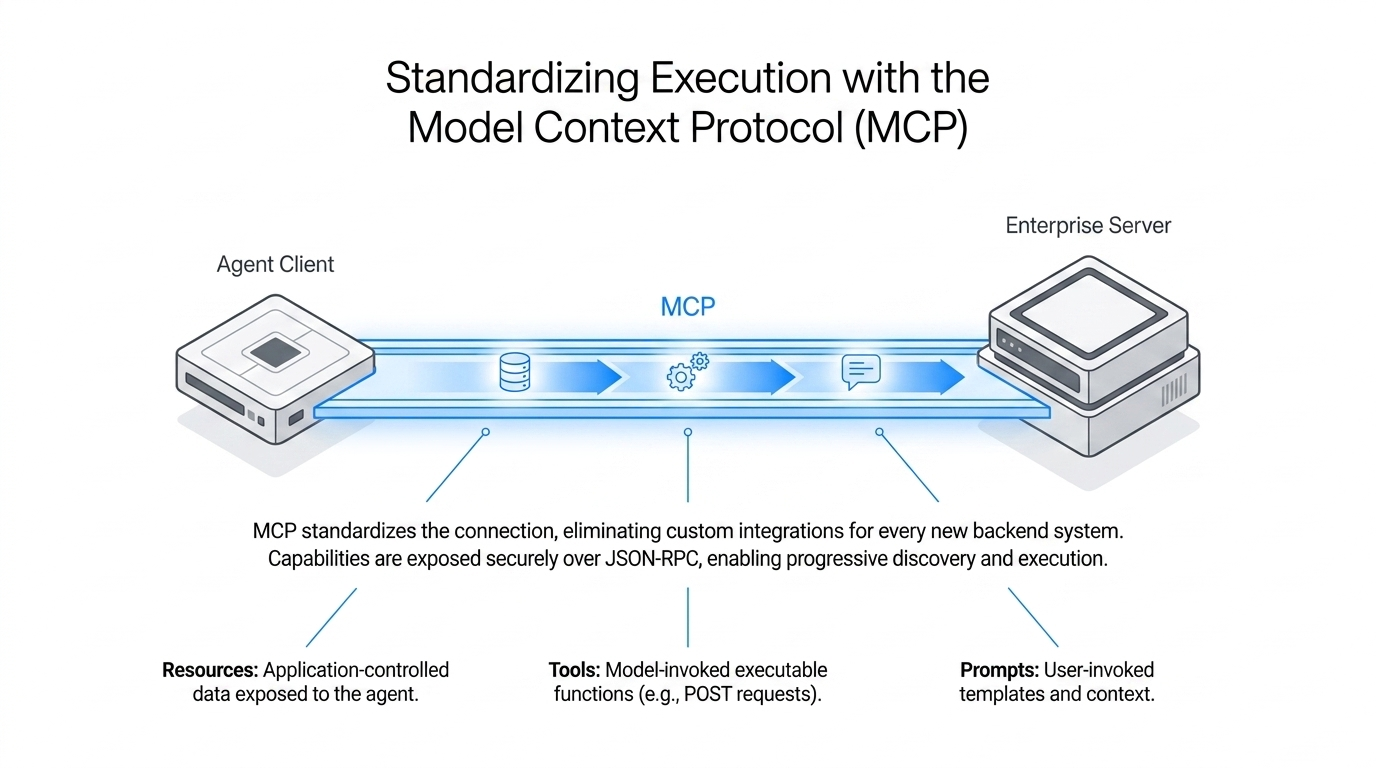
The capability types serve distinct purposes:
- Resources expose application-controlled data to the agent.
- Tools expose model-invoked executable functions.
- Prompts expose user-invoked templates and context.
Together, ARD and MCP create a two-stage interaction. ARD finds the right resource. MCP provides the standardized bridge for execution. Discovery logic, tool metadata, and integration plumbing therefore do not need to become permanently embedded in the language model's context.
For enterprise architecture, this decoupling is the key benefit. Agents can remain specialized while the capability ecosystem grows independently around them.
6. Treat Orchestration as a Continuous Control Loop
Production agentic systems are not hardcoded chains that run once from left to right. They behave more like control systems that repeatedly interpret state, select resources, act, and update what they know.
The continuous orchestration loop in this blueprint has five stages:
- User intent
- ARD query to select the needed capability
- MCP connection to inject the selected interface
- Tool execution
- State update and reflection before the next step
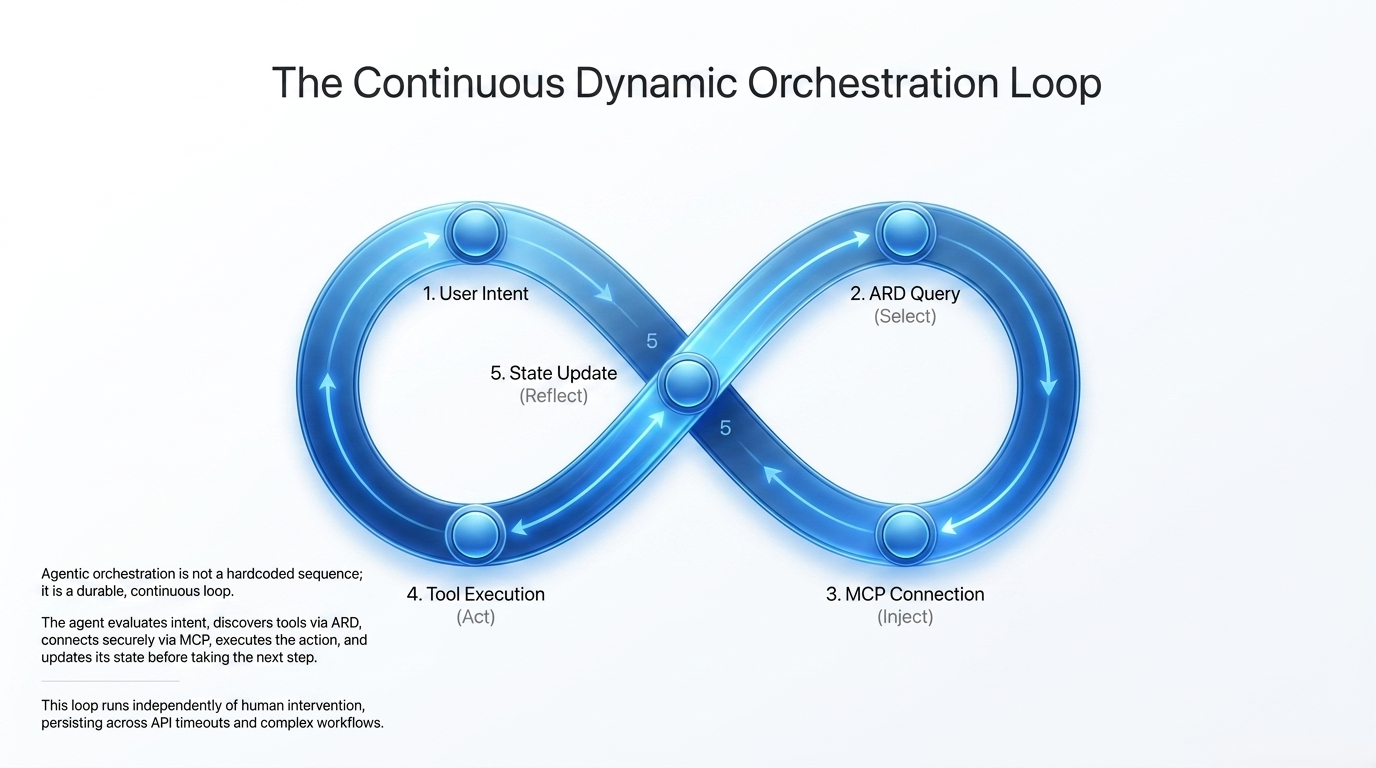
This loop is intended to persist across API timeouts, multi-step workflows, and other execution complexity. The agent is not simply following a script; it is continually deciding what the next correct action is based on current state.
That makes state management a first-class subsystem. The system must know what has already happened, what artifacts were produced, what calls succeeded, what failed, and what the next step is allowed to do. Without durable state, a dynamic loop can degrade into uncontrolled retry behavior.
The design goal is therefore not maximum autonomy. It is controlled autonomy with explicit state transitions.
7. Redefine QA for Non-Deterministic Outputs
Traditional test automation was designed for deterministic software. Given fixed inputs, the expected output can often be represented as a precise value, a known DOM state, or an exact API response.
AI systems break that assumption. Two acceptable outputs may use different wording, ordering, or reasoning while still satisfying the same intent. Exact-string assertions therefore turn normal variability into false failures.
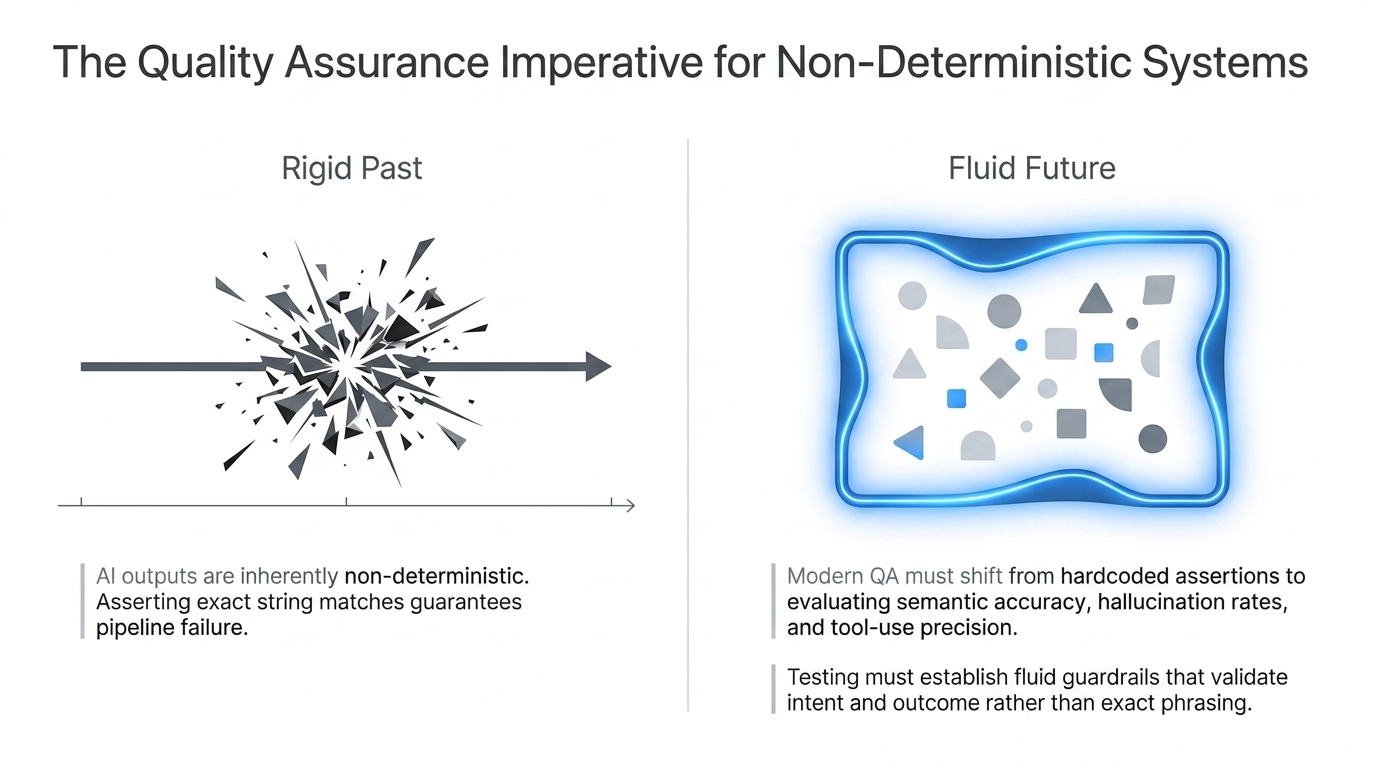
Modern AI QA must evaluate properties that remain meaningful even when wording changes. The architecture highlights semantic accuracy, hallucination rates, and tool-use precision. The purpose of the test becomes validating intent and outcome rather than exact phrasing.
That does not mean loosening standards. It means moving the standard to the correct abstraction level. A useful evaluation can require the right decision, the right evidence, the right tool, no unsupported claims, and compliance with a safety constraint without requiring every run to produce the same sentence.
The test oracle becomes a set of behavioral guardrails rather than one literal expected string.
8. Build a Layered AI Test Automation Framework
The QA architecture becomes more scalable when it is layered.
At the foundation, keyword-driven testing provides modular test skills and separates test-case design from execution. Above that, orchestration hooks inject validation directly into the dynamic agent loop. At the top, AI evaluation engines use programmable scoring, including LLM-as-a-judge pipelines, to assess properties such as accuracy, relevance, and safety.
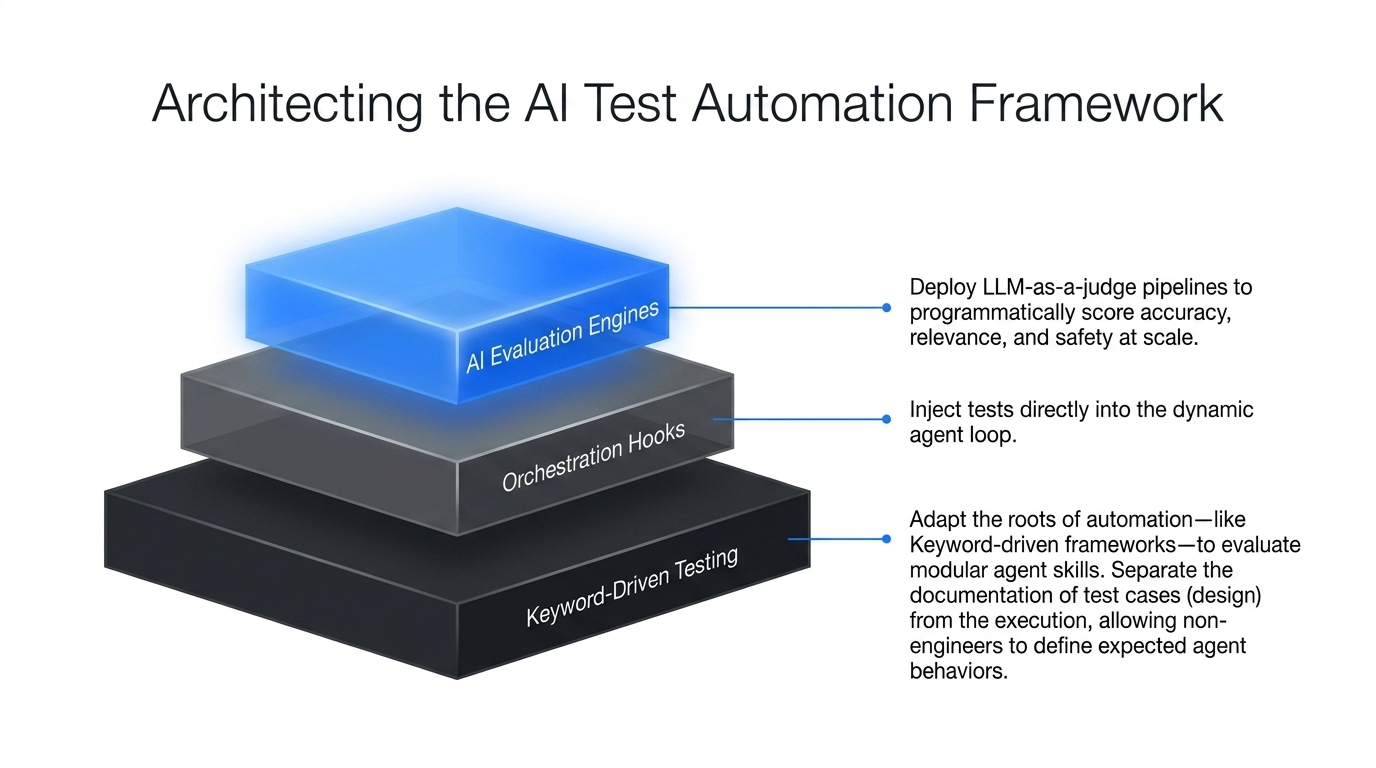
This structure preserves familiar automation principles while adapting them to agentic execution. Test designers can define expected behaviors as reusable skills, orchestration can run checks at meaningful points in the workflow, and evaluation engines can score outputs that cannot be validated with exact equality.
A production implementation should keep these layers independent. Test intent should be readable without requiring knowledge of the runtime harness. Execution hooks should capture the state needed for evaluation. Evaluation engines should return structured results that can be trended, audited, and compared across releases.
The objective is repeatable validation at scale without pretending that language-model behavior is deterministic.
9. Balance Automation with Human Oversight
Not every quality decision should be automated, and not every human review is a sign of architectural weakness. The QA matrix divides validation into four categories.
Automated technical checks cover regression, similarity, format validation, and performance benchmarking. Automated safety checks cover safety filters, PII redaction, and hallucination checks.
Manual nuance checks handle subjective quality, tone alignment, and cultural sensitivity. Manual high-stakes checks introduce human-in-the-loop approvals for financial transactions, novel edge cases, and irreversible workflow actions.
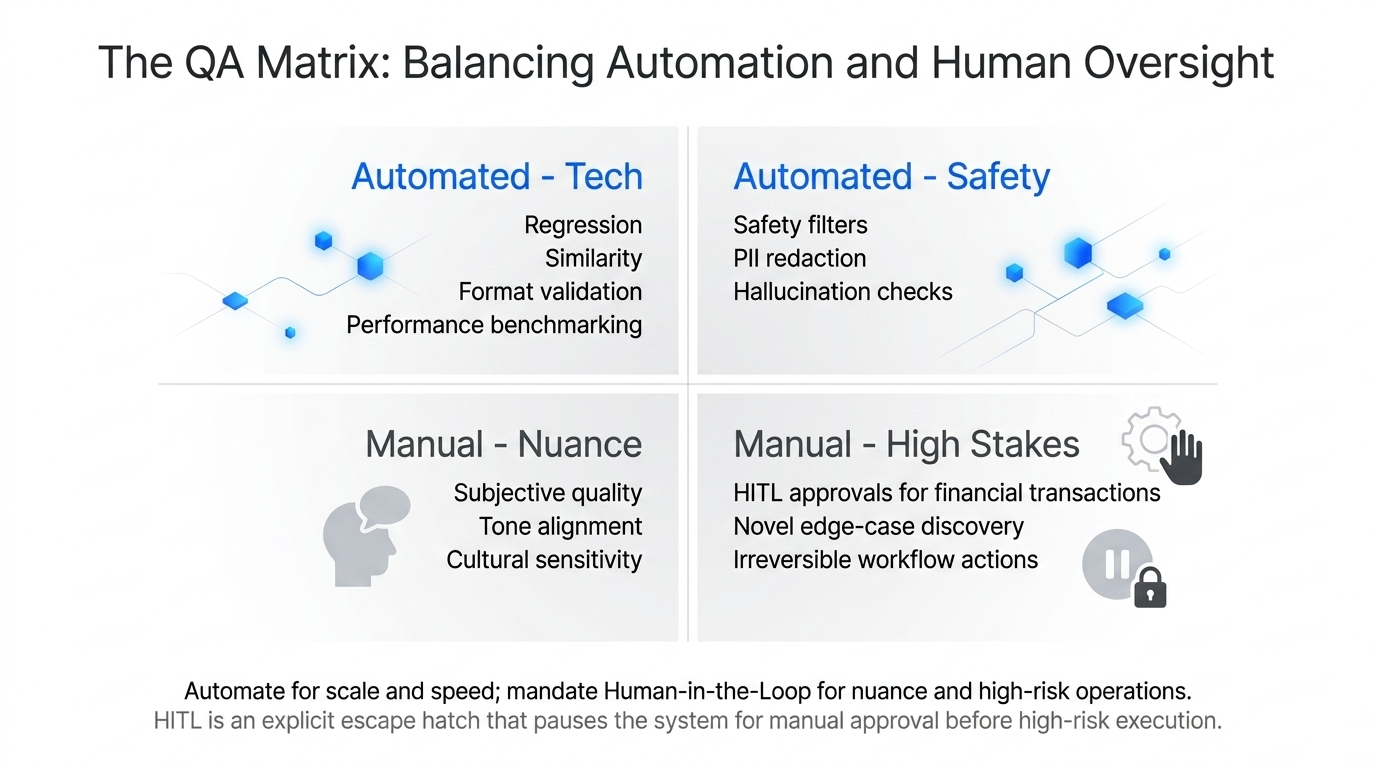
The system should automate where speed and scale dominate, and deliberately stop where judgment or consequence dominates. Human-in-the-loop is an explicit escape hatch: the agent pauses before a high-risk action and waits for approval.
This is also a governance boundary. The architecture makes clear that model confidence is not the same thing as authorization to act. High-risk workflows need an independent control that can block execution even when an agent believes its reasoning is complete.
10. Make the Agent Loop Observable
An agent cannot be reliably tested or debugged if its execution remains opaque. Production AI therefore requires granular telemetry across the full workflow.
The observability layer tracks token usage, reasoning traces, tool success rates, and context retrieval latency. It also records every LLM call, retrieved document, and executed API.
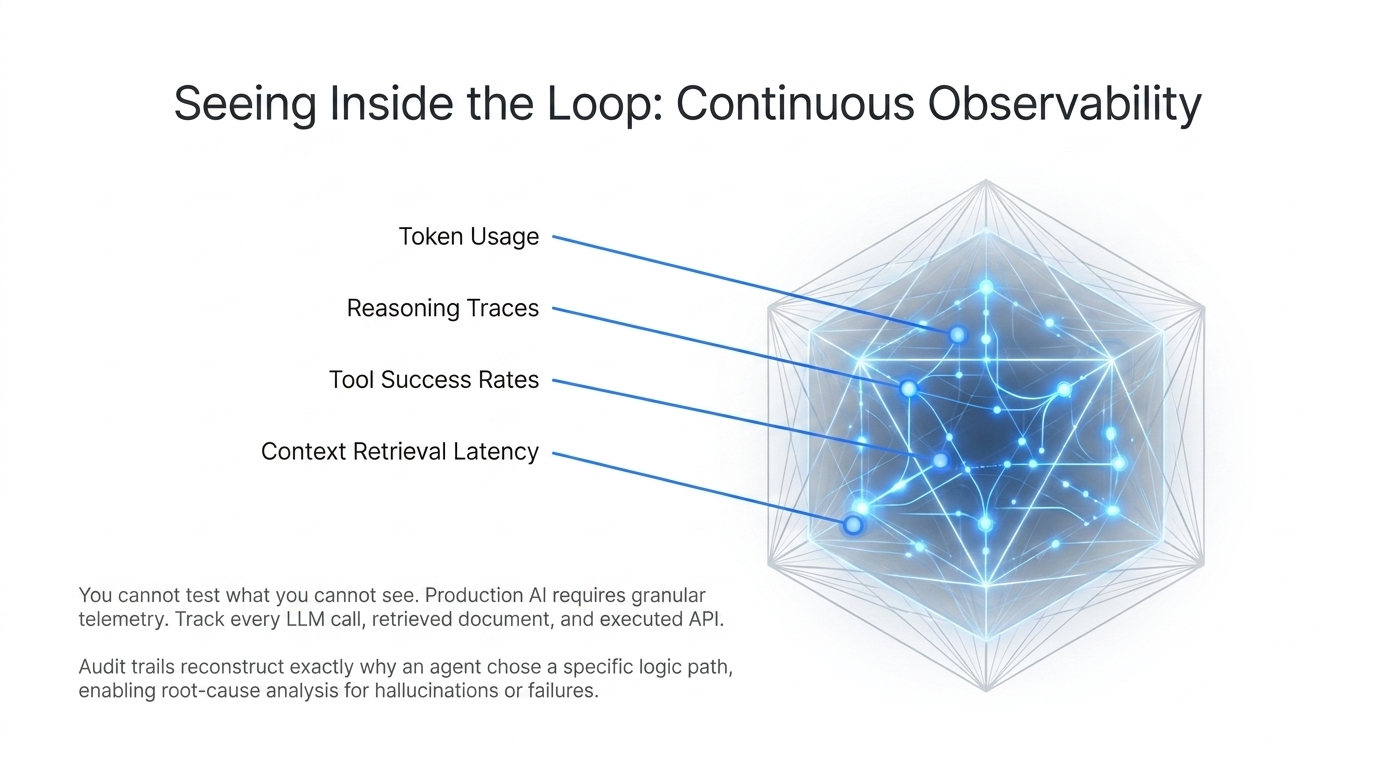
This telemetry supports two different activities. First, it enables operational monitoring: latency spikes, failing tools, or retrieval slowdowns can be detected while the system is running. Second, it supports forensic analysis: audit trails can reconstruct why an agent selected a particular path after an unexpected result.
Observability is especially important for dynamic systems because the exact execution path may vary between runs. If the system cannot reconstruct the sequence of decisions and external calls, root-cause analysis becomes guesswork.
The practical rule is simple: instrument the loop at the same granularity at which it can fail.
11. Add Diagnostic Agents for Self-Healing Workflows
Observability tells the platform what happened. A more advanced design can use those signals to attempt controlled recovery.
The self-healing pattern introduces a diagnostic service agent that monitors worker-agent tool calls. When execution fails, the diagnostic agent can adjust prompt or parameter context and then trigger a retry.
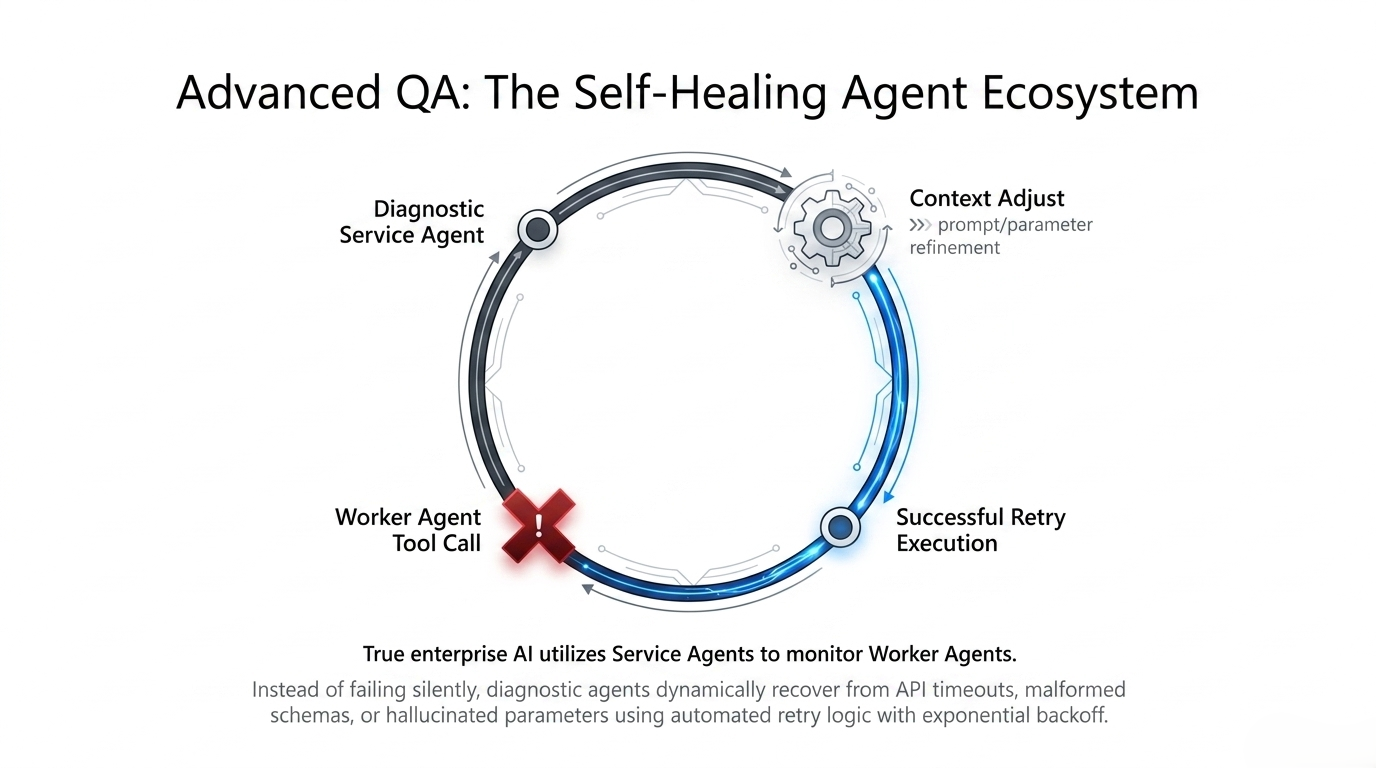
The failure modes shown include API timeouts, malformed schemas, and hallucinated parameters. Rather than allowing those failures to disappear inside a long workflow, the system turns them into an explicit recovery cycle.
For production use, recovery logic should remain bounded and observable. A retry should be tied to a diagnosed condition, produce a traceable state change, and eventually escalate rather than loop indefinitely. That recommendation follows from the control-loop architecture: automated recovery should remain governable.
The broader lesson is that resilience can itself be specialized. Worker agents do the business task; diagnostic agents monitor execution health and coordinate recovery.
12. Measure the System by Business Outcomes
AI platforms can generate abundant internal metrics, but activity is not the same as value. The final operational layer therefore connects technical behavior to business impact.
The blueprint groups measurement into three categories. Technical health includes latency, retrieval accuracy, and hallucination rate. Operational efficiency includes workflow completion time, hours saved, and automation rate. Commercial impact includes qualified outcomes, CSAT, and revenue influenced.
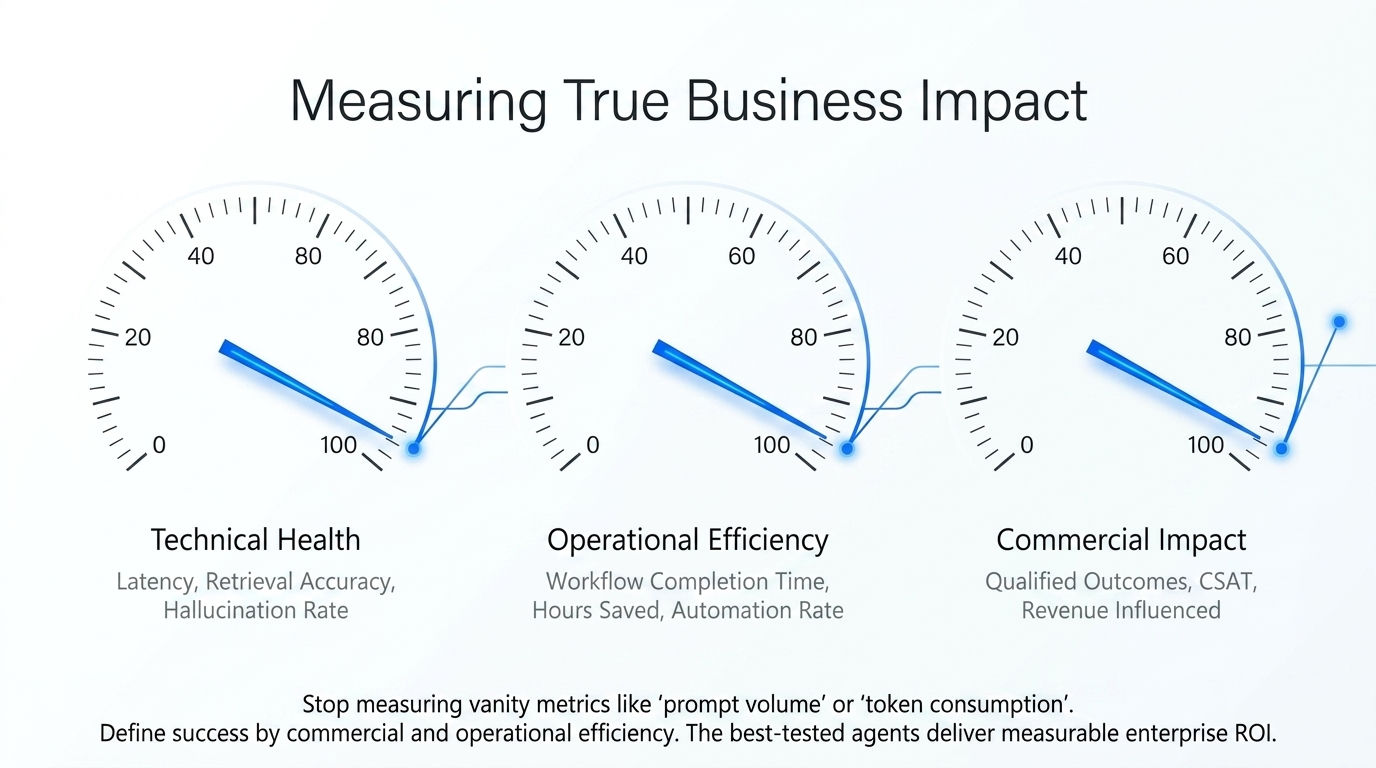
This hierarchy prevents the organization from optimizing only for model-centric vanity metrics such as prompt volume or token consumption. Those measures can still be useful for capacity or cost analysis, but they do not establish whether the system is performing useful work.
A production AI program should connect evaluation results to the outcomes that justify automation. Technical quality protects reliability. Operational metrics show whether the workflow is improving. Commercial metrics show whether that improvement matters to the organization.
Engineering Principles
The architecture ultimately depends on several principles:
-
Specialize by responsibility
Keep agent roles narrow enough that ownership, context, and quality can be measured independently. -
Discover capabilities dynamically
Use a registry such as ARD to select the right tool at runtime rather than loading every possible integration into every prompt. -
Standardize execution boundaries
Use a common protocol layer such as MCP so agent logic does not become inseparable from backend-specific integration code. -
Validate behavior, not phrasing
Treat AI outputs as non-deterministic and test semantic intent, safety, tool use, and outcomes instead of exact wording. -
Instrument every control loop
Collect enough telemetry to reconstruct execution, diagnose failures, enforce oversight, and connect technical quality to business impact.
Final Synthesis
The complete enterprise architecture is a pipeline of responsibilities rather than a single intelligent component. The Architect layer defines specialized multi-agent teams. The Select layer resolves the tools and capabilities those agents need through ARD registries and dynamic discovery. MCP bridges standardize the connection to external resources. The Validate layer surrounds execution with observability, continuous QA, anomaly detection, performance monitoring, and self-healing triggers.
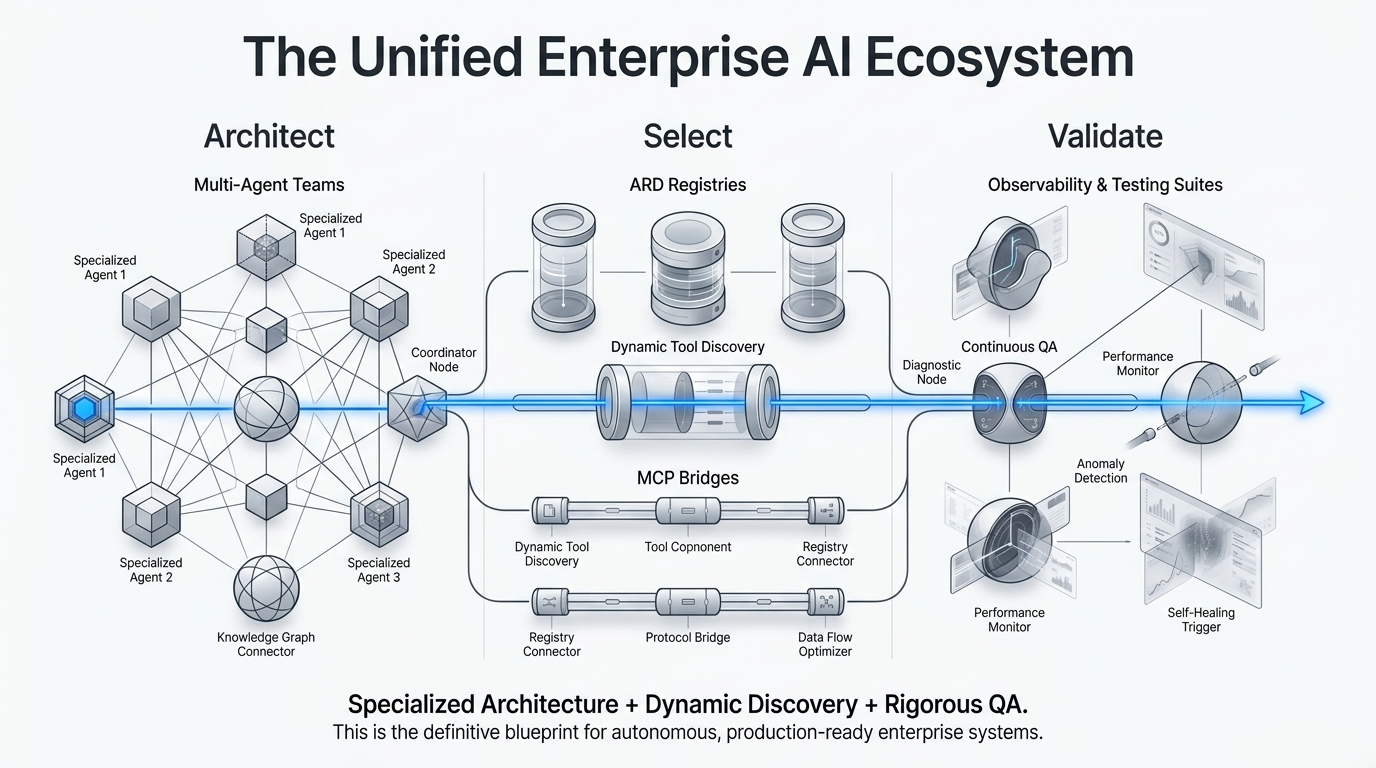
The system works because these layers reinforce one another. Specialization reduces cognitive and contextual overload. Dynamic discovery avoids hardcoding every capability into every agent. Standardized protocol bridges keep execution interfaces consistent. Continuous QA checks non-deterministic behavior against meaningful guardrails. Observability exposes what happened. Diagnostic services provide a path to recovery. Human approval remains available for nuanced or irreversible actions.
The production-ready system combines:
- Deterministic foundation: explicit roles, state, routing, protocol boundaries, and structured tool interfaces
- Testing layer: semantic evaluation, regression checks, safety validation, and orchestration-level test hooks
- Agent or AI layer: specialized workers, coordinators, planners, and diagnostic service agents
- Security and governance: safety filters, PII redaction, human-in-the-loop approvals, and auditable execution
- Observability layer: LLM, retrieval, tool, latency, reasoning, and performance telemetry
- Production outcome: measurable technical health, operational efficiency, and commercial impact
The architecture does not attempt to eliminate variability. It contains variability with specialization, state, validation, and visibility.
Closing Thought
Enterprise AI becomes dependable when intelligence is treated as one component inside a disciplined software system rather than as the system itself.
Production readiness is the result of architecture, discovery, validation, and observability working as one control loop.