
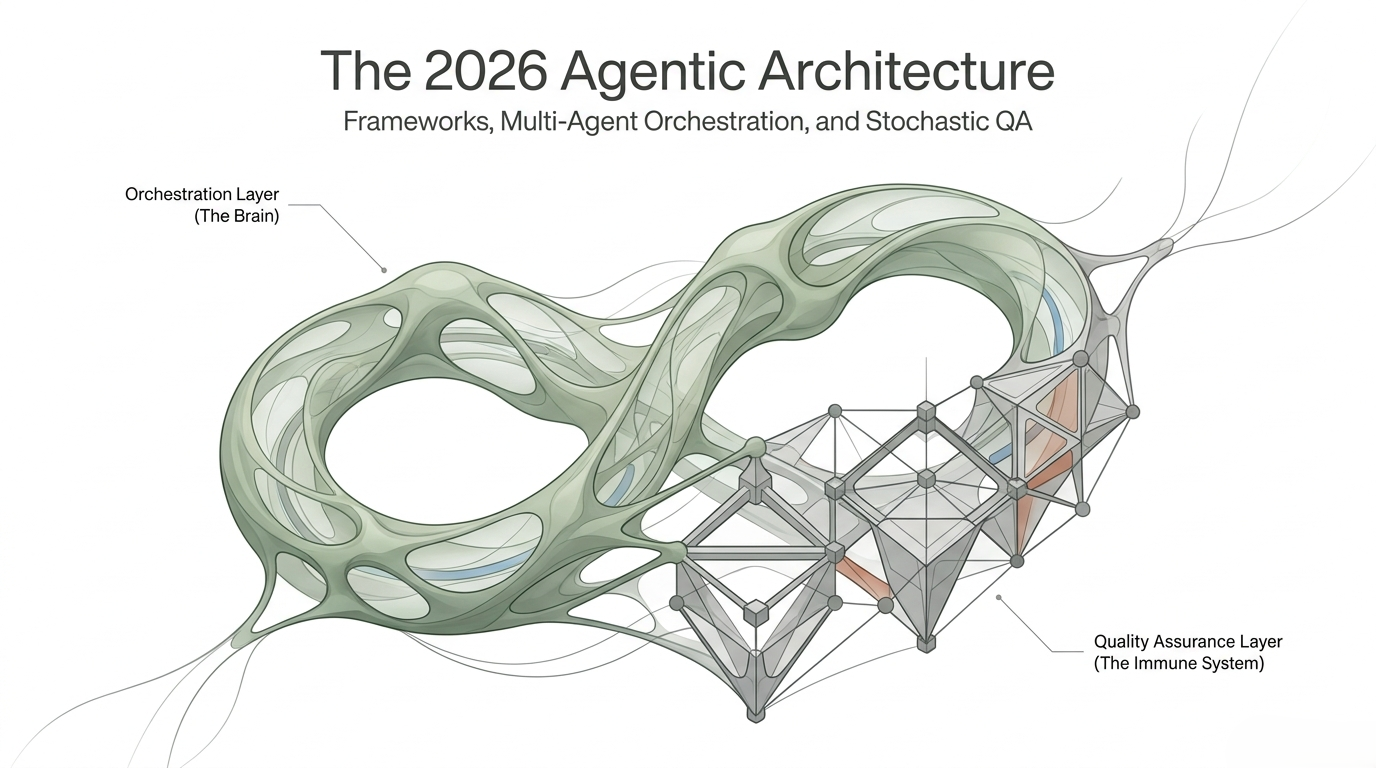
The 2026 Agentic Architecture: Multi-Agent Orchestration and Stochastic QA
Agentic systems break a familiar software assumption: the same input no longer guarantees the same observable execution path. A model can choose different tools, traverse different reasoning branches, consume different context, and still produce an acceptable result.
That shift changes quality assurance more than orchestration. Traditional tests are optimized for deterministic functions and stable state transitions. Multi-agent systems require a testing discipline that can reason about distributions, confidence, behavior traces, invariants, cost, and human review.
The architecture in this article treats orchestration and QA as two coupled layers. The orchestration layer decides how agents collaborate. The QA layer decides whether the resulting behavior is statistically trustworthy enough to ship.
1. The End of Determinism in the SDLC
Legacy software testing assumes a comparatively stable contract: provide an input, assert an output, and fail when the equality check no longer holds. Agentic software does not remove contracts, but it makes many of them probabilistic.
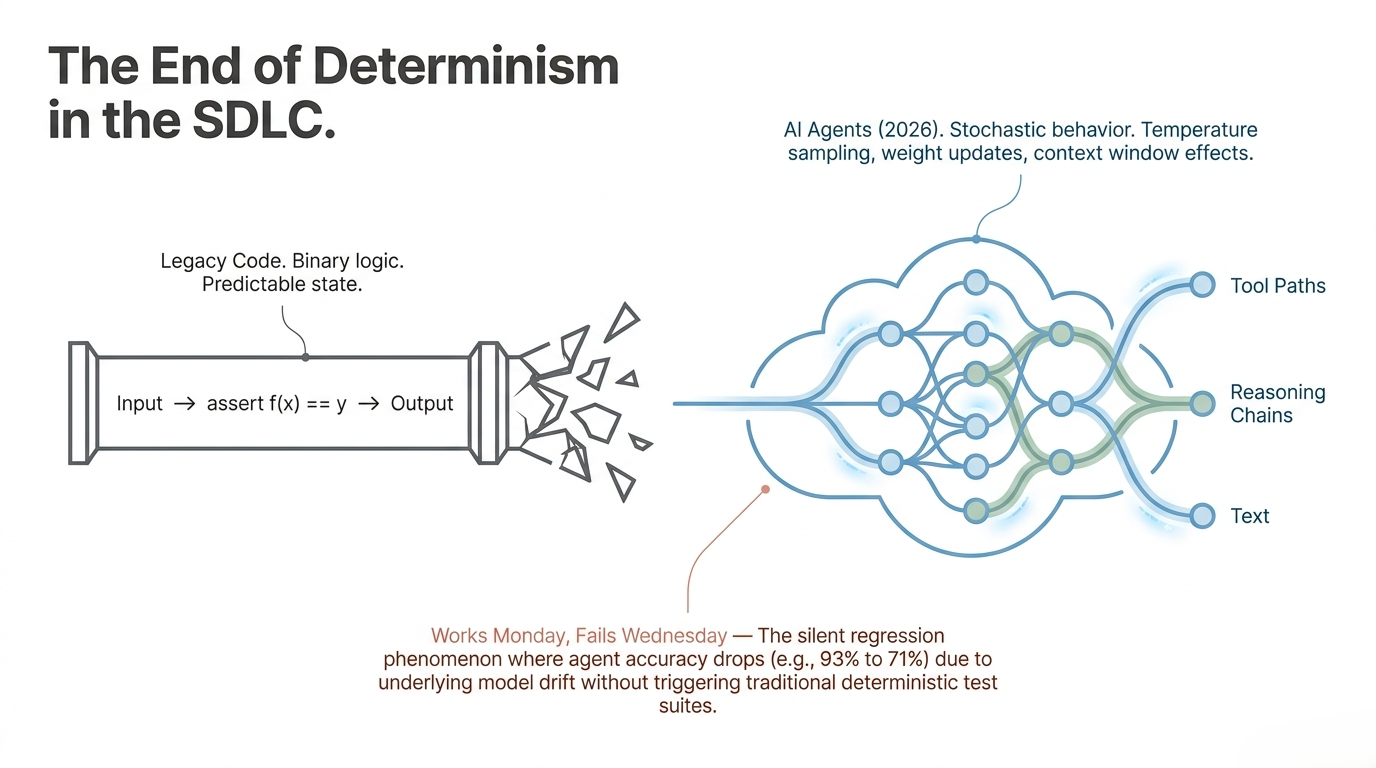
The diagram contrasts a deterministic pipeline with an agent whose behavior depends on temperature, sampling, weight updates, context-window effects, tool choices, and reasoning chains. The practical problem is not merely response variability. The same application can drift without producing a crisp assertion failure.
The slide labels this as the “works Monday, fails Wednesday” problem: a silent regression in which a model-backed agent degrades while conventional tests remain green. The example accuracy numbers on the slide are illustrative of the failure mode rather than a universal benchmark.
For engineering teams, the consequence is clear: test the system’s behavior distribution, not only a single text response.
2. Choose Orchestration by Control Model
The orchestration landscape is not a single maturity ladder. It is a set of different control models optimized for different kinds of work.
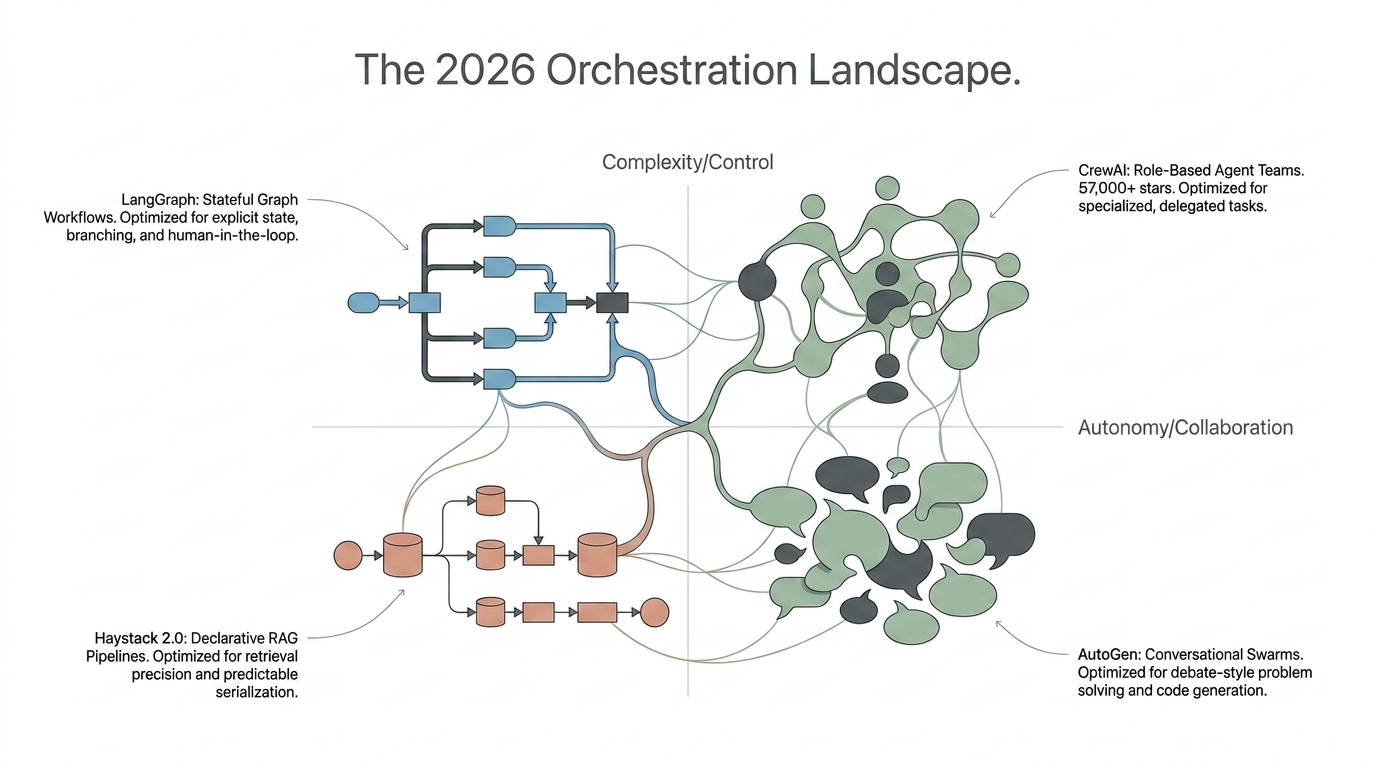
The landscape separates four useful patterns:
- LangGraph emphasizes explicit state, branching, and controlled workflows.
- CrewAI emphasizes role-based teams and delegated tasks.
- AutoGen emphasizes conversational collaboration and debate-like problem solving.
- Haystack emphasizes declarative retrieval pipelines and predictable composition.
These are not interchangeable abstractions. The framework you choose determines which parts of the system are directly inspectable and which parts must be inferred from traces.
The architectural mistake is to select an orchestration framework first and bolt on one generic test suite later. QA should follow the framework’s control surface.
3. CrewAI and Event-Driven Team Behavior
CrewAI models an agent system as a team: agents have roles, goals, backstories, and tasks, and those responsibilities are coordinated through flows and events.
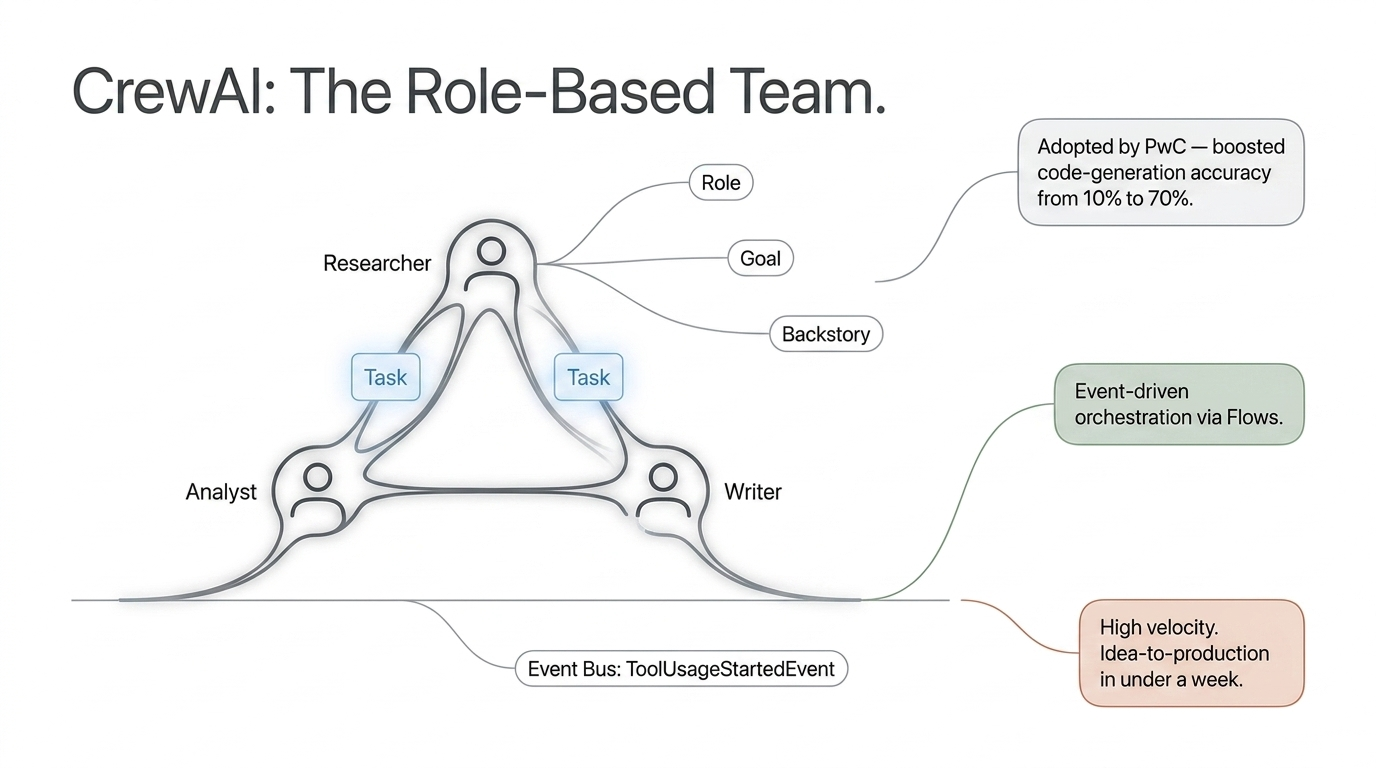
This style makes delegation a first-class behavior. A useful QA strategy therefore focuses on the event stream around delegation: which agent received which task, when tool use began, whether expected transitions occurred, and whether the team completed the intended work.
The slide calls out event-driven orchestration through flows and an event bus example around ToolUsageStartedEvent. That suggests a concrete test boundary: validate the events that represent the team’s contract rather than asserting the exact natural-language wording each agent emits.
Quantitative adoption or productivity callouts on the source slide should be treated as source-specific claims. The durable engineering lesson is the testing surface: role boundaries, delegation events, and task completion semantics.
4. LangGraph and Stateful Execution
LangGraph exposes state transitions explicitly. Nodes, conditional edges, subgraphs, parallel sends, pauses, and human-in-the-loop checkpoints turn an agent workflow into a graph that can be reasoned about structurally.
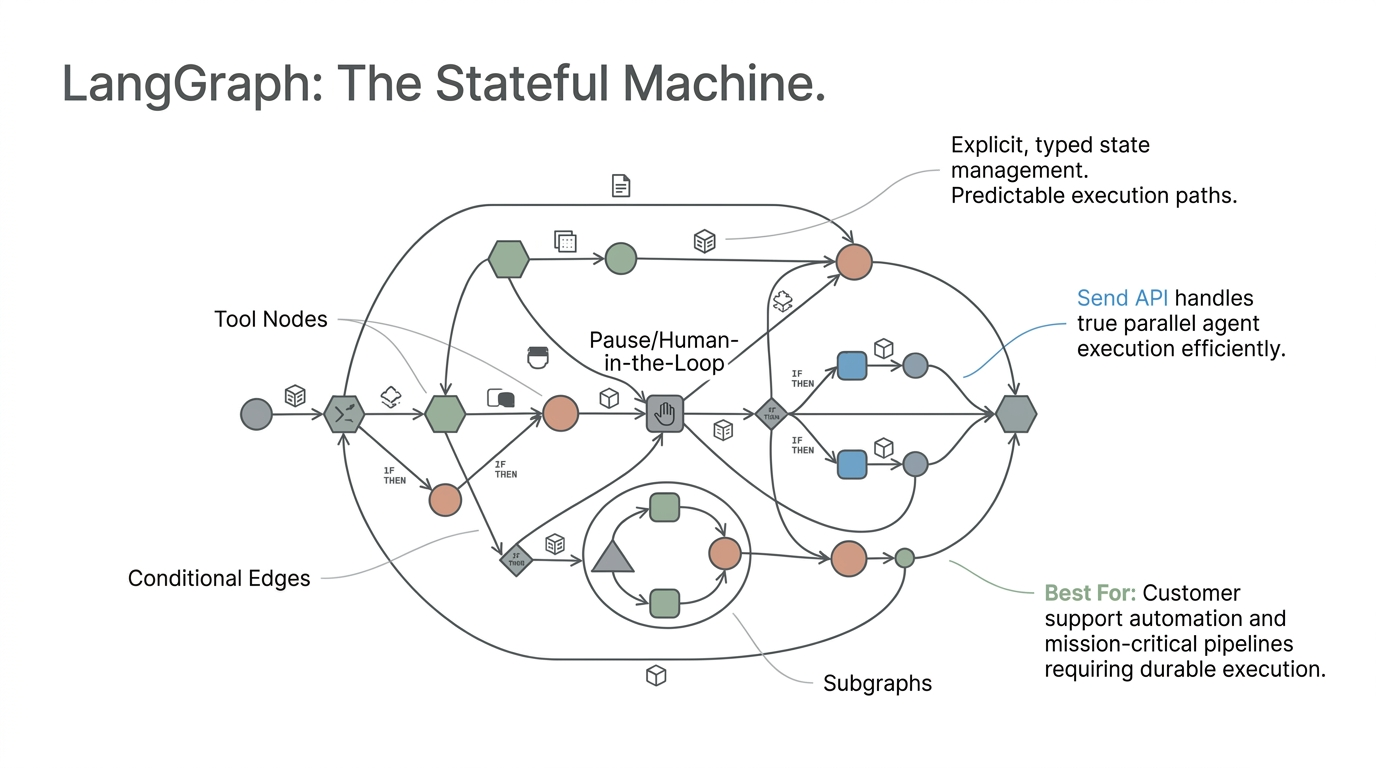
That explicit state changes how QA should work. Instead of asking only whether the final answer is acceptable, a test can verify:
- that a transition happened from an allowed state,
- that node boundaries preserve required fields,
- that parallel branches were launched under the correct condition,
- that human review was reached when the graph required it,
- and that a subgraph returned a state compatible with the parent graph.
This is where stochastic testing becomes most useful when anchored to deterministic structure. The model can remain probabilistic inside a node while the graph enforces durable state invariants around it.
5. Pipeline Predictability vs. Conversational Consensus
Declarative pipelines and conversational swarms sit at opposite ends of a QA spectrum.
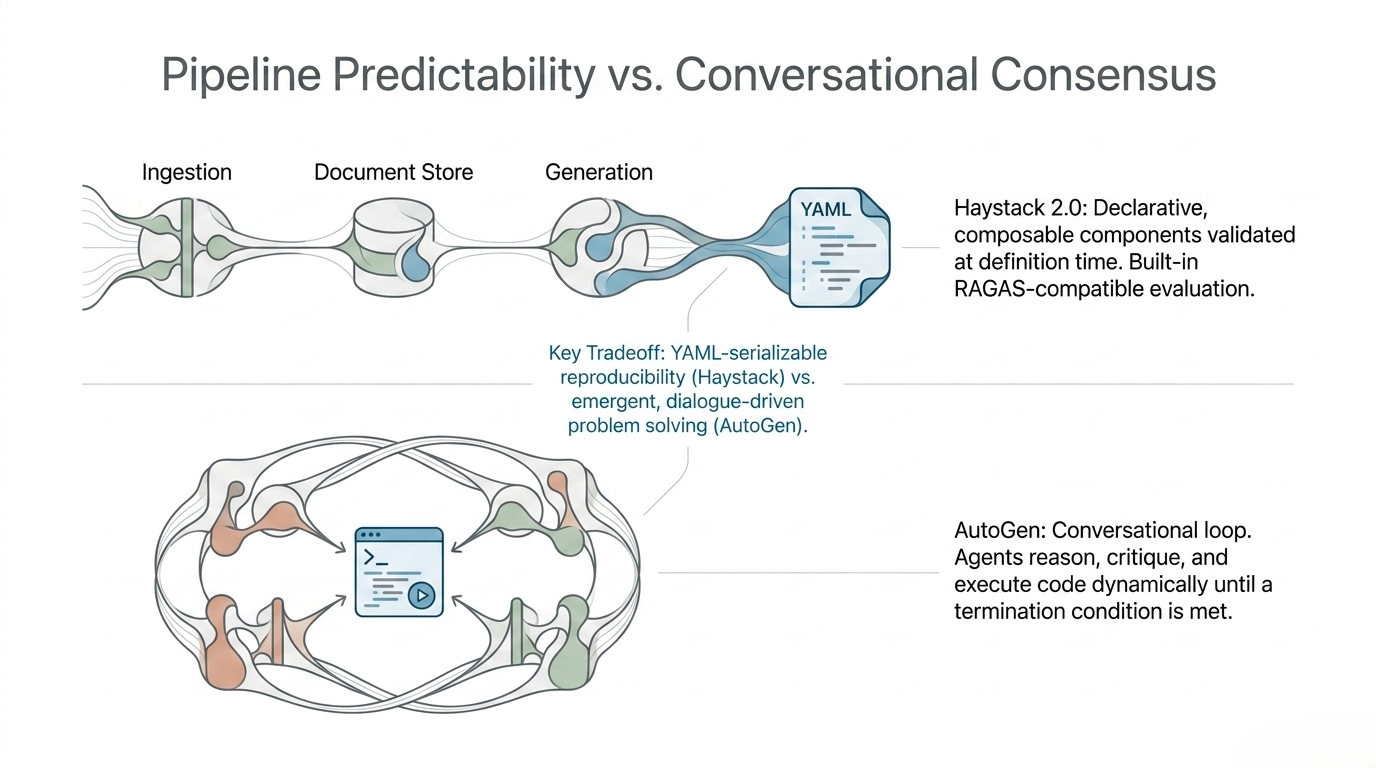
The slide contrasts a serialized Haystack-style pipeline with an AutoGen-style conversational loop. In a declarative pipeline, ingestion, document storage, generation, and configuration are stable enough to validate at definition time. In a conversational system, agents reason, critique, execute, and continue until a termination condition is met.
The key tradeoff is not “simple versus advanced.” It is reproducibility versus emergent coordination.
A declarative system can often be tested through configuration validation, component contracts, and retrieval metrics. A conversational system needs trace-aware evaluation: whether debate converged, which tools were invoked, how reasoning branched, and whether the termination condition was justified.
The QA architecture should therefore mirror the orchestration architecture instead of forcing both into the same pass/fail mold.
6. QA Is Also a Token-Economics Problem
Stochastic validation can become prohibitively expensive when teams copy fixed-sample statistical methods directly into CI.
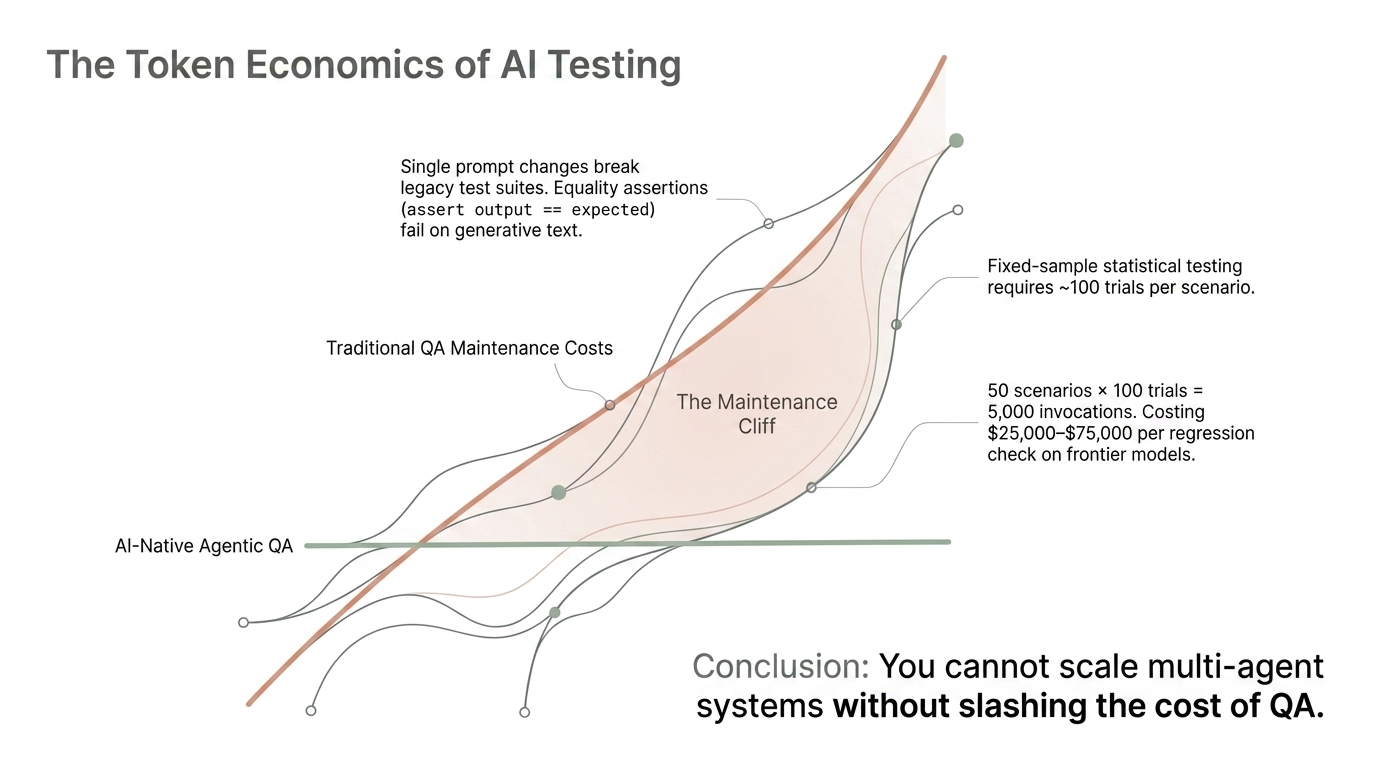
The source diagram shows the “maintenance cliff”: legacy equality assertions fail on generative text, while fixed-sample statistical testing can require many model invocations per scenario. Its worked example multiplies 50 scenarios by 100 trials, producing 5,000 invocations and a large regression-test cost on frontier models.
Whether the exact dollar range applies to a given system depends on model pricing, prompt size, caching, and workload. The general cost equation is still unavoidable:
more stochastic evidence means more tokens unless the test strategy becomes adaptive.
This changes test design. Teams need a portfolio of cheap offline checks, targeted live trials, sequential tests that stop early, and high-cost deep evaluations only where uncertainty remains.
7. Replace Binary Assertions with a Three-Valued Verdict
A single model run is weak evidence. One failure may be noise; one success may be luck.
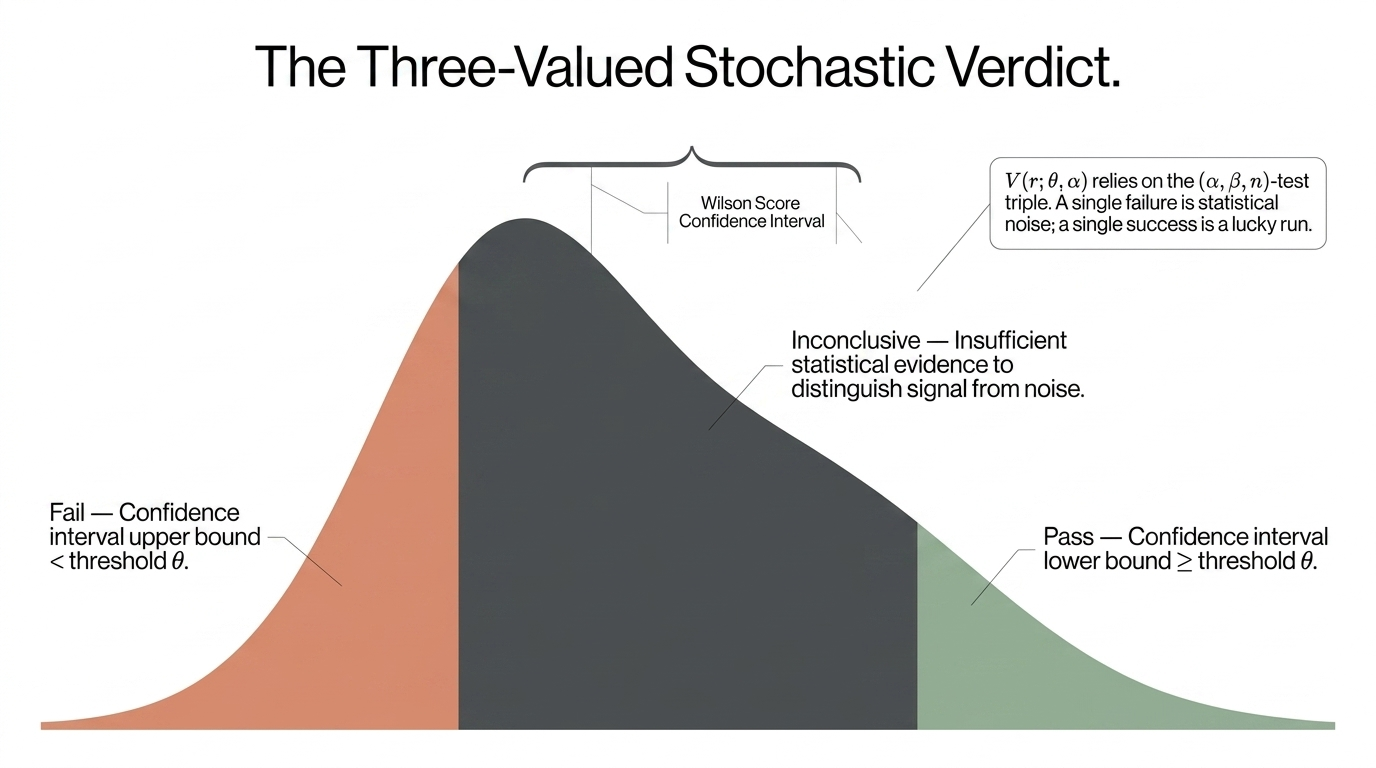
The three-valued verdict introduces a better release primitive:
- Fail when the confidence interval’s upper bound is below the required threshold.
- Pass when the confidence interval’s lower bound meets or exceeds the threshold.
- Inconclusive when the observed evidence is insufficient to separate signal from noise.
The slide illustrates this with a Wilson score confidence interval and a threshold (\theta). The important design choice is the existence of the third state.
“Inconclusive” prevents engineering teams from pretending uncertainty is certainty. It also creates a clean bridge to human review, additional sampling, or a more expensive evaluator.
A production gate should be allowed to say, “we do not yet know.”
8. Behavioral Fingerprinting Tests the Shape of an Agent
Exact output matching throws away too much information. An agent can preserve the same answer while changing its execution path in ways that affect reliability, latency, cost, or safety.
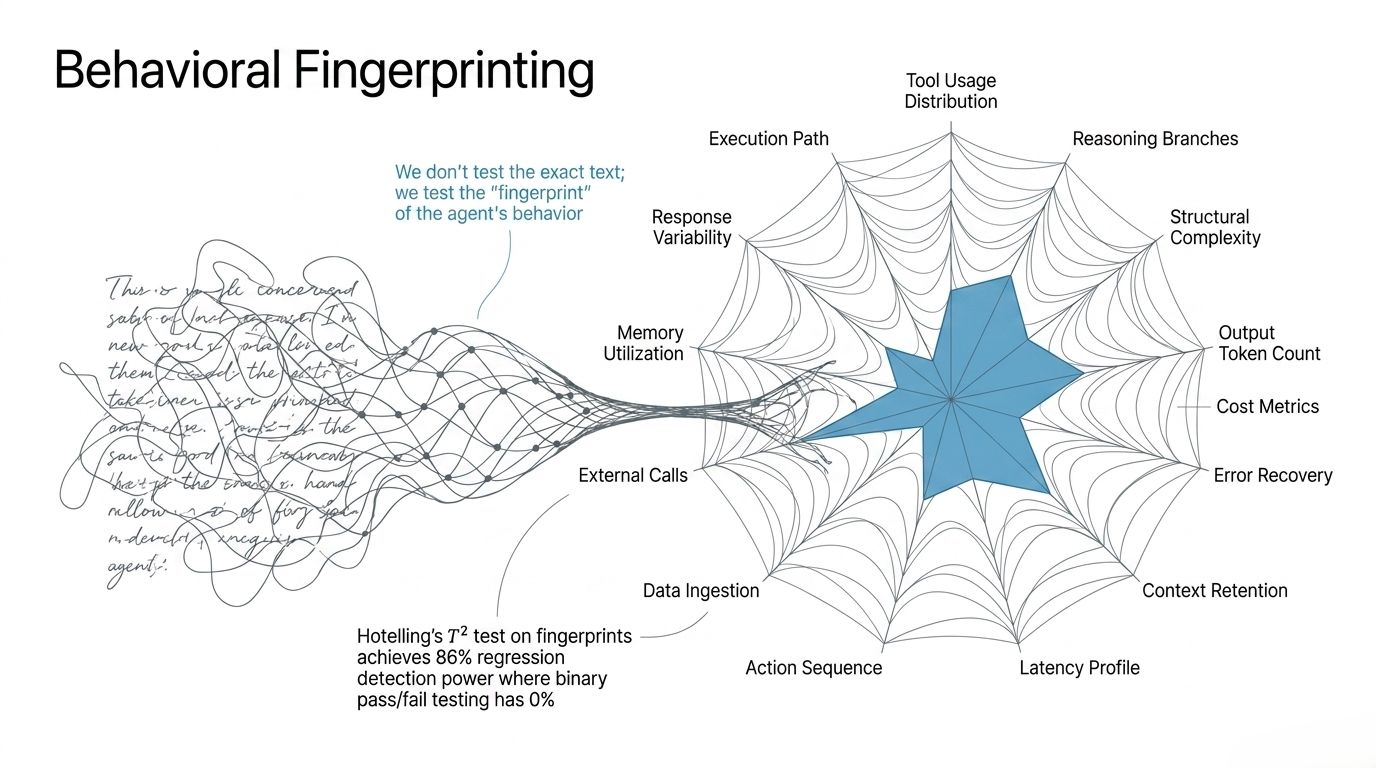
Behavioral fingerprinting treats the agent as a multivariate process. The slide’s dimensions include execution path, tool-usage distribution, reasoning branches, structural complexity, output token count, cost metrics, error recovery, context retention, latency profile, action sequence, data ingestion, external calls, memory utilization, and response variability.
The fingerprint becomes a regression surface. A release can be compared with a previous version even when both produce plausible text.
The source also cites a Hotelling’s (T^2) example in which a multivariate fingerprint detects a regression that binary testing misses. The exact detection percentage is workload-specific, but the underlying principle is broadly useful: compare behavioral distributions, not isolated strings.
Fingerprinting is especially valuable for conversational frameworks where “correctness” is partly encoded in how the system reaches the result.
9. Close the QA Loop
Testing agentic systems should not be a one-way pipeline from test generation to a report. It should be a control loop.
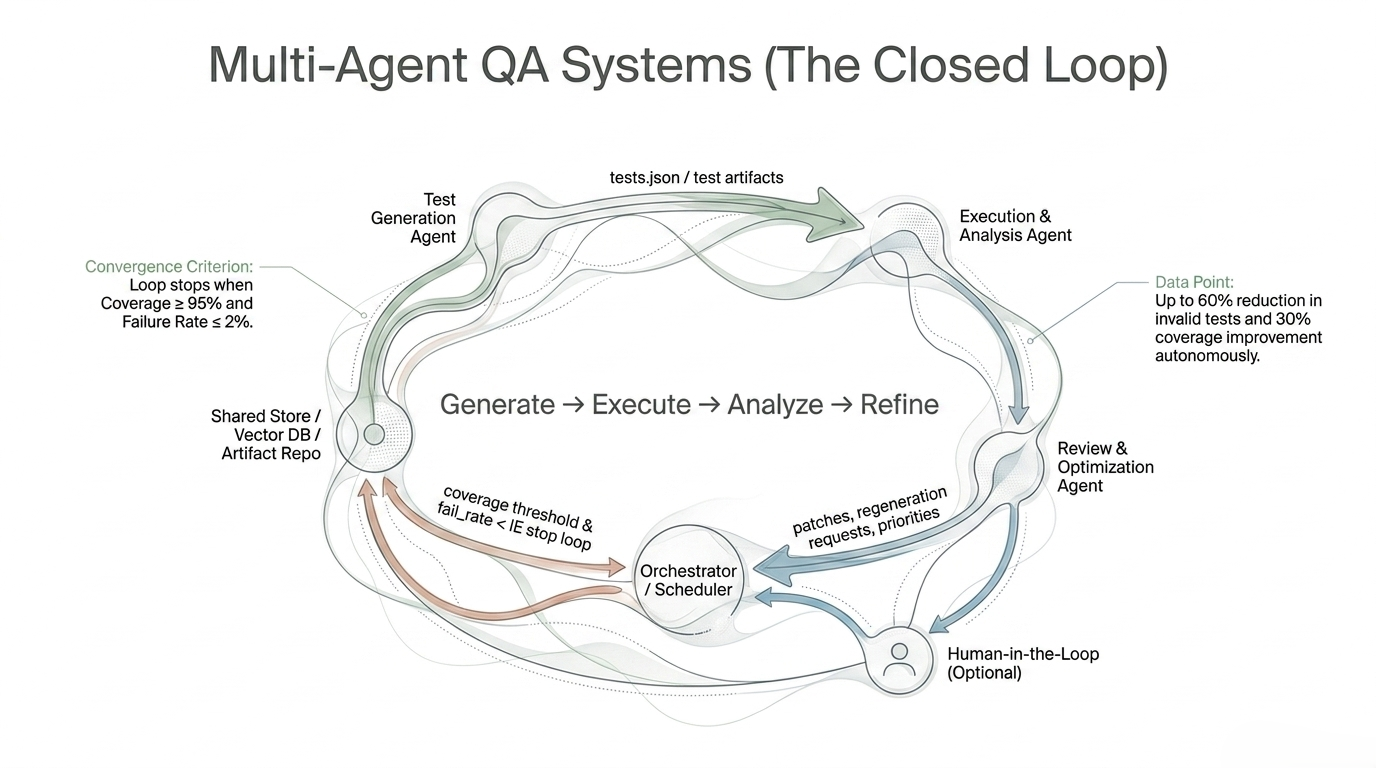
The closed-loop architecture separates responsibilities across agents:
- a test-generation agent creates candidate tests,
- an execution and analysis agent runs them and measures outcomes,
- a review and optimization agent identifies weak tests and improvement opportunities,
- an optional human reviewer handles ambiguity or policy-sensitive decisions,
- an orchestrator schedules regeneration and reprioritization,
- and a shared artifact store retains tests, vectors, traces, and results.
The loop stops only when explicit convergence criteria are satisfied. The source uses coverage and failure-rate thresholds as an example. That is important: autonomous optimization without a measurable stop condition becomes endless self-editing.
The slide also presents example gains in invalid-test reduction and coverage improvement. Those values should be validated against the target system, but the architectural takeaway stands: QA itself can be agentic, provided the loop is bounded by measurable criteria.
10. Make Statistical Testing Token-Efficient
The right question is not how to eliminate stochastic testing. It is how to spend statistical evidence where it changes a decision.
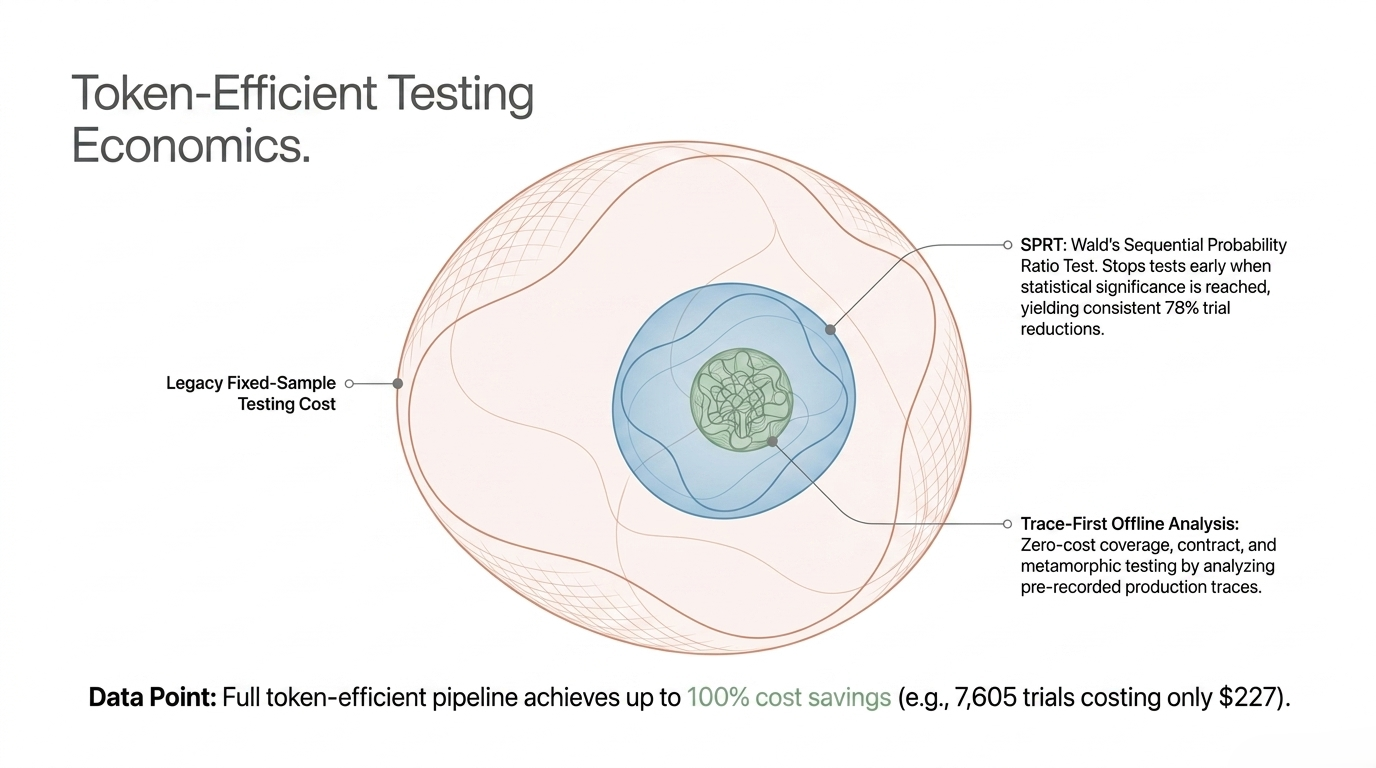
Two techniques in the source slide are particularly complementary.
Sequential Probability Ratio Testing (SPRT) evaluates evidence as it arrives and stops once a statistical boundary is reached. Strong passes and strong failures can terminate early instead of consuming a predetermined sample count.
Trace-first offline analysis extracts coverage, contract, and metamorphic checks from previously captured production traces. This moves many validations away from paid model calls and into deterministic analysis.
The source gives aggressive trial-reduction and cost-savings examples. One callout even states “up to 100% cost savings” alongside a non-zero example cost; teams should define the comparison baseline before reusing that claim. The durable idea is more important than the marketing number: use offline evidence first, then spend live tokens only on unresolved uncertainty.
11. Metamorphic Relations Create Oracles When Exact Answers Do Not Exist
A difficult property of generative systems is the oracle problem: for many inputs, there is no single canonical output string.
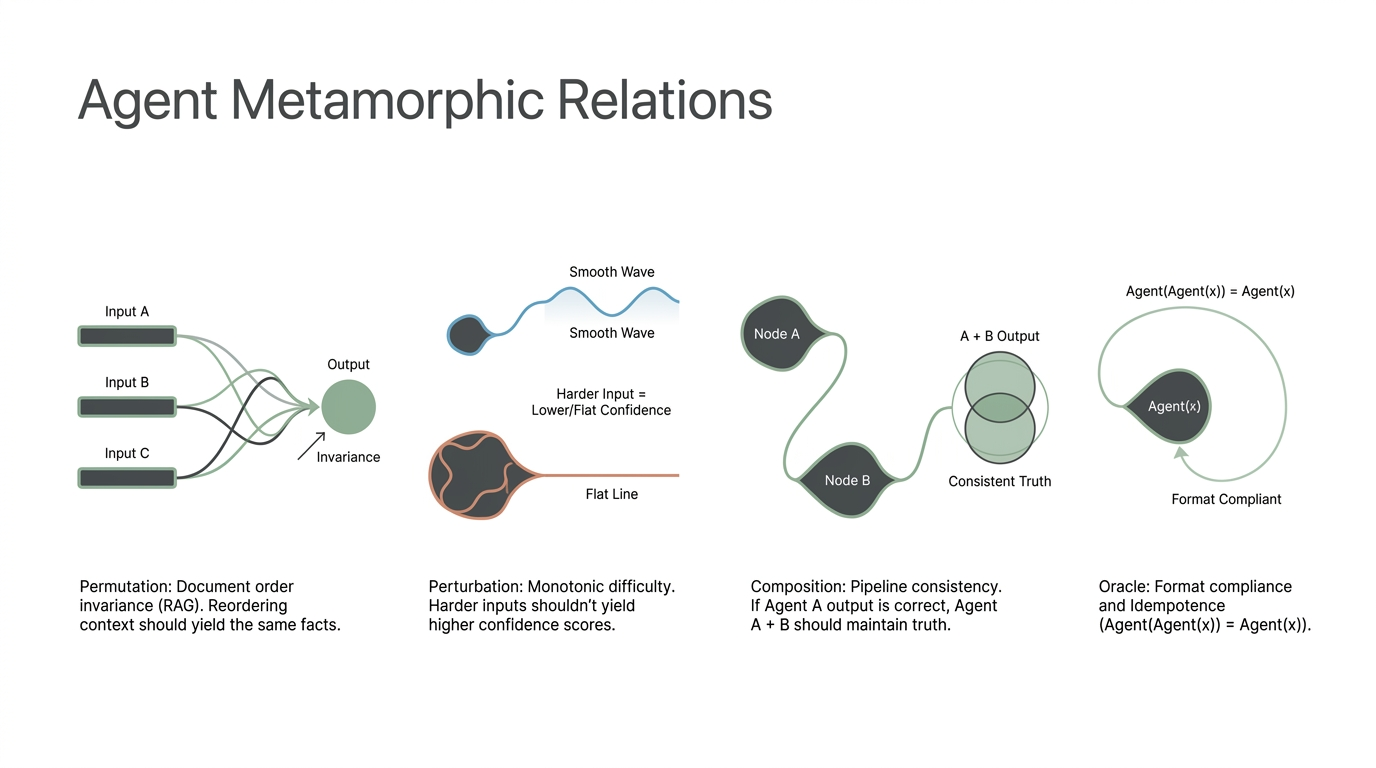
Metamorphic testing replaces a missing exact oracle with relations that should remain true across controlled transformations.
The source slide gives four useful classes:
- Permutation: reordering retrieval documents should preserve the underlying facts.
- Perturbation: harder inputs should not produce suspiciously higher confidence without justification.
- Composition: if agent A and agent B each preserve a required truth, the composed pipeline should preserve it too.
- Idempotence / format oracle: applying an operation repeatedly should not keep changing an already compliant result.
These relations are powerful because they test invariants across runs instead of betting on one “golden” response. They are especially well suited to retrieval systems, formatting agents, structured workflows, and composed multi-agent pipelines.
12. Match the QA Technique to the Framework
The most useful architecture is not a universal agent test harness. It is a compatibility layer between orchestration semantics and QA semantics.
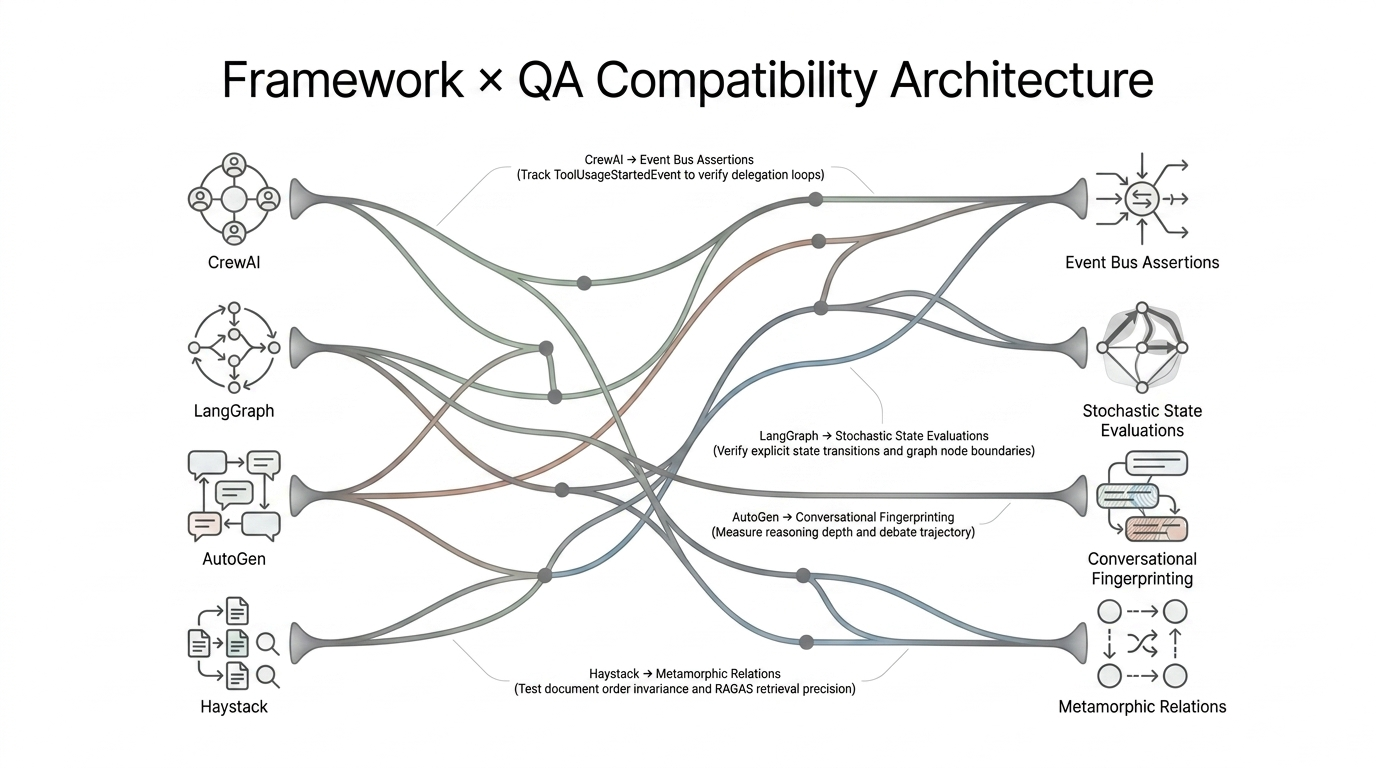
The mapping in the source is a strong starting point:
- CrewAI → Event Bus Assertions to verify delegation and role-driven tool use.
- LangGraph → Stochastic State Evaluations to validate explicit state transitions and graph boundaries.
- AutoGen → Conversational Fingerprinting to measure dialogue depth, debate trajectory, and emergent execution behavior.
- Haystack → Metamorphic Relations to validate retrieval invariants and pipeline consistency.
The important phrase is “starting point.” Real systems often blend patterns: a stateful graph may contain a conversational node, or a role-based team may call a declarative retrieval pipeline. QA should therefore be composable at the same boundaries as the application.
A good rule is simple: test what the framework makes explicit, and statistically characterize what it leaves emergent.
Engineering Principles
The architecture ultimately depends on several principles:
-
Keep deterministic contracts around probabilistic components.
Typed state, schemas, event boundaries, permissions, and stop conditions reduce the amount of behavior that must be inferred statistically. -
Use three outcomes instead of forced certainty.
Pass, fail, and inconclusive support safer release decisions than collapsing weak evidence into a binary answer. -
Measure behavior at multiple layers.
Final-answer quality is only one signal. Add state transitions, tool calls, latency, token use, memory behavior, error recovery, and execution-path structure. -
Spend tokens adaptively.
Prefer replay, trace analysis, metamorphic checks, and sequential testing before fixed large sample sizes. -
Treat QA as a closed control loop.
Test generation, execution, analysis, refinement, and human escalation need measurable convergence criteria and durable artifacts.
Final Synthesis
A production agentic system needs two architectures at once: an orchestration architecture that coordinates intelligence and a QA architecture that constrains uncertainty.
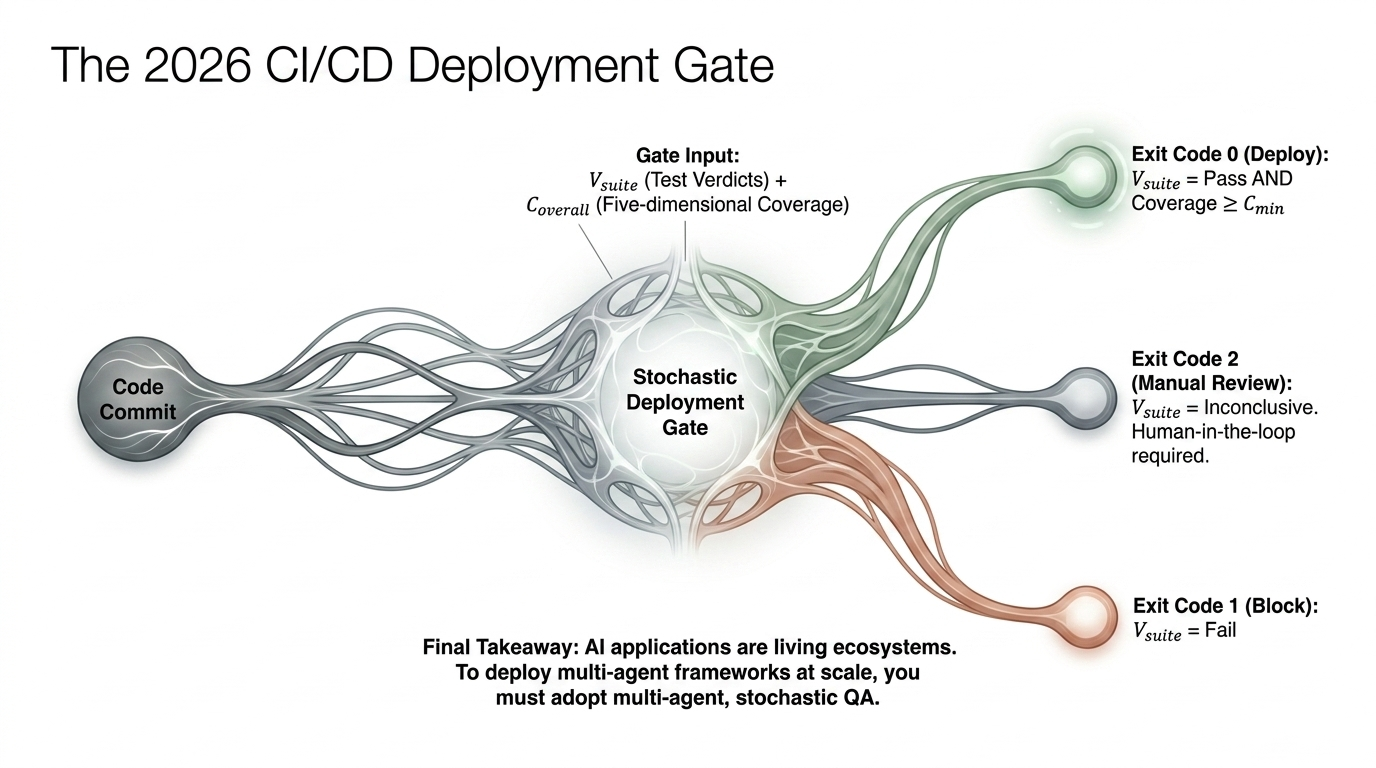
The final deployment gate combines a stochastic test verdict (V_{suite}) with an overall coverage measure (C_{overall}). That produces three operational exits:
- Deploy when the suite passes and coverage is at or above the required minimum.
- Manual review when the suite is inconclusive.
- Block when the suite fails.
This gate turns statistical reasoning into an ordinary CI/CD contract. Uncertainty is no longer hidden in a dashboard; it becomes an explicit exit code and an explicit release path.
The production-ready system combines:
- Deterministic foundation: schemas, typed state, graph boundaries, event contracts, permissions, and termination conditions.
- Testing layer: confidence-based verdicts, behavioral fingerprints, metamorphic relations, and framework-specific assertions.
- Agent layer: role-based teams, stateful graphs, conversational swarms, and declarative retrieval pipelines.
- Security and governance: human review for ambiguous or policy-sensitive outcomes, controlled tool access, and auditable execution traces.
- Observability layer: traces, event streams, token usage, latency, state transitions, error recovery, and versioned test artifacts.
- Production outcome: a CI/CD gate that can deploy, block, or escalate based on evidence rather than intuition.
Closing Thought
Agentic applications are living execution systems: their behavior can change even when the surrounding code does not.
The scalable pattern is not to make agents deterministic; it is to make uncertainty measurable, bounded, and deployable.