
Architecting Enterprise AI Agents
Enterprise AI agents become useful when they stop being isolated model demonstrations and start behaving like engineered systems. The source material makes that shift explicit: begin with measurable business outcomes, give reasoning components access to deterministic tools, choose coordination patterns that match the workflow, and surround the entire system with security, observability, testing, and governance.
The central engineering problem is not how to make an individual agent appear smarter. It is how to make a network of agents and capabilities reliable enough to participate in real business processes without losing control of state, permissions, cost, latency, or accountability.
The core thesis is therefore architectural: treat enterprise agents as a connected production platform rather than a collection of AI features. Reasoning should be separated from execution; capabilities should be discoverable and governed; multi-agent topologies should be chosen deliberately; human oversight should scale with risk; and technical performance should ultimately map to commercial outcomes.
1. Start With Business Outcomes, Not AI Features
The first design decision happens before framework selection or prompt construction. The source material argues that successful AI should own a measurable responsibility instead of merely exposing another conversational feature. A chatbot attached to an application may demonstrate a model, but it does not by itself establish an accountable operating unit.
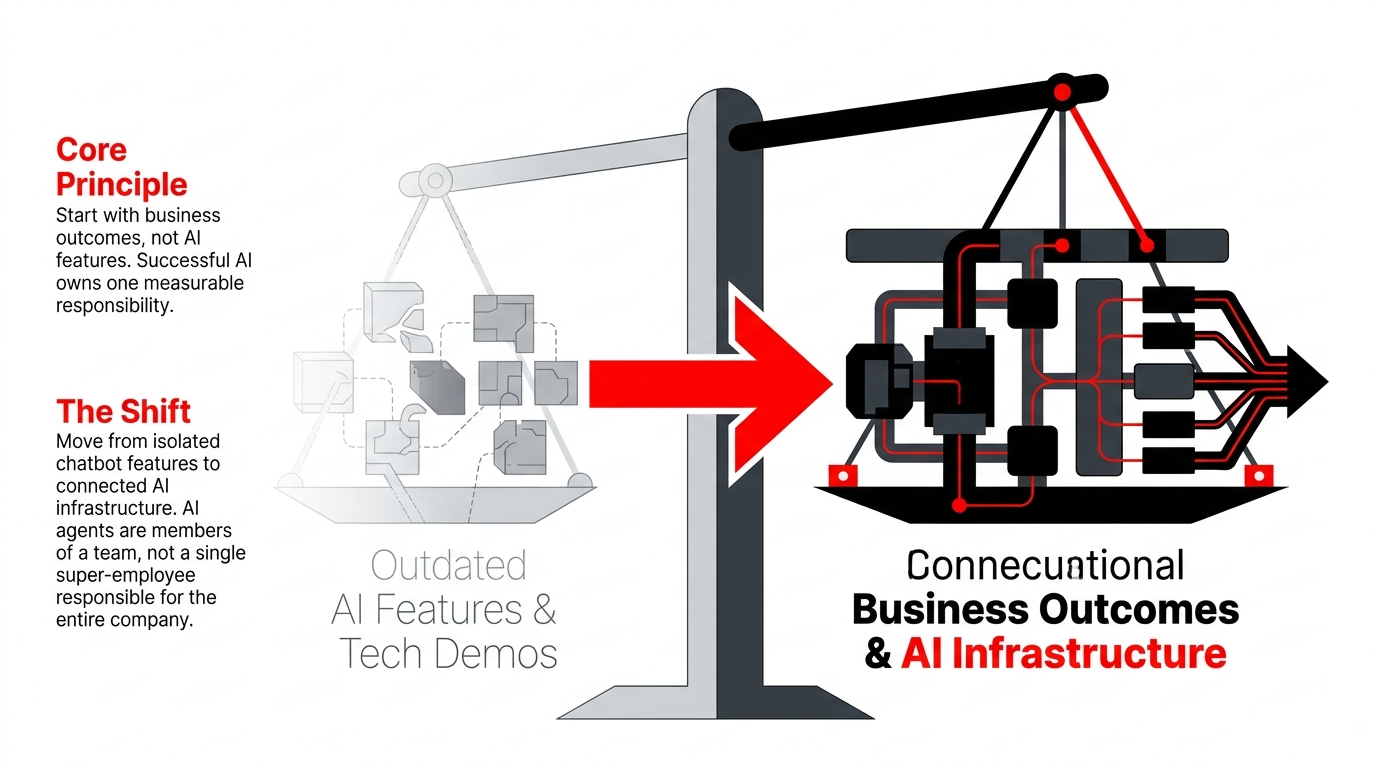
The diagram frames this as a shift away from “outdated AI features and tech demos” toward consequential business outcomes supported by AI infrastructure. The analogy is organizational: agents should act more like members of a team than like one super-employee that carries the responsibility of the entire company.
That framing has direct architecture consequences. If the desired outcome is “reduce case-resolution time,” the system boundary must include the systems of record, permissions, tool calls, audit trail, and approval points that determine whether a case can actually be resolved. If the desired outcome is “improve qualified pipeline,” the system needs a measurable path from prospect research to CRM action and downstream conversion metrics.
This outcome-first perspective prevents a common architecture failure: optimizing the intelligence layer while leaving the operational path undefined. An enterprise agent is only as useful as the business process it can safely complete.
2. Separate Thinking From Doing
The source material proposes a three-layer model for production agent systems:
- Company AI Brain — centralized knowledge, semantic search, and retrieval-augmented generation.
- Reasoning Layer — LLM decision-making and context engineering.
- Tool Layer — deterministic actions and execution.
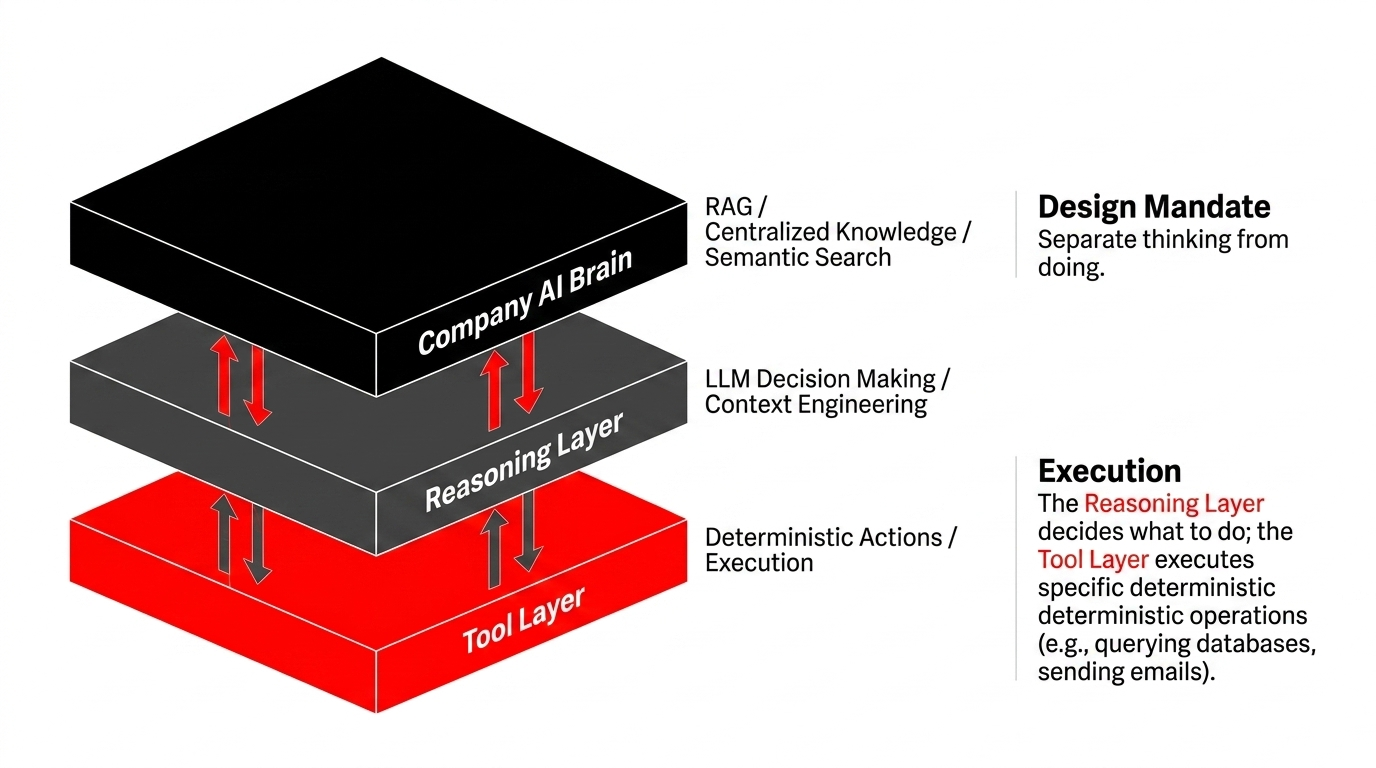
The design mandate is concise: separate thinking from doing.
The reasoning layer decides what should happen. The tool layer performs the specific operation. That separation is more than a conceptual convenience. It lets the engineering team put deterministic boundaries around consequential actions such as querying databases, sending emails, updating records, invoking APIs, or triggering downstream workflows.
This also changes how failures can be classified. A poor decision can be investigated in the reasoning layer. A malformed API request belongs to tool execution. A wrong fact may trace back to the knowledge layer. Without these boundaries, all failures collapse into “the agent did something wrong,” which is too vague to debug or govern.
The three-layer architecture also suggests a clean state flow. Knowledge should be retrieved and supplied as context; reasoning should transform context into a decision; and tools should expose explicit contracts for action. Production controls can then be attached to each boundary instead of relying on the model to police itself.
3. Choose a Coordination Model Deliberately
Not every agent interaction requires a complex multi-agent system. The source material presents three coordination models with distinct trade-offs.
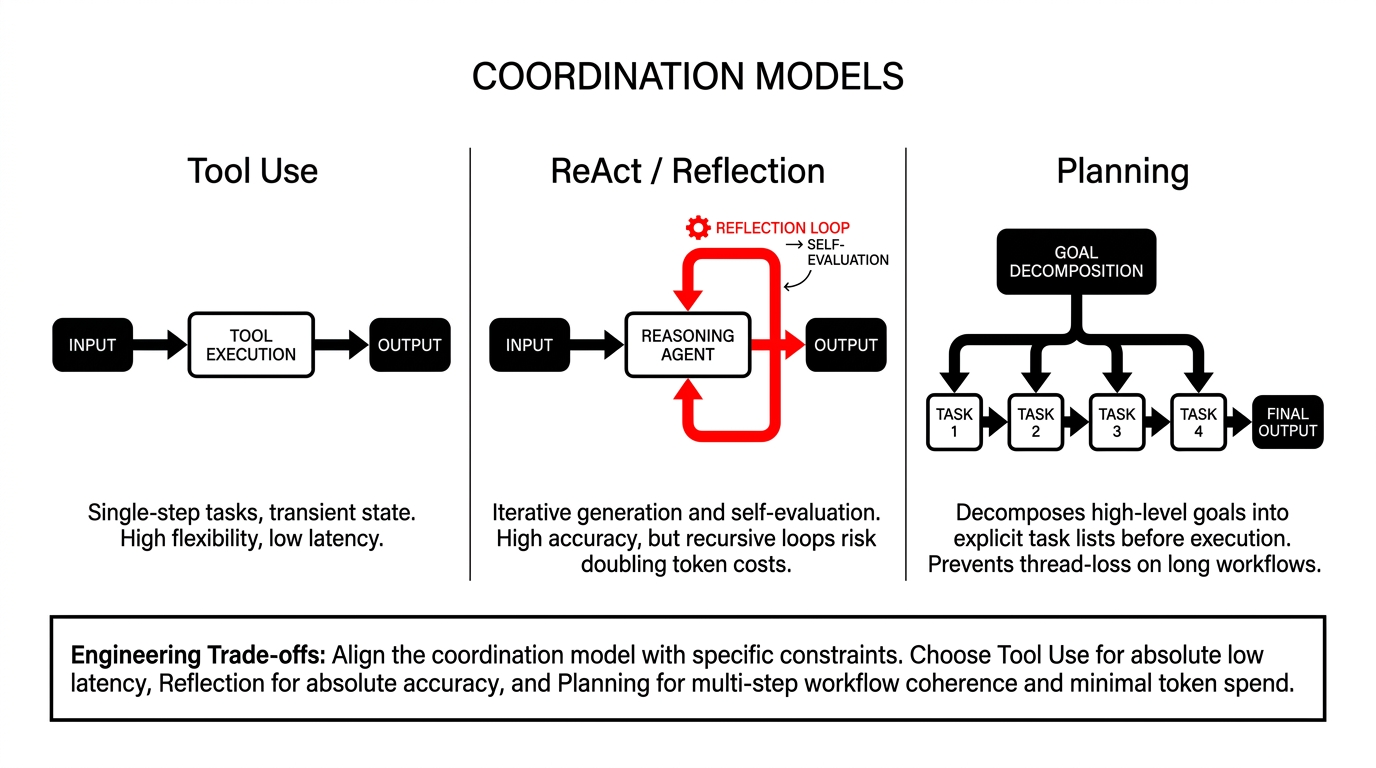
Tool Use
Tool use is a direct input → tool execution → output path. The source frames it as suitable for single-step tasks with transient state, high flexibility, and low latency.
Architecturally, this is the simplest pattern because it avoids unnecessary recursive reasoning. It is well suited to workflows where the decision boundary is narrow and the tool contract already encodes most of the business logic.
ReAct / Reflection
The reflection pattern introduces an iterative loop in which a reasoning agent produces an output, evaluates it, and may revise its own work. The source notes the potential for higher accuracy alongside the risk of recursive loops doubling token costs.
The important production implication is that reflection must have explicit stopping conditions. Iterative quality improvement is useful only when bounded by latency, token, or step budgets.
Planning
Planning decomposes a high-level goal into explicit tasks before execution. The source emphasizes two benefits: preserving coherence across multi-step workflows and preventing thread-loss on long executions.
The engineering trade-off is therefore not “which model is smartest?” but “which coordination model fits the constraints?” Use the smallest pattern that reliably achieves the outcome. Low-latency tasks benefit from direct tool use; accuracy-sensitive tasks may justify bounded reflection; long-running workflows benefit from explicit plans and checkpoints.
4. Match the Multi-Agent Topology to the Workflow Shape
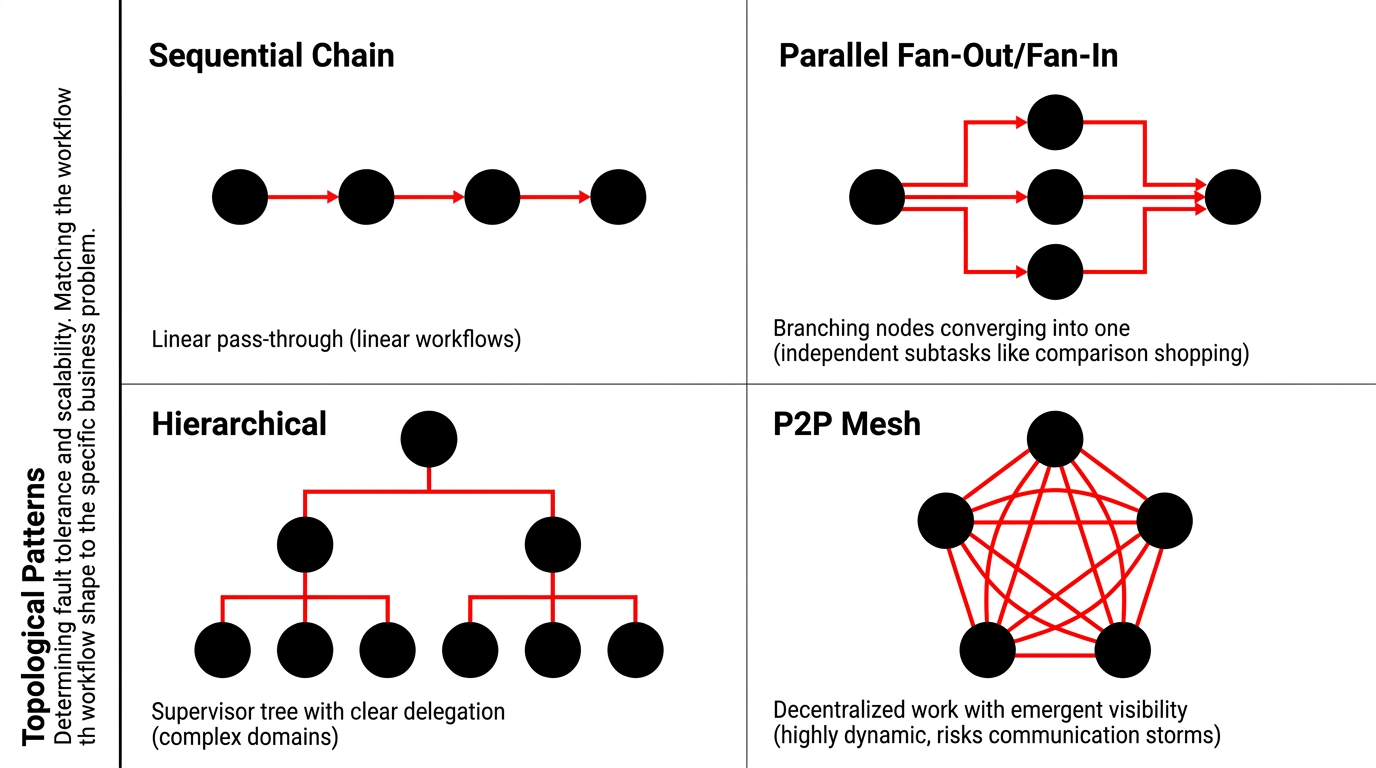
Once more than one agent or worker is involved, topology becomes part of the system design. The source presents four patterns: sequential chains, parallel fan-out/fan-in, hierarchical delegation, and peer-to-peer mesh coordination.
Sequential Chain
A sequential chain is appropriate when each stage depends on the output of the previous stage. It is easy to reason about because control flow is linear, but latency accumulates and upstream errors propagate.
Parallel Fan-Out/Fan-In
Parallel execution fits independent subtasks that can be processed simultaneously and then merged. The source uses comparison shopping as an example of independent work converging into one result.
This topology improves wall-clock time when tasks are genuinely independent, but it requires a fan-in strategy: how are conflicts resolved, how are partial failures handled, and what happens if one branch times out?
Hierarchical
A hierarchical topology uses supervisor-style delegation. The source positions it for complex domains that benefit from clear delegation.
The main advantage is bounded responsibility. A supervisor can own the plan while specialized workers own domain tasks. That structure also supports different permissions and tool sets by role.
P2P Mesh
A peer-to-peer mesh enables decentralized work and emergent visibility. The source also warns that highly dynamic meshes risk communication storms.
In production, mesh coordination should therefore be used with care. The apparent flexibility of “every agent can talk to every other agent” creates an expensive state and observability problem. If the workflow can be expressed as a graph or hierarchy, a more constrained topology is usually easier to audit.
The general principle is to match topology to business process shape and fault tolerance, not to the novelty of the orchestration pattern.
5. Framework Selection Is an Architecture Decision
The source compares three agent frameworks by paradigm, primary strength, and ideal use case.
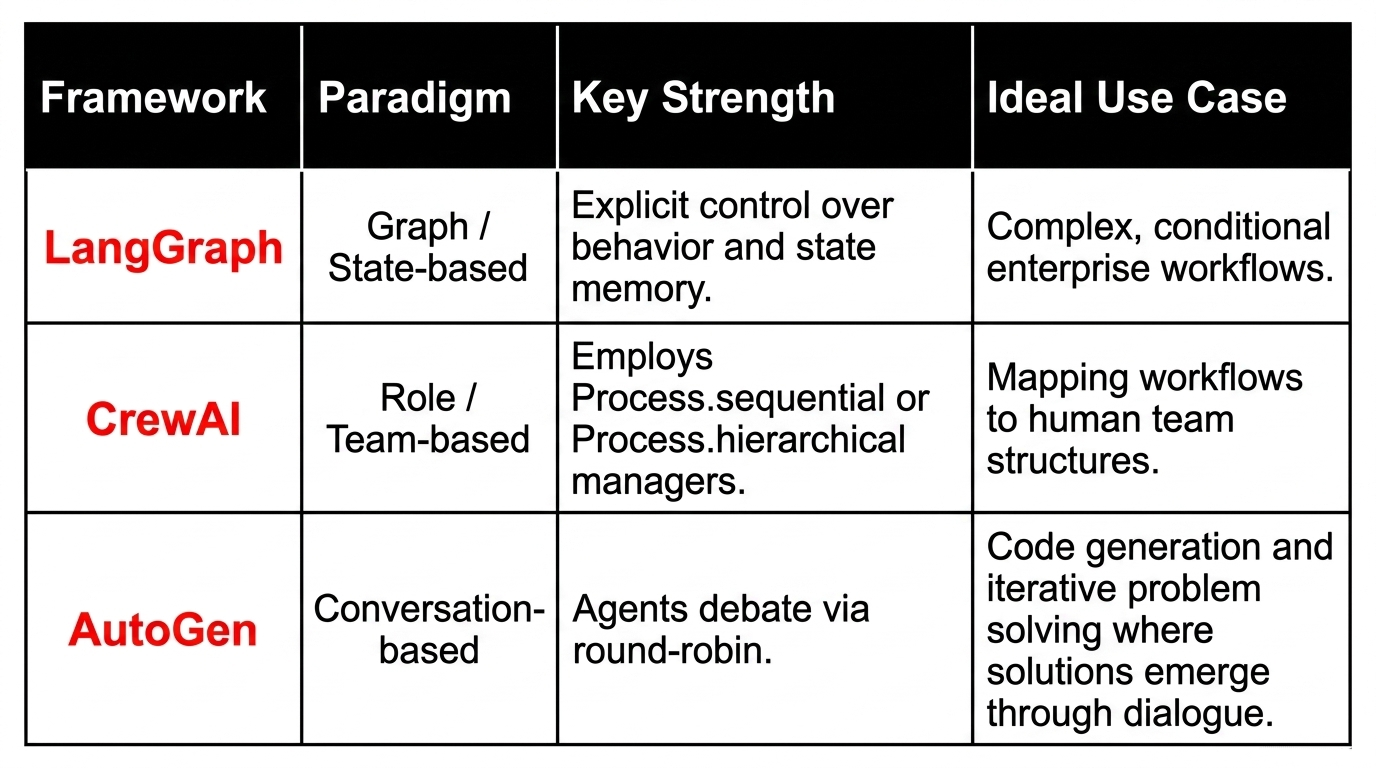
- LangGraph is presented as graph/state-based, emphasizing explicit control over behavior and state memory for complex conditional enterprise workflows.
- CrewAI is presented as role/team-based, emphasizing sequential or hierarchical process structures that map naturally to human team organization.
- AutoGen is presented as conversation-based, emphasizing round-robin debate and iterative problem solving where solutions emerge through dialogue.
The key engineering lesson is that frameworks encode assumptions about control flow. A graph-oriented framework encourages explicit state transitions. A role-oriented framework emphasizes delegation and team structure. A conversation-oriented framework makes dialogue itself part of the control mechanism.
That means framework choice should follow the workflow model. If the business process is stateful and conditional, explicit graph control is a natural fit. If the problem maps to a manager-and-specialist organization, role-based delegation is easier to reason about. If the task benefits from iterative debate, conversation-centric orchestration may be appropriate.
A framework is not just developer ergonomics. It shapes how state, retries, delegation, and debugging appear in the production system.
6. The Broader Tooling Ecosystem Solves Different Problems
The source separates orchestration frameworks from ecosystem tools that solve adjacent production concerns.
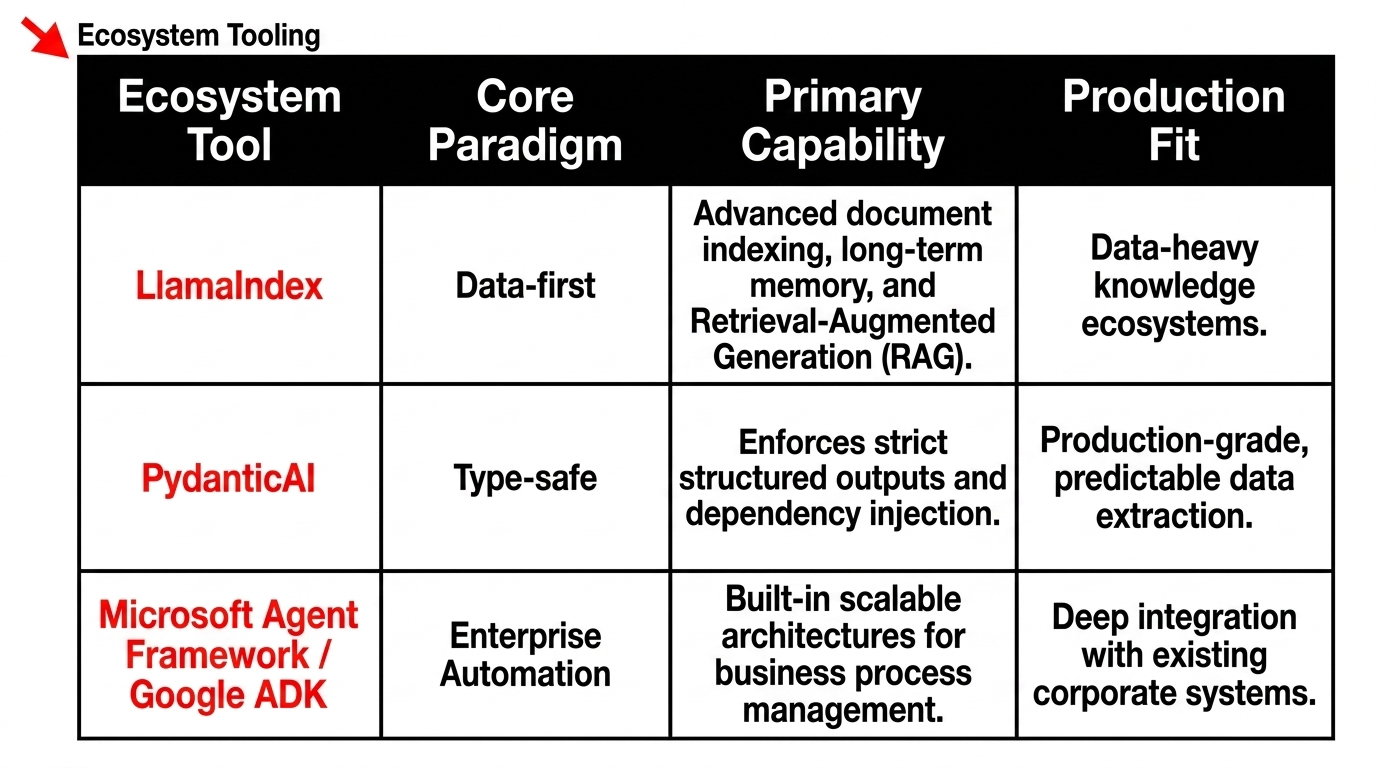
The ecosystem view includes:
- LlamaIndex as a data-first tool for document indexing, long-term memory, and retrieval-augmented generation in data-heavy knowledge ecosystems.
- PydanticAI as a type-safe approach emphasizing strict structured outputs and dependency injection for predictable data extraction.
- Microsoft Agent Framework / Google ADK as enterprise-automation tooling with scalable architectures intended for business-process integration and deep connection to existing corporate systems.
The architectural implication is composability. No single framework needs to own knowledge retrieval, orchestration, structured output, enterprise integration, and runtime governance. A production platform can select components according to responsibility.
This also reinforces the three-layer model. Data-first knowledge tooling belongs close to the company brain. Structured output and dependency control strengthen the boundary between reasoning and deterministic execution. Enterprise automation frameworks can integrate agent decisions into business-process infrastructure.
7. Build a Skill-First Capability Registry
A major scaling challenge appears when an agent platform accumulates many tools. The source proposes a skill-first inversion: define capabilities as self-describing, versioned, testable units and project the same definition into multiple runtime protocols.
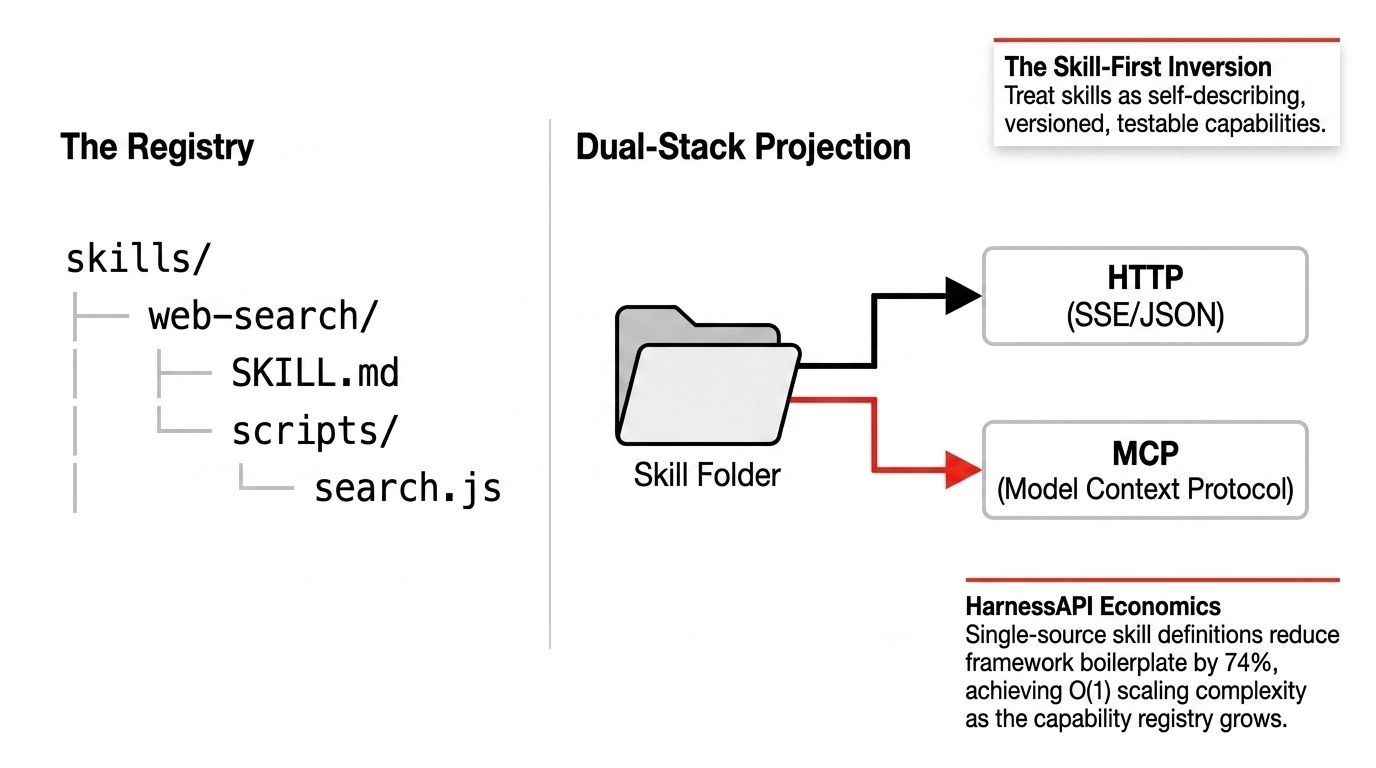
The example registry is file-oriented:
skills/
└── web-search/
    ├── SKILL.md
    └── scripts/
        └── search.js
A single skill folder can then be exposed through an HTTP interface such as SSE/JSON and through MCP, the Model Context Protocol.
This approach separates the capability definition from the transport or framework adapter. That is important because enterprise platforms rarely remain homogeneous. Different agents may run in different frameworks, different languages, or different hosting environments. Reimplementing the same tool separately for every framework multiplies boilerplate and creates semantic drift.
The source frames the economics strongly: single-source skill definitions reduce framework boilerplate and aim to keep scaling complexity constant as the capability registry grows. Whether a specific percentage reduction holds for a given codebase depends on the implementation, but the architectural point is durable: capabilities should have one canonical definition and multiple projections.
A skill registry should therefore contain more than a callable function. A production skill needs a name, purpose, version, inputs, outputs, required permissions, side-effect classification, error model, test contract, and ownership metadata. Those properties make the registry governable rather than merely discoverable.
8. Discover Tools Dynamically Instead of Loading Everything
A large registry introduces another problem: context bloat. The source emphasizes dynamic tool discovery so that agents receive only the tool context relevant to the current query.
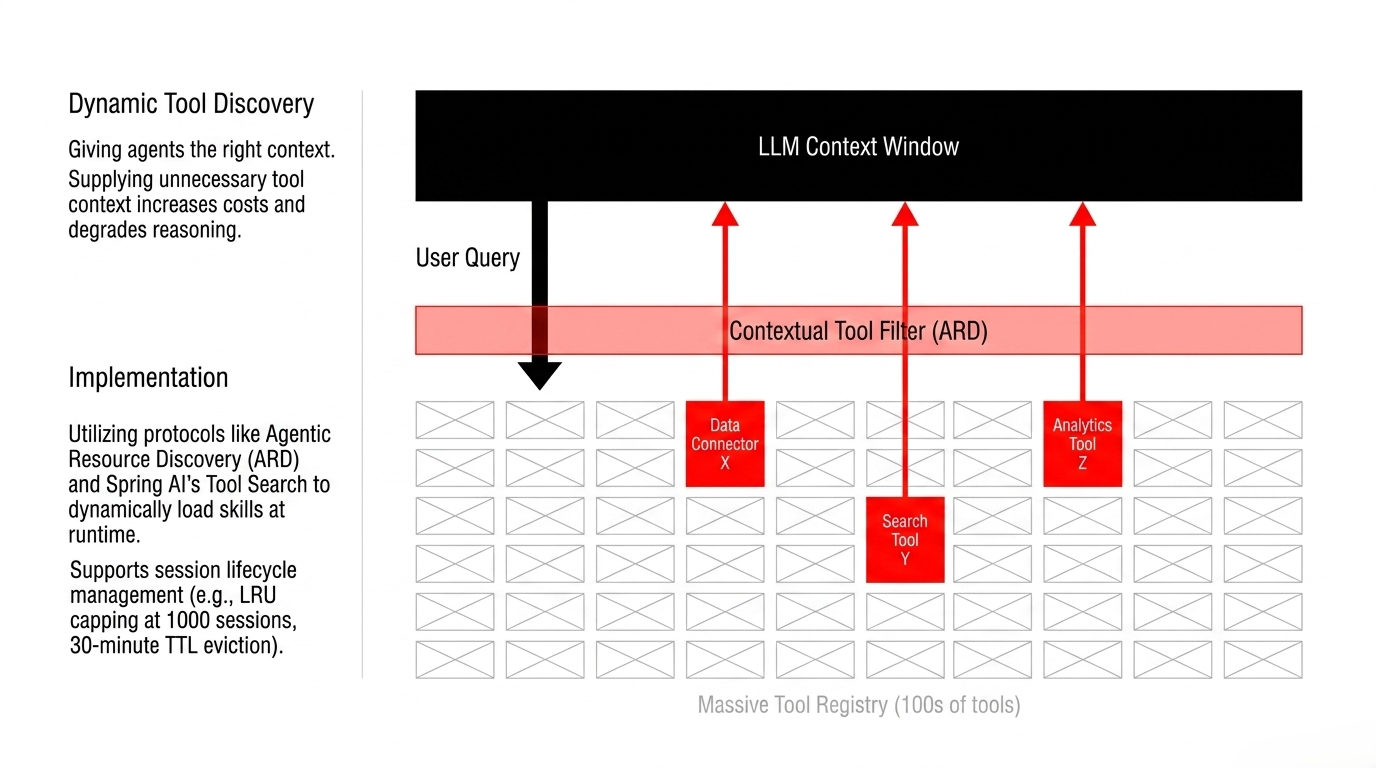
The diagram shows a massive tool registry filtered through a contextual tool filter, with only selected capabilities entering the LLM context window. It mentions Agentic Resource Discovery (ARD) and Spring AI’s Tool Search as examples of runtime discovery approaches. The source also points to session lifecycle management, including LRU-style capping and TTL-based eviction.
The key engineering problem is not just lookup speed. It is context discipline. Supplying dozens or hundreds of irrelevant tool descriptions can raise token cost and make the model’s selection problem harder.
A dynamic discovery layer can reduce this burden by treating tool selection as a retrieval problem:
- Receive the user query and workflow state.
- Search the capability registry.
- Apply permission and policy filters.
- Inject only the relevant tool schemas into the reasoning context.
- Cache the selected set for the session when appropriate.
- Evict stale session state according to explicit lifecycle rules.
This turns the tool registry into infrastructure rather than prompt decoration. It also creates an auditable point where teams can log which tools were considered, which were filtered out, and why the final set was exposed.
9. Scale Human Oversight With Execution Risk
Enterprise autonomy is not binary. The source presents a spectrum from human-in-the-loop (HITL), to human-on-the-loop (HOTL), to fully autonomous execution.
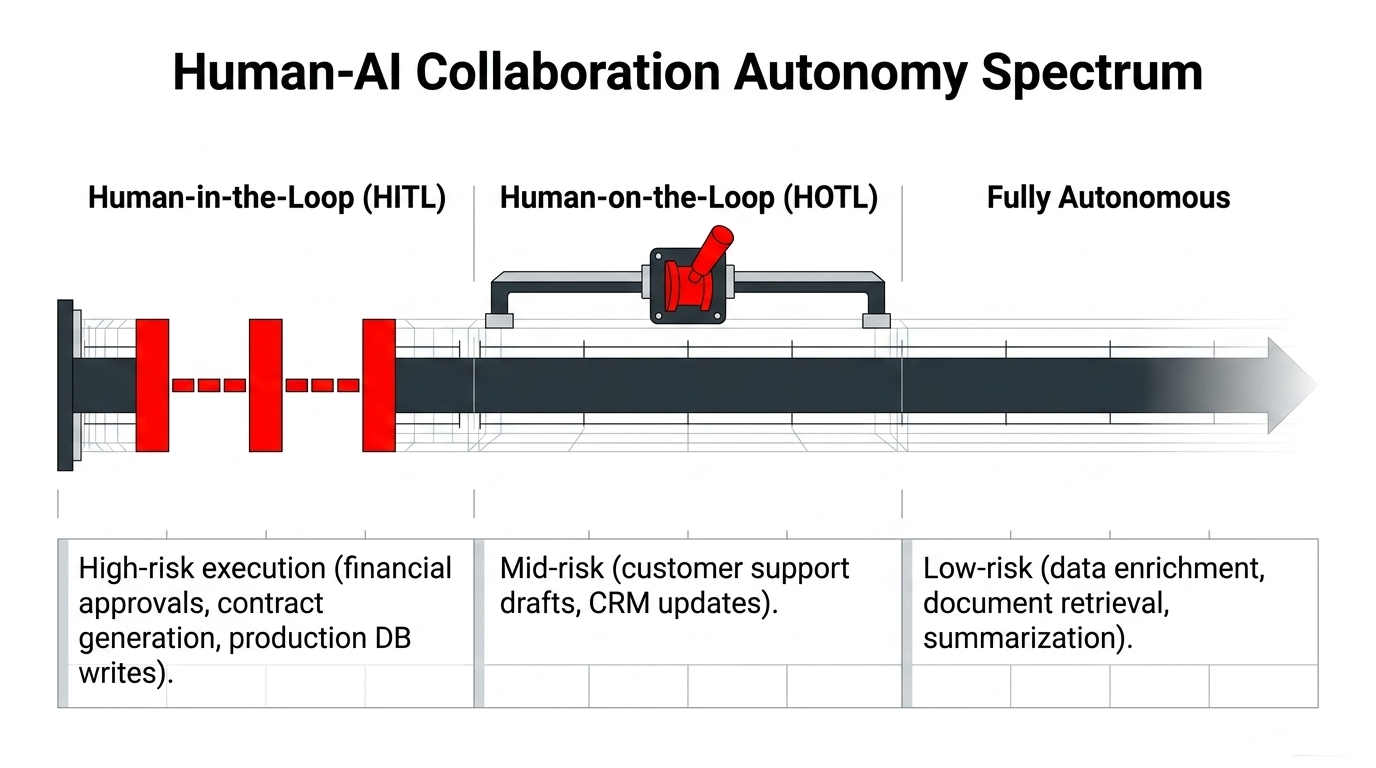
The examples map higher-risk actions to stronger human control:
- High-risk execution: financial approvals, contract generation, production database writes.
- Mid-risk actions: customer-support drafts and CRM updates.
- Low-risk actions: data enrichment, document retrieval, summarization.
This is a practical governance model because it ties review effort to the consequence of failure.
Human-in-the-loop means a human approval is part of the execution path. The workflow cannot cross a control boundary without explicit review.
Human-on-the-loop means the system can proceed but remains observable and interruptible. Humans supervise the automation rather than approving every step.
Fully autonomous execution is most appropriate where actions are low-risk, reversible, or tightly constrained.
The engineering challenge is to encode this spectrum into policy rather than relying on social convention. A tool should declare its risk class, side effects, reversibility, and required approval mode. The orchestrator should enforce those rules before execution.
10. Apply Zero-Trust Principles to Agent Execution
Security cannot be an afterthought when agents have the ability to act. The source presents a concentric zero-trust model around API execution.
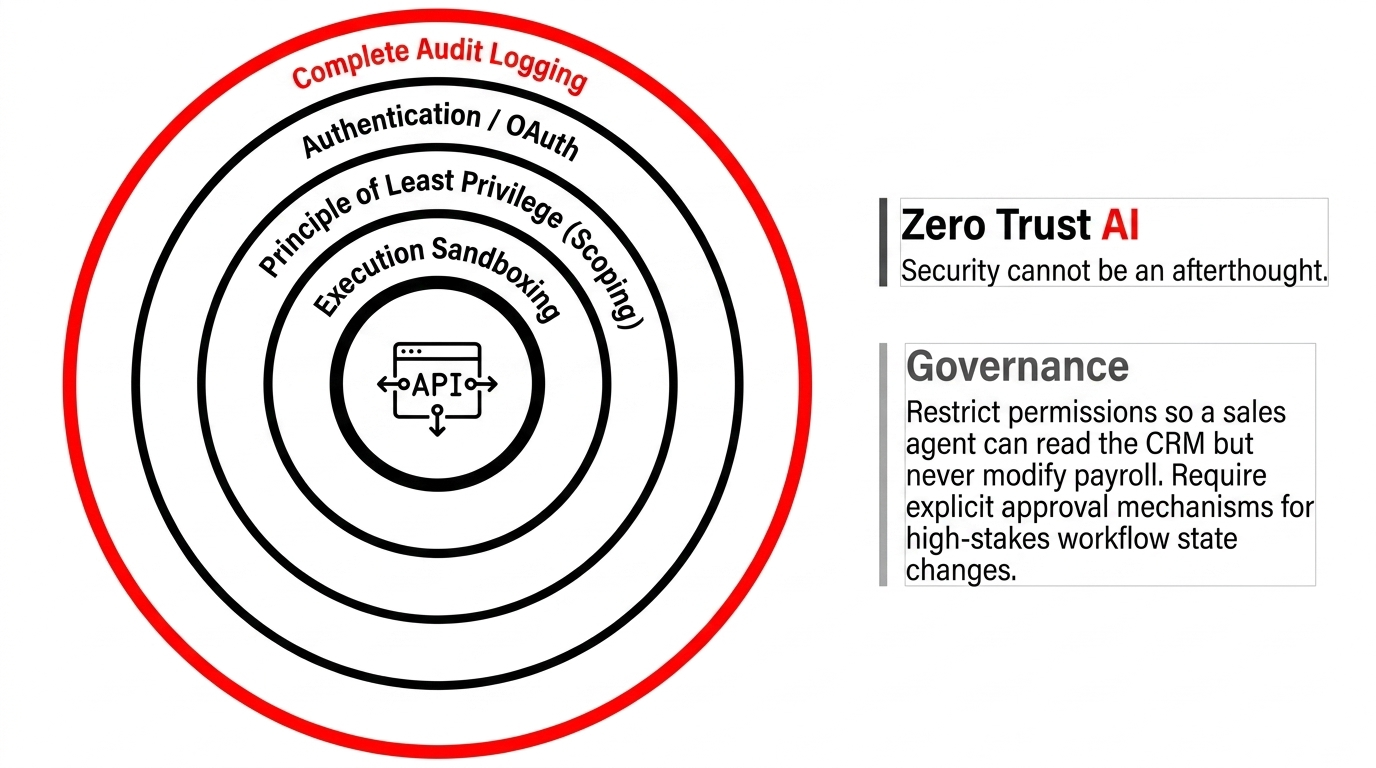
The controls, moving outward, are:
- Execution sandboxing
- Principle of least privilege (scoping)
- Authentication / OAuth
- Complete audit logging
The governance example is deliberately concrete: a sales agent may be allowed to read CRM data while being prohibited from modifying payroll. High-stakes workflow state changes should require explicit approval mechanisms.
This is the right way to think about agent identity. The model itself should never implicitly inherit broad credentials from the hosting application. Instead, each tool invocation should be executed under scoped permissions tied to the agent role, user context, tenant, and action.
A secure agent platform therefore needs policy checks at several points:
- Can this agent discover the tool?
- Can this user authorize the agent to use it?
- Can the tool access this resource?
- Is the requested action within scope?
- Does the action require approval?
- Is the execution environment isolated?
- Is the request and result fully logged?
Zero trust transforms tool use from “the model can call an API” into “the platform can prove why this specific call was allowed.”
11. Observe the Path to the Outcome, Not Just the Output
Agent systems introduce a debugging challenge: the final answer is often insufficient evidence of how the system got there. The source labels this problem “tracking the black box.”
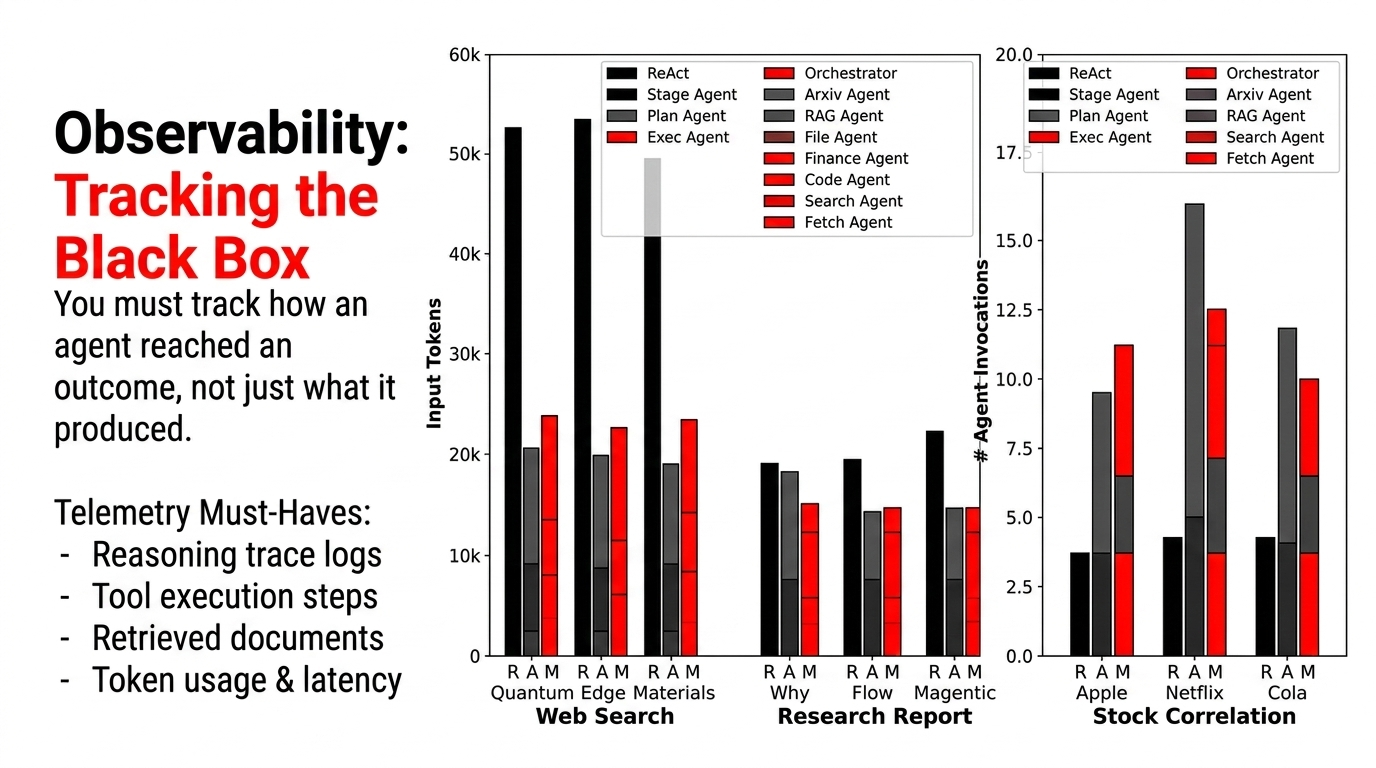
The telemetry must-haves listed in the source are:
- Reasoning trace logs
- Tool execution steps
- Retrieved documents
- Token usage and latency
The charts reinforce the need to observe both cost and orchestration behavior across workflows. Input tokens reveal context pressure. Agent-invocation counts reveal coordination overhead. Together with tool and retrieval logs, these metrics provide a path-level view of execution.
The practical implication is that every run should receive a trace identifier that follows the workflow across reasoning steps, retrieval calls, agent handoffs, approvals, and tool executions. A production trace should answer at least five questions:
- What did the system know at the time of the decision?
- Which agents or stages were invoked?
- Which tools were considered and executed?
- What did each step cost in latency and tokens?
- Which step produced the state change that mattered?
Observability should also be privacy- and policy-aware. Recording internal traces does not mean storing unrestricted sensitive data. Logs need retention rules, redaction, and access control just like any other production telemetry.
12. Test Probabilistic Systems Differently
Traditional software testing assumes a large amount of deterministic behavior. The source contrasts that with LLM application testing, where outputs can be probabilistic and context-sensitive.
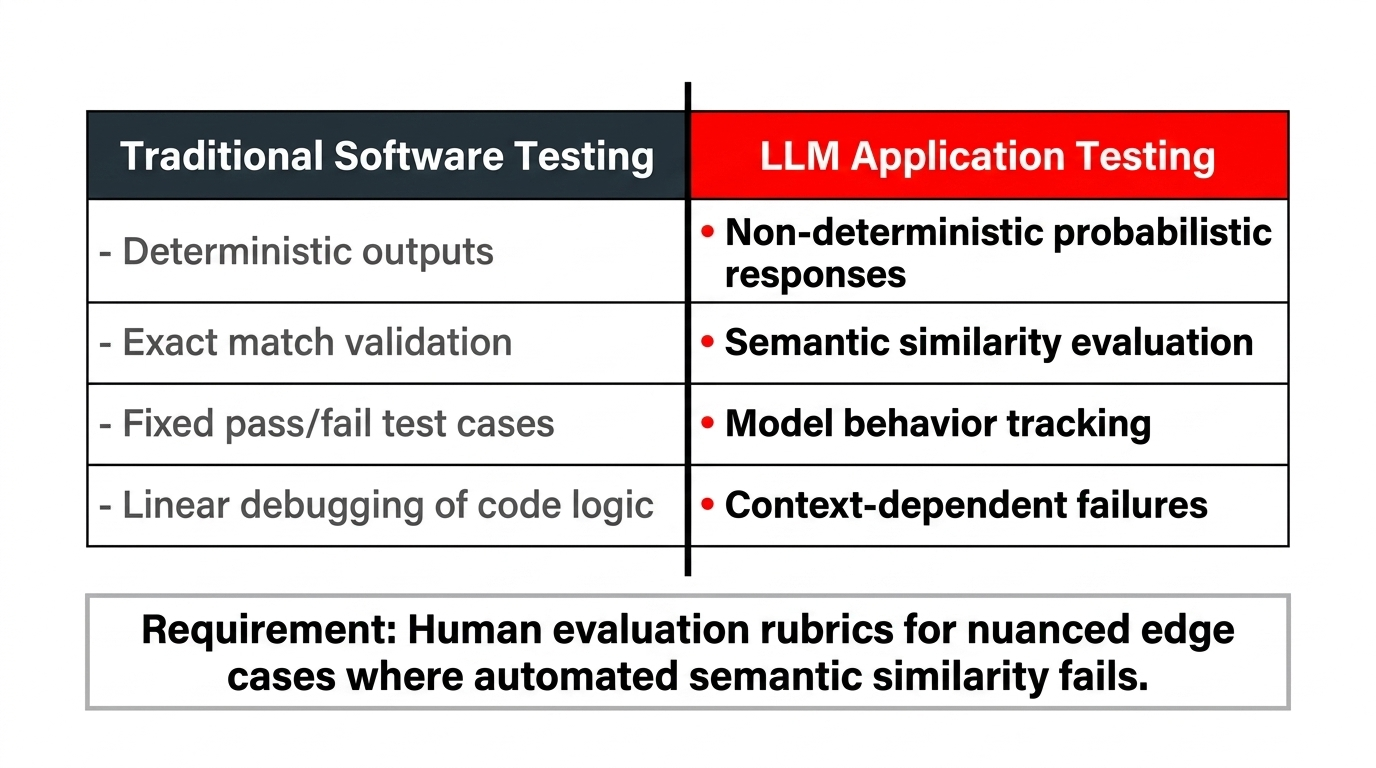
The source contrasts four dimensions:
| Traditional software testing | LLM application testing | | --- | --- | | Deterministic outputs | Non-deterministic probabilistic responses | | Exact match validation | Semantic similarity evaluation | | Fixed pass/fail test cases | Model behavior tracking | | Linear debugging of code logic | Context-dependent failures |
It also states a requirement: human evaluation rubrics are necessary for nuanced edge cases where automated semantic similarity is insufficient.
This implies a layered test strategy.
Deterministic tool tests should still use ordinary assertions. Input schemas, permission checks, database adapters, workflow state transitions, and API clients should be tested like conventional software.
Agent behavior tests need scenario sets, quality rubrics, and distribution-aware evaluation. Instead of asking whether one output exactly matches a golden string, the test should ask whether the response satisfies the required intent, policy, factual grounding, and action constraints.
End-to-end workflow tests should verify that the reasoning layer chooses correct tools, approvals fire when required, state is preserved, and failures are recoverable.
The testing boundary should match the architecture boundary. Deterministic layers remain deterministic. Probabilistic layers are evaluated with behavioral criteria rather than pretending they are deterministic functions.
13. Measure AI ROI With Business Metrics
Production AI systems should be measured by business impact, not by prompt volume or token consumption. The source organizes AI ROI into three metric families.
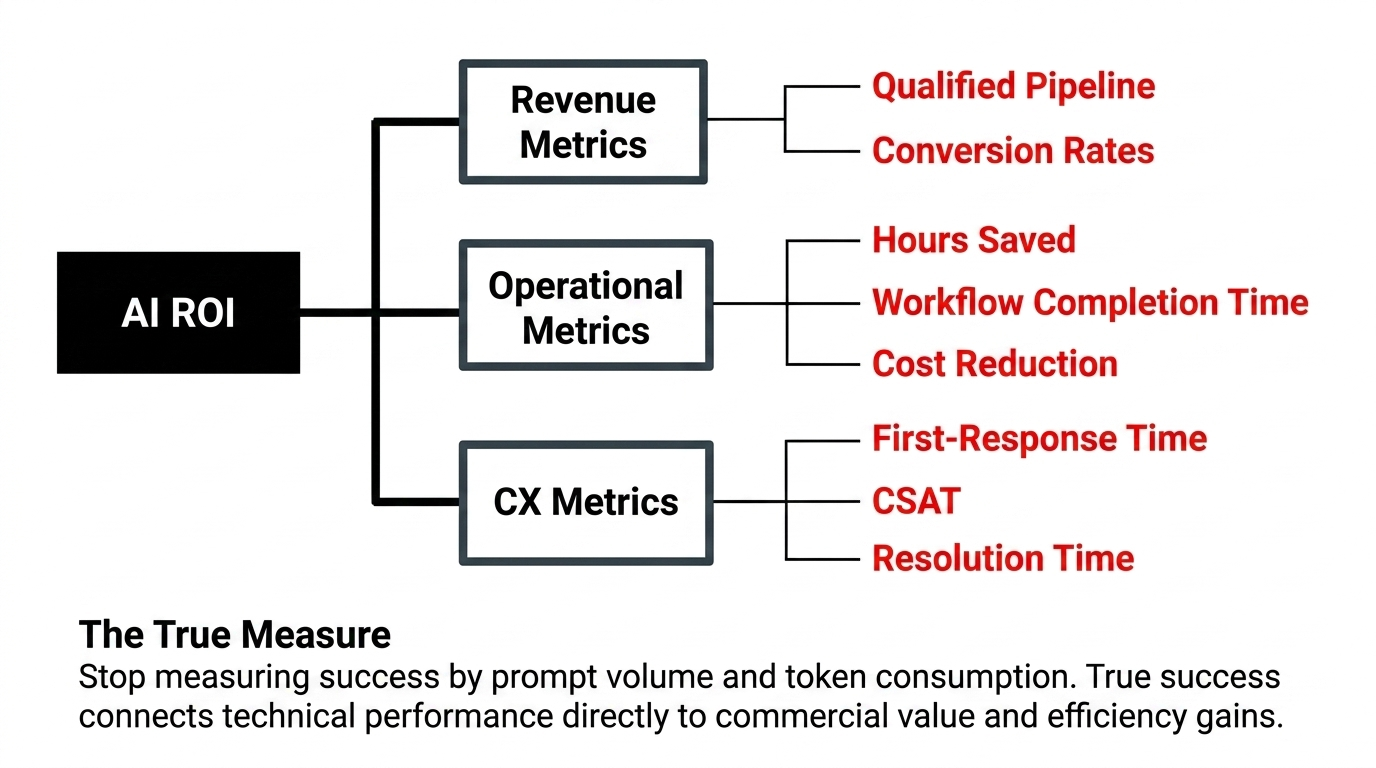
Revenue Metrics
- Qualified pipeline
- Conversion rates
Operational Metrics
- Hours saved
- Workflow completion time
- Cost reduction
Customer Experience Metrics
- First-response time
- CSAT
- Resolution time
The key point is to connect technical performance to commercial value and efficiency gains. Token usage and latency remain important engineering metrics, but they are inputs to the economics of the system, not the final definition of success.
A useful measurement chain therefore links layers:
trace → workflow → operational KPI → business outcome
For example, an orchestration change might reduce the average number of agent invocations. That lowers token and latency cost. If the workflow completes faster, case handling time may fall. If customers receive faster responses, first-response time and satisfaction may improve. Only then can the architecture change be evaluated in business terms.
This also helps prioritize optimization. A five-percent token reduction is valuable only if it matters at the scale and economics of the workflow. A reliability improvement on a high-value approval process may be worth more than a dramatic optimization on a low-value summarization task.
14. Assemble the Connected Enterprise Agent Ecosystem
The final source image connects the major components into one production architecture: a company AI brain, a multi-agent orchestration layer, a dynamic tool-routing filter, a secure skill registry, and strict observability.
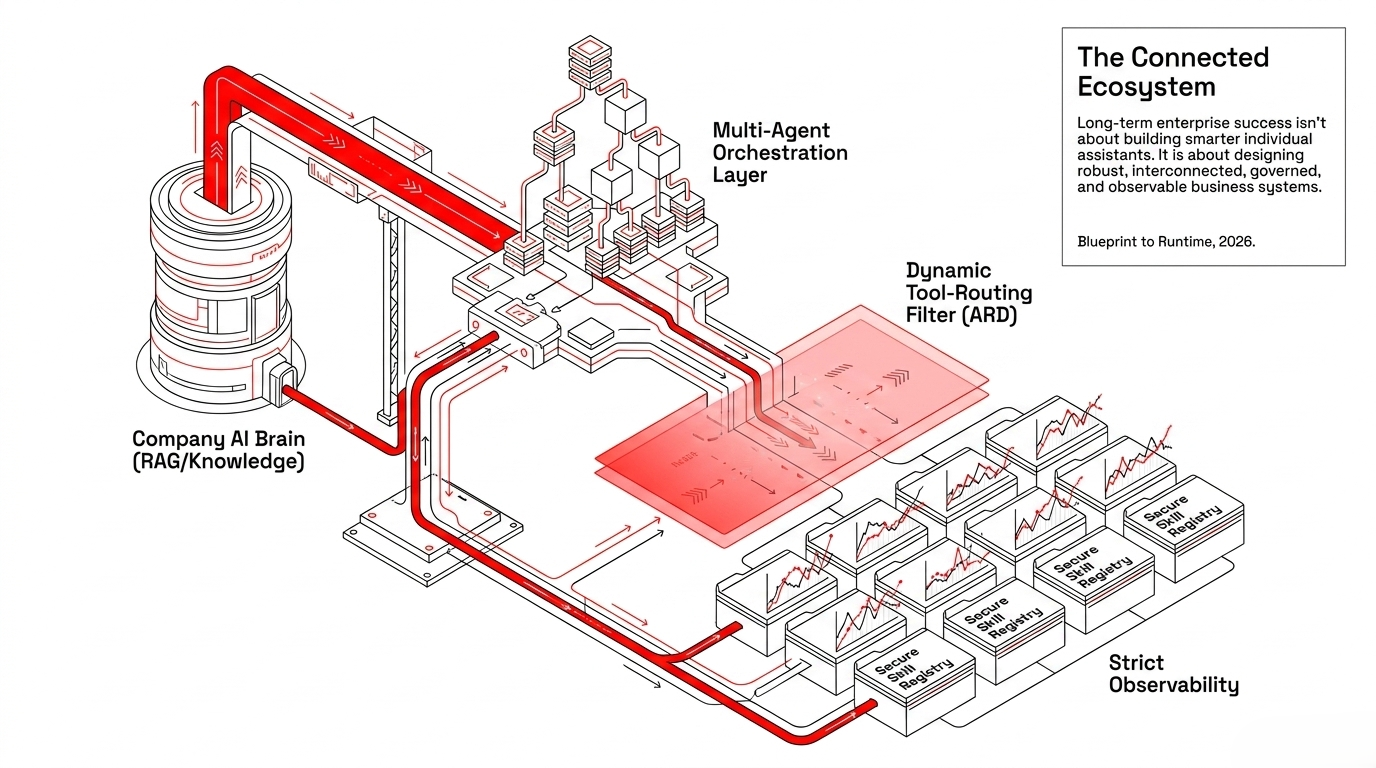
The architecture can be read as a runtime flow.
A request enters the system and is grounded against the Company AI Brain, which supplies enterprise knowledge through retrieval. The multi-agent orchestration layer determines how the work should be decomposed and coordinated. The dynamic tool-routing filter selects the small set of relevant capabilities from the broader registry. The selected secure skills execute deterministic operations under policy, authentication, and least-privilege controls. Strict observability captures the path, cost, and state transitions across the entire run.
What makes this “connected” is not the number of components. It is the separation of concerns plus explicit contracts between them.
The company brain owns knowledge access.
The reasoning and orchestration layer owns decisions.
The tool and skill layer owns deterministic execution.
The policy layer owns permissions and approvals.
The telemetry layer owns reconstruction and accountability.
The business-metrics layer owns the definition of success.
That separation lets each part evolve without requiring the entire platform to collapse into one framework.
Engineering Principles
The architecture ultimately depends on several principles:
-
Design backward from measurable business outcomes
Define what responsibility the system owns and how success will be measured before selecting agents, prompts, or frameworks. -
Separate probabilistic reasoning from deterministic execution
Let models decide among bounded options while ordinary software enforces schemas, permissions, side effects, and state transitions. -
Match coordination and topology to workflow shape
Use direct tool calls, reflection loops, explicit planning, sequential chains, fan-out/fan-in, hierarchy, or mesh only where the business process actually requires them. -
Treat capabilities as governed, reusable skills
Maintain canonical, versioned, testable capability definitions that can be discovered dynamically and projected into multiple runtime interfaces. -
Scale autonomy with risk and surround execution with zero-trust controls
High-impact actions need stronger review, tighter permissions, sandboxing, authentication, and complete auditability. -
Instrument every execution path
Capture retrieval, reasoning stages, agent handoffs, tool calls, token usage, latency, approvals, and final state changes so failures can be reconstructed. -
Test each layer according to its behavior
Keep deterministic software under deterministic tests while evaluating model behavior with scenarios, rubrics, semantic criteria, and human review for nuanced cases. -
Optimize for business value, not AI activity
Connect technical metrics to workflow efficiency, customer outcomes, revenue impact, and cost reduction.
Final Synthesis
Architecting enterprise AI agents is less about discovering a single ideal agent framework and more about engineering a controlled execution fabric. The source material consistently returns to the same pattern: intelligence must be constrained by architecture.
A production-ready system combines:
- Deterministic foundation — explicit tools, typed contracts, workflow state, and constrained side effects
- Testing layer — conventional software tests plus model-behavior evaluation and human rubrics
- Agent / AI layer — knowledge retrieval, reasoning, planning, reflection, and multi-agent orchestration
- Security and governance — sandboxing, least privilege, authentication, approvals, and audit logging
- Observability layer — traces across retrieval, reasoning, tool execution, tokens, latency, and agent invocations
- Production outcome — measurable revenue, operational, and customer-experience improvement
The result is not one autonomous “super-agent.” It is a governed network in which agents, tools, knowledge, people, and policies each have explicit responsibilities.
Closing Thought
The enterprise agent platforms that endure will not be defined by how many agents they can launch. They will be defined by how clearly they can explain what happened, why it was allowed, what it cost, and which business outcome improved.
Build the system so intelligence can scale without control becoming optional.