
Agentic Adaptive SDLC: Architecting Autonomous Software Engineering with Multi-Agent Swarms
The shift from AI-assisted development to agentic software engineering is not primarily about generating more code. It is about changing who owns the execution loop.
Assistive systems wait for a human to frame a task, issue a prompt, inspect the answer, and decide what happens next. An agentic SDLC moves more of that loop into the system itself: agents decompose goals, coordinate work, operate in real environments, inspect results, recover from failures, and continue until a stopping condition is satisfied.
That changes the engineering problem. The question is no longer, “How good is the model at writing code?” It becomes, “How do we build an autonomous software-delivery system that can reason, act, verify, retain state, remain traceable, and still preserve human accountability?”
The architecture in these slides answers that question with a layered model built around specialized worker swarms, orchestration, shared memory, environment-in-the-loop validation, interoperability standards, and explicit governance gates.
1. From Software Engineering 2.0 to Software Engineering 3.0
The conceptual break is between AI as an assistant and AI as an execution system.
Software Engineering 2.0 is framed around copilots, vibe coding, single-turn prompts, human-driven execution, and isolated generative tasks. These tools can accelerate an engineer, but the human still owns task decomposition, sequencing, validation, and recovery.
Software Engineering 3.0 shifts those responsibilities into an agentic runtime.
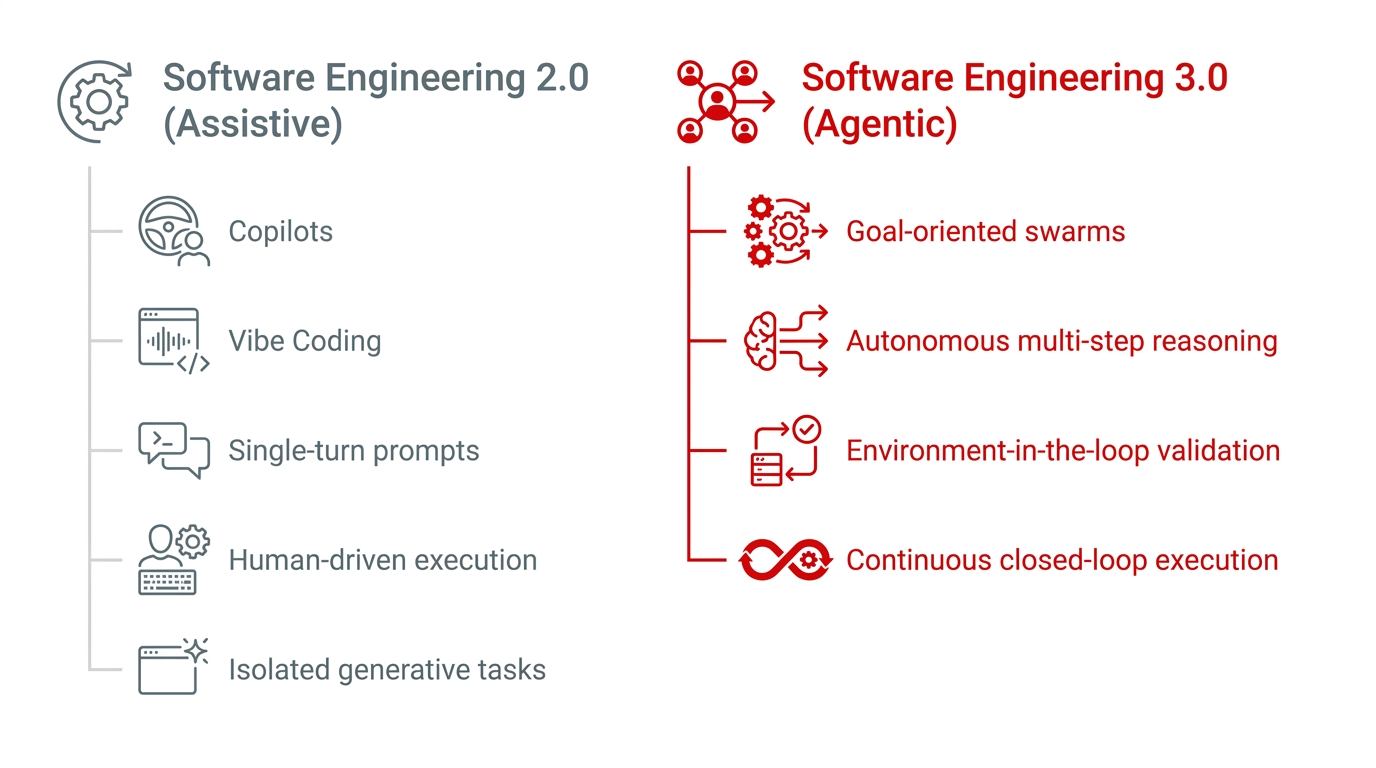
The slide identifies four properties of that runtime:
- Goal-oriented swarms turn an objective into coordinated work across specialized agents.
- Autonomous multi-step reasoning lets the system maintain progress across several dependent actions rather than responding once.
- Environment-in-the-loop validation grounds decisions in execution results, not only model confidence.
- Continuous closed-loop execution makes validation and remediation part of the operating cycle.
This is an important architectural distinction. A model that can emit a plausible patch is still only a component. An agentic engineering system needs a control loop around that model: state, tools, execution environments, error signals, and termination criteria.
The practical goal is therefore not maximum autonomy at every step. It is bounded autonomy with observable state transitions and verifiable outcomes.
2. The Layered Runtime Behind a Multi-Agent SDLC
A multi-agent SDLC needs more than a collection of prompts. It needs a runtime that separates domain work from coordination, memory, model capability, interoperability, and infrastructure.
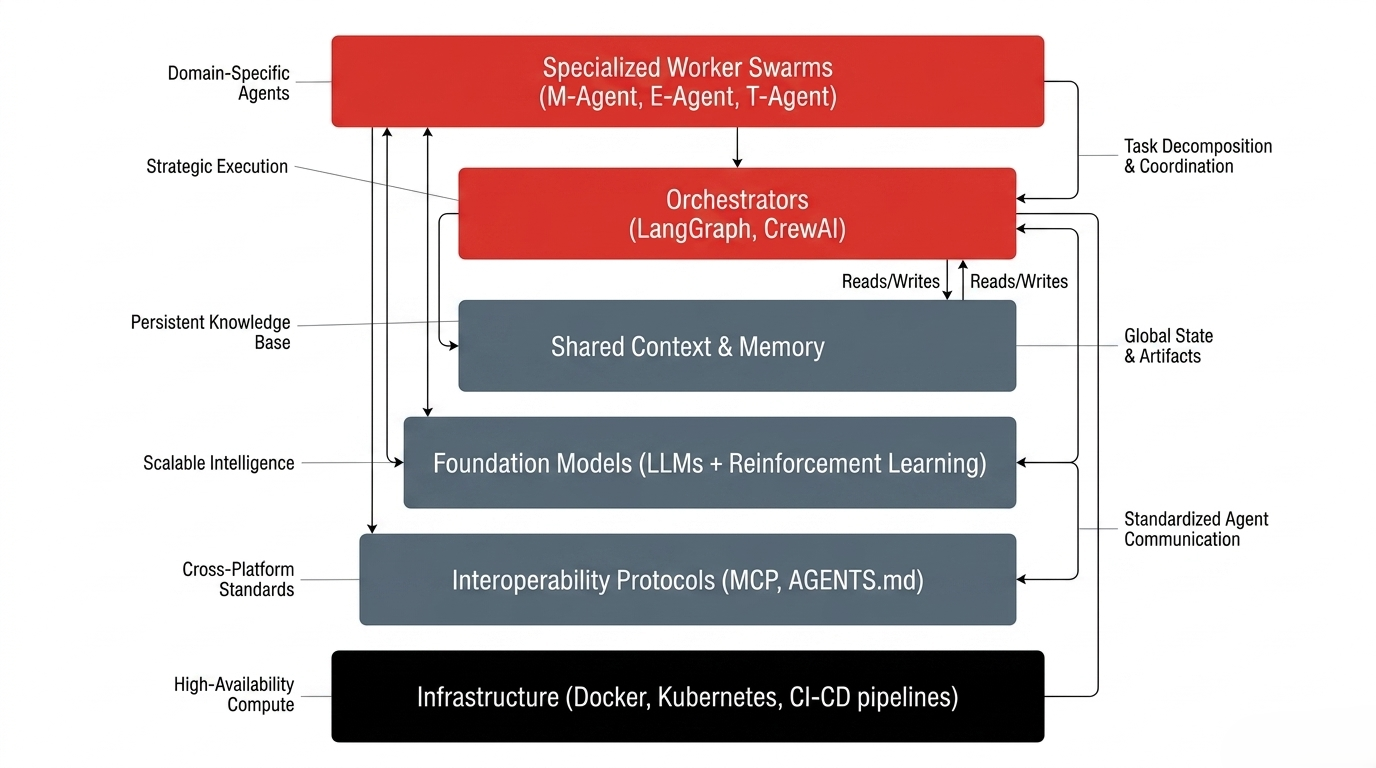
At the top are specialized worker swarms, illustrated as M-Agent, E-Agent, and T-Agent. The names later map naturally to migration, environment, and testsuite responsibilities. These workers should stay domain-specific: a migration agent edits and refactors code; an environment agent provisions and observes execution; a test agent produces and evaluates test assertions.
Below that, orchestrators such as LangGraph and CrewAI are responsible for decomposition and coordination. They do not need to perform every task themselves. Their job is to decide which worker acts next, what context it receives, what artifact it should produce, and how the system reacts to success or failure.
The shared context and memory layer acts as the system's blackboard. It carries global state and artifacts between workers so that the swarm does not collapse into independent agents with incompatible local narratives. For software engineering, this state can include specifications, repository maps, schemas, patches, test results, logs, dependency graphs, and execution histories.
The model layer provides LLMs plus reinforcement-learning capability, but it remains one layer among several. Underneath it, the slide places interoperability protocols such as MCP and AGENTS.md so agents can communicate through standard interfaces rather than ad hoc glue.
Finally, the system runs on normal production infrastructure: Docker, Kubernetes, and CI/CD pipelines.
The key design lesson is that autonomy becomes more reliable when model intelligence is surrounded by deterministic systems engineering. The model proposes. The runtime records. The environment measures. The orchestrator routes. The infrastructure constrains.
3. Swarm Topology Is an Architectural Decision
“Multi-agent” does not imply one universal communication pattern. Different tasks call for different topologies, and choosing the wrong one can create unnecessary latency, coordination overhead, or ambiguity.
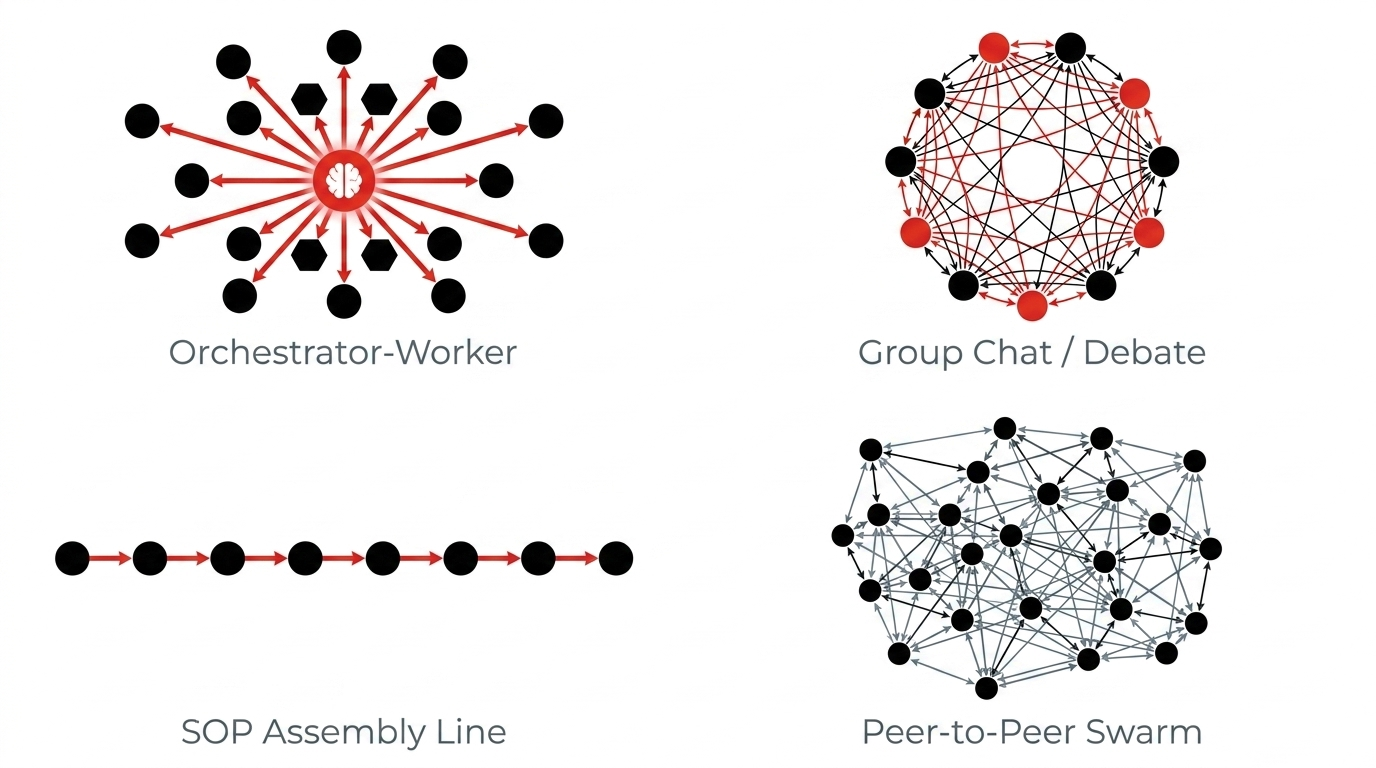
The slides present four useful patterns.
Orchestrator-worker is the clearest default for decomposable engineering work. A central coordinator distributes tasks to workers, collects results, and owns the global plan. This topology makes control flow easy to inspect and is well suited to migration programs, codebase analysis, or parallel implementation.
Group chat or debate creates a dense discussion among multiple agents. It can be useful when the problem benefits from competing hypotheses, review, or consensus, but its communication cost rises rapidly because every participant can influence every other participant.
SOP assembly line is intentionally sequential. Each stage receives an artifact, performs a constrained transformation, and passes it forward. This topology fits deterministic pipelines such as requirements normalization, build packaging, release approval, or fixed review procedures.
Peer-to-peer swarm maximizes local autonomy and communication freedom. It can explore large solution spaces, but it also creates the hardest observability and coordination problem. Without strong message contracts and convergence rules, a fully connected swarm can spend more time coordinating than solving.
A production architecture will often combine these patterns rather than choose only one. A central orchestrator may delegate to small debate groups, route artifacts through fixed SOP stages, and allow bounded peer-to-peer collaboration inside a sandbox.
The topology should follow the shape of the problem, not the novelty of the coordination pattern.
4. The SDLC Gap: Most Agentic Work Starts Too Late
The slide deck argues that research and implementation effort is heavily concentrated in post-design execution phases, with the headline claim that 85% is concentrated after design.
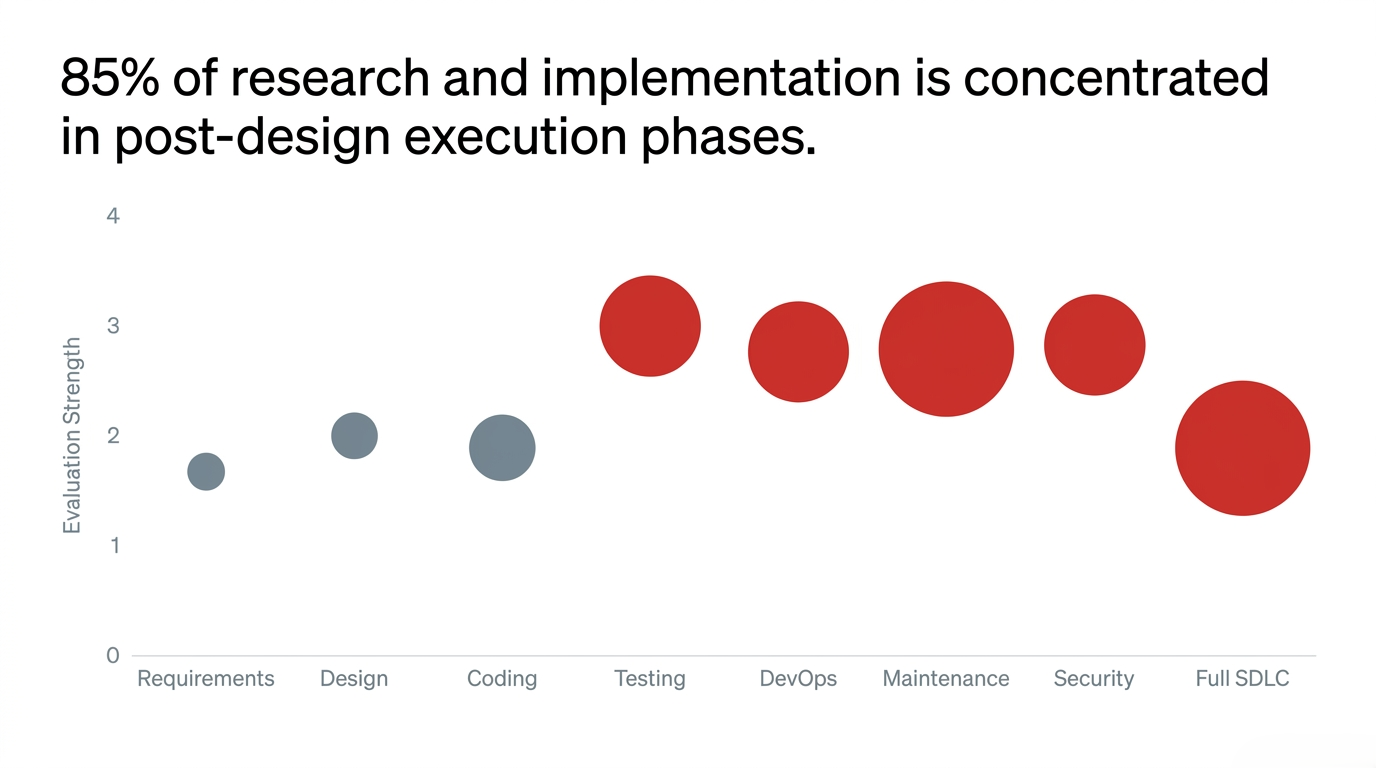
The exact percentage is presented in the supplied slide without supporting methodology, so it should be read as a framing claim rather than a universally established benchmark. The architectural point, however, is clear: current agentic systems are strongest where feedback is easiest to automate.
Coding, testing, DevOps, maintenance, and security all provide relatively direct machine-readable signals. A patch compiles or does not. A test passes or fails. A container starts or crashes. A scanner reports a finding. Deployment health can be observed.
Requirements and design are harder because their correctness depends on intent, context, undocumented constraints, and organizational knowledge. That creates a dangerous asymmetry: automation becomes strongest downstream while ambiguity remains unresolved upstream.
If the system accelerates implementation without improving the quality of its inputs, it can simply produce the wrong software faster.
A truly adaptive SDLC therefore has to extend agentic techniques into requirements recovery, architectural interpretation, and traceability, while preserving a way to validate those upstream conclusions.
5. Requirements Archaeology: Recovering Intent From Existing Systems
Legacy modernization often begins with an uncomfortable fact: the running system knows more about the real requirements than the documentation does.
The deck calls the answer Requirements Archaeology.
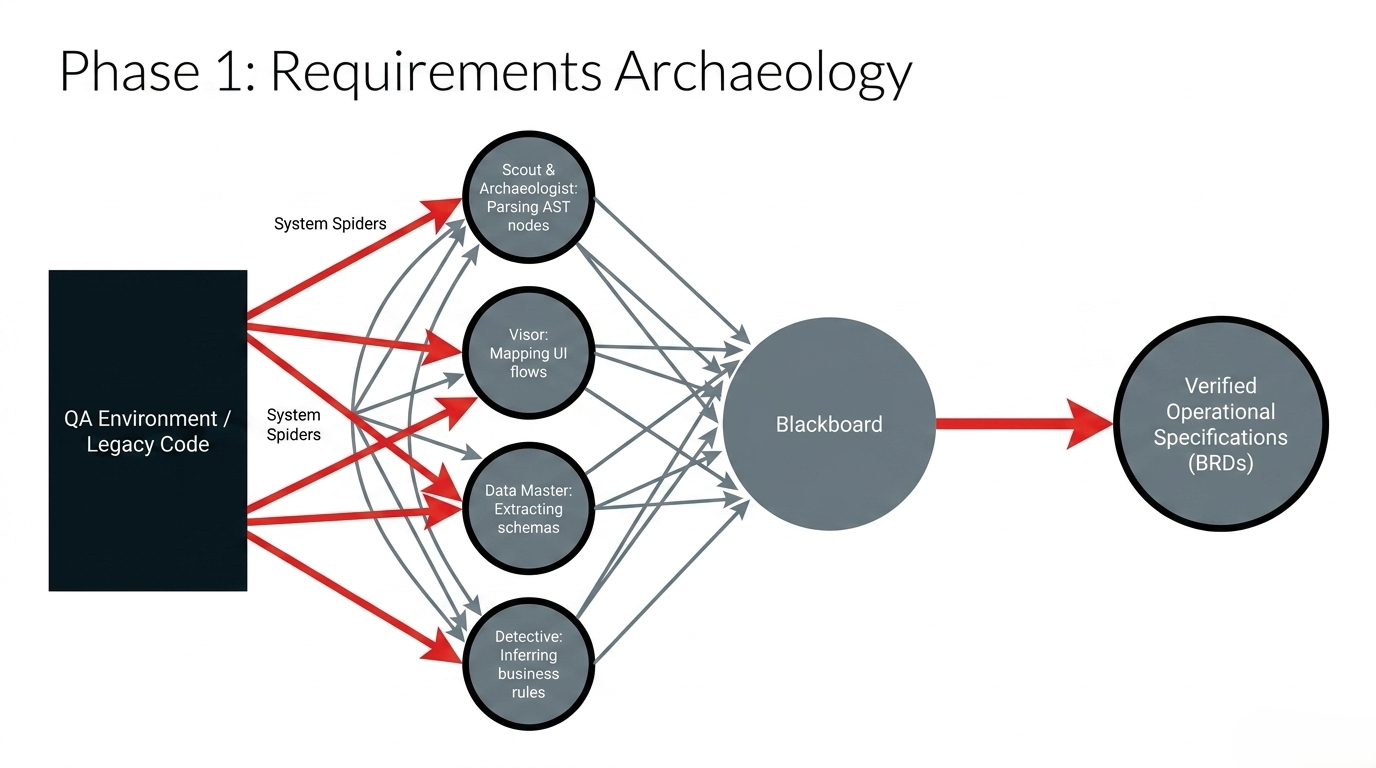
A QA environment or legacy codebase is treated as primary evidence. Specialized “system spiders” inspect different dimensions of the application:
- a Scout & Archaeologist parses AST nodes;
- a Visor maps user-interface flows;
- a Data Master extracts schemas;
- a Detective infers business rules.
These agents do not immediately generate replacement code. They first deposit findings into a shared blackboard, where evidence can be reconciled into verified operational specifications (BRDs).
This is a stronger pattern than asking a single model to “understand the repository.” Large systems expose truth through different channels: static code structure, UI behavior, database contracts, test fixtures, runtime logs, network interactions, and operational conventions. No single view is sufficient.
The blackboard pattern also separates evidence gathering from synthesis. That matters because it creates an explicit place to record conflicts. If a UI implies one rule, a schema suggests another, and a test encodes a third, the system should surface the inconsistency rather than silently average it away.
Requirements archaeology turns modernization into an evidence pipeline: observe, extract, reconcile, verify, then specify.
6. Parallelizing Implementation Around a Target Architecture
Once the intended behavior and target architecture are explicit, work can be decomposed by domain instead of serialized through a single development queue.
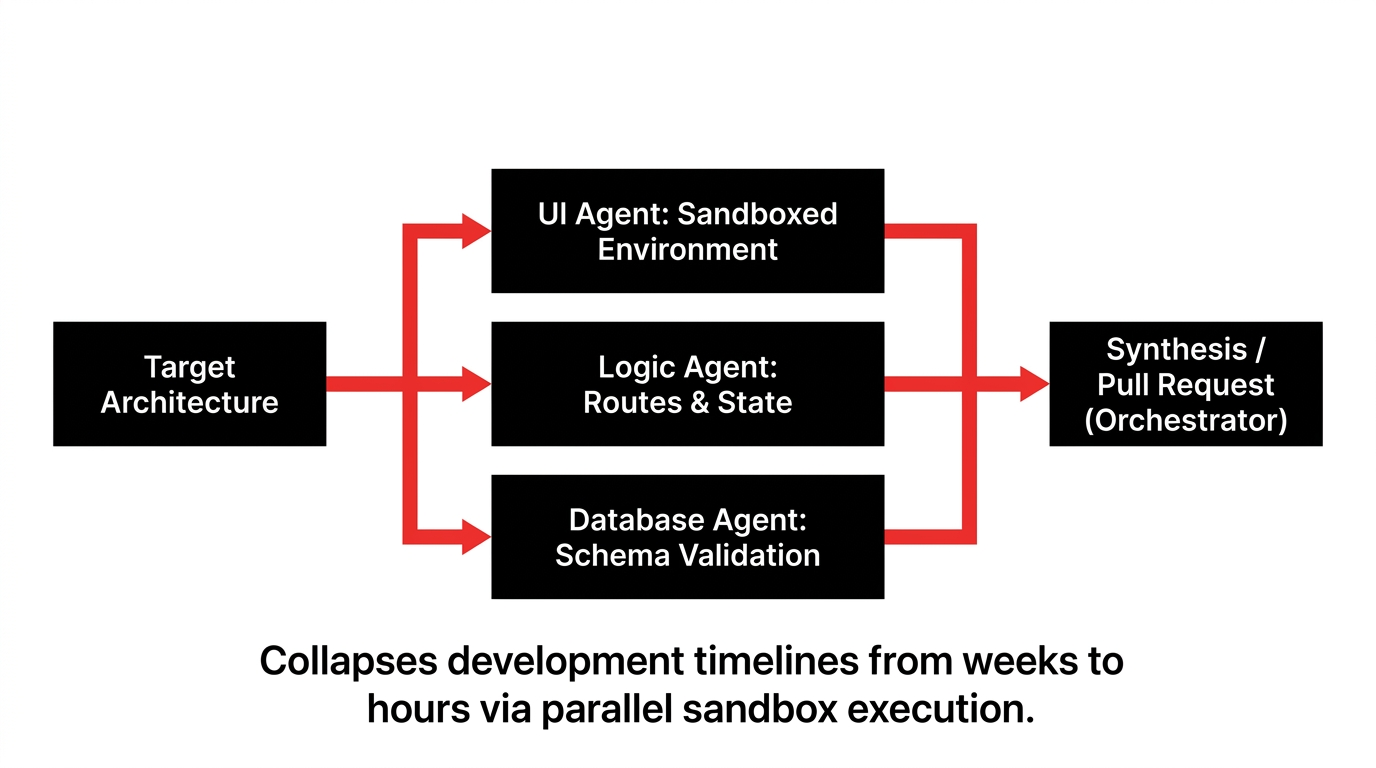
The diagram splits a target architecture across three specialist agents:
- a UI agent operating in a sandboxed environment;
- a logic agent responsible for routes and state;
- a database agent performing schema validation.
Their outputs converge in a synthesis or pull-request stage controlled by an orchestrator.
The slide describes this pattern as collapsing development timelines from weeks to hours through parallel sandbox execution. That is a source claim rather than a generally proven performance guarantee, but the mechanism is technically plausible: independent workstreams can execute concurrently when interfaces are known and conflicts are bounded.
The critical word is sandbox. Parallel autonomous work is valuable only if workers cannot corrupt each other's state or push unreviewed changes directly to production. Each worker needs an isolated execution environment, a clear artifact boundary, and deterministic merge criteria.
Parallelism also makes interface design more important. If the UI, logic, and data agents do not share a stable contract, the final synthesis stage becomes a conflict-resolution bottleneck.
The architecture is therefore less about “three agents coding at once” and more about turning the target design into separable, testable contracts that agents can own independently.
7. The Migration–Environment–Test Feedback Triangle
The most important capability in an autonomous SDLC is not generation. It is a reliable feedback loop.
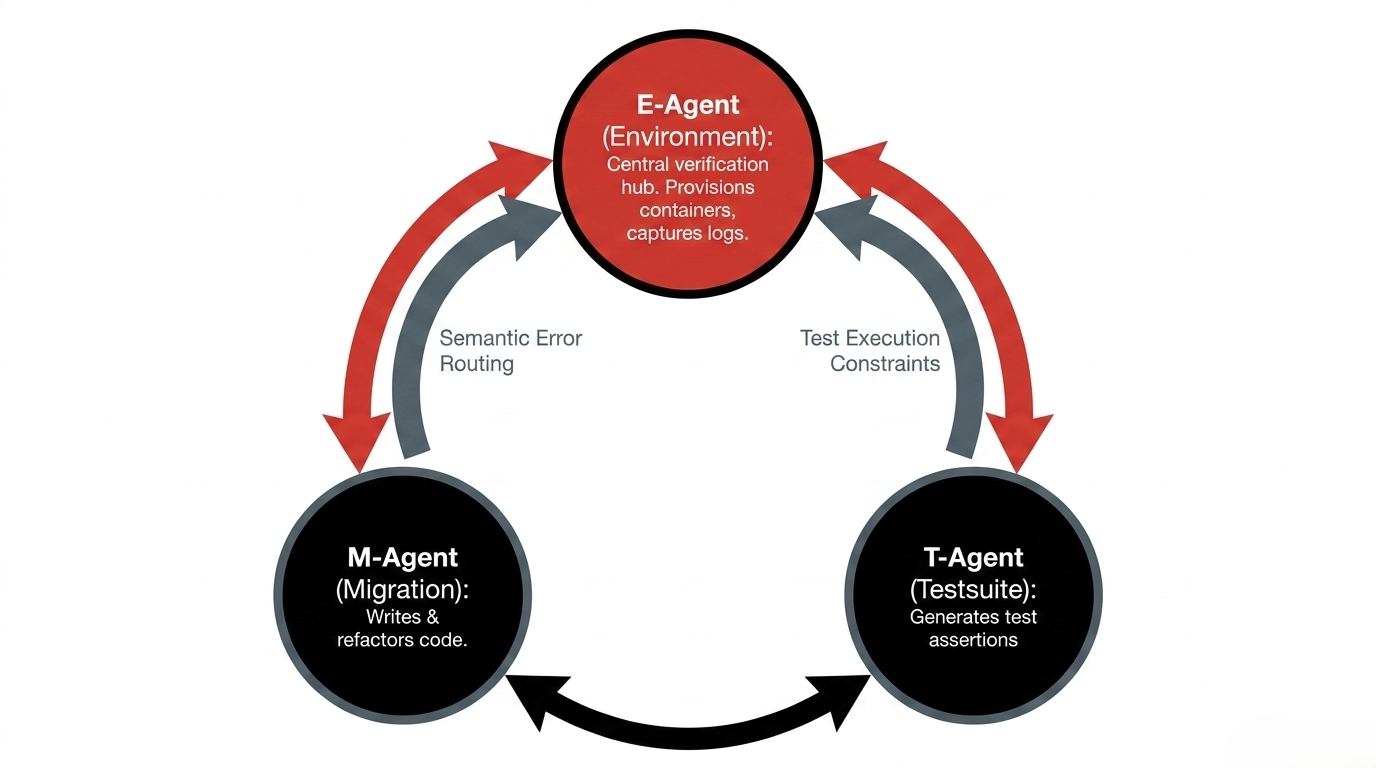
The deck defines three complementary roles:
- M-Agent (Migration) writes and refactors code.
- E-Agent (Environment) acts as the central verification hub, provisions containers, and captures logs.
- T-Agent (Testsuite) generates test assertions.
The environment agent sits at the top because it owns the system's strongest source of truth: execution. It can route semantic errors back to the migration agent and impose test-execution constraints on the testsuite agent.
This triangle avoids a common failure mode in autonomous coding systems: letting the same agent write the change, invent the test, interpret the result, and declare success. When one model controls the entire evidence chain, confirmation bias becomes a system property.
Role separation creates checks and balances. The migration agent is rewarded for implementation. The test agent is rewarded for finding defects. The environment agent is rewarded for faithfully measuring what actually happened.
The loop also produces the raw material required for observability: container state, compiler output, test results, execution traces, and semantic failure categories. Those artifacts should be first-class records, not temporary prompt text.
8. Self-Healing QA Depends on Environment Feedback
Testing becomes agentic when failure is not the end of the pipeline but an input to the next action.
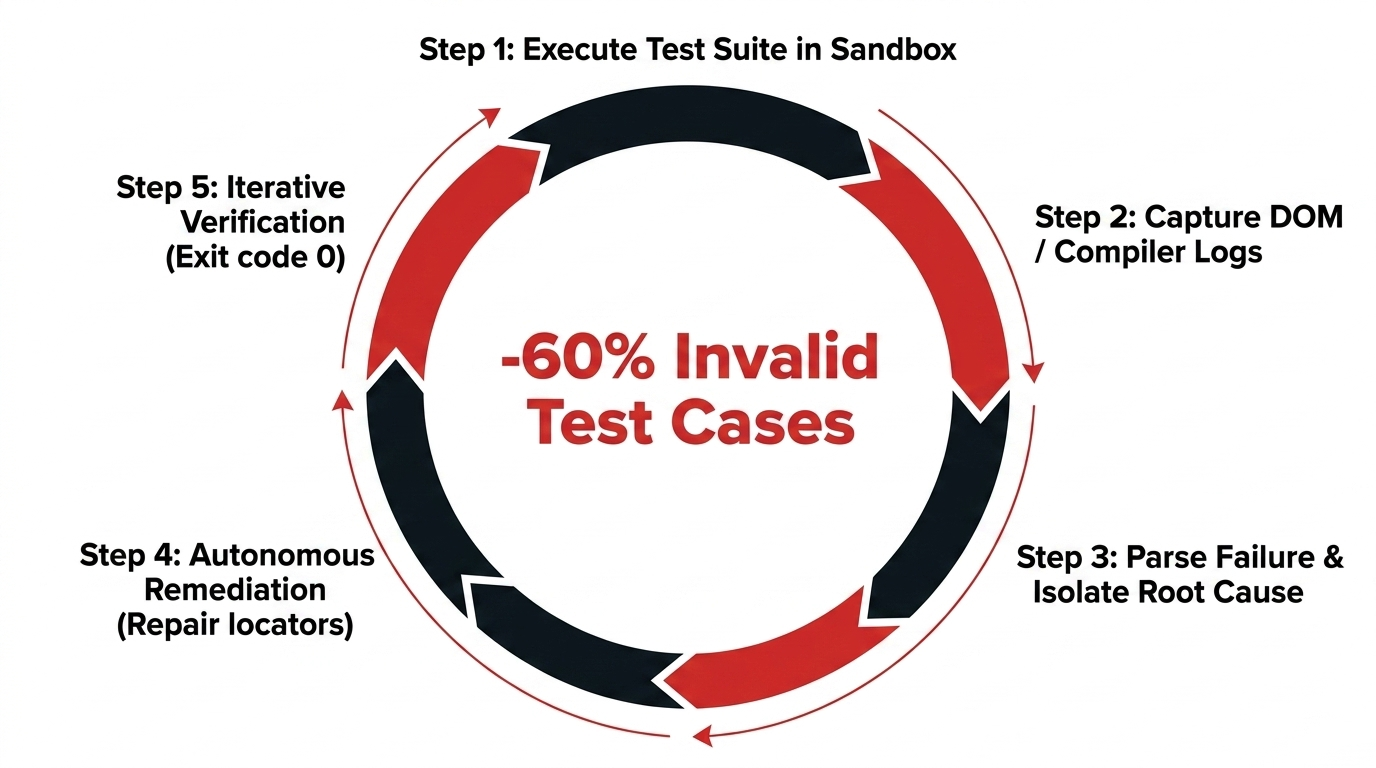
The slide describes a five-step cycle:
- execute the test suite in a sandbox;
- capture DOM or compiler logs;
- parse the failure and isolate the root cause;
- remediate autonomously, such as repairing locators;
- rerun until verification succeeds with exit code 0.
The headline result shown is a 60% reduction in invalid test cases. The supplied material does not include the dataset, baseline, or experimental method, so the figure should be treated as a reported result from the source rather than a universal expectation.
The more important pattern is the distinction between product failure and test failure. A brittle UI locator, stale fixture, or broken test harness can report red even when the product behavior is acceptable. Conversely, an agent that reflexively edits tests until they pass can erase evidence of a real regression.
Self-healing QA therefore needs constraints:
- remediation should be scoped to known repair classes;
- every test mutation should be recorded;
- the environment should preserve the failing evidence;
- repeated healing attempts should have a budget;
- ambiguous failures should escalate rather than converge by force.
The system becomes trustworthy when it can explain not only that the test eventually passed, but what changed, why that change was allowed, and which execution evidence justified it.
9. Agentic CI/CD Extends the Loop Into Deployment
The same closed-loop model can continue through build and deployment.
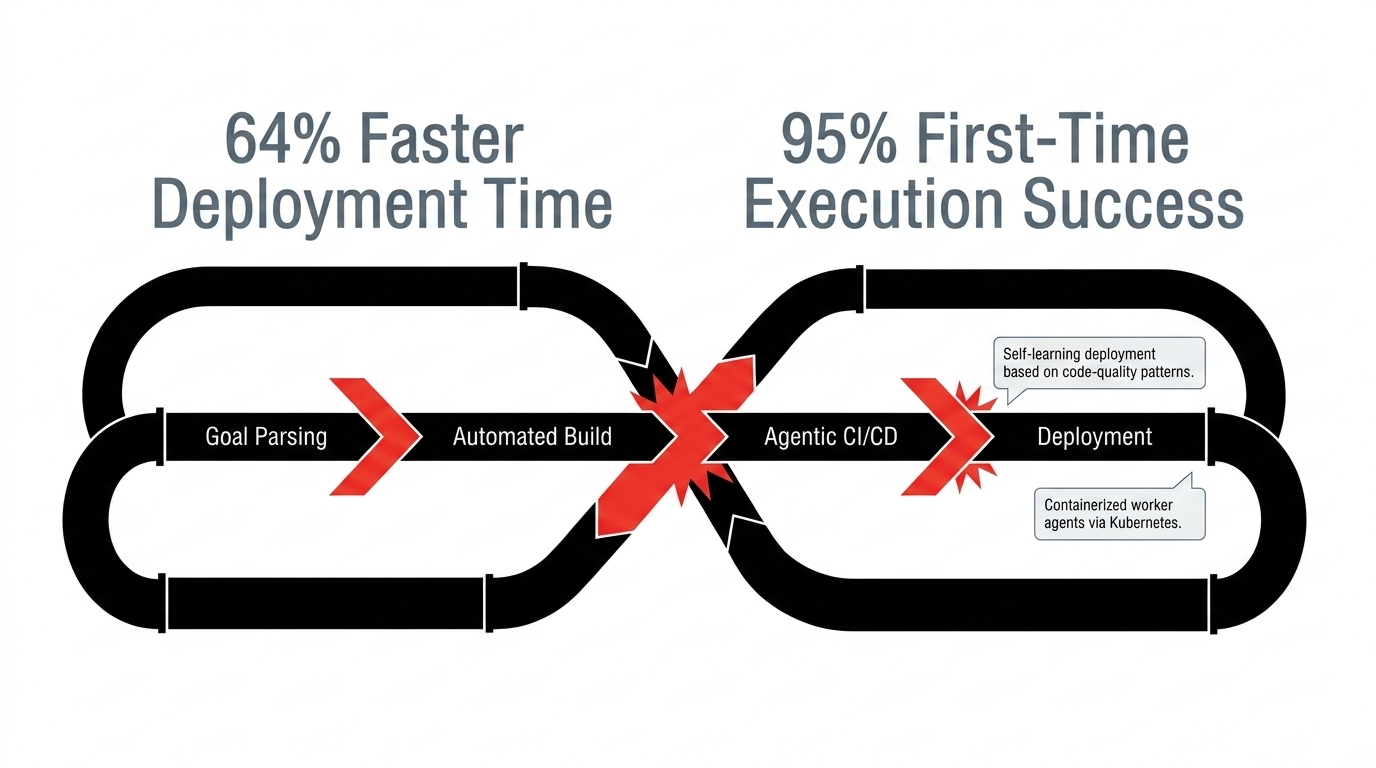
The diagram begins with goal parsing, moves into automated build, crosses an agentic CI/CD control point, and ends in deployment. Kubernetes-hosted worker agents and self-learning deployment behavior are presented as mechanisms for adapting execution to code-quality patterns.
The slide reports 64% faster deployment time and 95% first-time execution success. As with the other performance figures, the supplied slides do not provide a reproducible benchmark protocol, so production teams should treat them as claims that require local validation.
Architecturally, the deeper implication is that CI/CD stops being a passive sequence of scripts and becomes a decision-making system. Instead of merely failing a job and waiting for a human, an agentic pipeline can classify the failure, choose a bounded remediation, rerun the affected stage, and escalate only when it cannot prove recovery.
That can reduce operational toil, but it also increases the blast radius of bad decisions. The safe design is to give agents progressively stronger permissions only after progressively stronger evidence.
Build repair may be fully autonomous in a sandbox. Release creation may require policy checks. Production rollout may require a human gate or automated risk threshold. Rollback should remain deterministic and immediately available.
Autonomous delivery should increase the speed of recovery without weakening the controls that define a safe release.
10. Human-in-the-Loop as a Validation Gate
Autonomy does not eliminate human responsibility. It changes where humans are most valuable.
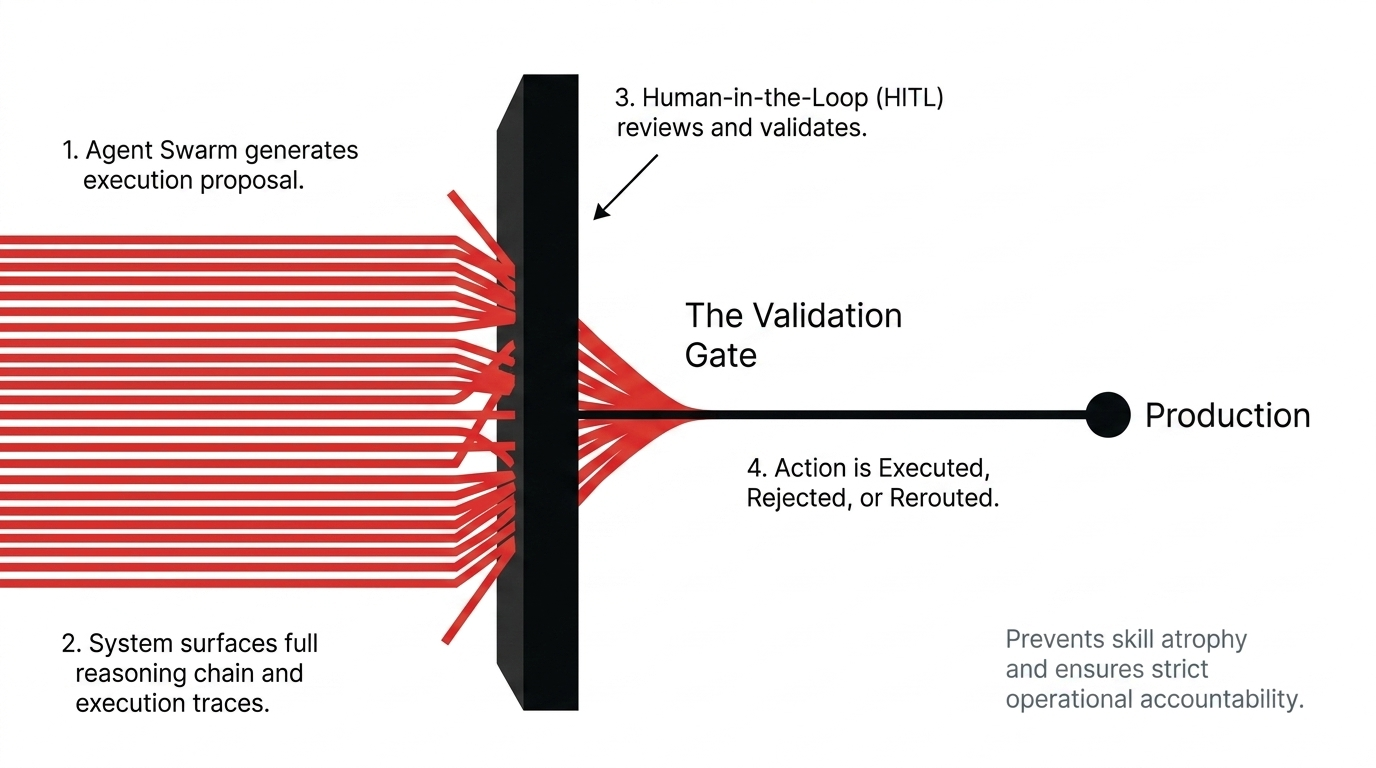
The validation-gate pattern is deliberately asymmetric. The swarm can generate many execution proposals in parallel, but those proposals converge before production.
The system is expected to surface its reasoning chain and execution traces. A human reviewer then validates the proposed action. From the gate, the action can be executed, rejected, or rerouted.
This is not a manual approval step for every low-risk action. Used well, human-in-the-loop control is a risk boundary. Routine, reversible operations can pass automatically when policy and evidence are strong. High-impact or ambiguous operations can pause for explicit review.
The slide also links the gate to two organizational concerns: skill atrophy and operational accountability. If engineers never inspect the system's reasoning or execution traces, they gradually lose the context required to challenge it. If no human owns the final decision boundary, accountability becomes difficult when the swarm behaves correctly according to its local rules but incorrectly according to business intent.
A useful principle is: humans should approve consequences, not re-perform machine work. The agent system should do the analysis and present evidence; the reviewer should adjudicate the decision at the appropriate risk threshold.
11. Traceability From Business Rule to Generated Code
Once agents can modify a codebase autonomously, provenance becomes part of correctness.
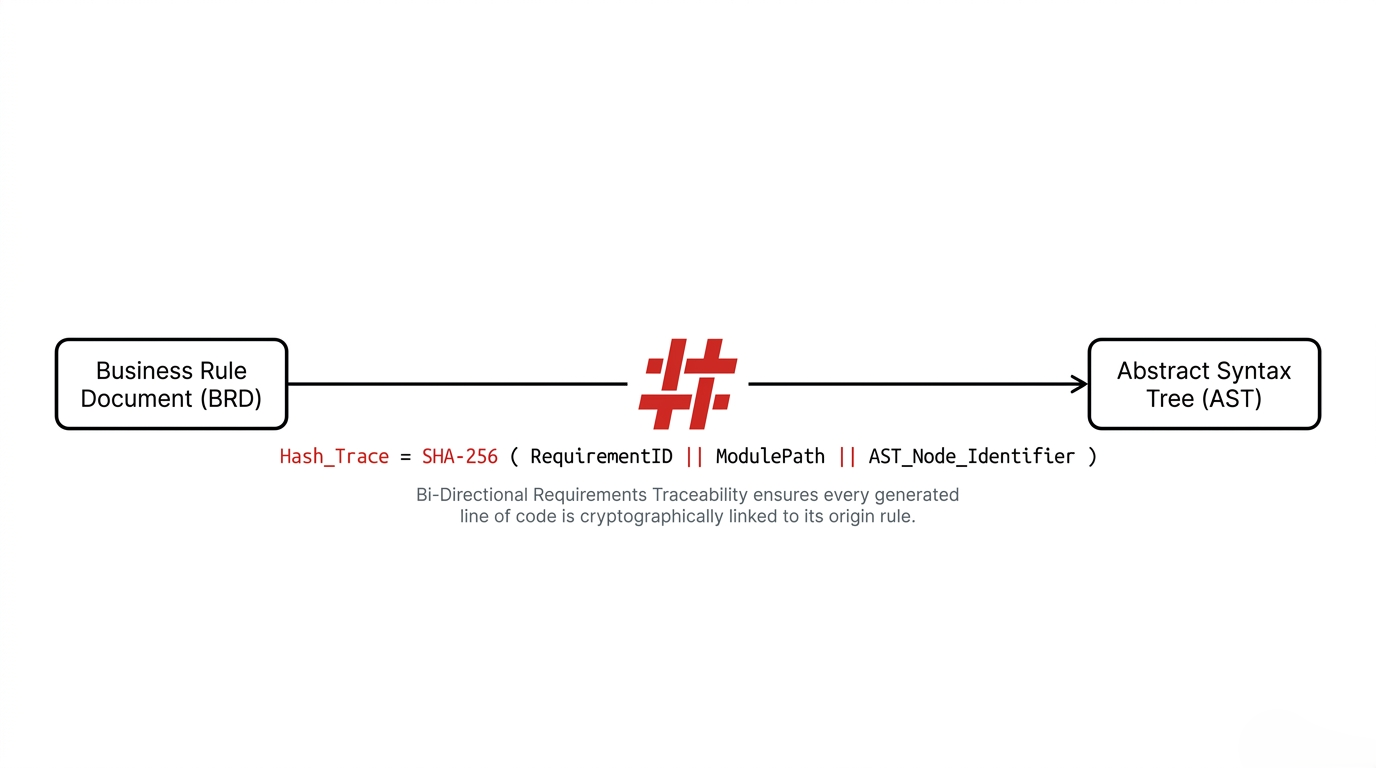
The deck proposes a bidirectional trace between a Business Rule Document (BRD) and an Abstract Syntax Tree (AST) node using a SHA-256 hash over:
RequirementID || ModulePath || AST_Node_Identifier
The intent is that generated code can be linked cryptographically back to its originating rule.
A hash alone cannot prove that the implementation is semantically correct, but it can create a durable identity relationship between requirement, module location, and code structure. That relationship becomes useful for impact analysis, audit, change review, and regeneration.
If a requirement changes, the system can identify which modules and AST nodes were derived from it. If a generated line is questioned, the system can walk backward to the rule and execution history that produced it.
This is especially valuable in a multi-agent environment because artifacts are constantly handed between workers. Without provenance, shared memory can become an opaque collection of “current answers.” With provenance, each artifact can carry a lineage: source requirement, producing agent, model or policy version, execution evidence, approvals, and downstream consumers.
Traceability converts swarm behavior from ephemeral reasoning into an auditable engineering process.
12. Measuring the System Without Confusing Claims With Guarantees
The slides consolidate several reported outcomes:
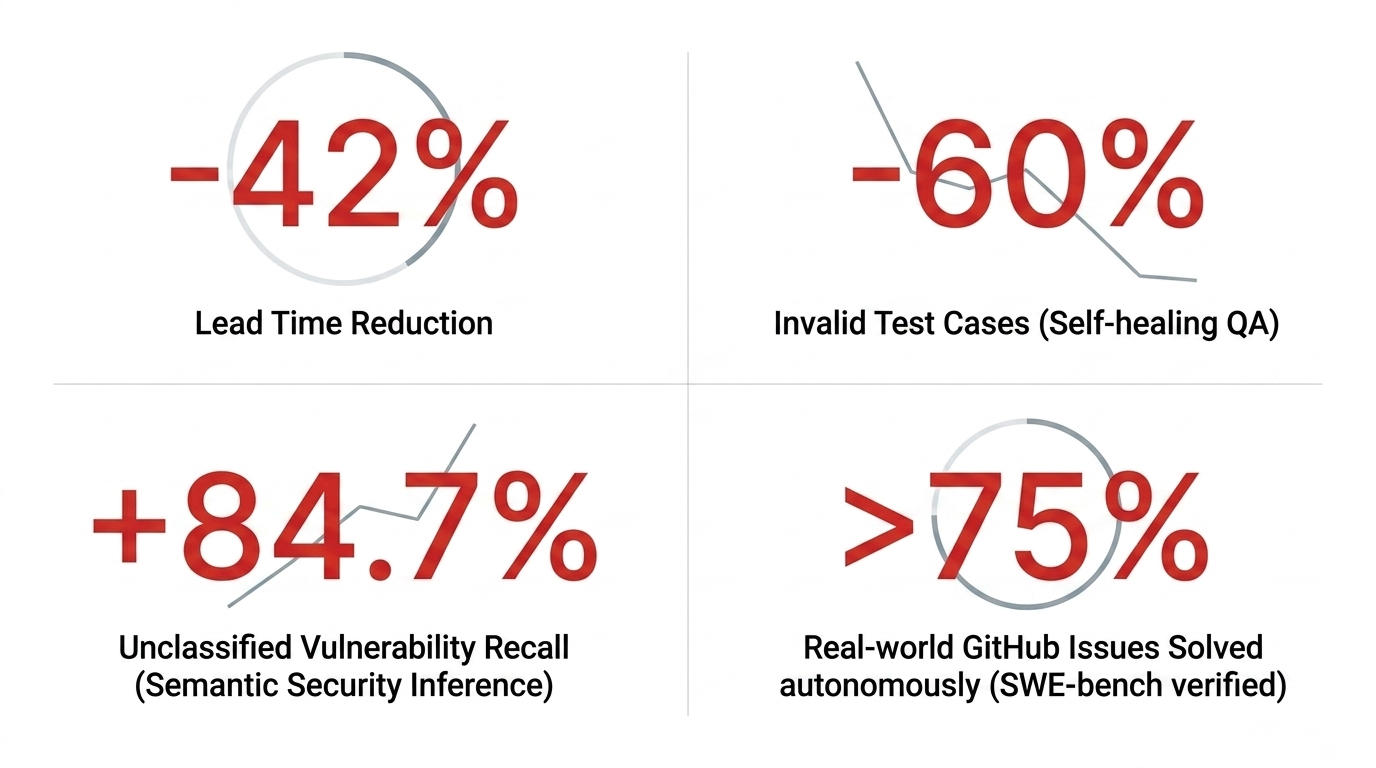
- 42% lead-time reduction
- 60% fewer invalid test cases through self-healing QA
- 84.7% improvement in unclassified vulnerability recall through semantic security inference
- more than 75% of real-world GitHub issues solved autonomously, labeled as SWE-bench verified
These figures communicate the kinds of outcomes an agentic SDLC is intended to optimize: speed, test reliability, security detection, and autonomous issue resolution. The supplied material does not include experimental design, sample size, benchmark version, baselines, or confidence intervals, so the numbers should not be generalized beyond the source without independent validation.
For production adoption, the stronger measurement strategy is to define local metrics around the closed loop itself.
Track attempts to verified completion, not just generation success. Measure autonomous remediation rate, escalation rate, rollback rate, false-positive test repair, human review time, mean time to evidence, provenance completeness, and the percentage of actions that can be replayed from stored traces.
For security, distinguish detection recall from actionable remediation quality. For delivery, distinguish faster pipeline execution from safe deployment. For code generation, distinguish syntactic acceptance from behavior verified in the target environment.
Agentic systems should be evaluated on verified outcomes under realistic constraints, because that is the level at which their autonomy creates operational value.
13. Adoption Is Constrained by Organization as Much as Computation
The final barrier is not simply model capability.
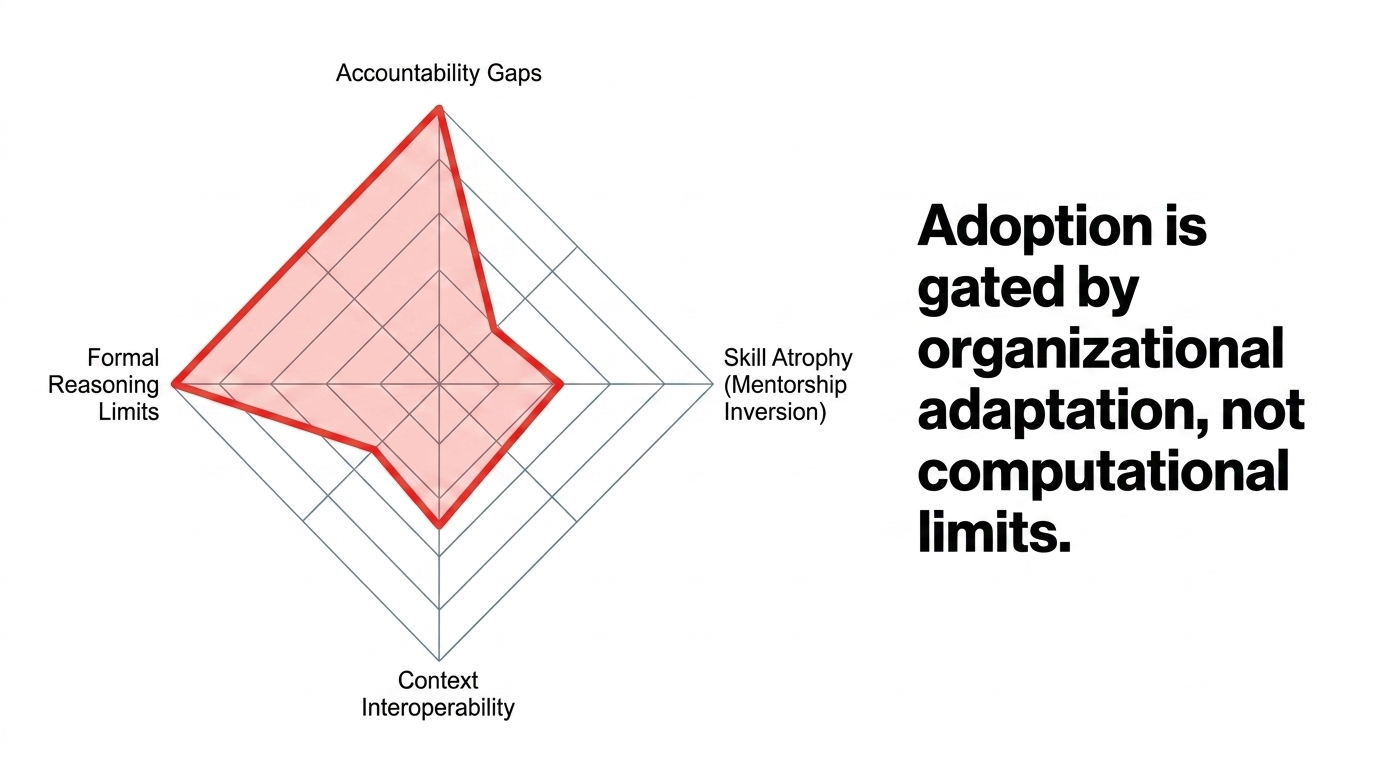
The radar chart highlights four constraints:
- accountability gaps
- formal reasoning limits
- context interoperability
- skill atrophy / mentorship inversion
The slide's central statement is that adoption is gated by organizational adaptation, not computational limits.
That framing matters because a technically capable swarm can still fail in an organization that has no ownership model for autonomous actions, no standard artifact contracts, no policy for escalations, or no way to train engineers to supervise the system.
Accountability gaps require explicit responsibility boundaries. Someone must own the policy that allowed an action, the environment in which it executed, and the business consequence it produced.
Formal reasoning limits require the system to know when model inference is insufficient. Deterministic checks, type systems, compilers, policy engines, database constraints, and formal methods should remain outside the model where possible.
Context interoperability requires common formats and stable interfaces. Shared memory is useful only when agents agree on what an artifact means, how fresh it is, and which system is authoritative.
Skill atrophy requires deliberate operating practice. Engineers need continued exposure to architecture, failure analysis, and production reasoning even when agents perform more of the routine implementation.
The difficult part of agentic engineering is not only making agents capable. It is making an organization capable of governing agents as a new class of software operator.
14. The Swarm Agentic Paradigm
The closing slide frames autonomous software engineering as a search problem rather than a single deterministic path.
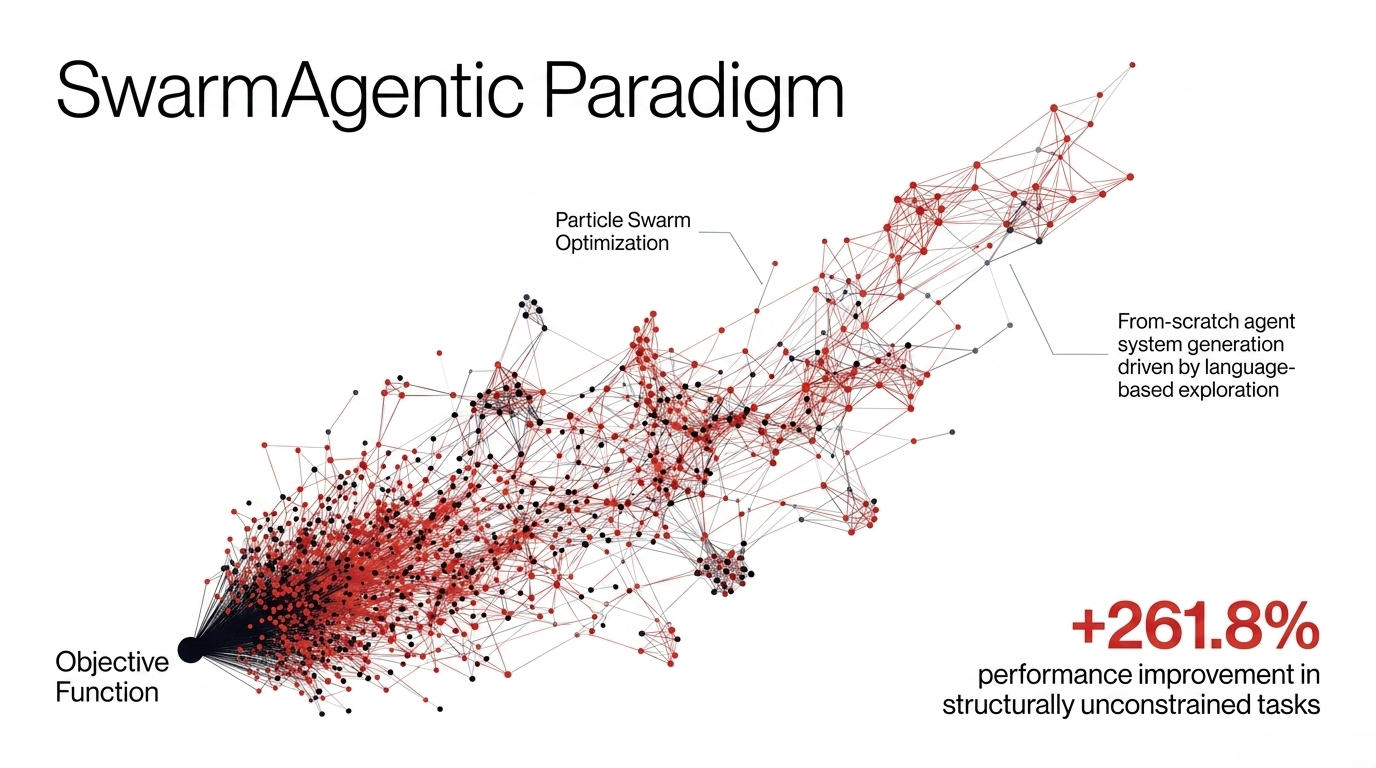
The graph begins at an objective function and expands through a large network of candidate trajectories. Two ideas are highlighted: particle swarm optimization and from-scratch agent system generation driven by language-based exploration.
This reframes multi-agent engineering. Instead of treating the SDLC as one scripted chain, the system can explore multiple solution branches, compare outcomes, and route resources toward better-performing paths.
The slide reports 261.8% performance improvement in structurally unconstrained tasks. No benchmark methodology is included in the supplied material, so the figure should be understood as a source claim. The useful design idea is the hybrid search pattern: structured optimization can guide broad exploration, while language models generate and revise candidate strategies.
That approach is most appropriate where the task structure is genuinely open-ended. For tightly regulated or safety-critical operations, unconstrained exploration should be bounded by policies, sandboxes, test oracles, and approval gates.
The strongest architecture combines both modes:
- exploratory intelligence where the solution space is uncertain;
- deterministic validation where correctness can be measured;
- human governance where consequences require judgment.
The swarm is not valuable because it can produce more trajectories. It is valuable when the system can select, verify, and justify the trajectory that reaches the objective safely.
Engineering Principles
The architecture ultimately depends on several principles:
-
Separate generation from verification
The same agent should not be the sole author, tester, and judge of its own work. Use role separation and environment-derived evidence. -
Treat execution environments as the source of truth
Compiler output, test results, runtime state, DOM evidence, logs, and deployment health are stronger signals than model confidence. -
Make state and provenance first-class artifacts
Shared memory should record not only conclusions but lineage: originating requirement, producing agent, execution evidence, changes, and approvals. -
Choose swarm topology by task structure
Use orchestrator-worker for decomposition, assembly lines for fixed procedures, debate for competing hypotheses, and peer-to-peer interaction only when its coordination cost is justified. -
Bound autonomy with explicit gates and budgets
Sandboxes, retry limits, permission tiers, policy checks, rollback paths, and human validation keep closed-loop execution from becoming uncontrolled execution. -
Keep deterministic engineering below probabilistic reasoning
Infrastructure, schemas, type systems, tests, security policy, CI constraints, and audit records should constrain model-driven decisions. -
Measure verified outcomes, not generated output
The meaningful unit is work that reaches an acceptable environment state with traceable evidence, not the number of patches, tokens, or agent steps produced.
Final Synthesis
An agentic adaptive SDLC is best understood as a closed-loop software production system.
Requirements archaeology reconstructs intent from the legacy environment. A target architecture converts that intent into separable contracts. Specialized workers execute in parallel. An orchestrator manages decomposition and coordination. Shared context preserves global state and artifacts. Environment agents provide hard feedback. Test agents challenge implementations. CI/CD agents extend remediation into delivery. Provenance links generated code back to business rules. Human validation gates control high-consequence actions.
Across that flow, the model is important but not sovereign. Reliability comes from the system around it.
The production-ready architecture combines:
- Deterministic foundation: repository contracts, schemas, AST structure, containerized infrastructure, CI/CD rules, and rollback mechanisms.
- Testing layer: sandbox execution, environment-derived evidence, self-healing tests with bounded remediation, and independent verification roles.
- Agent or AI layer: specialized worker swarms, orchestrators, shared memory, language models, and structured exploration.
- Security and governance: human validation gates, permission boundaries, provenance, accountability rules, and traceability to business requirements.
- Observability layer: logs, compiler output, DOM captures, execution traces, global state, artifacts, and replayable decision history.
- Production outcome: autonomous progress where evidence is strong, safe escalation where evidence is weak, and controlled execution at the production boundary.
The architectural thesis is simple: software engineering becomes truly agentic only when autonomy is paired with memory, environment feedback, traceability, and governance.
Closing Thought
The next generation of software engineering will not be defined by agents that can write code without help. It will be defined by systems that can understand intent, coordinate specialized work, prove what happened, recover from failure, and know when to hand control back to a human.
Autonomy becomes engineering only when execution is observable, verifiable, and accountable.