
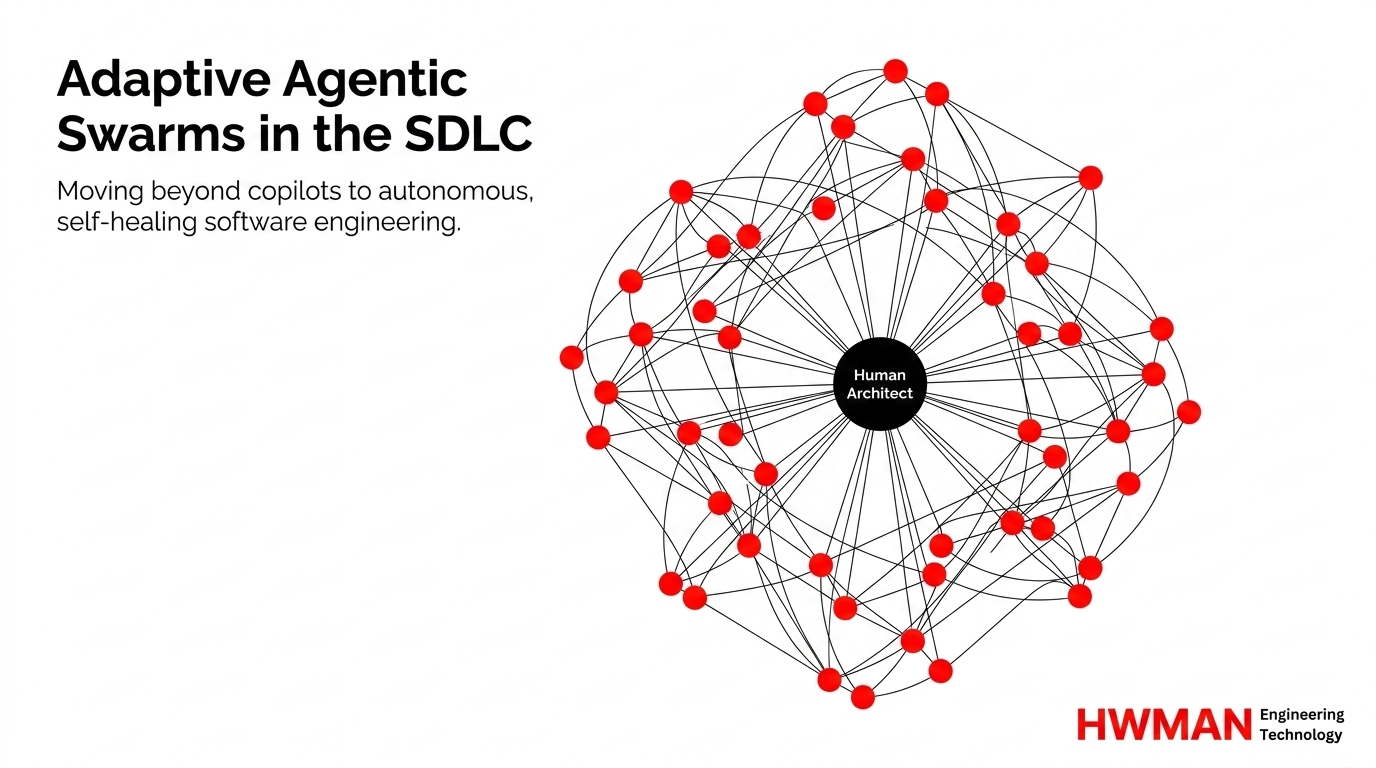
Adaptive Agentic Swarms in the SDLC
Software engineering is moving past a model in which AI waits for a developer to ask the next question. The more consequential shift is architectural: from assistive copilots that respond to isolated prompts toward systems of agents that can decompose goals, coordinate work, inspect their own outcomes, and adapt their behavior over time.
That shift matters most in enterprise delivery environments where the dominant constraints are not typing speed or code generation. They are undocumented legacy behavior, fragmented toolchains, cross-team dependencies, validation burden, security controls, and the difficulty of maintaining confidence while software changes continuously.
The central engineering challenge is therefore not simply to make an agent capable of writing code. It is to design a sociotechnical system in which autonomous execution remains observable, testable, governable, and aligned with business intent.
1. The Enterprise Bottleneck Is System Complexity
Legacy estates often accumulate behavior faster than they accumulate explanation. Interfaces, database relationships, APIs, operational workarounds, and historical assumptions become an implicit specification distributed across the runtime environment.
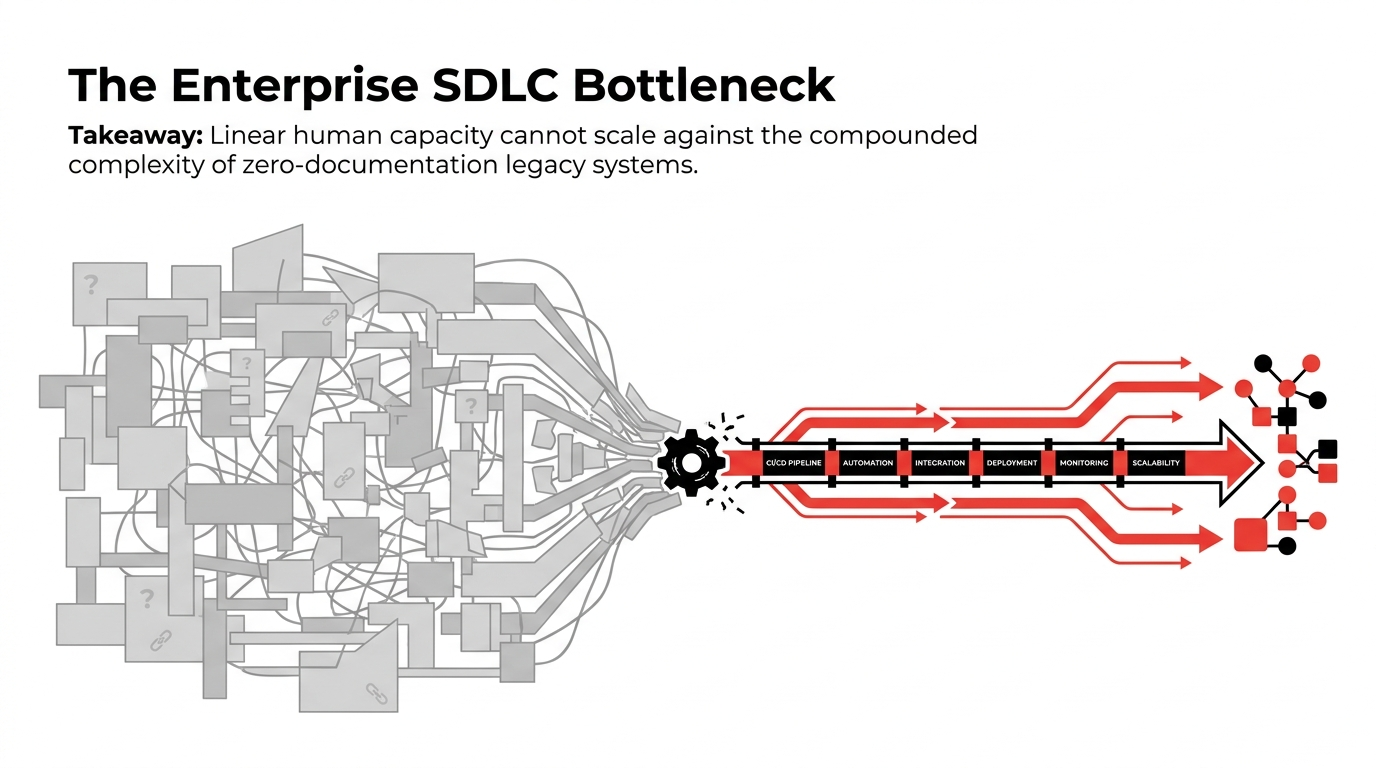
The result is a throughput problem that conventional automation only partially solves. CI/CD pipelines can accelerate known workflows, but they do not automatically recover missing intent or explain why a brittle dependency exists. Human engineering capacity remains linear while the number of hidden relationships in the system can compound.
Agentic engineering is compelling in this context because it can distribute investigative and execution work across specialized roles. But adding agents to a poorly understood system does not remove complexity. It changes where that complexity must be managed: in orchestration, evidence collection, validation, and governance.
2. Software Engineering 3.0 Changes the Unit of Interaction
The progression from manual coding to copilots and then to agentic swarms is not simply an increase in model capability. It changes the unit of work.
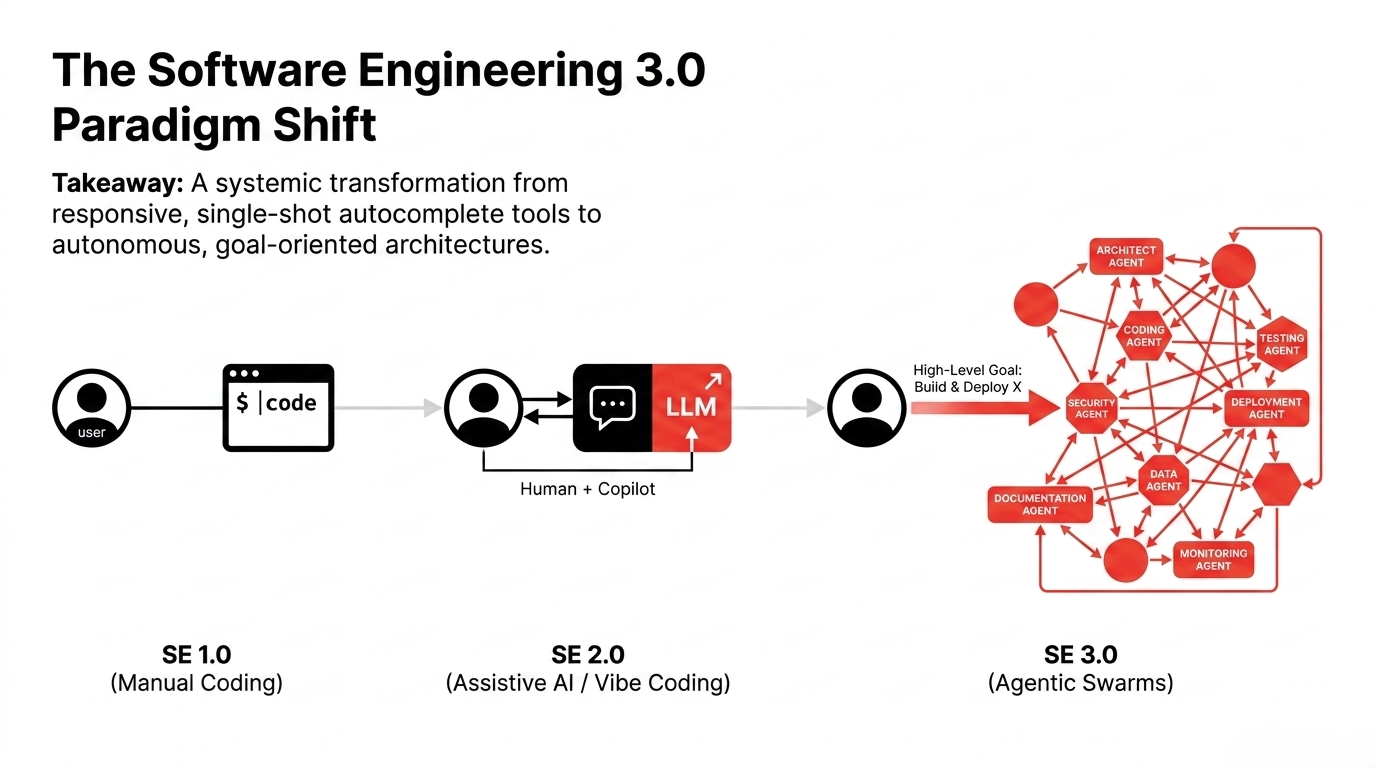
In a manual workflow, the developer is the primary executor. In an assistive workflow, an LLM helps produce local artifacts while the human still manages decomposition, sequencing, and verification. In an agentic workflow, the human can express a higher-level goal and a coordinated system of agents performs parts of architecture, coding, testing, security, deployment, documentation, data work, and monitoring.
That changes the engineer's role from continuous step-by-step operator toward systems architect and governor. The implementation challenge becomes less about issuing the perfect prompt and more about creating explicit operating boundaries for a network of autonomous components.
3. The Core Agentic Triad: Autonomy, Adaptability, and Goal-Directedness
A useful distinction between a sophisticated workflow and a genuinely agentic system is the combination of three properties.
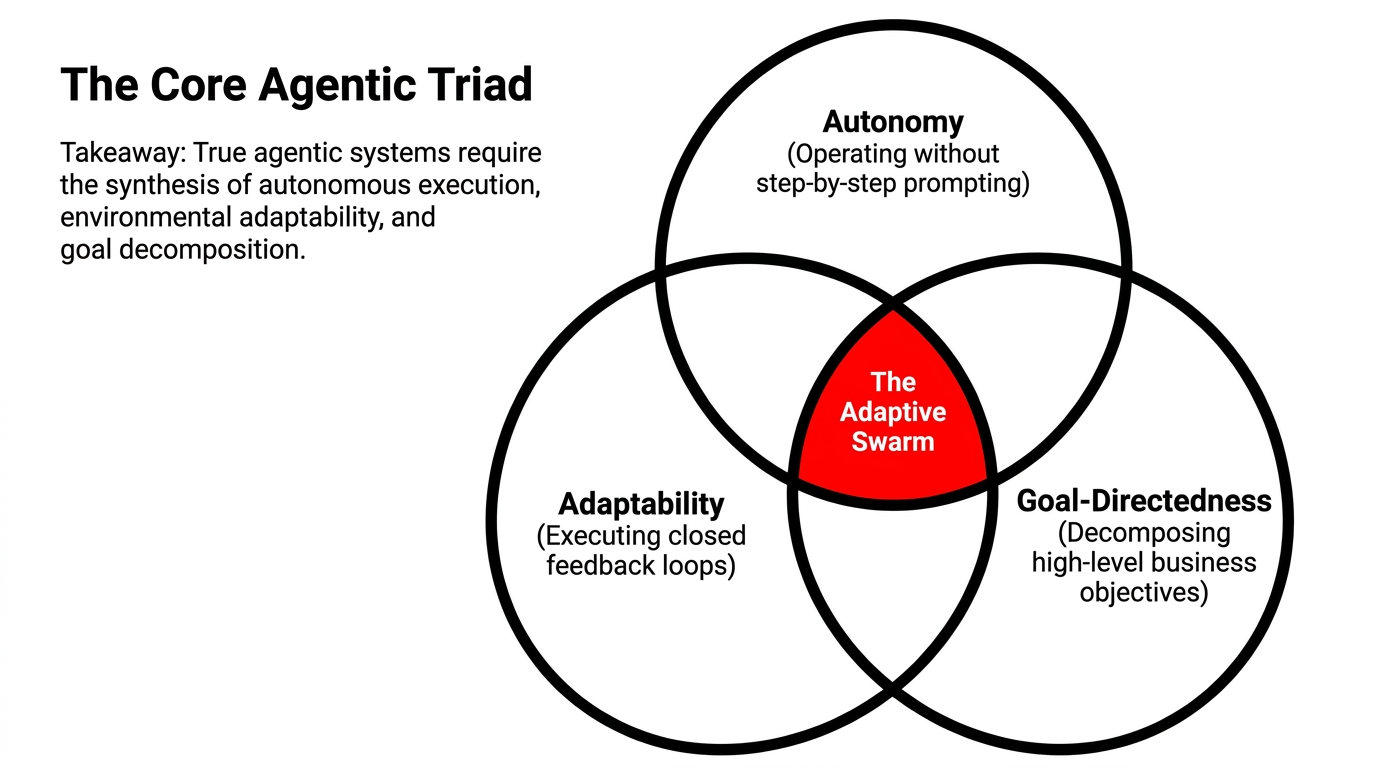
- Autonomy means the system can continue operating without requiring a human to prescribe every intermediate step.
- Adaptability means behavior changes in response to observed outcomes, not merely a static sequence of instructions.
- Goal-directedness means a high-level objective can be decomposed into concrete tasks, responsibilities, and success criteria.
The adaptive swarm sits at the intersection. Remove autonomy and the system becomes a prompt-driven assistant. Remove adaptability and it becomes a fixed automation pipeline. Remove goal-directedness and it may execute actions without maintaining a coherent connection to the business objective.
This triad also provides an evaluation lens. Each agent or subsystem should have a clear answer to three questions: what decisions can it make independently, what feedback can change its behavior, and what measurable objective is it optimizing?
4. Agentic Capability Is Uneven Across the SDLC
Agentic adoption will not mature uniformly across every lifecycle phase. The source material presents execution-oriented phases such as coding, testing, DevOps, and maintenance as more technically mature than requirements and security.
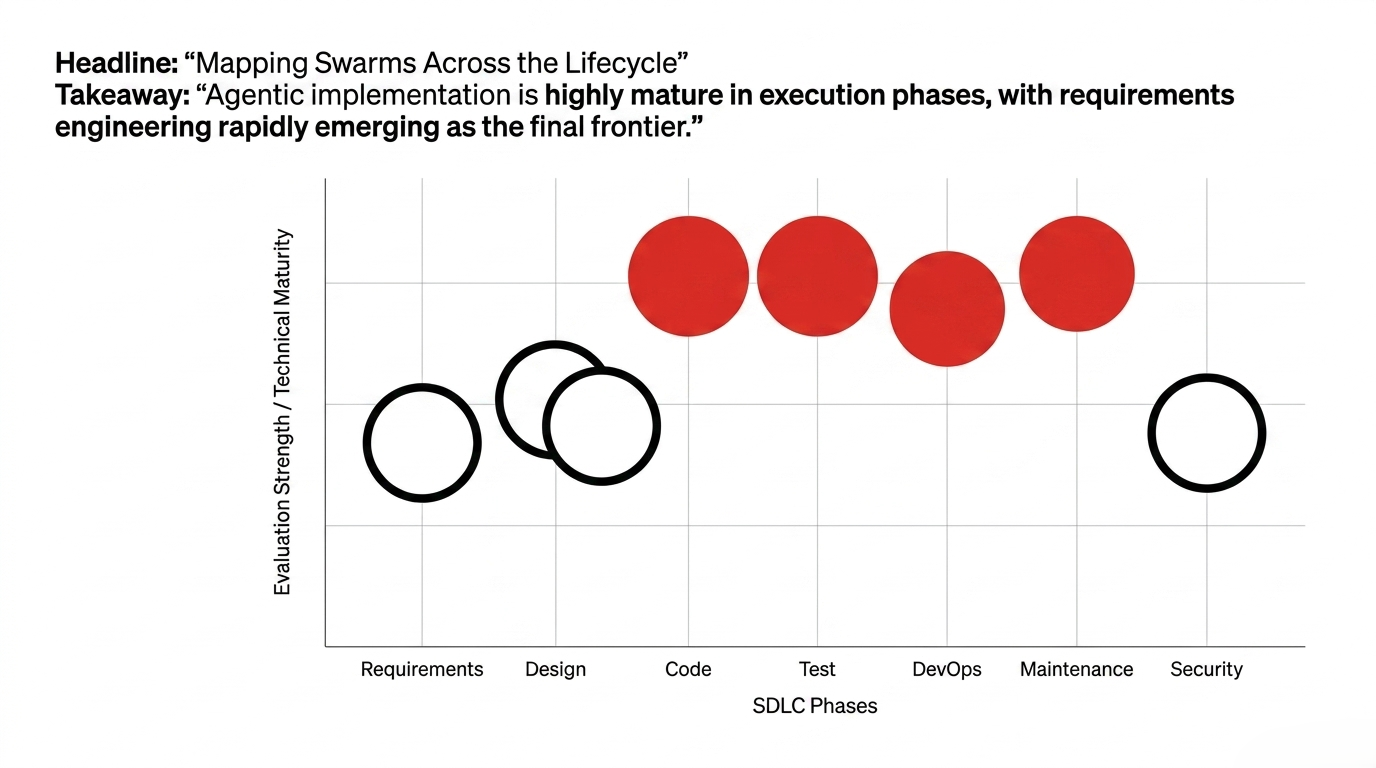
That asymmetry is predictable. Execution tasks often expose machine-readable inputs and outputs: code compiles or fails, tests pass or fail, deployments emit telemetry, and operational systems produce logs. Requirements engineering deals more directly with ambiguous intent, undocumented constraints, conflicting stakeholder goals, and business semantics that are not always encoded in a single artifact.
This suggests a practical rollout strategy: apply stronger autonomy first where the environment provides reliable feedback, then expand into less structured lifecycle stages as evidence quality and governance improve.
5. Match the Orchestration Pattern to Cognitive Load
Not every problem needs a peer-to-peer swarm. Agentic architectures should scale in complexity only when the work requires it.
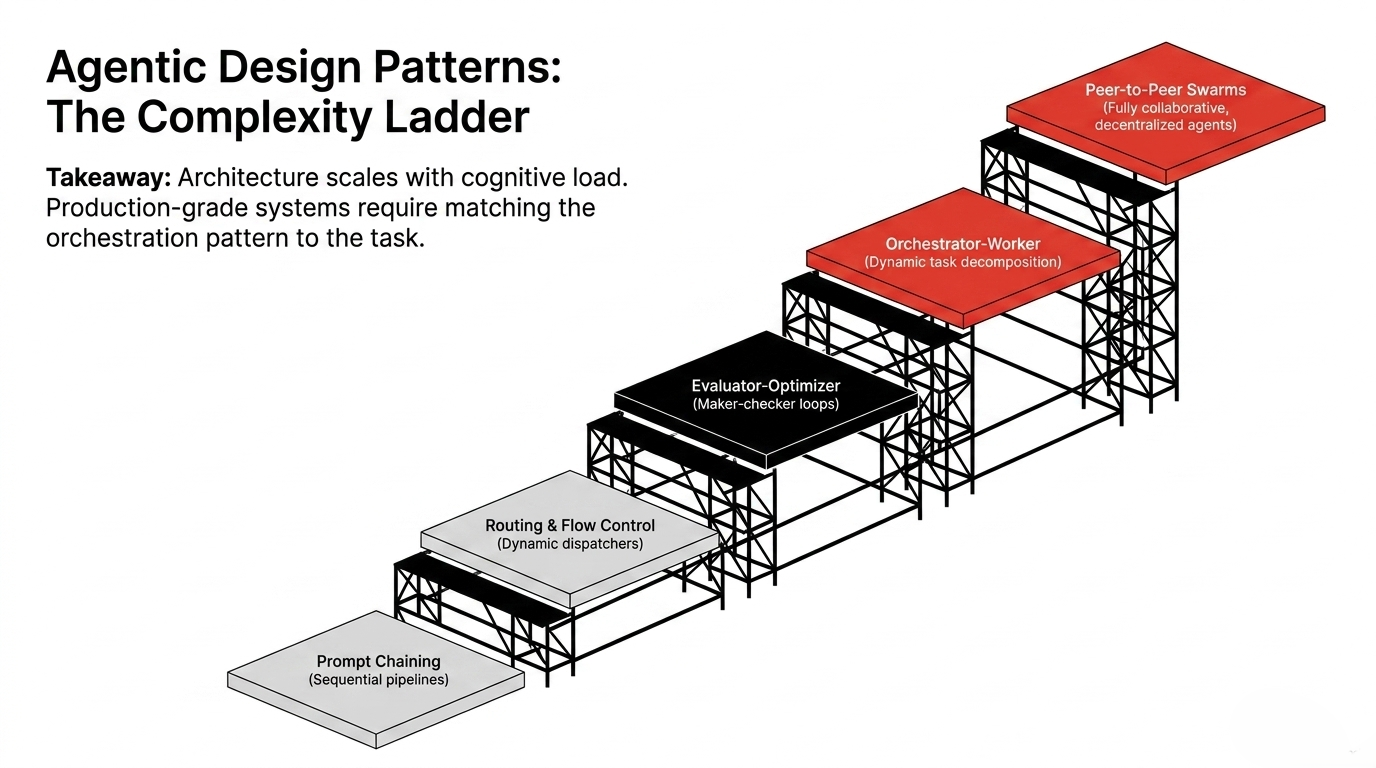
A useful progression is:
- Prompt chaining for deterministic sequential pipelines.
- Routing and flow control when work must be dispatched dynamically.
- Evaluator-optimizer loops when outputs require iterative critique and revision.
- Orchestrator-worker patterns when a manager must decompose work across specialists.
- Peer-to-peer swarms when decentralized collaboration is itself part of the problem-solving strategy.
The engineering principle is to minimize unnecessary coordination. Every additional agent relationship introduces more state, more failure modes, more observability requirements, and more opportunities for contradictory decisions. Complex topologies are justified when they reduce task complexity more than they increase system complexity.
6. Topology Is an Architectural Decision, Not a Style Preference
Topology determines how control, delegation, and accountability flow through the system.
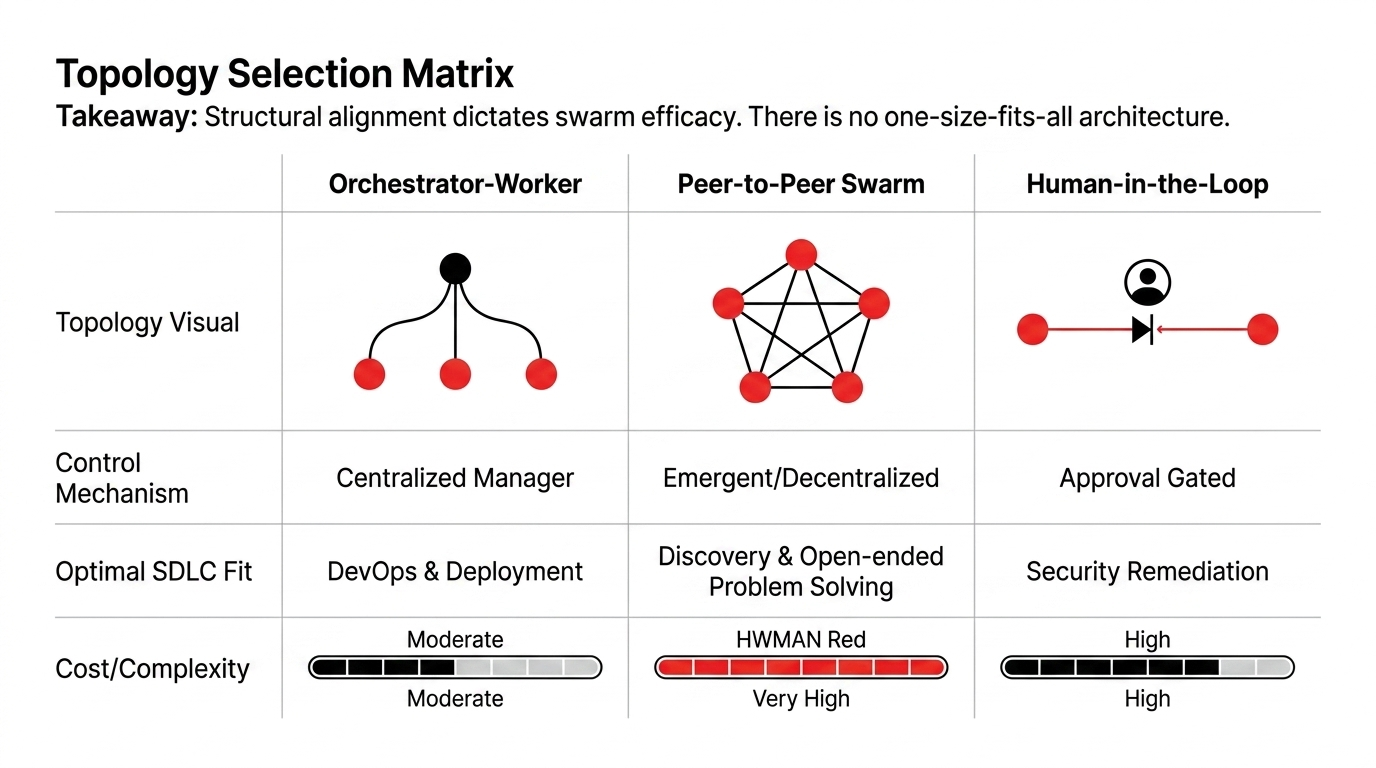
An orchestrator-worker model is well suited to work that benefits from centralized planning and delegated execution, such as deployment or DevOps automation. A peer-to-peer swarm supports exploratory or open-ended work where multiple agents may contribute, challenge, or route among themselves. A human-in-the-loop topology is appropriate when approval must gate consequential actions, especially in security-sensitive remediation.
The choice should be based on the cost of coordination, the reversibility of actions, the availability of objective feedback, and the consequence of being wrong. The correct topology is the one that exposes the right control points for the task.
7. Requirements Archaeology Turns Runtime Evidence Into Specifications
One of the most important enterprise use cases is discovering what an undocumented system actually does.
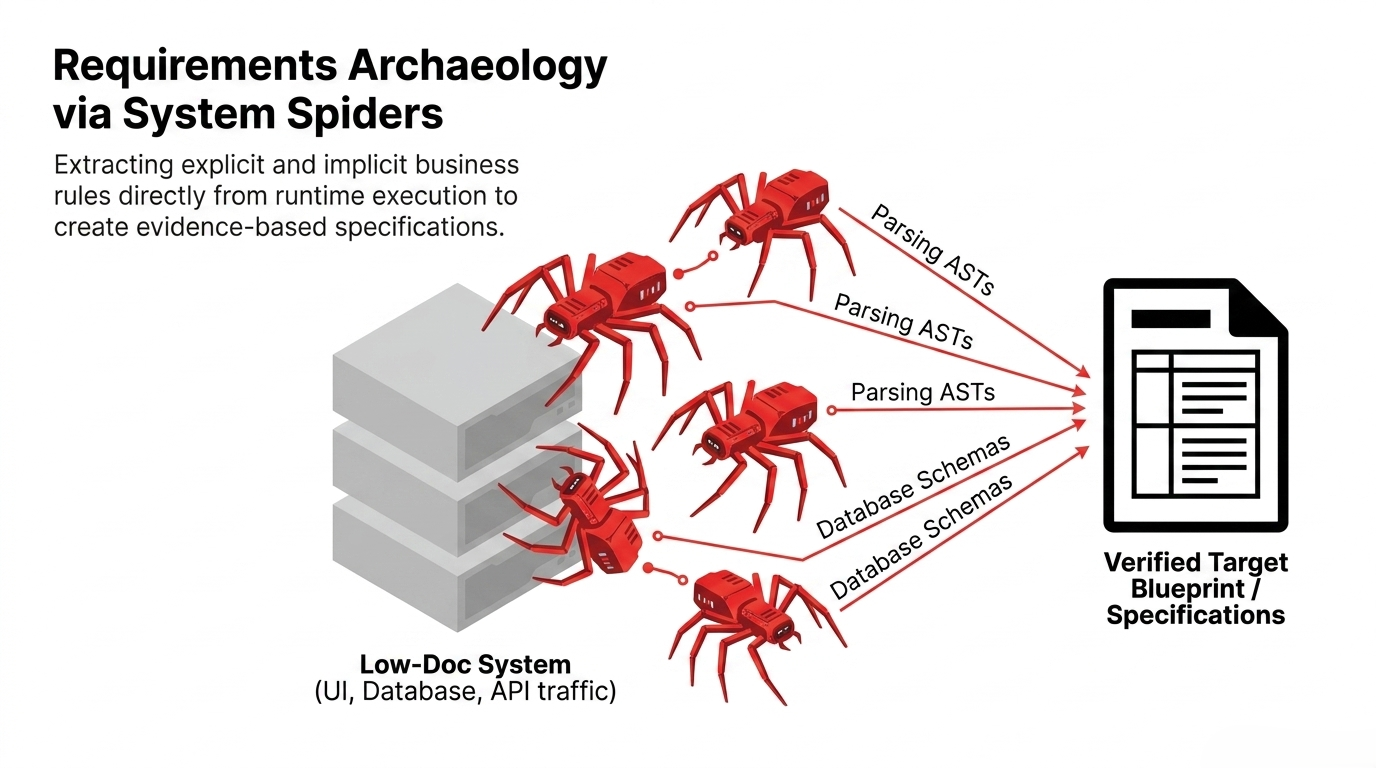
The illustrated "system spiders" represent agents that inspect multiple evidence sources: UI behavior, database schemas, API traffic, and abstract syntax trees. Their role is not to invent requirements. It is to recover candidate business rules and technical constraints from observable system behavior.
A production implementation should preserve provenance for every inferred requirement. A specification derived from a database relationship should be distinguishable from one inferred from an API trace or a code path. Confidence should be attached to evidence, and conflicting signals should trigger review rather than silent consolidation.
This is where agentic systems can reduce the cost of understanding legacy software without pretending that reverse engineering automatically reveals stakeholder intent.
8. Environment-in-the-Loop Validation Makes Autonomy Testable
Autonomous code generation is only useful when generated changes can be exercised against a realistic environment.
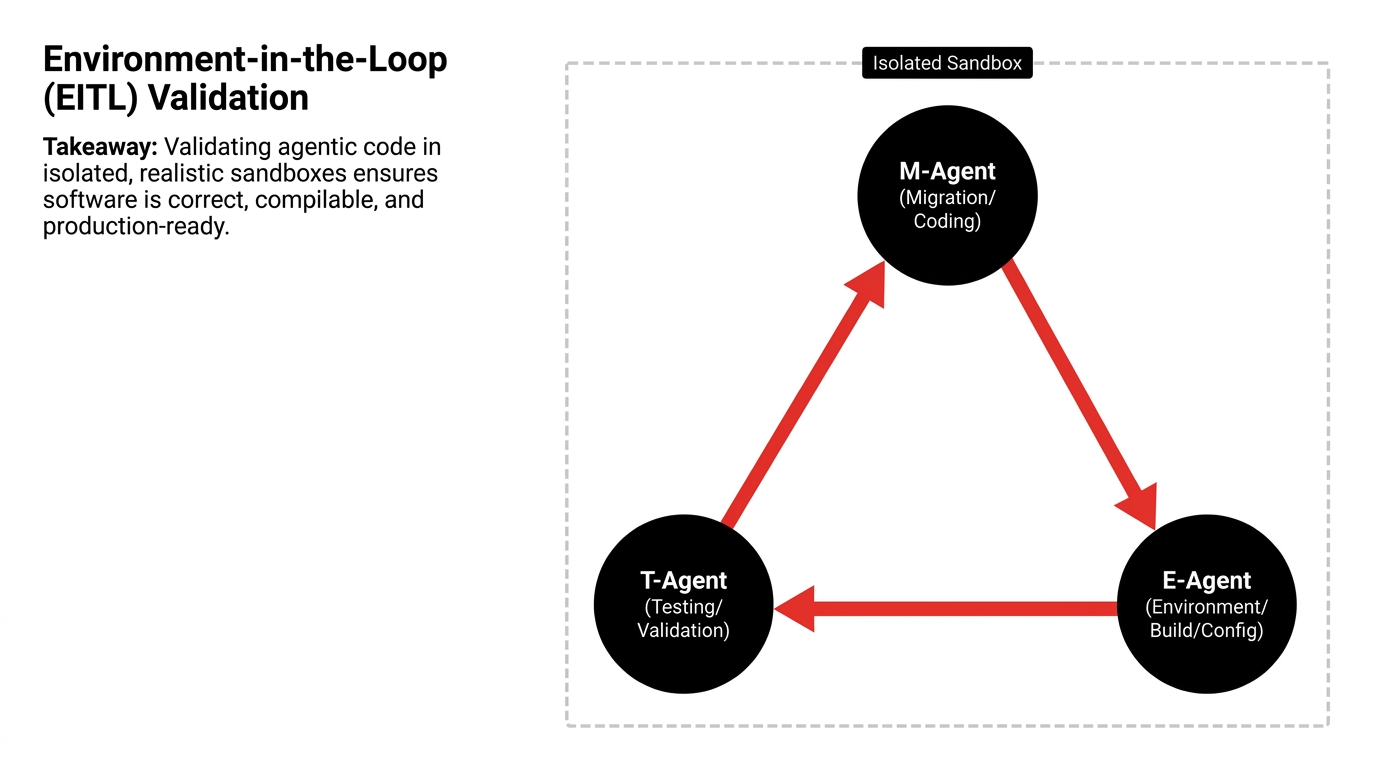
The environment-in-the-loop pattern separates responsibilities among migration or coding, environment construction, and testing or validation agents. These agents operate inside an isolated sandbox so that changes can be compiled, configured, and exercised before they reach production.
The sandbox is not merely a safety wrapper. It is the feedback surface that makes adaptation possible. If an agent can observe build failures, dependency conflicts, configuration errors, test results, and runtime behavior, then it has structured evidence for deciding what to change next.
Production readiness depends on making that evidence deterministic enough to trust. Reproducible environments, fixed test fixtures, versioned dependencies, and explicit exit criteria are therefore core agentic infrastructure.
9. Reflexion Loops Turn Failure Into a Control Signal
Self-healing behavior is a closed-loop process, not a one-time retry.
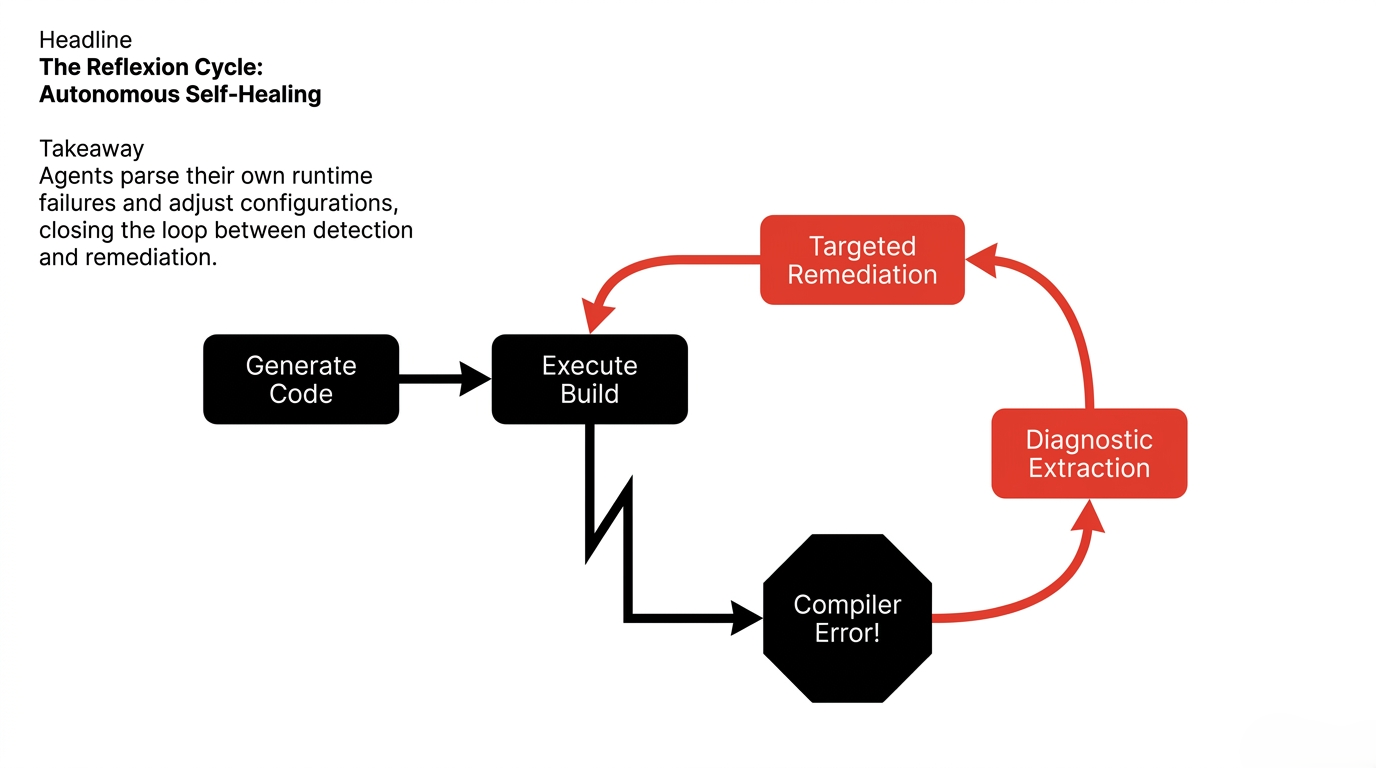
The illustrated cycle begins with code generation and execution. A compiler failure produces diagnostic evidence. That evidence is extracted and transformed into targeted remediation, which feeds the next build attempt.
The important design choice is to make failure legible. Agents should not merely receive raw error streams and guess. Diagnostic extraction can normalize logs, isolate the relevant failure, identify likely ownership, and provide structured context for remediation.
Guardrails are equally important. Retry budgets, change scopes, rollback points, and escalation thresholds prevent a reflexion loop from becoming an uncontrolled mutation loop.
10. Interoperability Requires a Layered Agentic Stack
Enterprise agent systems need more than models. They need a stack that separates infrastructure, model capability, protocol interoperability, and orchestration.
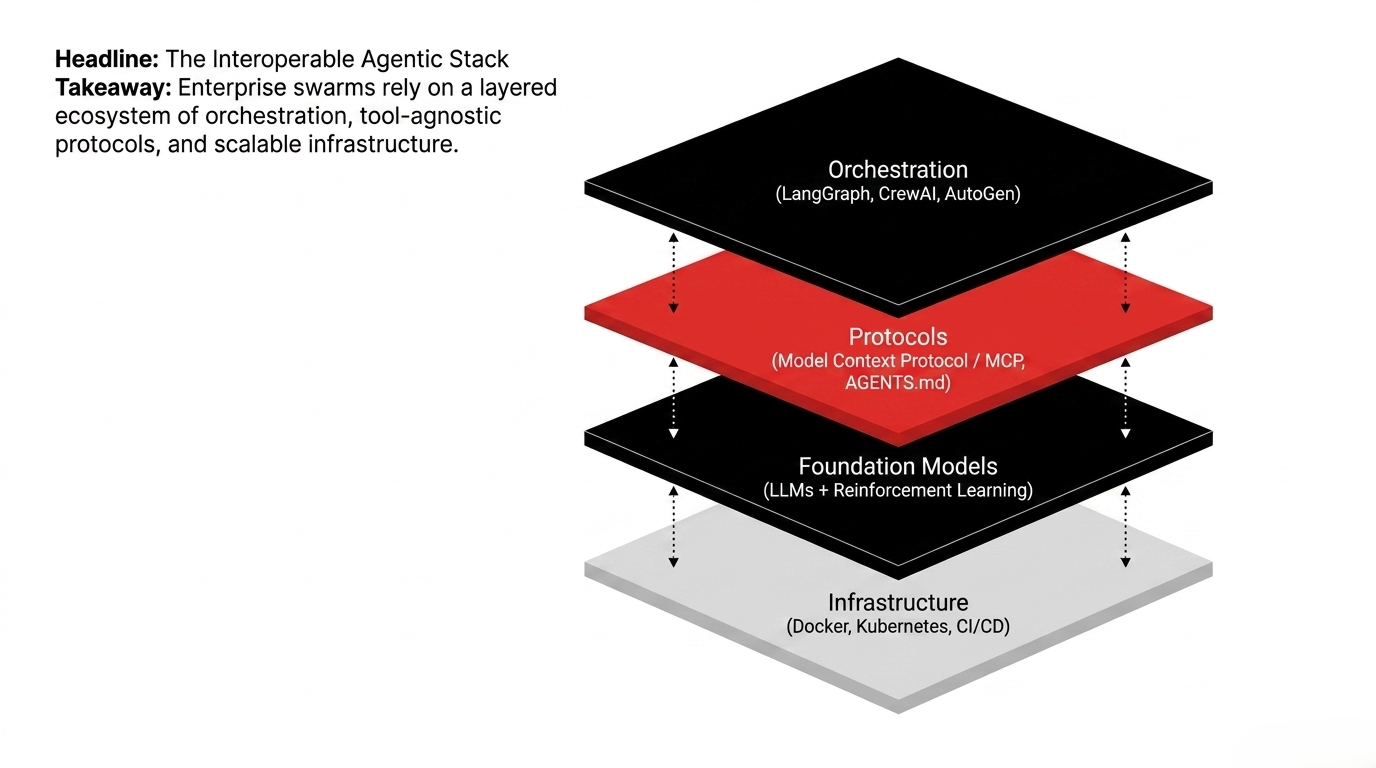
At the base, containerization, cluster management, and CI/CD provide the execution substrate. Foundation models supply reasoning and generation capabilities. Protocols such as Model Context Protocol (MCP) and agent-oriented instruction conventions provide standardized interfaces for tools, context, and collaboration. Orchestration frameworks coordinate agent state, task flow, and control logic.
Layering matters because it reduces coupling. If tools are exposed through stable protocols, the orchestration layer does not need bespoke integration logic for every system. If the model layer is replaceable, teams can evolve model choices without redesigning the entire runtime.
The goal is not abstraction for its own sake. It is to preserve the ability to change one layer without destabilizing the rest of the agentic system.
11. Quantification Requires Reproducible Baselines
The source deck reports substantial gains across invalid-test reduction, vulnerability discovery recall, SDLC lead time, and planning efficiency.
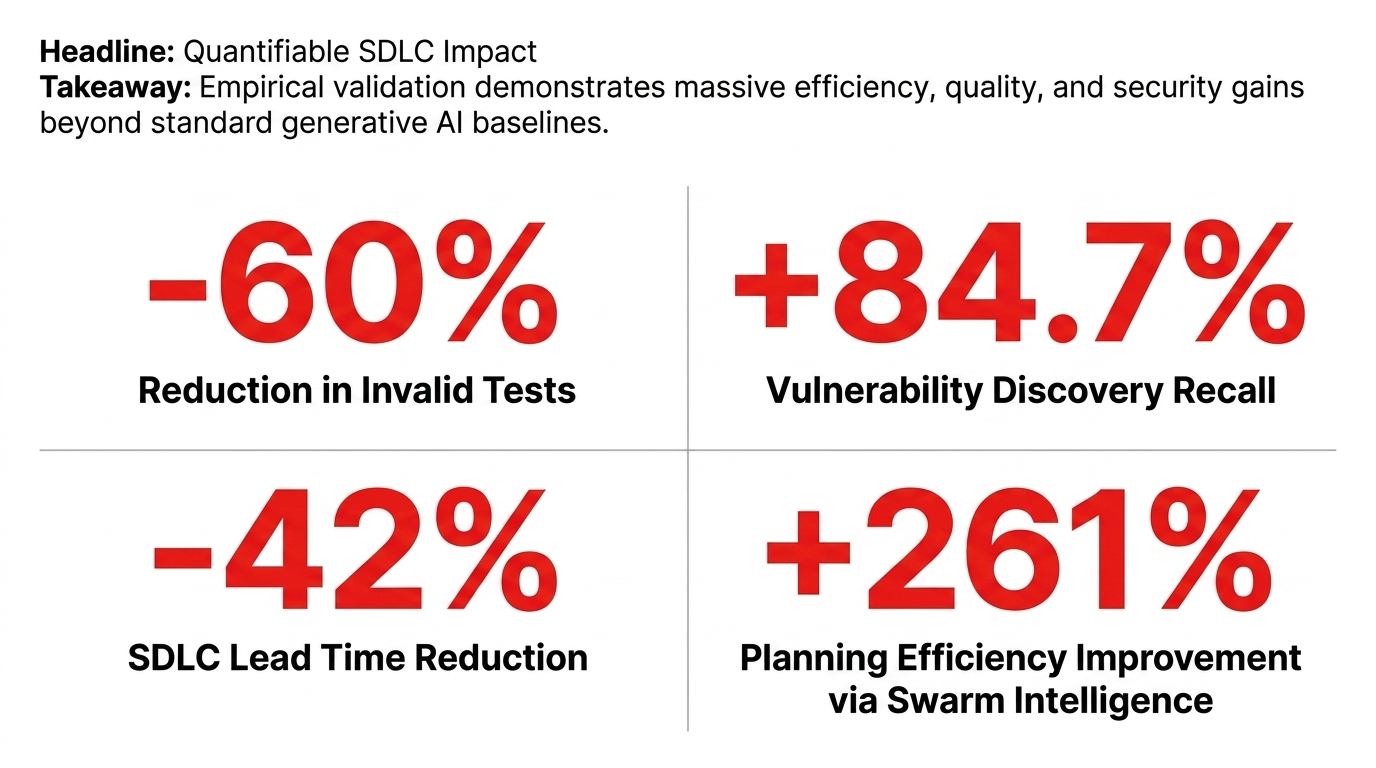
These figures are useful as examples of the categories that matter, but a production engineering program should treat such numbers as hypotheses to reproduce within its own environment. The slide does not provide the underlying datasets, baselines, sample sizes, evaluation protocols, or confidence intervals needed to independently validate the percentages.
A rigorous measurement plan should define:
- the baseline workflow being compared;
- the exact unit of analysis;
- acceptance and rejection criteria;
- how human review effort is counted;
- whether retries and failed agent actions are included;
- how security findings are verified;
- and whether improvements persist across repositories and teams.
Agentic systems should be evaluated as systems, not only as model outputs. End-to-end measures such as lead time, escaped defects, review burden, rollback frequency, and cost per accepted change are often more useful than isolated generation benchmarks.
12. Sociotechnical Risk Grows With Autonomy
Greater autonomy introduces engineering risks that are not purely technical.
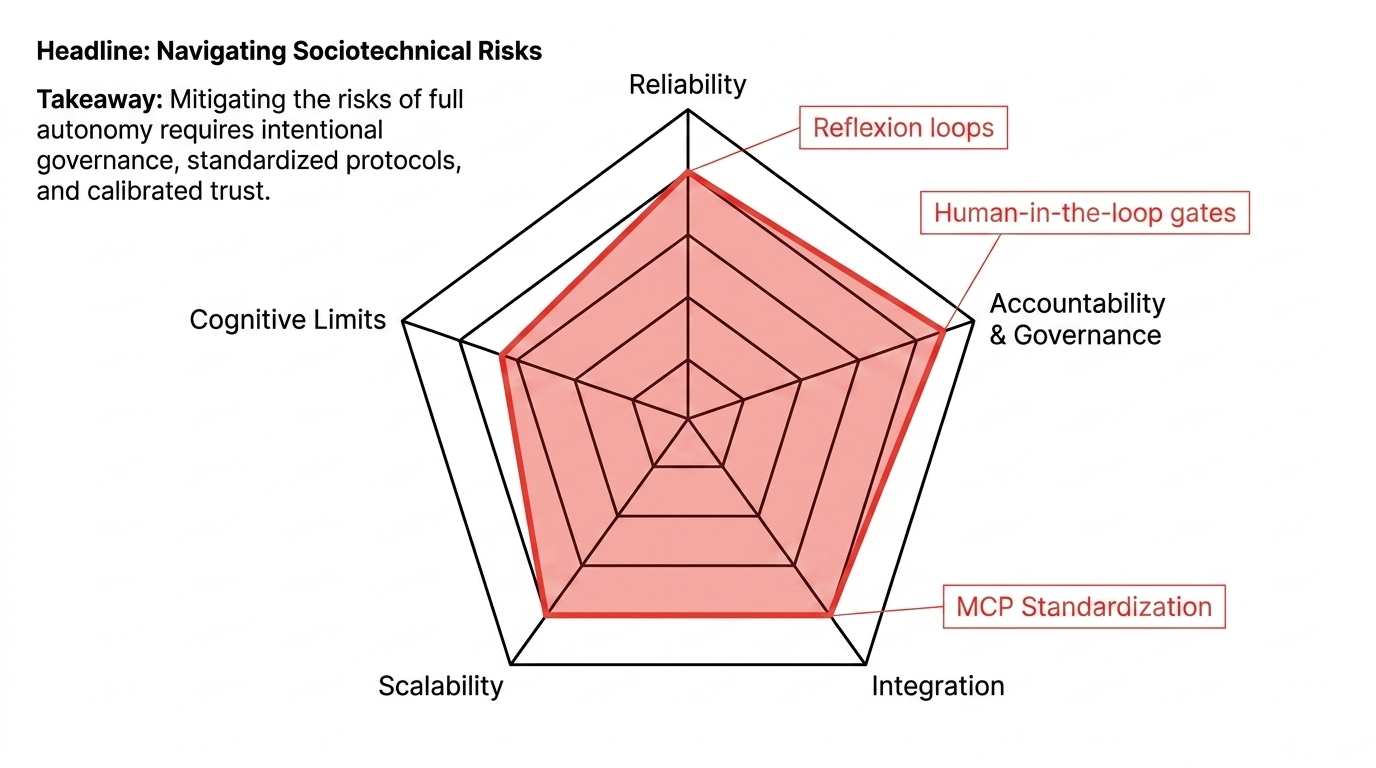
The risk profile spans reliability, accountability and governance, integration, scalability, and cognitive limits. The slide highlights three mechanisms that help contain those risks: reflexion loops, human-in-the-loop gates, and MCP standardization.
These controls address different failure classes. Reflexion improves local recovery from execution failures. Human gates constrain high-consequence decisions. Protocol standardization limits integration sprawl and makes tool boundaries more explicit.
Calibrated trust is the connecting idea. Teams should grant autonomy according to observed reliability and reversibility, not according to a generalized belief that more automation is always better.
13. The Fully Adaptive SDLC Is a Continuous Control Loop
A mature agentic lifecycle is better represented as an adaptive loop than as a sequence of disconnected phases.
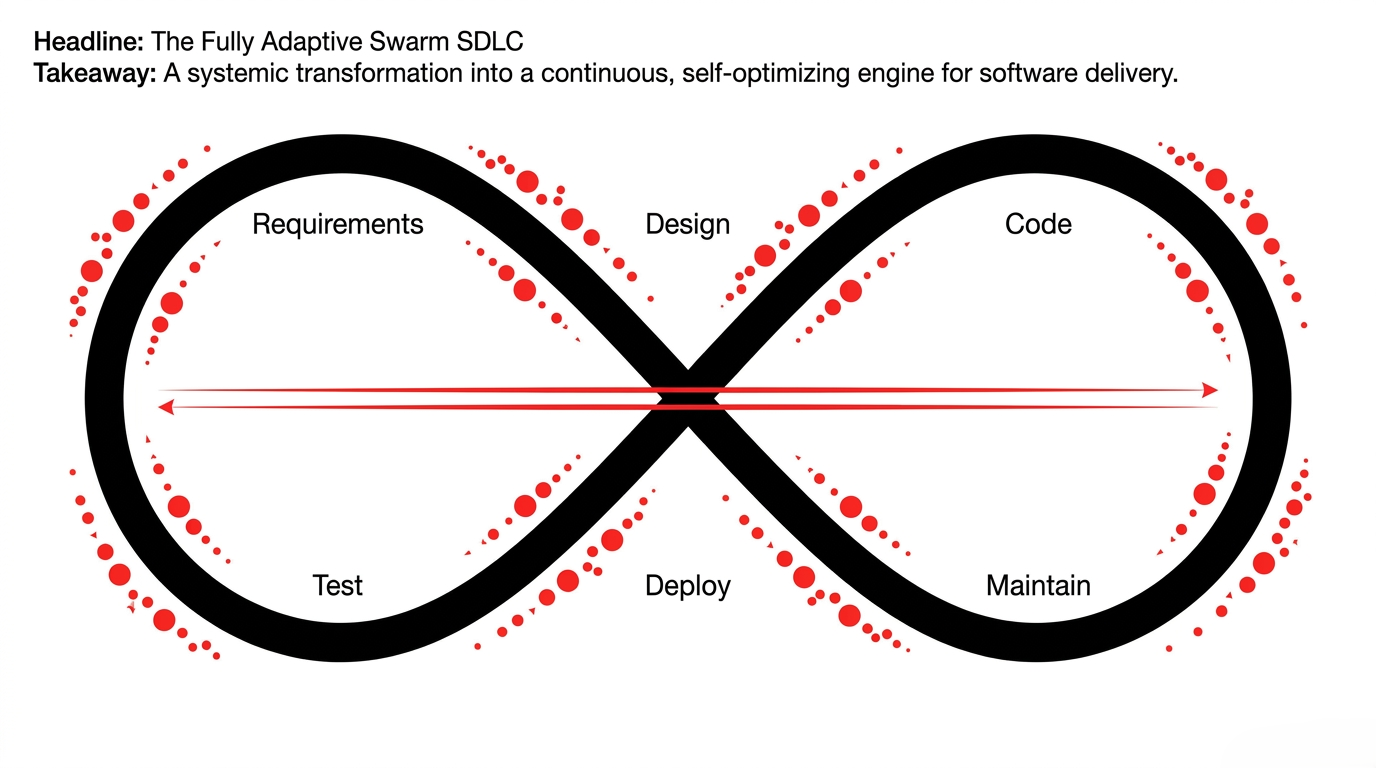
Requirements, design, code, test, deploy, and maintain are continuously coupled through feedback. Observations from production can reshape maintenance priorities, test failures can alter implementation, and newly recovered requirements can revise design assumptions.
This does not eliminate lifecycle discipline. It makes transitions more fluid while increasing the need for state management. Every agent must know what version of the goal, system state, evidence, and policy it is acting against.
The defining property is not speed alone. It is the ability to continuously sense, decide, act, verify, and correct while preserving traceability.
14. The Engineer Becomes the Systems Architect
As execution becomes distributed across many specialized agents, the human role moves upward in abstraction.
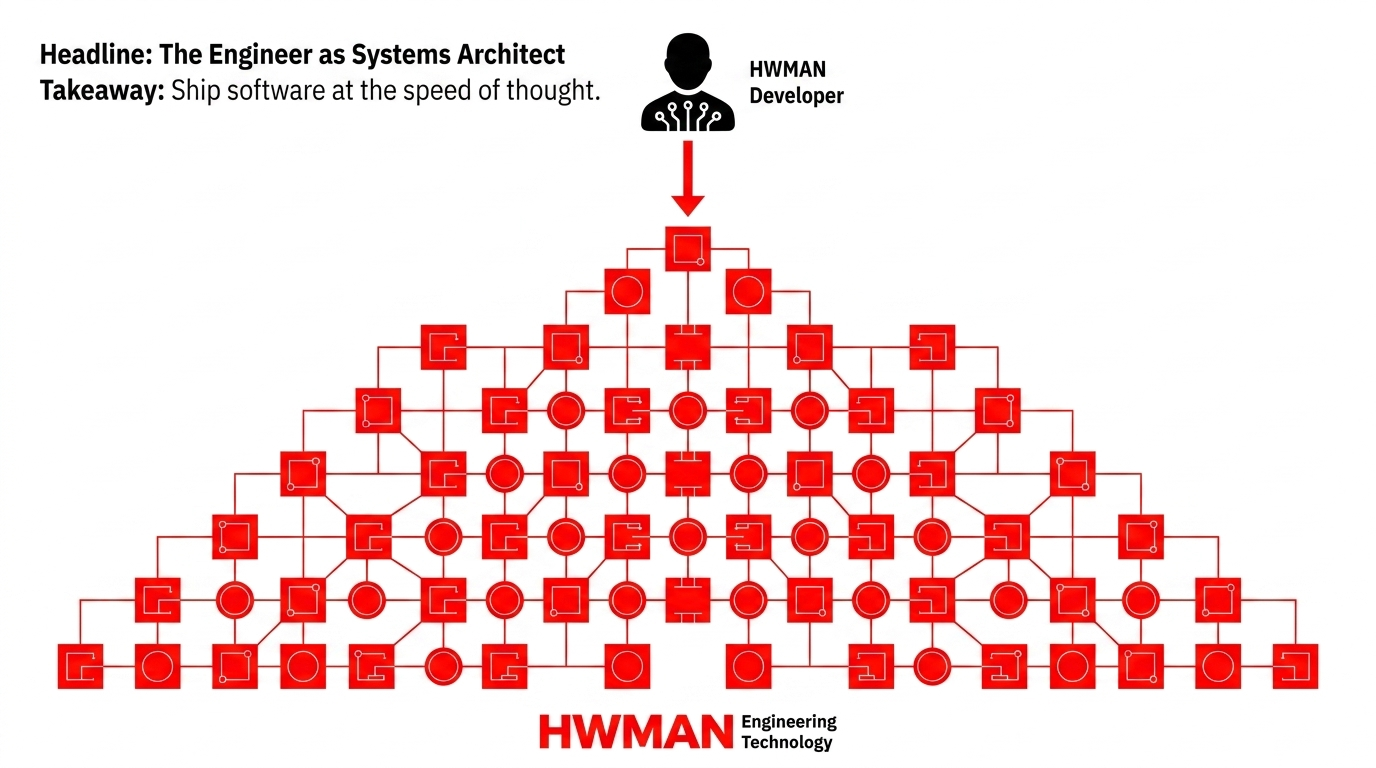
The engineer defines the operating model: agent responsibilities, orchestration boundaries, tools, data access, validation criteria, escalation rules, governance, and observability. Instead of manually executing every task, the engineer designs the system that can execute tasks safely and repeatedly.
That role still requires deep technical judgment. In fact, autonomy increases the value of architecture because local automation can amplify both good and bad system design. A swarm with weak boundaries can produce complexity faster than a human team can review it.
The objective is therefore not to remove engineering judgment. It is to apply that judgment at the level where it has the most leverage.
Engineering Principles
The architecture ultimately depends on several principles:
-
Use the simplest topology that fits the work
Coordination overhead is real. Add agents only when specialization, parallelism, or feedback justifies the extra system complexity. -
Make feedback executable
Logs, compiler failures, tests, traces, policy checks, and runtime telemetry should be structured so agents can act on them deterministically. -
Preserve evidence and provenance
Requirements, decisions, and remediations should be traceable to the artifacts and runtime observations that produced them. -
Gate irreversible or high-consequence actions
Human approval and policy controls belong at points where errors are costly, difficult to reverse, or subject to regulatory accountability. -
Standardize interfaces before scaling autonomy
Protocols, tool schemas, identity, authorization, and observability need stable boundaries so that agent count can grow without creating integration chaos.
Final Synthesis
Adaptive agentic engineering is best understood as a control architecture for software delivery. Requirements discovery supplies evidence. Goal decomposition converts intent into executable work. Orchestration assigns that work across specialized agents. Sandboxed environments provide realistic feedback. Reflexion loops turn failures into remediation. Protocol layers keep tools interoperable. Human gates and governance constrain risk.
The final shape is a software delivery system that can become more autonomous because it is also more observable and more explicitly controlled.
The production-ready system combines:
- A deterministic foundation built on versioned infrastructure, reproducible environments, and explicit interfaces.
- A testing layer that continuously evaluates behavior against executable evidence.
- An agent layer that decomposes goals, coordinates specialists, and adapts using closed feedback loops.
- Security and governance that enforce authorization, approvals, provenance, and escalation boundaries.
- An observability layer that records actions, decisions, outcomes, retries, and human interventions.
- A production outcome in which autonomy can scale without sacrificing accountability.
Closing Thought
The most important shift is not from humans to agents. It is from manually operated workflows to deliberately engineered adaptive systems.
The faster software can act on its own, the more carefully we must architect the system that tells it when to stop, verify, and ask for help.