
Autonomous Agentic Swarms in the SDLC
Modern test automation often fails for reasons that have little to do with the business behavior being tested. A locator changes. A UI hierarchy shifts. An undocumented dependency appears only at runtime. A test that once encoded useful intent becomes a maintenance task whose cost grows faster than the product it protects.
The architecture in this article reframes quality assurance as a distributed agentic system rather than a collection of static scripts. An LLM-centered orchestration layer interprets intent and decomposes work, specialized workers discover runtime behavior and maintain execution details, and deterministic tools such as Playwright and Appium remain responsible for interacting with real applications.
The central idea is not to replace testing with language models. It is to separate reasoning from execution, make discovery continuous, and close the loop between failure, repair, validation, and traceability.
1. The Friction Point in Conventional Automation
Traditional QA pipelines accumulate friction in three places: semantics, execution, and maintenance. Business requirements are written in one vocabulary, application behavior is expressed in another, and test code becomes the translation layer between them.
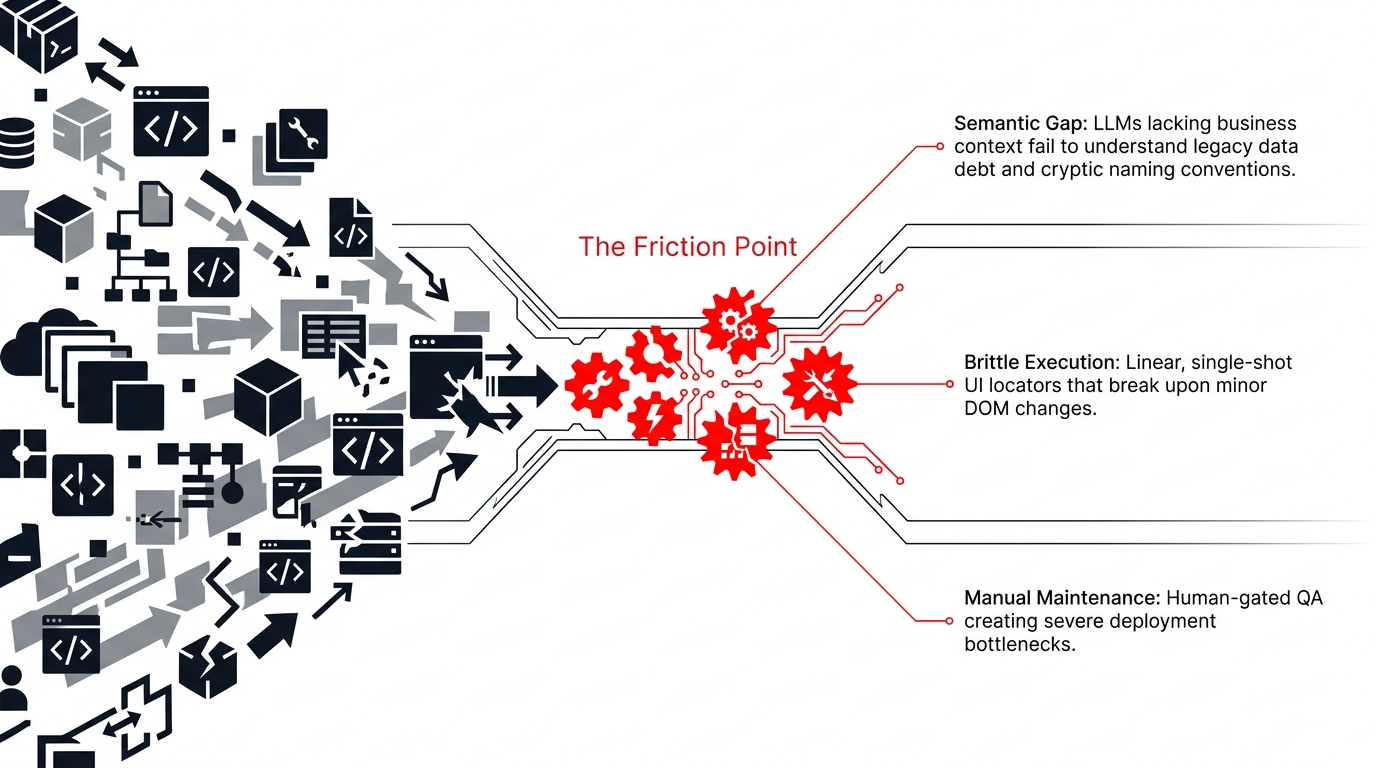
The first failure mode is the semantic gap. A model or test generator that sees only code, DOM fragments, or isolated tickets can miss the business context required to decide what behavior matters. Legacy data contracts, naming conventions, and undocumented workflow assumptions amplify the problem.
The second is brittle execution. Single-shot selectors and linear scripts encode a snapshot of the interface rather than a durable description of intent. Minor DOM changes can therefore invalidate tests even when the user-visible behavior remains correct.
The third is manual maintenance. When every failed locator or environmental mismatch requires a human to diagnose and patch the test, QA becomes a release bottleneck. The more automation exists, the more maintenance work can paradoxically accumulate.
A useful agentic design attacks all three problems separately instead of asking one model to solve them in a single pass.
2. From Assistive Coding to Agentic Software Engineering
The presentation positions agentic QA as part of a broader evolution in software engineering: from manual execution, to assistive copilots, to multi-agent systems that can pursue goals, adapt to changing conditions, and decompose work.
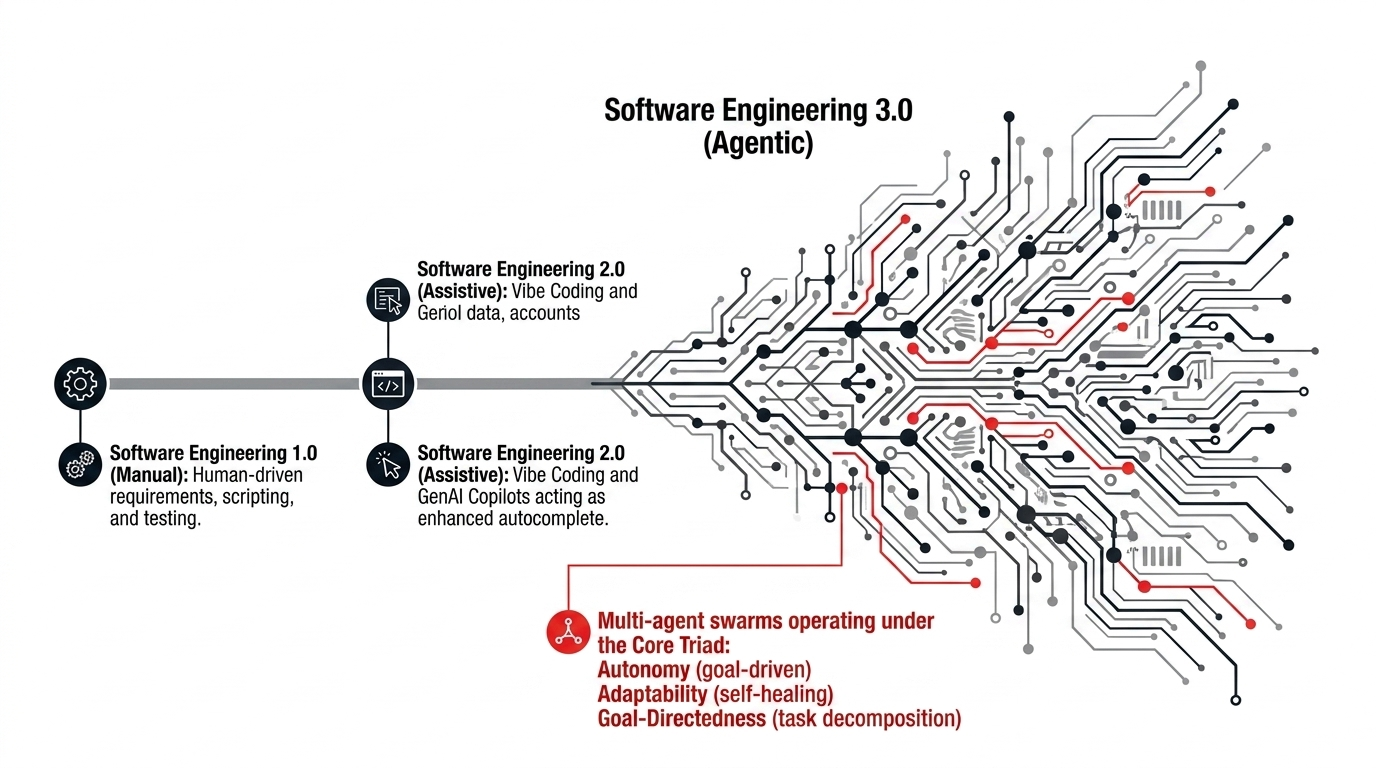
In an assistive workflow, a model waits for a prompt and produces an artifact: code, a test, a query, or a suggestion. In an agentic workflow, the system owns a bounded objective and coordinates multiple steps needed to complete it.
Three properties matter:
- Autonomy: an agent can progress toward a goal without requiring a human prompt at every step.
- Adaptability: the system can react to runtime evidence, including failed selectors, dependency changes, or incomplete assumptions.
- Goal-directedness: the task can be decomposed into specialist responsibilities rather than solved as one monolithic generation request.
The engineering implication is significant: the unit of design is no longer a prompt. It is a closed-loop workflow with state, tools, policies, and validation.
3. A Swarm Architecture for QA
The core architecture uses a central orchestrator surrounded by specialist agents and a deterministic execution layer.
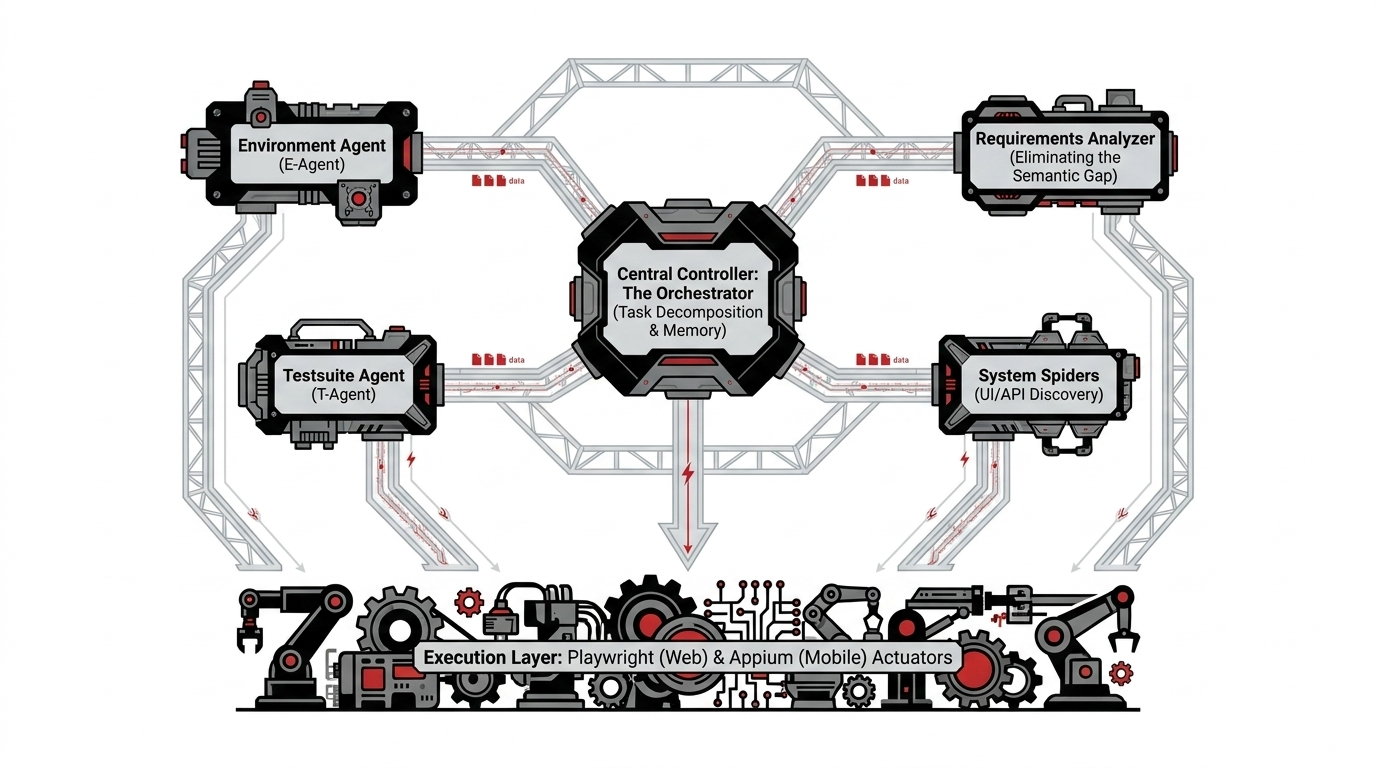
The central controller acts as the orchestration plane. It decomposes tasks, maintains memory, assigns work, and reconciles outputs. Around it are specialized roles:
- A Requirements Analyzer translates business intent into testable semantics and narrows the semantic gap.
- System Spiders inspect the live UI and APIs to discover what the application actually exposes.
- A Testsuite Agent turns test intent into executable scenarios and maintains the suite as the system changes.
- An Environment Agent provisions and validates the runtime context in which tests execute.
At the bottom, Playwright and Appium are the actuators. They are deliberately deterministic: reasoning may be probabilistic, but clicking a control, invoking an endpoint, capturing a trace, or reading a native XML hierarchy should be performed by tools with explicit runtime behavior.
This separation creates a practical boundary. Agents decide what should happen and how to recover; automation frameworks perform what can be deterministically executed and observed.
4. The Orchestrator and the Operatives
Not every agent in the system needs the same model class. The presentation distinguishes high-reasoning orchestrators from low-latency specialist operatives.
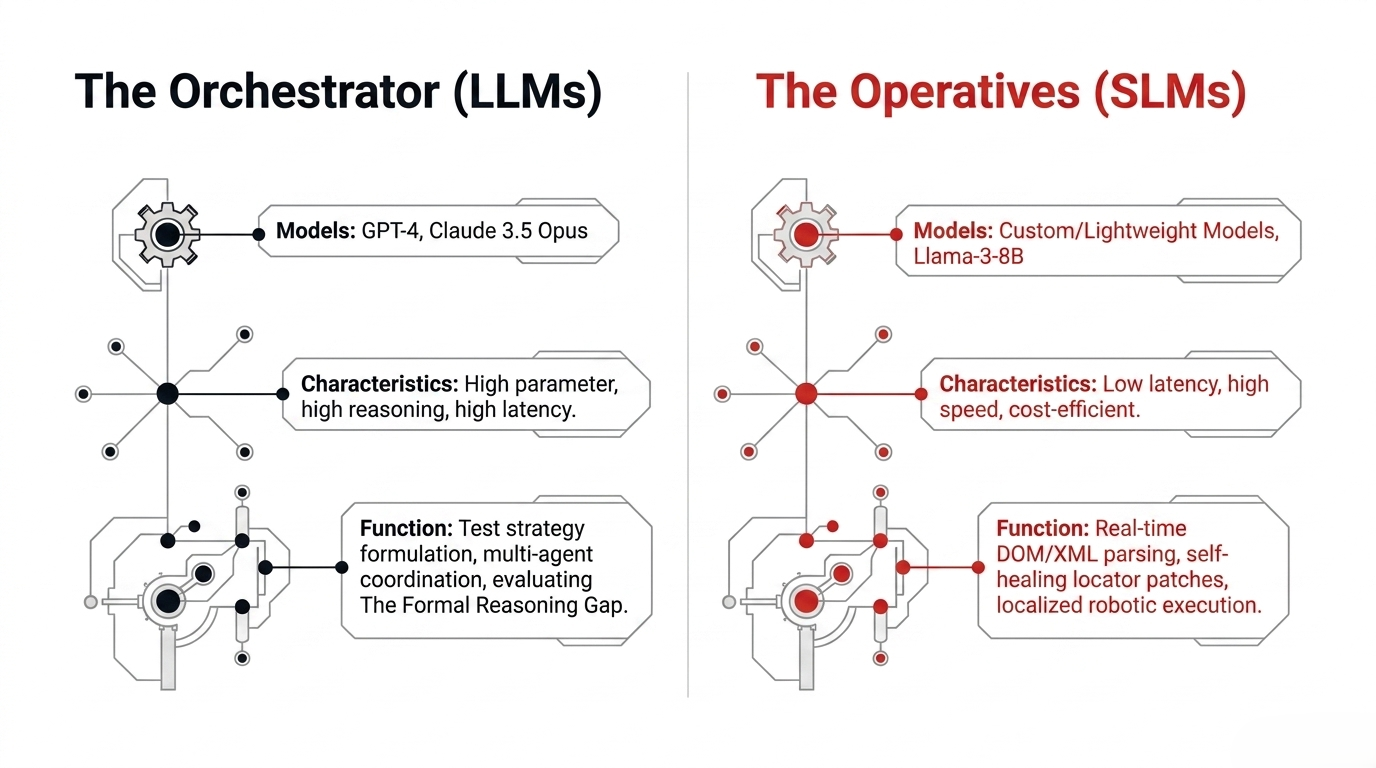
The orchestrator is suited to work that benefits from broader context: test strategy, decomposition, cross-agent coordination, and evaluation of ambiguous requirements. Those tasks are expensive but relatively infrequent.
The operative layer is optimized for narrower jobs such as DOM or XML parsing, localized repair, or high-frequency robotic execution. These jobs benefit more from predictable latency and constrained scope than from maximum general reasoning capability.
This split is important because a production swarm should not treat every token or decision as equally valuable. A common design principle is to place expensive reasoning at decision boundaries and use smaller, faster workers for repetitive, tool-constrained loops.
It also creates a stronger safety model. Narrow workers can receive smaller context windows, fewer permissions, and explicit tool scopes, reducing the blast radius of an incorrect decision.
5. Agent Frameworks Are Complementary Building Blocks
The architecture diagram compares CrewAI, BeeAI, and LangGraph as overlapping but differently emphasized orchestration approaches.
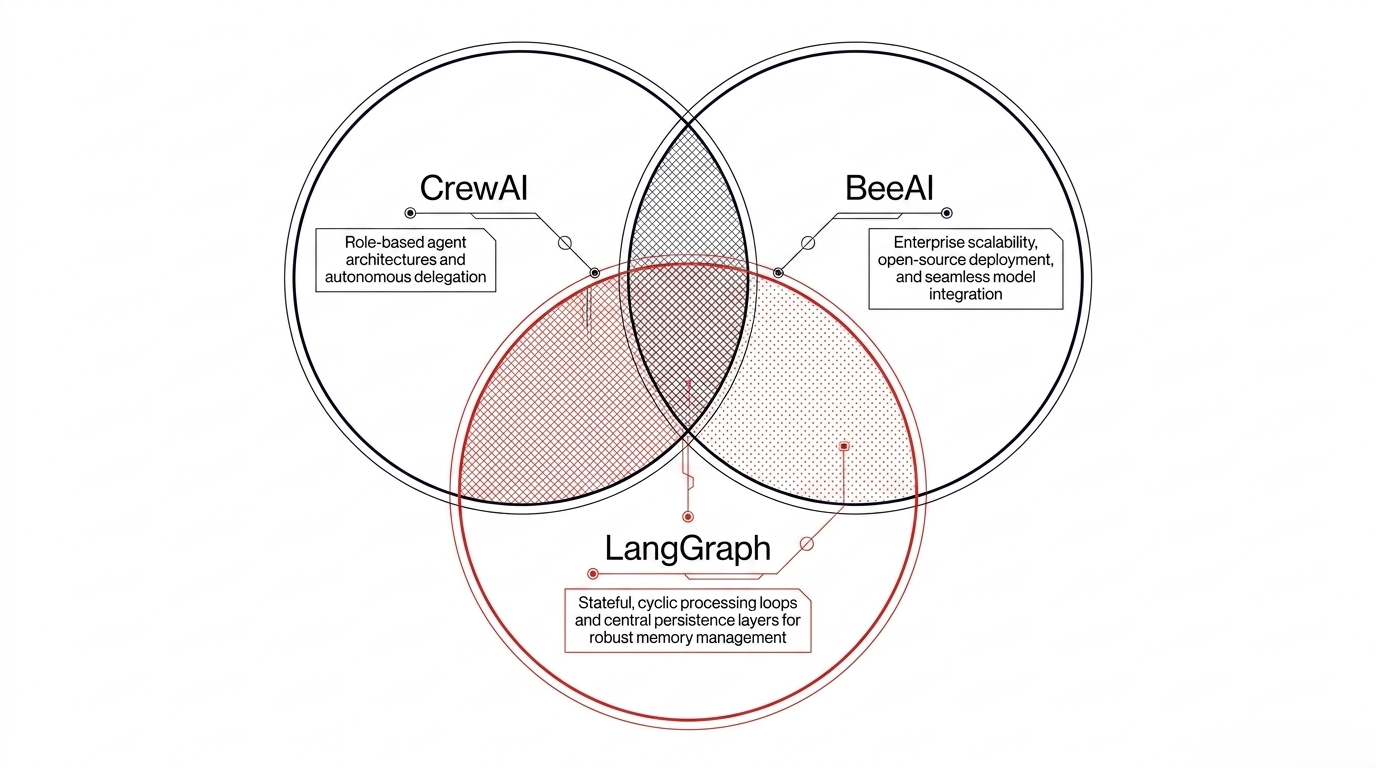
The presentation associates CrewAI with role-based delegation, BeeAI with enterprise deployment and model integration, and LangGraph with stateful cyclic processing and persistence.
The larger engineering point is not that one framework eliminates the others. It is that agent systems need several distinct capabilities:
- Role and task modeling so specialists receive bounded responsibilities.
- State and memory so the workflow survives multi-step execution and retries.
- Graph or loop control so failure can route back into diagnosis, repair, and revalidation.
- Deployment discipline so tools, credentials, policies, and model choices can be managed in production.
Framework choice should follow these needs. The critical design artifact is the workflow graph and its state model, not the brand of orchestration library around it.
6. Runtime Discovery Closes the Semantic and Structural Gaps
Static test generation is weakest when the system under test is poorly documented or changes faster than the tests. The System Spider concept addresses this by making discovery an active part of QA.
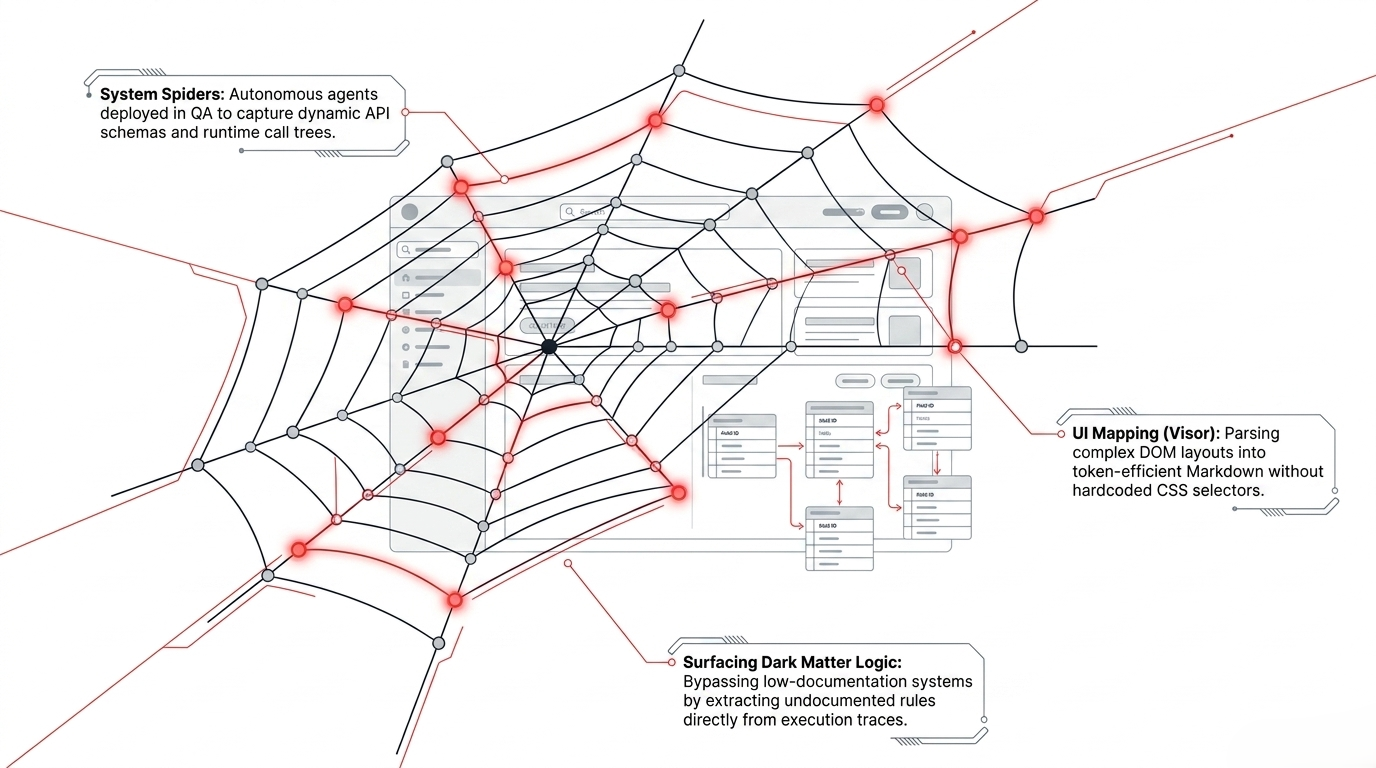
The spiders inspect runtime behavior to capture API schemas, call trees, DOM structures, and execution traces. That evidence becomes a shared source of truth for downstream agents.
For web interfaces, a semantic mapping layer can interpret the DOM in terms of meaningful elements rather than hardcoded CSS paths. For APIs, runtime traces reveal dependencies and data flow that may be absent from specifications. In legacy systems, execution evidence can expose "dark matter" logic: behavior that exists in production but is not represented cleanly in documentation.
This discovery loop reduces the distance between what the requirement says, what the code implies, and what the system actually does.
It also creates an observability obligation. Discovery artifacts should be versioned or at least correlated with test runs so that an engineer can explain why a locator, route, or repair was chosen at a specific point in time.
7. Deterministic Actuation Across Web and Mobile
Once strategy and intent are established, execution must remain concrete. The architecture maps shared business logic into platform-specific interaction models.
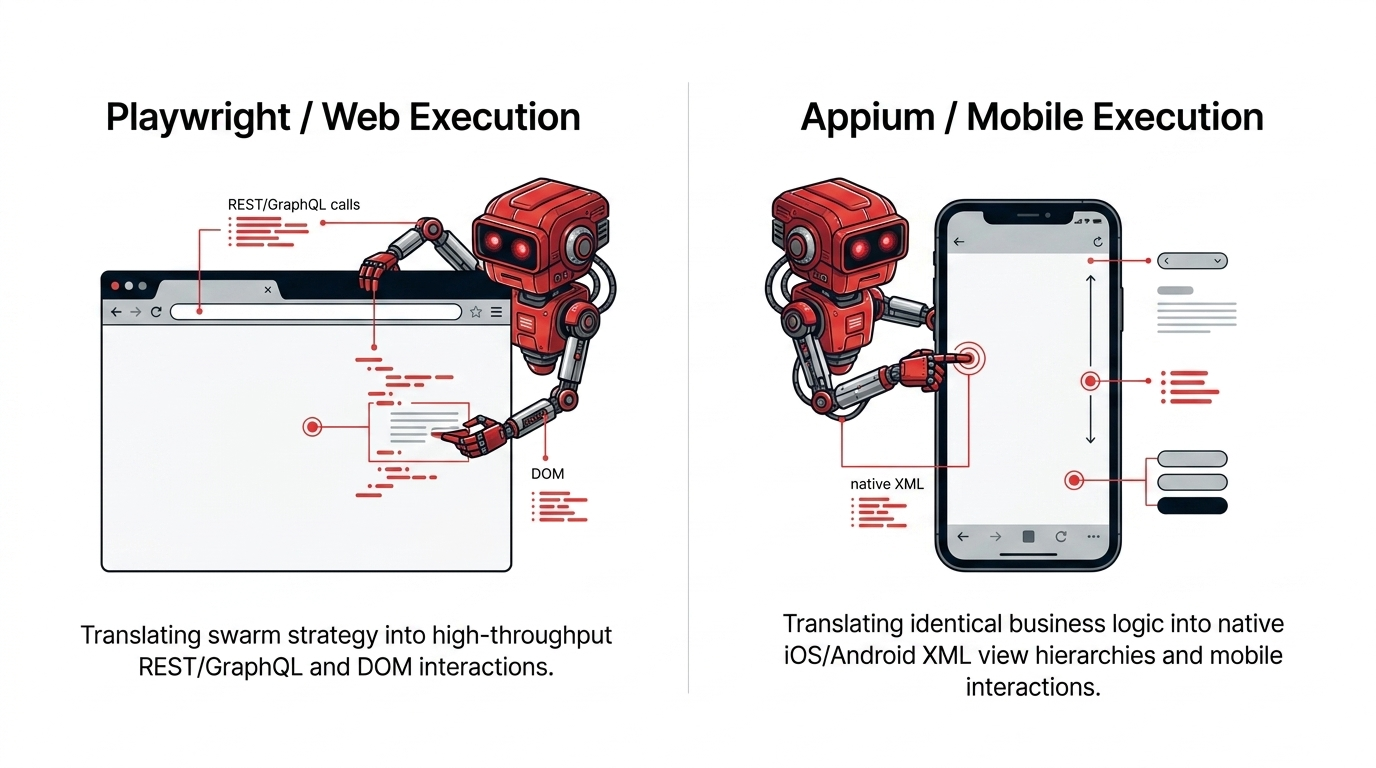
On the web side, Playwright can combine browser interactions with REST or GraphQL calls and direct inspection of the DOM. On mobile, Appium works against native iOS or Android view hierarchies represented through platform XML structures.
The important abstraction is the business action, not the selector technology. "Authenticate a user," "submit an order," or "confirm an approval" can remain stable even when the underlying browser DOM and mobile accessibility trees are different.
A robust swarm therefore keeps business intent in one layer and platform adapters in another. That makes it possible for the orchestrator to reuse test strategy while specialized workers translate the same intent into the correct web or mobile actuator calls.
8. Self-Healing Must Be a Validated Loop
Self-healing testing is useful only when repair is constrained by evidence. The presentation illustrates a five-stage reflex loop: application change, test failure, failure analysis, locator repair, and re-execution.
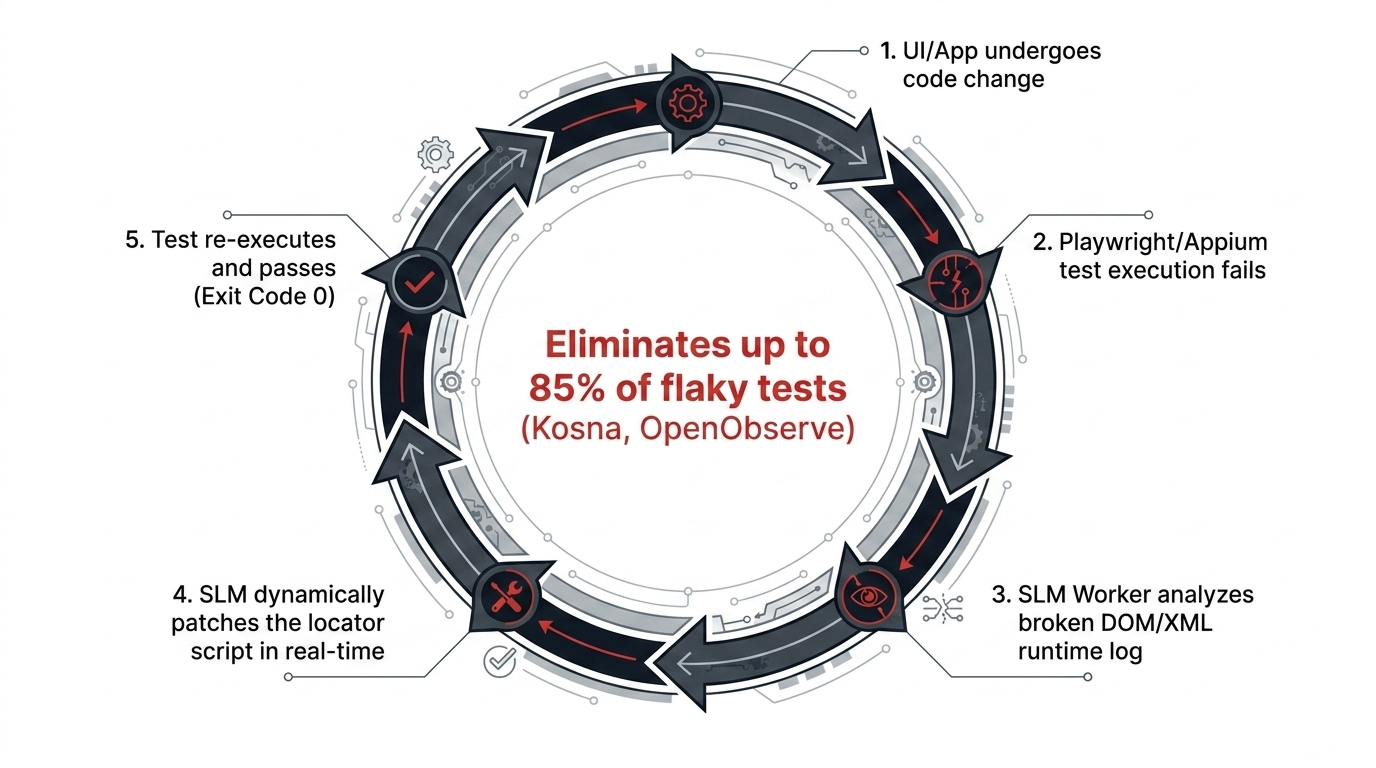
A safe repair loop should behave like a hypothesis test:
- The application changes and a previously valid test fails.
- The worker captures runtime evidence such as DOM/XML state, trace data, and the failure location.
- A specialist proposes a minimal patch.
- The patched test is rerun against the same intended behavior.
- The repair is accepted only if validation passes and no policy boundary is violated.
The source slide associates this pattern with a substantial reduction in flaky tests. That figure should be treated as a presentation claim, not as a universal outcome. In practice, the value of self-healing depends on how often failures are caused by representational drift rather than genuine product defects.
The failure mode to avoid is silent adaptation. If a test changes itself merely to become green, it can erase evidence of a real regression. Every repair therefore needs an audit trail and a clear distinction between locator drift and behavioral change.
9. Environment-in-the-Loop Validation
Agent-generated tests are only meaningful if they execute in realistic environments. The Environment Agent introduces isolation and runtime validation into the loop.
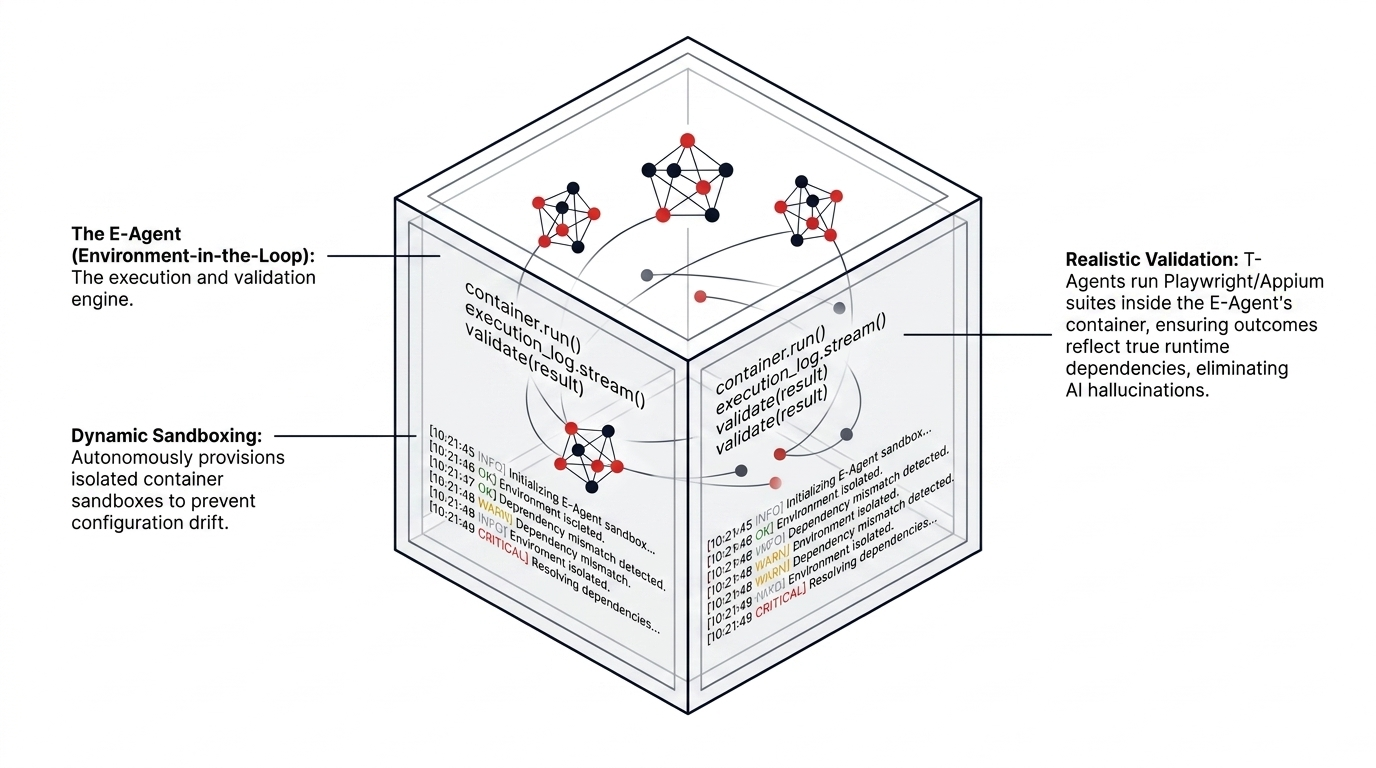
The pattern shown here provisions isolated container sandboxes, runs Playwright or Appium suites inside them, captures execution logs, and validates the result against the actual runtime.
This serves several purposes:
- Reproducibility: dependencies and configuration can be pinned per run.
- Isolation: one agent's experiment does not contaminate another test or production-like environment.
- Observability: logs and traces become first-class evidence for diagnosis.
- Hallucination control: proposed changes are judged by executable outcomes rather than by the model's confidence.
In production, the environment layer is also where quotas, timeouts, network policies, secret injection, artifact retention, and cleanup should be enforced. Agent autonomy without sandbox boundaries is operational risk.
10. Use Multi-Agent Review for High-Impact Decisions
The Builder-Critic-Validator pattern demonstrates how a swarm can reduce reliance on a single model output.
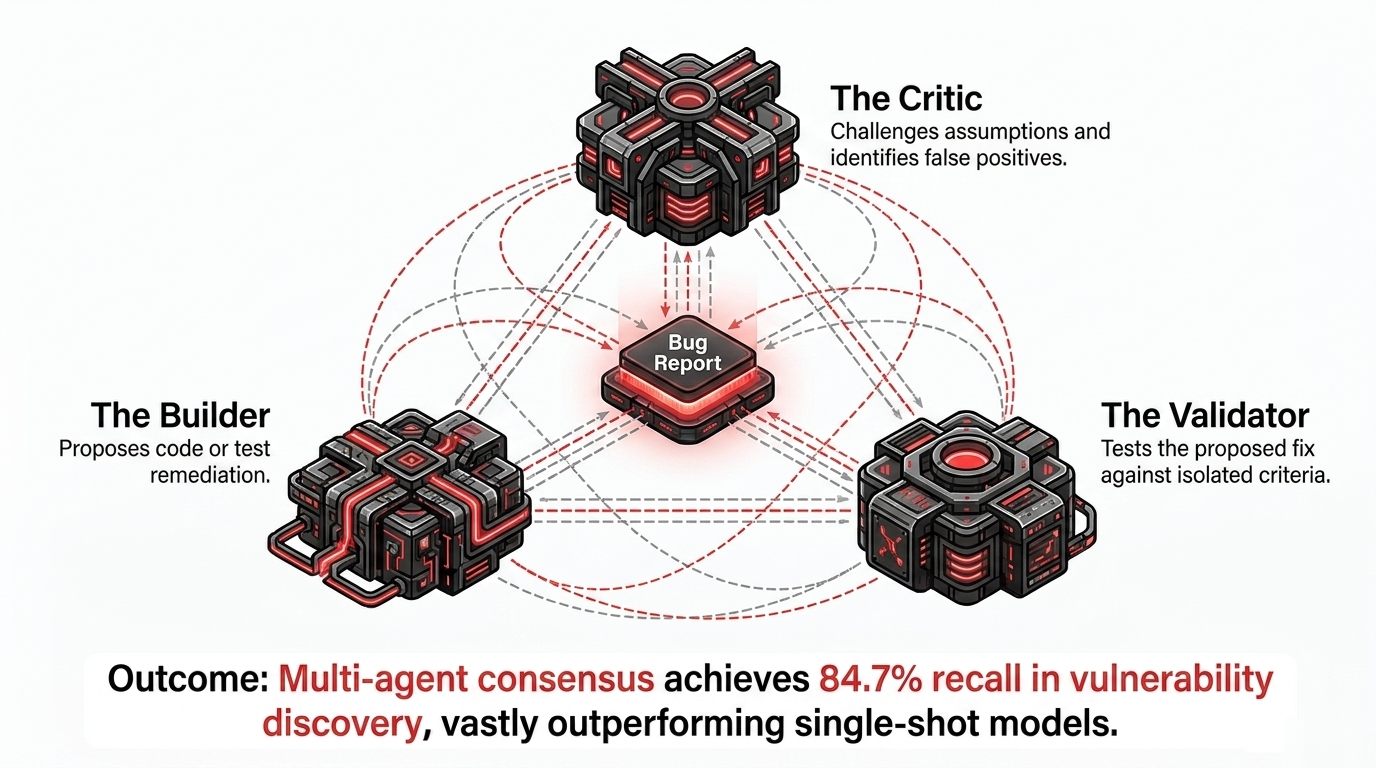
The Builder proposes a test or code remediation. The Critic challenges assumptions and searches for false positives. The Validator tests the proposed fix against isolated criteria.
This pattern is valuable because different roles optimize for different failure modes. A generator tends to maximize plausible completion. A critic looks for contradiction. A validator asks whether the proposal survives execution.
The source slide presents a vulnerability-discovery recall figure as an outcome of this consensus pattern. As with the self-healing metric, that number is best read as a source claim rather than a general benchmark. The transferable principle is stronger: independent challenge and executable validation are more trustworthy than single-shot generation.
For high-impact changes, disagreement itself is useful telemetry. An orchestration layer should be able to escalate unresolved conflicts to a human reviewer rather than forcing consensus.
11. Governance: Traceability, Retention, and Approval Gates
Autonomous QA still needs clear control boundaries. The governance model in the presentation is built around traceability, ephemeral processing, and human approval for consequential actions.
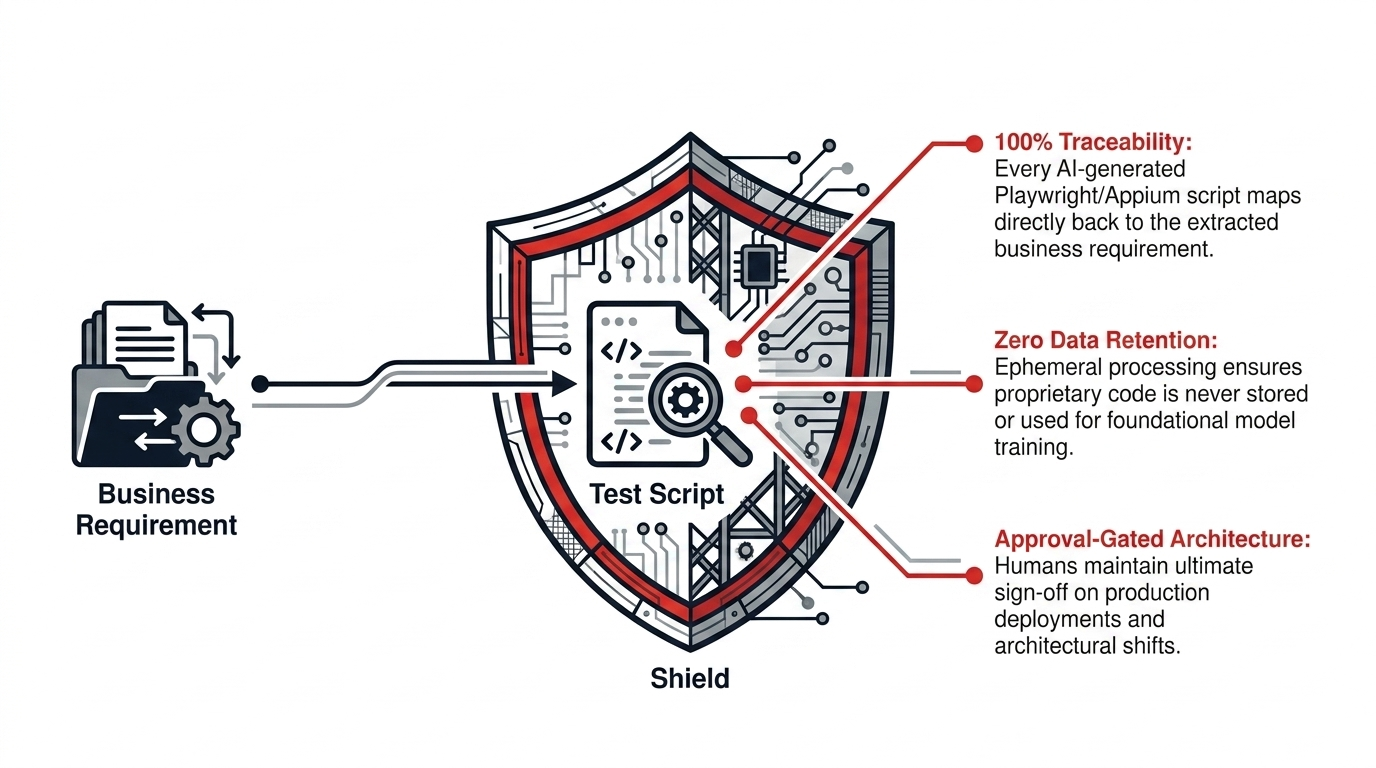
Traceability means each generated script can be mapped back to the business requirement or source intent that justified it. This is essential for change review: when a test evolves, engineers should know whether the change preserves the original requirement or silently broadens it.
Ephemeral processing minimizes retention of proprietary code or runtime data. Whether a deployment can truly guarantee zero retention depends on the models, infrastructure, logging configuration, and contracts in use, so this should be implemented and verified as a concrete data-handling policy rather than assumed.
Approval-gated architecture reserves production deployments and major architectural shifts for human sign-off. That boundary is especially important when agents can edit tests, code, environments, or pipeline configuration.
The governing principle is simple: give agents enough authority to resolve routine execution drift, but not enough authority to redefine the system's business intent without review.
12. Measuring the System Without Confusing Claims With Guarantees
The source material summarizes several quantitative outcomes, including reductions in lead time, brittle tests, and flaky tests, as well as a vulnerability recall rate.
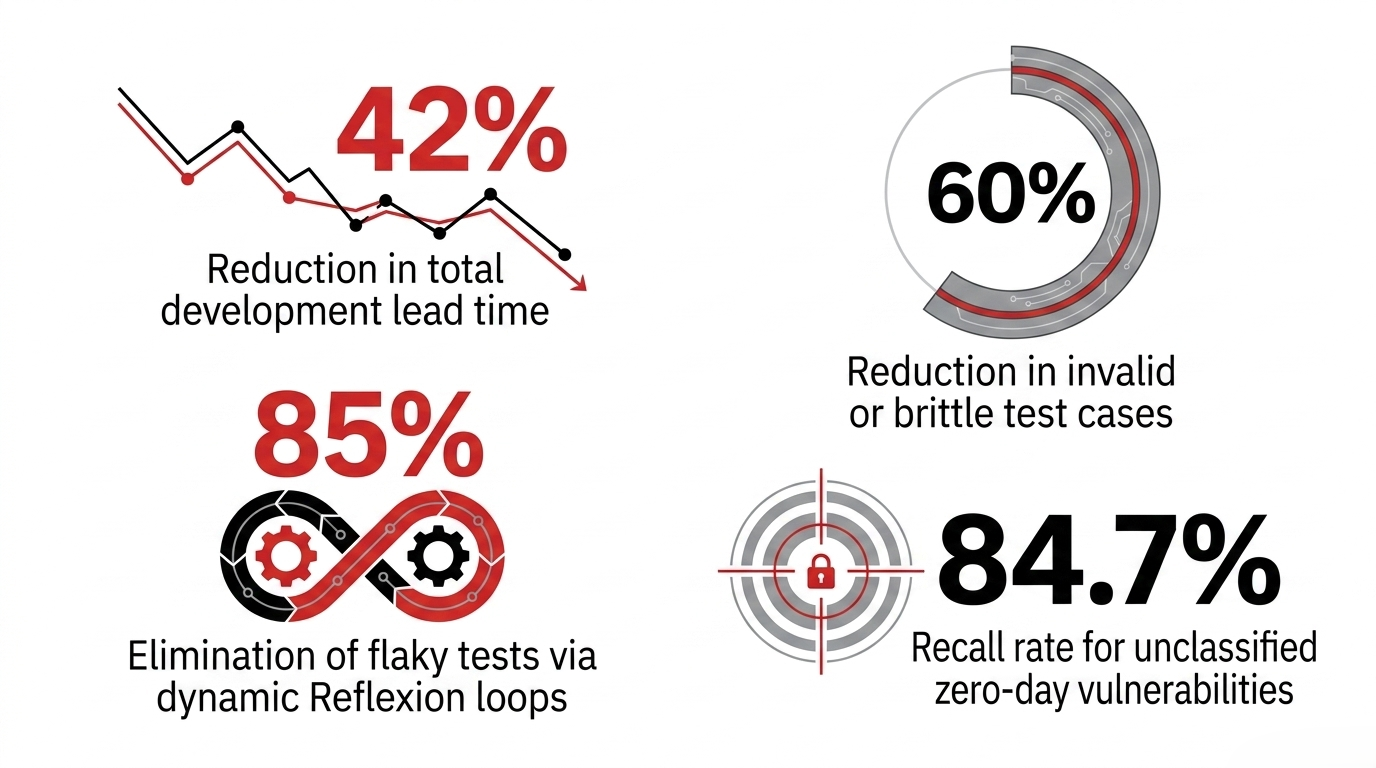
Those numbers are useful as examples of the categories a production team should measure, but they should not be copied into a business case as guaranteed results.
A practical measurement model would track:
- Lead time: time from requirement-ready to validated release candidate.
- Maintenance burden: engineer time spent repairing automation rather than adding coverage.
- Flake rate: proportion of failed runs that pass on retry without a product change.
- Repair precision: how often an automated repair preserves intended behavior.
- Escalation rate: how often an agent cannot resolve a case within policy.
- Defect escape rate: defects reaching later environments despite agentic QA.
- Traceability coverage: proportion of tests with a verifiable requirement lineage.
The important metric is not simply "how often the agent fixes a test." It is how often it fixes the right problem without masking a real defect.
13. The Continuous QA Factory
The final architecture assembles these ideas into a continuous pipeline: business intent enters, an LLM orchestrator decomposes work, parallel specialist workers discover and refine the system state, Playwright and Appium execute platform-specific actions, and validated outputs move toward production.
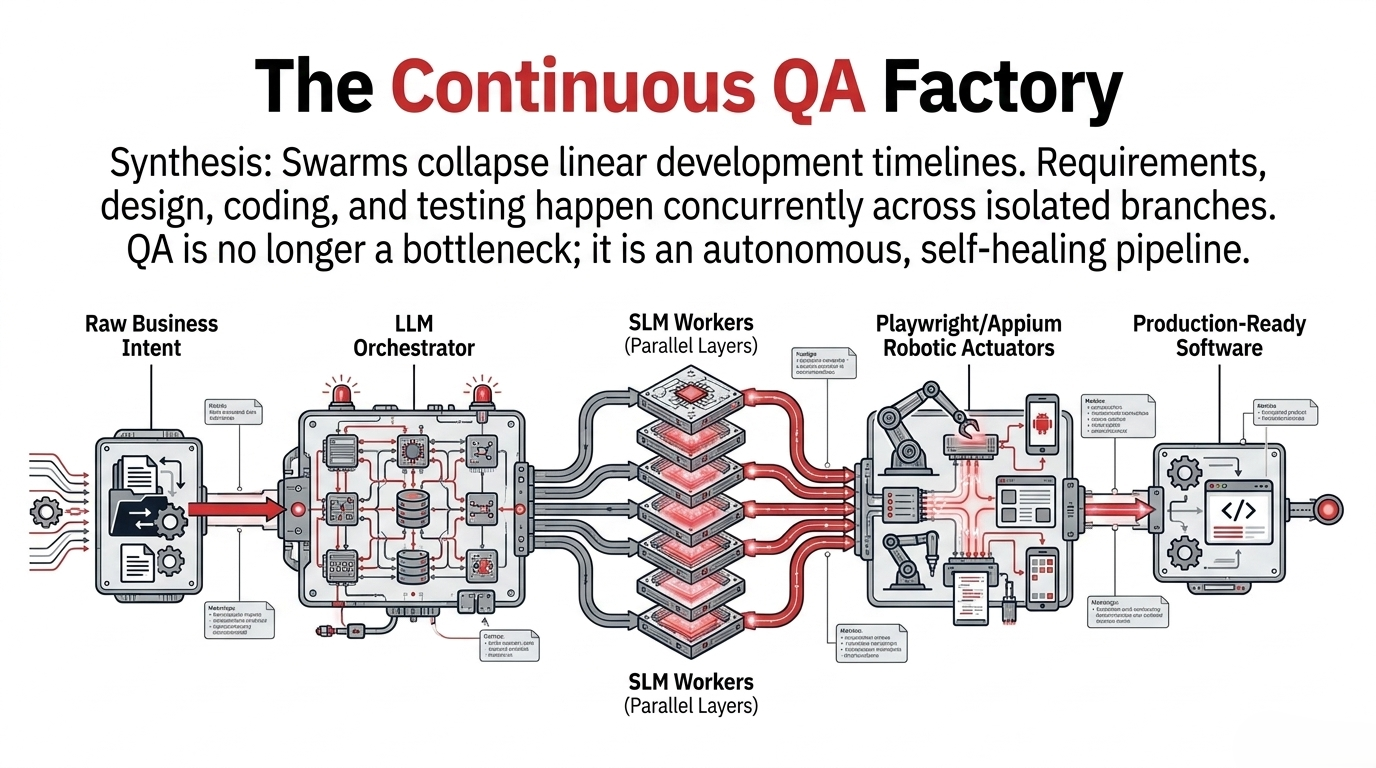
The pipeline is deliberately nonlinear. Requirements analysis, discovery, generation, testing, and repair can happen concurrently across isolated branches. A failed execution can route back into discovery or repair without restarting the entire workflow.
That changes the role of QA from a final gate to a continuous control system. Tests become living artifacts connected to requirements, runtime evidence, and environment state.
The architectural challenge is to keep that system explainable. Every loop should produce structured events: what triggered the agent, what evidence it observed, what action it proposed, which tool executed it, what changed, and what validated the result. Without that event model, an autonomous pipeline becomes difficult to audit even if it appears efficient.
Engineering Principles
The architecture ultimately depends on several principles:
-
Separate reasoning from deterministic execution
Use models to interpret, decompose, diagnose, and propose. Use Playwright, Appium, containers, APIs, and explicit validators to execute and verify. -
Make runtime evidence first-class
DOMs, XML hierarchies, API traces, logs, environment metadata, and failure artifacts should feed the workflow rather than remain postmortem debugging material. -
Constrain autonomy by role and policy
Specialist agents should have narrow responsibilities, limited tool permissions, and clearly defined escalation paths. -
Validate every repair
Self-healing is not "make the test green." A repair must preserve the original behavior and survive rerun or independent validation. -
Design for auditability
Requirements, generated artifacts, tool calls, model decisions, repairs, approvals, and results need a traceable lineage. -
Keep humans at consequential boundaries
Routine maintenance can be automated, while production release decisions, intent changes, and architectural shifts remain approval-gated.
Final Synthesis
Agentic QA is best understood as an orchestration architecture, not as a smarter test generator. It combines semantic interpretation, specialized discovery, constrained reasoning, deterministic actuation, sandboxed execution, self-healing loops, multi-agent review, and governance into one continuous system.
The production-ready system combines:
- A deterministic foundation of browsers, devices, APIs, containers, and executable validation.
- A testing layer built on Playwright and Appium for real web and mobile interactions.
- An agent layer that decomposes goals, discovers runtime structures, proposes repairs, and coordinates specialized work.
- Security and governance through traceability, bounded retention, tool permissions, and human approval gates.
- Observability through structured traces, logs, environment state, and decision lineage.
- A continuous production outcome in which QA adapts with the system instead of becoming a static bottleneck.
The result is a QA pipeline that can respond to change without giving up deterministic evidence.
Closing Thought
The strongest form of autonomous quality engineering does not remove humans, tests, or deterministic tools. It connects them through feedback loops that make intent, execution, and validation continuously visible.
Autonomy is valuable only when every adaptation can still be explained, reproduced, and trusted.