
The Agentic Swarm: A Blueprint for Autonomous Quality Assurance
Traditional test automation is excellent at repeating known procedures. It is much less effective when the environment changes, failures are ambiguous, or the path to a valid outcome cannot be fully scripted in advance. Modern software systems increasingly exhibit all three conditions at once.
The next step for quality engineering is therefore not simply “more AI-generated tests.” It is a change in execution model: from deterministic scripts that encode how to click toward bounded agents that understand what outcome to achieve, choose tools, observe results, adapt their plan, and operate under explicit governance.
The architecture explored here treats quality assurance as an agentic swarm: a set of specialized, auditable agents coordinated around a shared goal. The emphasis is not unconstrained autonomy. It is useful autonomy inside a production system that provides tools, memory, observability, evaluation, security boundaries, and human oversight.
1. Why Scripted Automation Reaches a Breaking Point
Scripted automation assumes that the important path through the system can be expressed as a stable sequence of actions. That assumption breaks down quickly in fast-moving products.
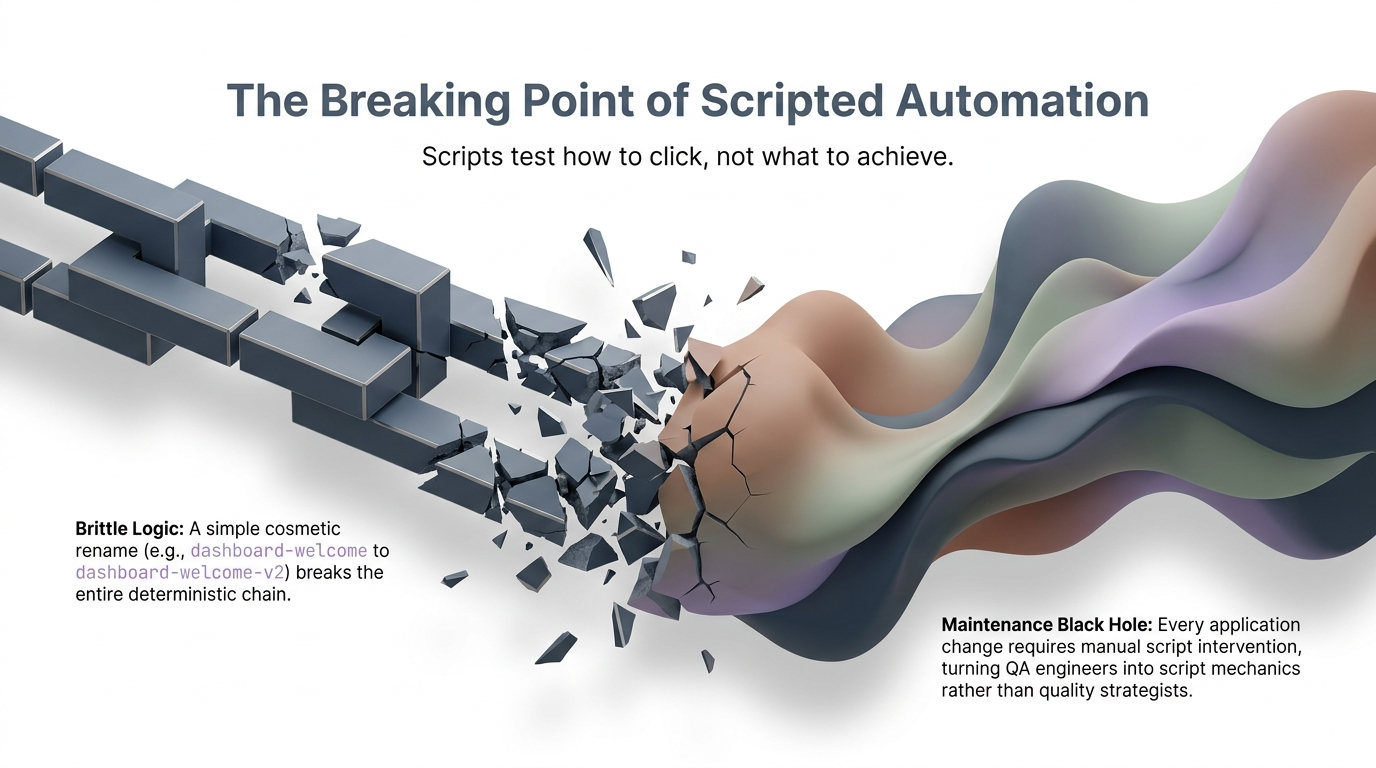
A cosmetic UI rename can invalidate selectors without changing the underlying business behavior. A workflow change can force engineers to repair tests that are technically “correct” but structurally coupled to yesterday's interface. The result is a maintenance loop in which QA specialists spend more time tending scripts than reasoning about product risk.
The central limitation is architectural: a script encodes a sequence, not an intent. It knows that step 4 comes after step 3, but it does not inherently know why those steps matter or whether a different path would satisfy the same acceptance criteria.
This distinction becomes critical as applications adopt dynamic front ends, asynchronous services, feature flags, personalized experiences, and non-deterministic dependencies. In those systems, exact-path replay is often the wrong abstraction.
2. Three Generations of Quality Assurance
The shift to agentic QA is easier to understand as an evolution rather than a replacement event.
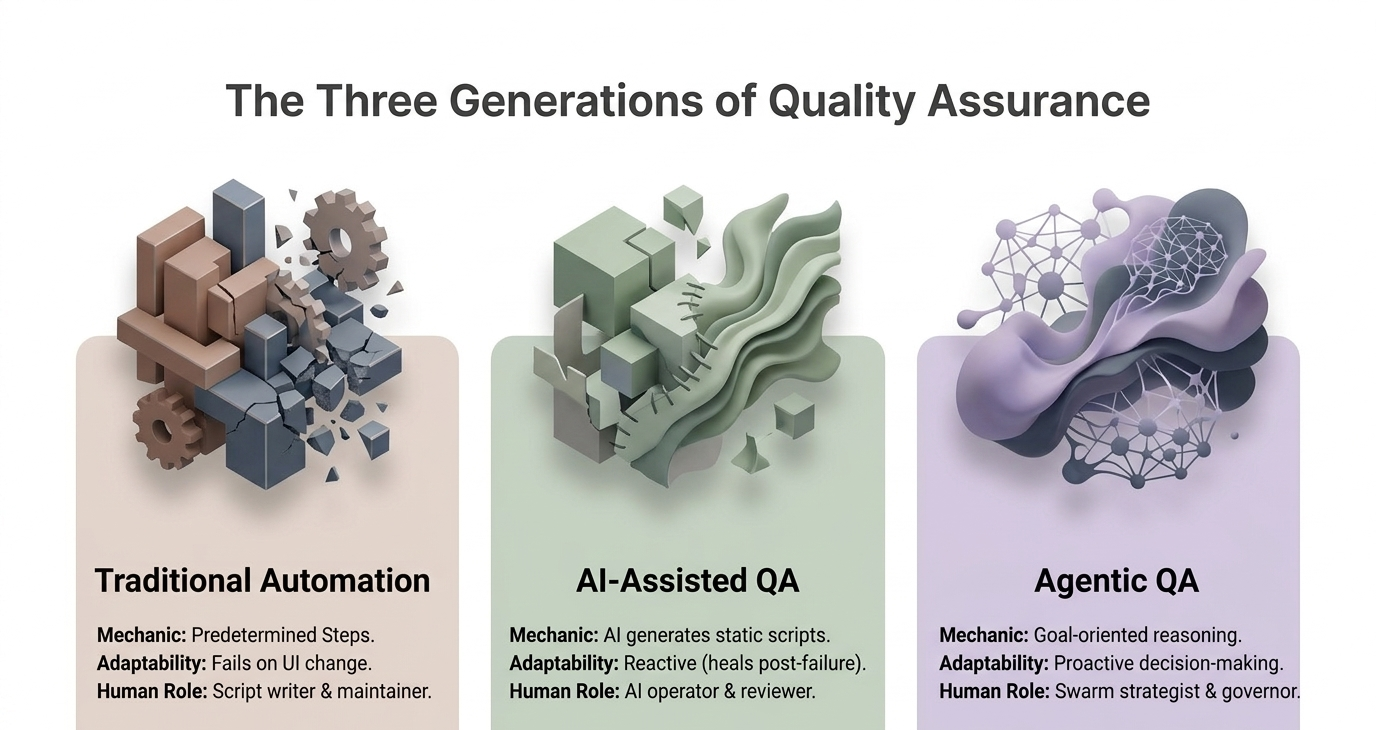
Traditional automation uses predetermined steps. It is predictable and easy to audit, but it fails when the user interface or workflow structure changes. The human role is largely script author and maintainer.
AI-assisted QA improves authoring speed by generating or repairing test code. This can reduce manual effort, but the generated artifact is still usually a static script. The system remains reactive: a human or automation loop notices a failure, then AI helps heal or regenerate the test.
Agentic QA moves reasoning into execution. The system receives an objective, observes the application, decides what to do next, and adapts as state changes. Humans move from writing every action to defining acceptance criteria, supplying domain context, setting boundaries, and reviewing decisions.
The important transition is from script generation to goal-oriented execution.
3. The Anatomy of Agency: Think, Act, Observe, Adapt
An agent is not merely a larger script with an LLM attached. The defining property is a feedback loop.
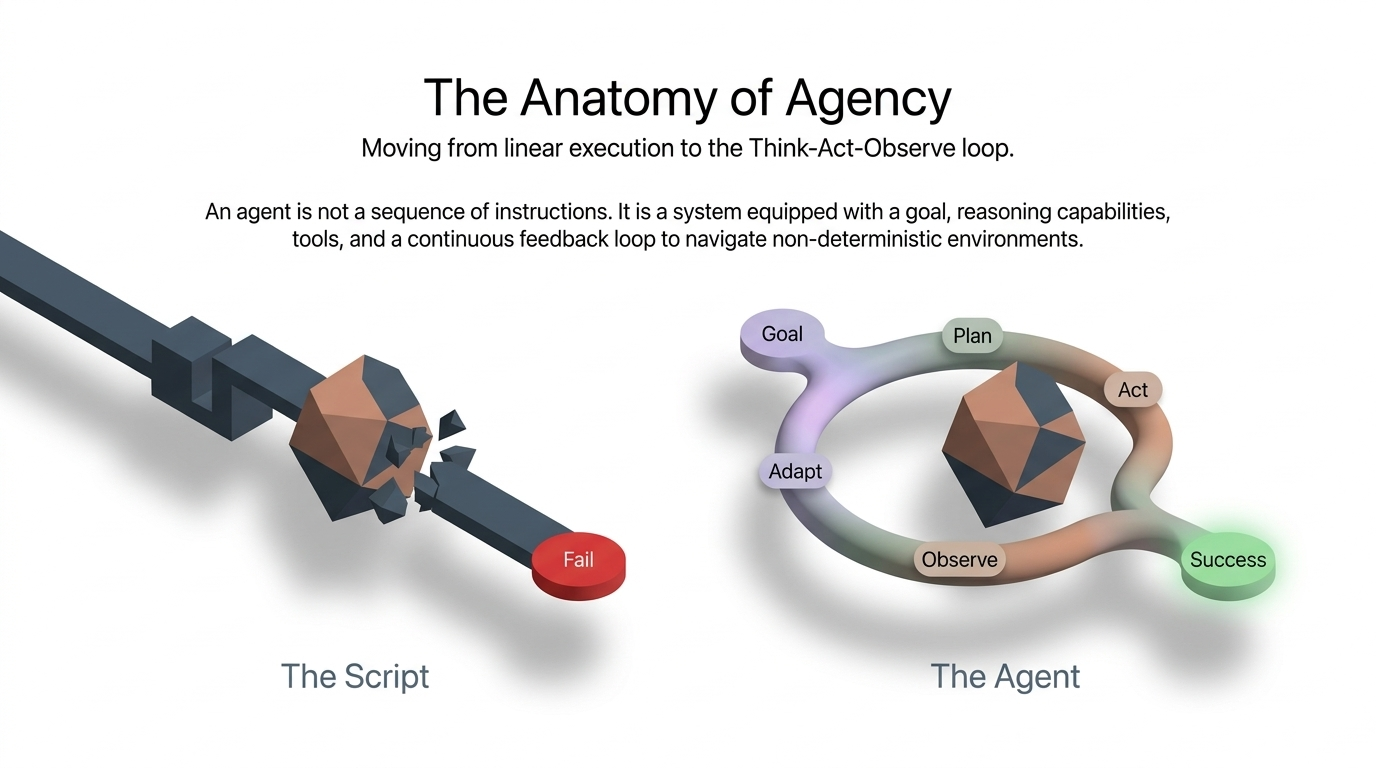
A linear script follows a known path until an unexpected condition causes failure. An agent, by contrast, operates through a recurring loop:
- Goal — interpret the intended outcome and constraints.
- Plan — choose a reasonable next action or subgoal.
- Act — use an approved tool against the environment.
- Observe — inspect the resulting state, telemetry, and errors.
- Adapt — revise the plan based on evidence.
This loop is what makes non-deterministic execution useful rather than chaotic. The agent is allowed to change how it reaches the goal, while the system still constrains what counts as a valid outcome.
That separation between path and objective is foundational for resilient autonomous testing.
4. The Agent-Native Engine
A production agent is best understood as a stack rather than a single model call.
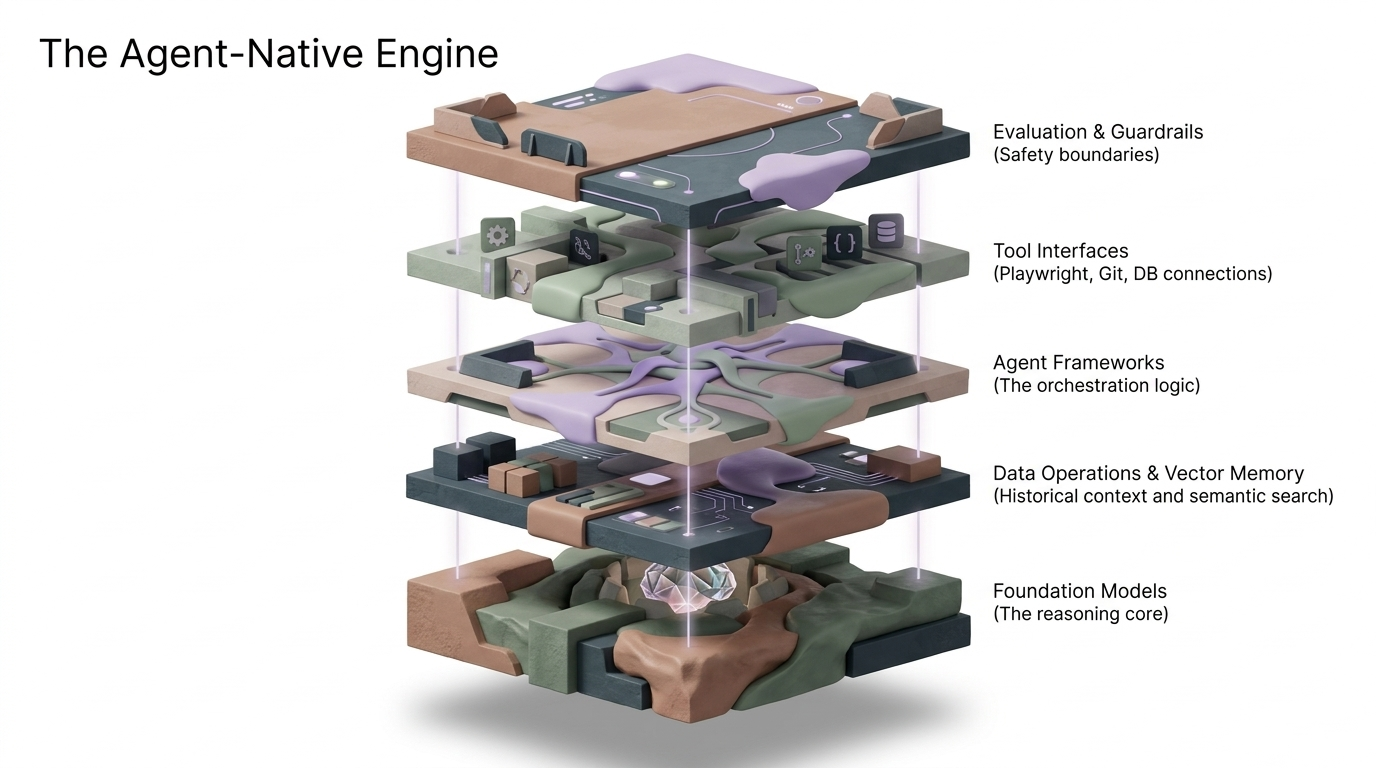
At the foundation are foundation models, which provide reasoning and language capabilities. Above them sits data operations and vector memory, supplying historical context, semantic retrieval, and test knowledge. Agent frameworks coordinate tasks, state, branching, and delegation. Tool interfaces connect the agent to browsers, source control, databases, observability platforms, and other systems. Finally, evaluation and guardrails enforce safety, correctness, and policy.
These layers serve different failure modes. A strong model cannot compensate for unsafe tool permissions. Rich memory cannot fix unobservable execution. Sophisticated orchestration cannot rescue weak acceptance criteria.
The practical design principle is simple: treat the model as one component inside a controlled runtime, not as the runtime itself.
5. Enter the Swarm: Specialization Beats Monoliths
A single general-purpose agent can become difficult to reason about as responsibilities accumulate. Prompt size grows, tool access expands, decision logic becomes tangled, and failures become harder to localize.
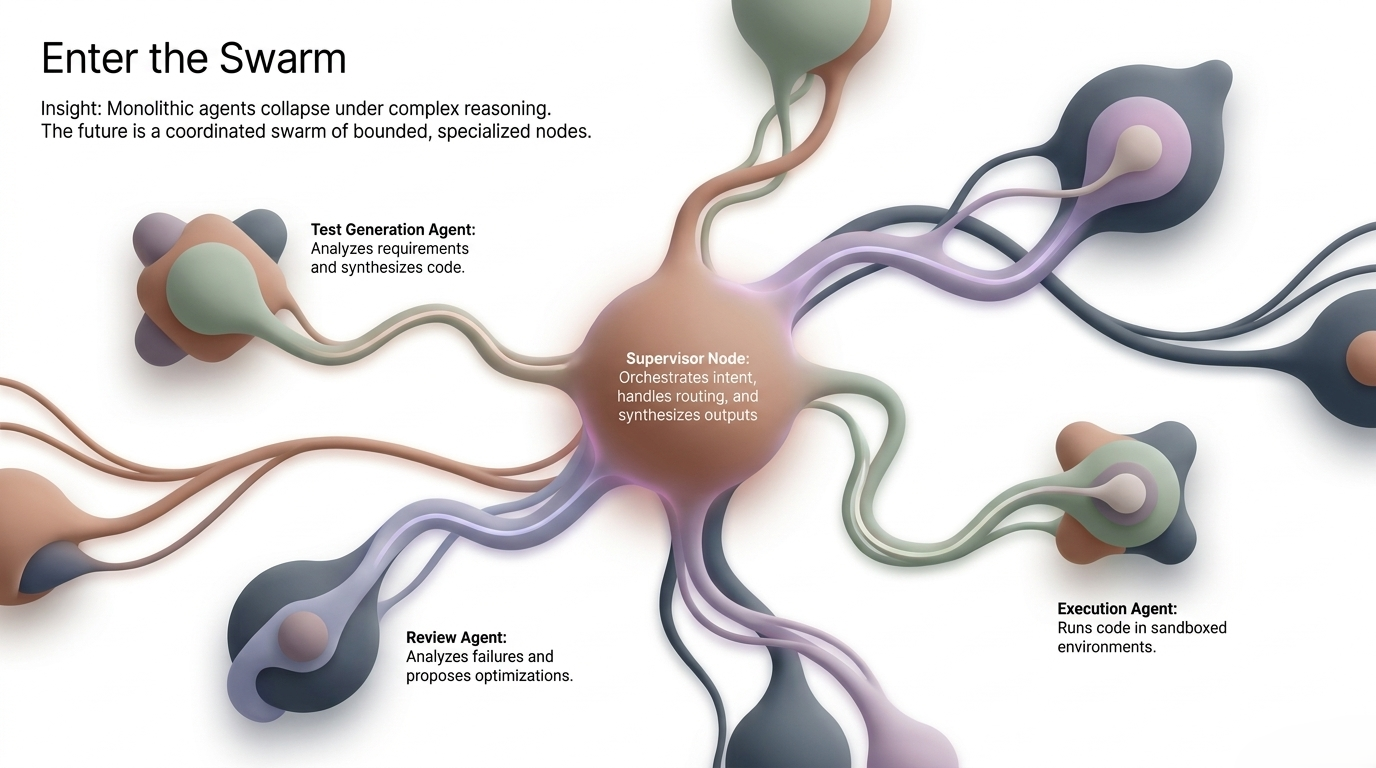
A swarm decomposes the work into bounded roles. A test generation agent can translate requirements into candidate checks. An execution agent can run those checks inside a sandbox. A review agent can classify failures and propose improvements. A supervisor node can route work, maintain shared intent, and synthesize outputs.
This is less about simulating an organization chart and more about reducing cognitive and operational scope. Each agent gets the minimum context and permissions required for its job.
Specialization improves testability as well. It is easier to validate “does the execution agent respect sandbox limits?” than to validate a monolithic agent that plans, edits code, changes infrastructure, runs tests, and interprets failures in one opaque loop.
6. The Generate–Execute–Analyze Loop
A useful swarm can be modeled as a closed quality loop.
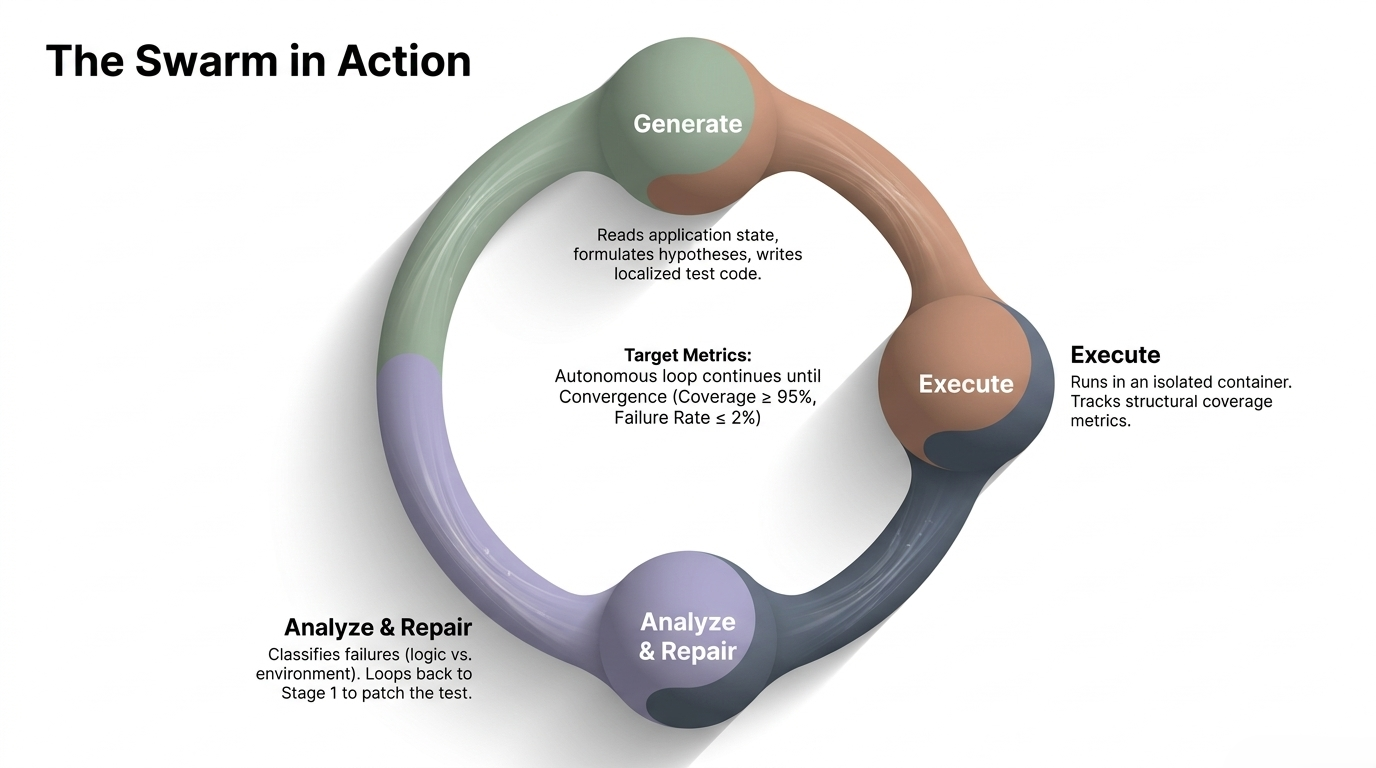
The Generate stage reads application state and requirements, forms hypotheses, and creates localized test logic. Execute runs the test in an isolated environment and records structural coverage. Analyze & Repair classifies failures, distinguishes product defects from environmental or agent failures, and sends precise feedback back into generation.
The loop should not run forever. It needs convergence criteria: target coverage, failure-rate thresholds, budget limits, maximum iterations, or other termination conditions defined by the organization.
That matters because autonomous systems are optimization systems. Without explicit stopping conditions, they can continue exploring long after the business value of another iteration has disappeared.
7. Interactive Debugging with the Debug2Fix Pattern
One of the most valuable forms of delegation is targeted troubleshooting.
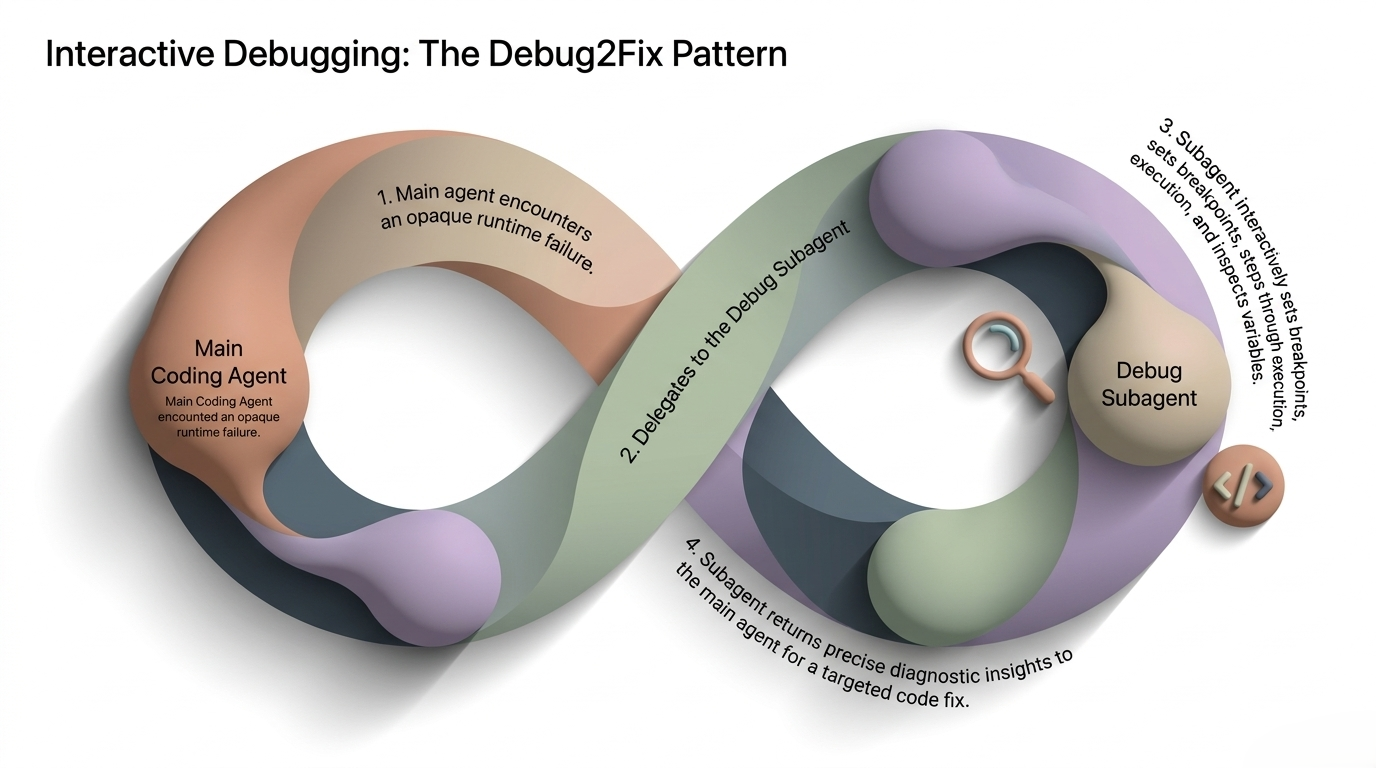
When a primary coding or test agent encounters an opaque runtime failure, it can delegate a narrow debugging task to a specialized subagent. That subagent can set breakpoints, step through execution, inspect variables, trace state transitions, and return a focused diagnosis.
The main agent then uses that diagnosis to make the code change.
This pattern is powerful because it separates investigation from modification. The debug subagent does not need broad authority to edit the system. Its purpose is to gather high-quality evidence. The parent agent remains responsible for the final action.
That division also creates a better audit trail: the system can record the observed failure, the diagnostic reasoning, and the resulting patch as distinct artifacts.
8. Equipping the Swarm with MCP
Agents become useful when they can safely operate tools. A standardized tool layer reduces bespoke integration work and makes capability boundaries explicit.
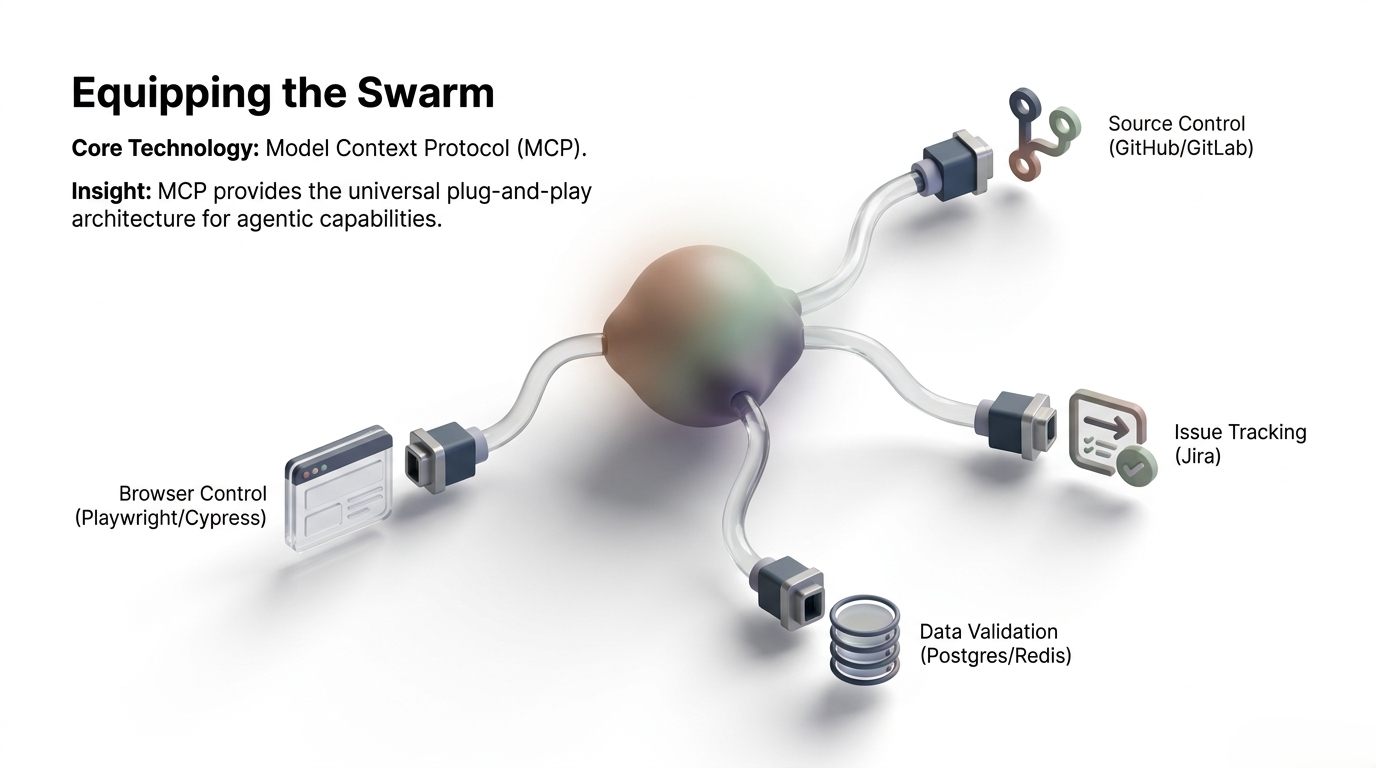
The Model Context Protocol (MCP) provides a common interface for exposing tools and data sources to agents. In a quality engineering environment, that can include browser control through Playwright or Cypress, source-control access through GitHub or GitLab, issue tracking through Jira, and data validation against systems such as Postgres or Redis.
The architectural value is not just convenience. Standardization enables consistent authentication, permissioning, observability, and tool discovery. It also lets teams swap or add integrations without rewriting the reasoning layer for every backend.
A useful rule is to expose capabilities, not unrestricted environments. An agent should receive a narrowly scoped operation—such as “read issue,” “run test in sandbox,” or “query this dataset”—instead of broad shell or production access whenever possible.
9. Orchestrating the Hive
Different multi-agent frameworks encode different assumptions about coordination.
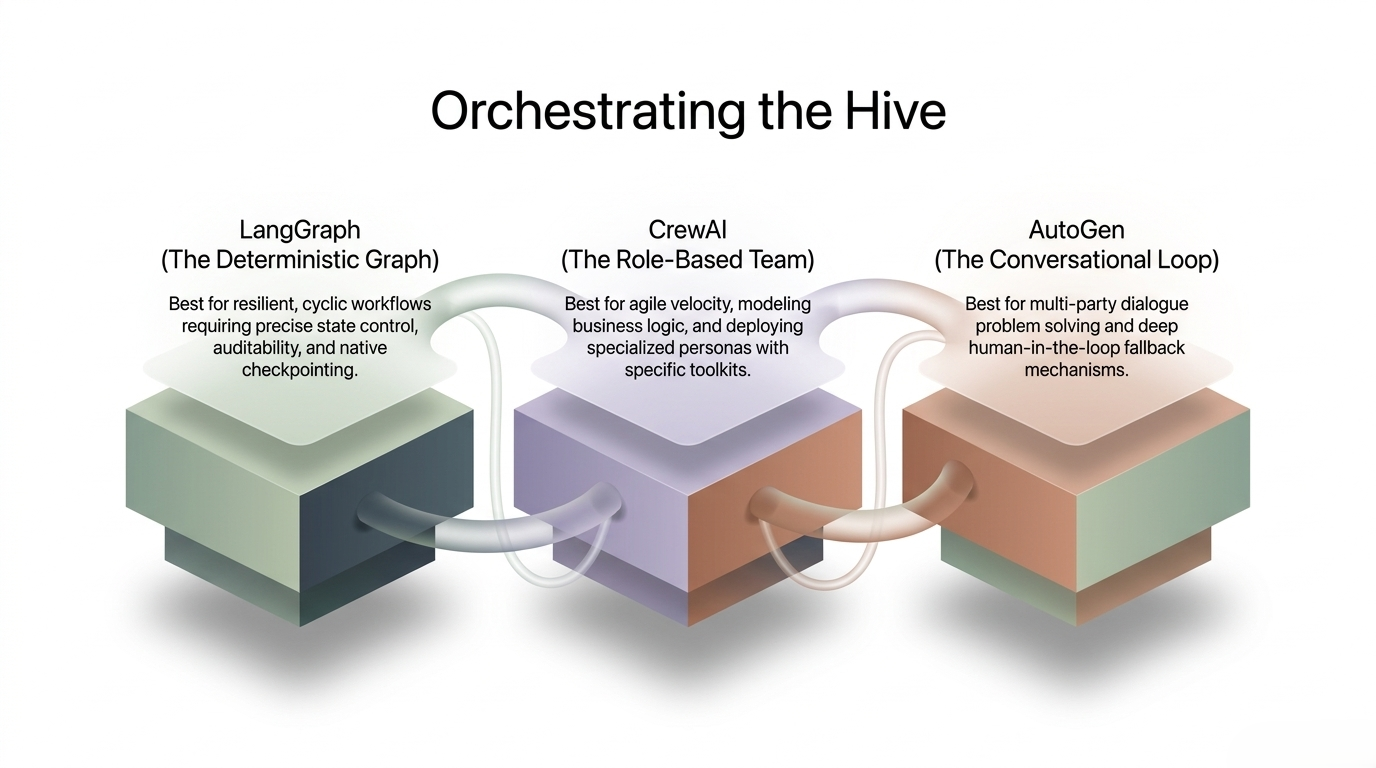
LangGraph is well suited to workflows that need explicit state, cyclical control flow, resumability, and checkpoints. Its graph model helps make transitions visible and auditable.
CrewAI emphasizes role-based collaboration. It can fit scenarios where specialized personas map naturally to tasks and where business logic is easier to express through cooperating roles.
AutoGen centers on conversational interaction among agents and humans. It can be useful for dialogue-heavy problem solving and workflows where human-in-the-loop escalation is a primary design feature.
The important choice is not which framework is fashionable. It is which orchestration semantics match the operational requirements: state control, recovery, auditability, tool isolation, human approval, and failure handling.
10. Embedding the Swarm in CI/CD
Agentic QA becomes materially useful when it is connected to the software delivery lifecycle rather than run as an occasional experiment.
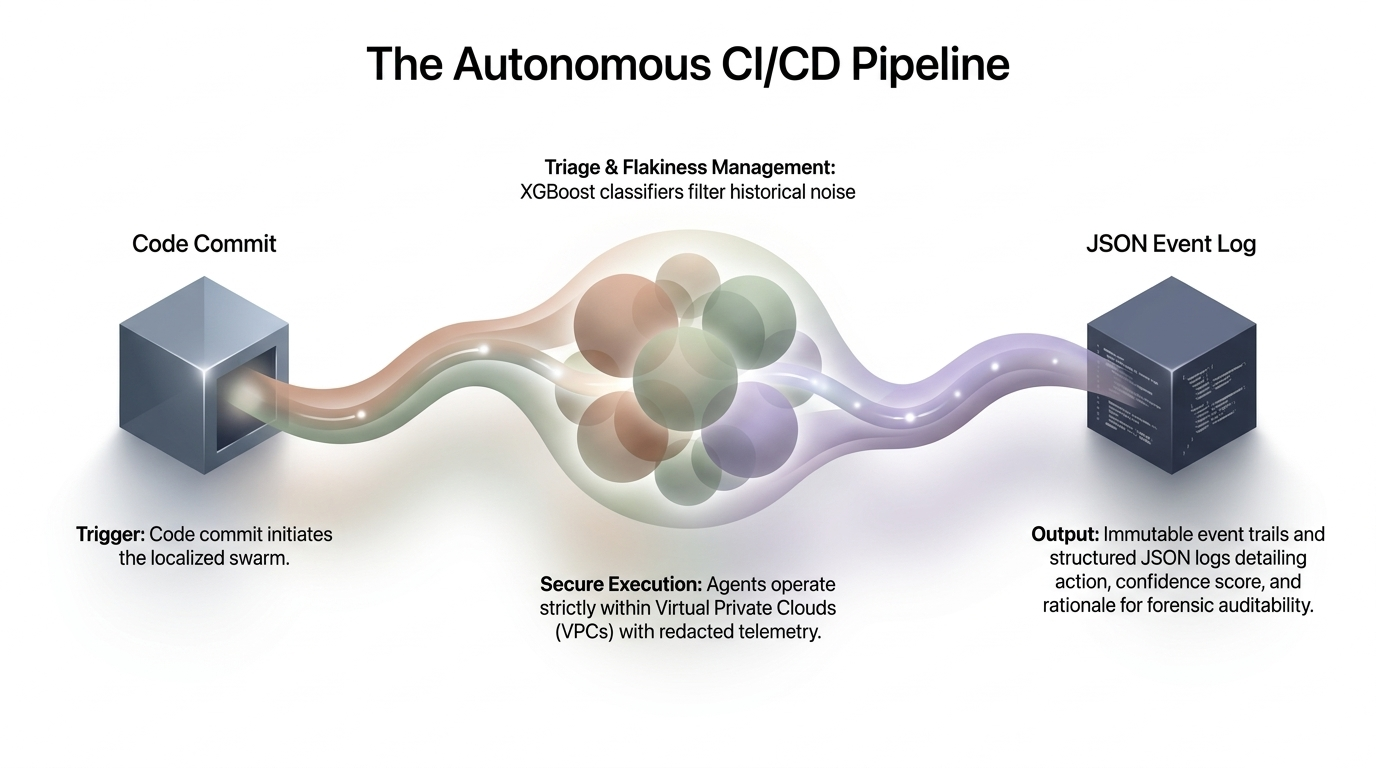
A code commit can trigger a localized swarm that generates and executes relevant tests, classifies failures, and emits structured results. The agents should operate inside isolated infrastructure such as VPCs or equivalent sandboxes, with telemetry redacted where necessary.
The output should be machine-readable and immutable: structured event logs that capture actions, confidence, evidence, tool calls, and rationale. That turns autonomous behavior into something engineering teams can inspect after the fact rather than merely trust in the moment.
Flakiness management belongs in the pipeline as well. Historical signals can help distinguish recurring environmental noise from meaningful regressions, reducing the amount of human review spent on known non-actionable patterns.
11. Validating Non-Deterministic Execution
A non-deterministic agent may take two different valid paths and still arrive at the same correct result. This breaks validation approaches based only on exact sequence matching.
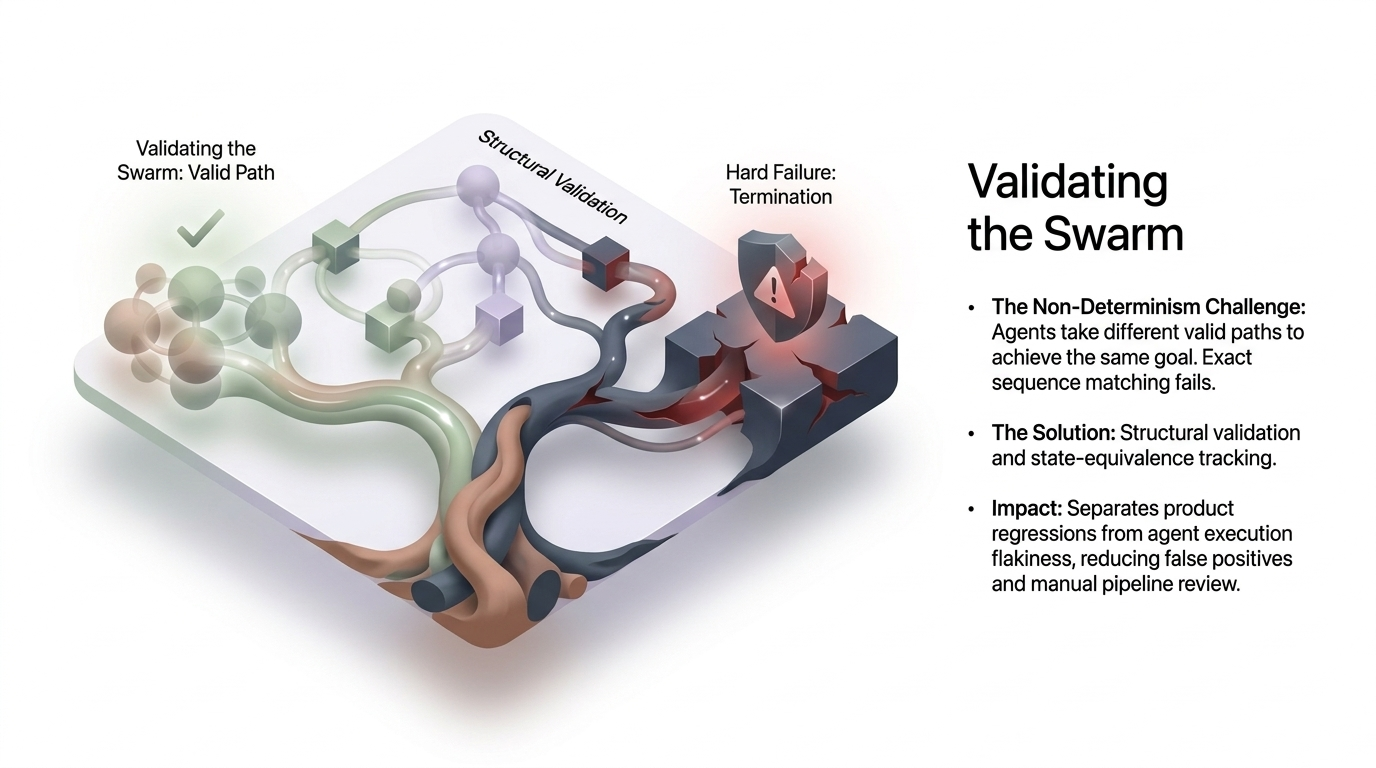
The alternative is structural validation and state-equivalence tracking. Instead of asserting that the agent clicked the same controls in the same order every time, the system validates that important invariants held and that the final state satisfies the acceptance criteria.
This distinction is essential for avoiding false positives. A changed path is not necessarily a test failure. A structurally valid path that reaches the desired state should be accepted, while unsafe transitions, invalid intermediate states, or incorrect outcomes should terminate the run.
In other words, agentic QA requires validators that understand what must remain true, not only what exact sequence was expected.
12. Governance and Autonomy Are Separate Decisions
Capability and authorization should not be conflated.
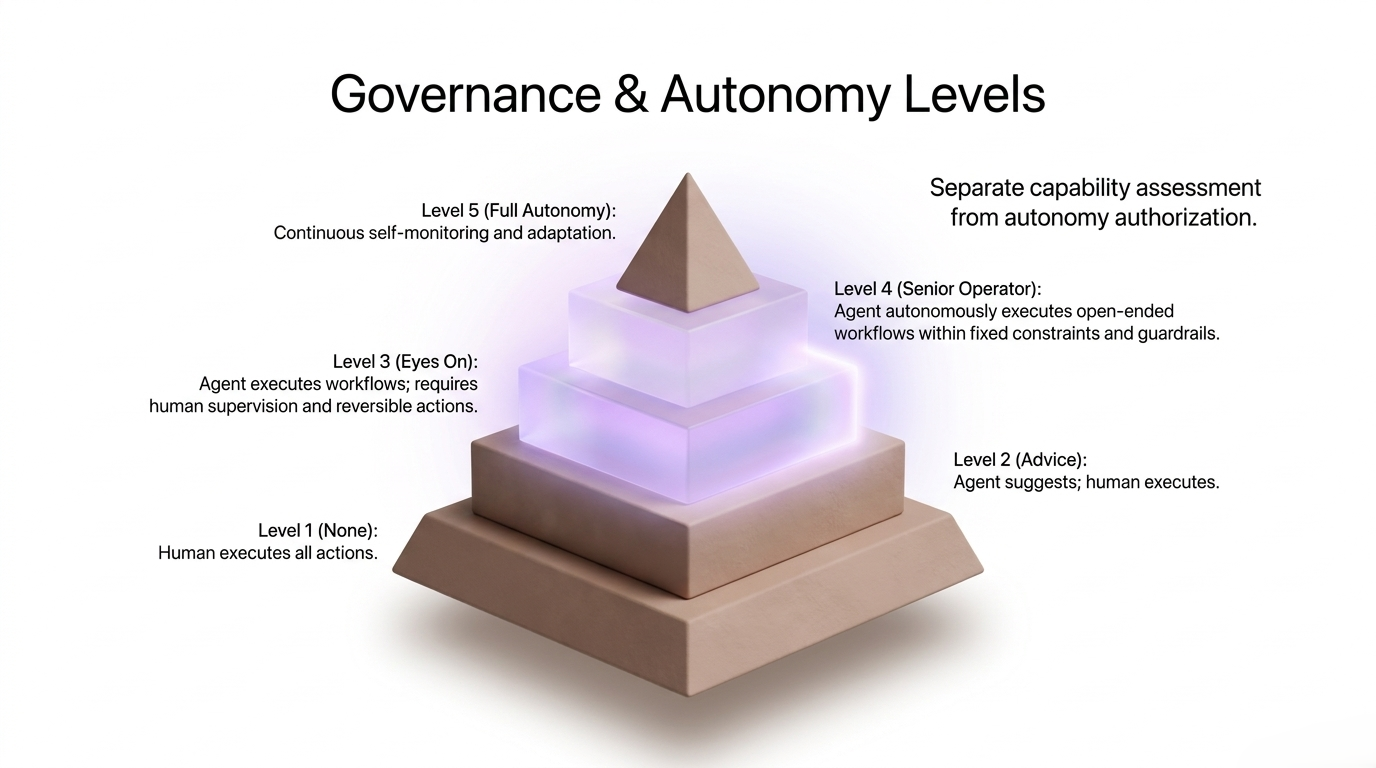
An agent may be technically capable of acting autonomously without being authorized to do so. A useful autonomy model therefore defines progressively broader execution rights:
- Level 1 — None: humans execute all actions.
- Level 2 — Advice: the agent suggests; humans execute.
- Level 3 — Eyes On: the agent executes within a bounded workflow while humans supervise and can reverse or stop actions.
- Level 4 — Senior Operator: the agent executes open-ended workflows inside fixed constraints and guardrails.
- Level 5 — Full Autonomy: the system continuously self-monitors and adapts.
For most enterprise QA environments, Level 3 is a practical starting point. It creates space to measure reliability, inspect failure modes, and build trust before granting broader execution rights.
Governance should cover permissions, data access, change scope, approval boundaries, rollback procedures, audit logging, and escalation rules. Autonomy is not a feature toggle; it is a risk-management decision.
13. The QA Engineer Moves Up the Stack
Agentic QA changes the human role, but it does not remove human judgment.
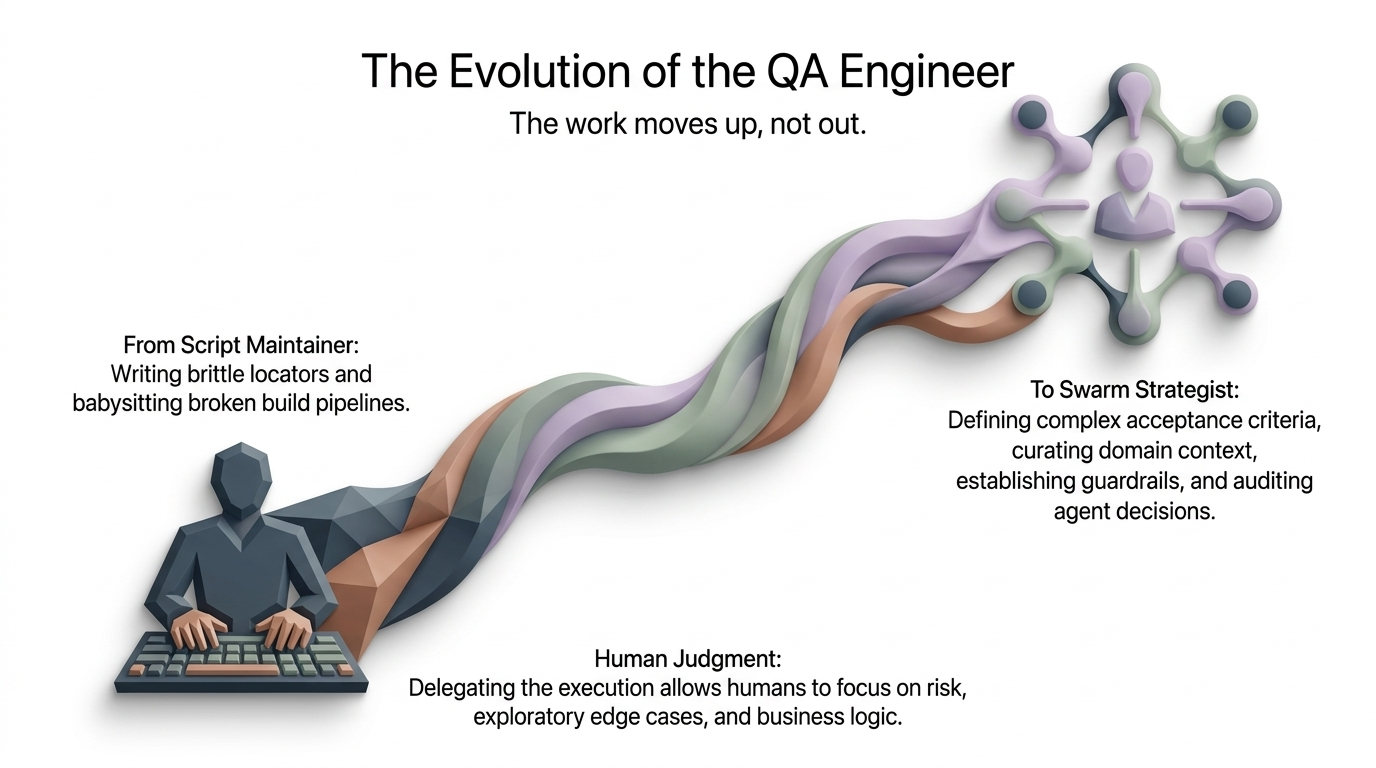
The value shifts away from maintaining brittle selectors and manually babysitting failing pipelines. Engineers spend more time defining meaningful acceptance criteria, curating domain knowledge, identifying high-risk edge cases, setting policy, reviewing agent decisions, and improving the quality system itself.
This is a move from script maintainer to swarm strategist.
The most important human skills become the ones that are hardest to encode in a generic automation layer: understanding business intent, spotting ambiguous requirements, recognizing unacceptable risk, and deciding which failures matter most.
Delegating execution only creates leverage if humans use the freed capacity to improve judgment and system design.
14. An Enterprise Blueprint for Starting Today
The transition does not require jumping directly to autonomous production agents. A staged architecture is both safer and more useful.
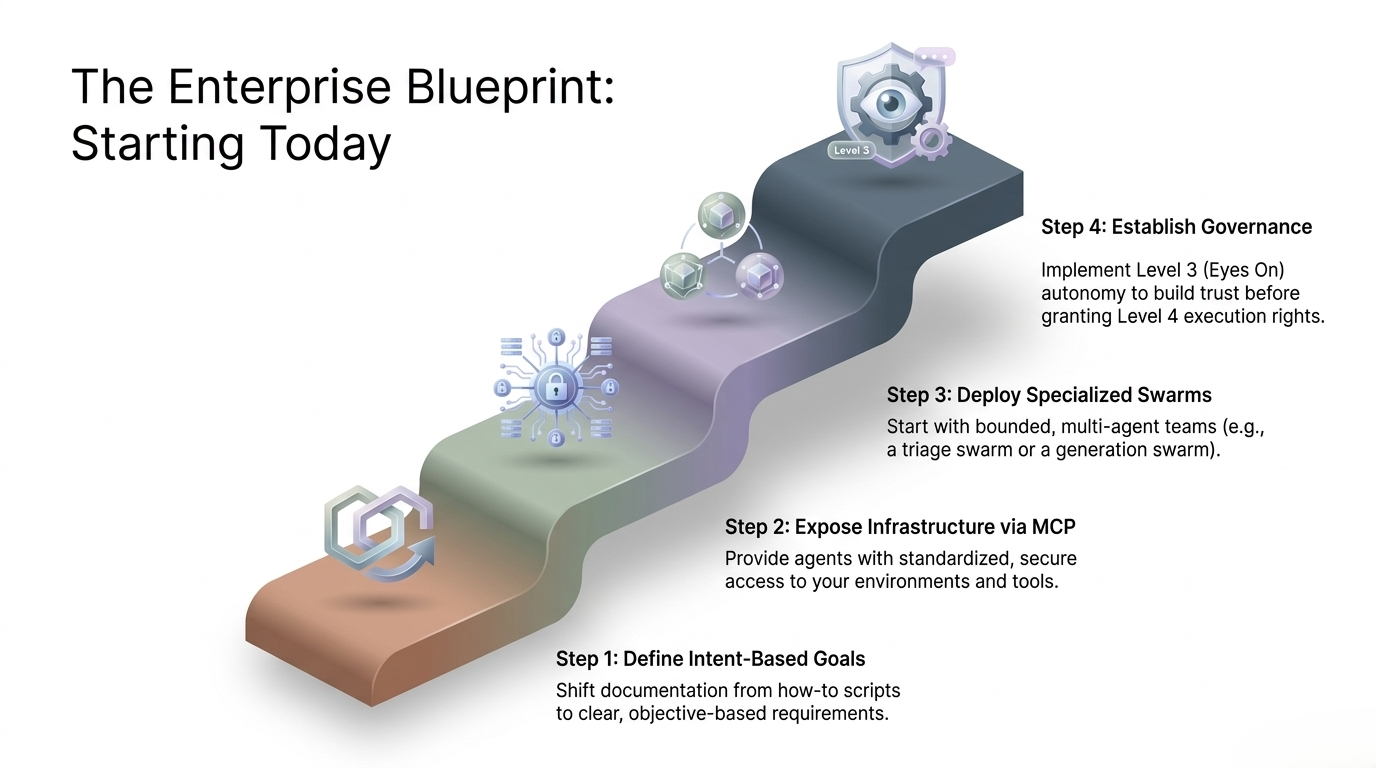
A practical adoption path has four steps:
- Define intent-based goals. Rewrite test documentation around outcomes, invariants, and acceptance criteria rather than procedural click paths.
- Expose infrastructure through standardized tool interfaces. Give agents secure, observable access to the browsers, repositories, databases, and test environments they need.
- Deploy specialized swarms. Start with bounded use cases such as test generation, triage, or debugging rather than a monolithic “do everything” agent.
- Establish governance. Begin with supervised execution, capture evidence, measure reliability, and expand autonomy only after the organization understands the risk profile.
This sequence matters. Teams that start with autonomy before clarifying intent and controls usually create a more complicated version of their existing automation problems.
Engineering Principles
The architecture ultimately depends on a small number of durable principles:
-
Specify outcomes, not click paths.
Intent-based acceptance criteria give agents room to adapt without losing correctness. -
Keep agents bounded.
Narrow responsibilities and least-privilege tools make behavior easier to test, audit, and govern. -
Separate reasoning from authority.
A capable agent should still be constrained by policy, environment, and approval level. -
Validate state, structure, and evidence.
Non-deterministic systems require stronger validators than exact-sequence assertions. -
Make every autonomous action observable.
Structured logs, confidence, rationale, and tool traces are prerequisites for operating agentic systems in production.
Final Synthesis
Agentic QA is not a replacement for deterministic engineering. It is a new layer built on top of it.
A production-ready system combines clear acceptance criteria, specialized agents, standardized tool access, isolated execution, stateful orchestration, structural validation, observable event trails, and graduated governance. Deterministic components remain essential wherever exact behavior matters; agentic components are introduced where adaptation and reasoning create leverage.
The result is a quality system that can respond to change instead of merely breaking under it.
The most important design choice is therefore not which model to use. It is where to place boundaries: what the agent is trying to achieve, what it is allowed to touch, what evidence it must produce, and when a human must remain in control.
Closing Thought
The strongest quality systems of the next generation will not be defined by how many tests they can execute. They will be defined by how well they can reason about intent, adapt to change, and remain governable while doing so.
Move automation from scripted steps to supervised agency—one bounded workflow at a time.