

The Unbounded Digital Worker
The next useful abstraction for computer-use AI is not a better chatbot. It is a spatial operator: a system that can decompose an objective, reason about an interface, take bounded actions, extract structured information, recover from change, and continue working without collapsing its own context.
That requires more than one model and more than one interaction technique. A production system has to solve three different engineering problems at once: orchestration, visual grounding, and structural extraction. Treating those as a single end-to-end agent makes every weakness compound with the others.
The architecture in this article takes the opposite approach. It separates the system into a brain, eyes, and hands. The brain schedules and coordinates work. The eyes translate semantic intent into precise GUI targets. The hands operate on the DOM and structured page state when visual automation is too slow or brittle.
The result is a design for digital workers that can move between applications, preserve context, and recover from interface drift without relying on one giant prompt or one fragile selector chain.
1. Separate the Failure Domains Before You Scale the Agent
A unified agentic computer-use system has three distinct interaction layers.
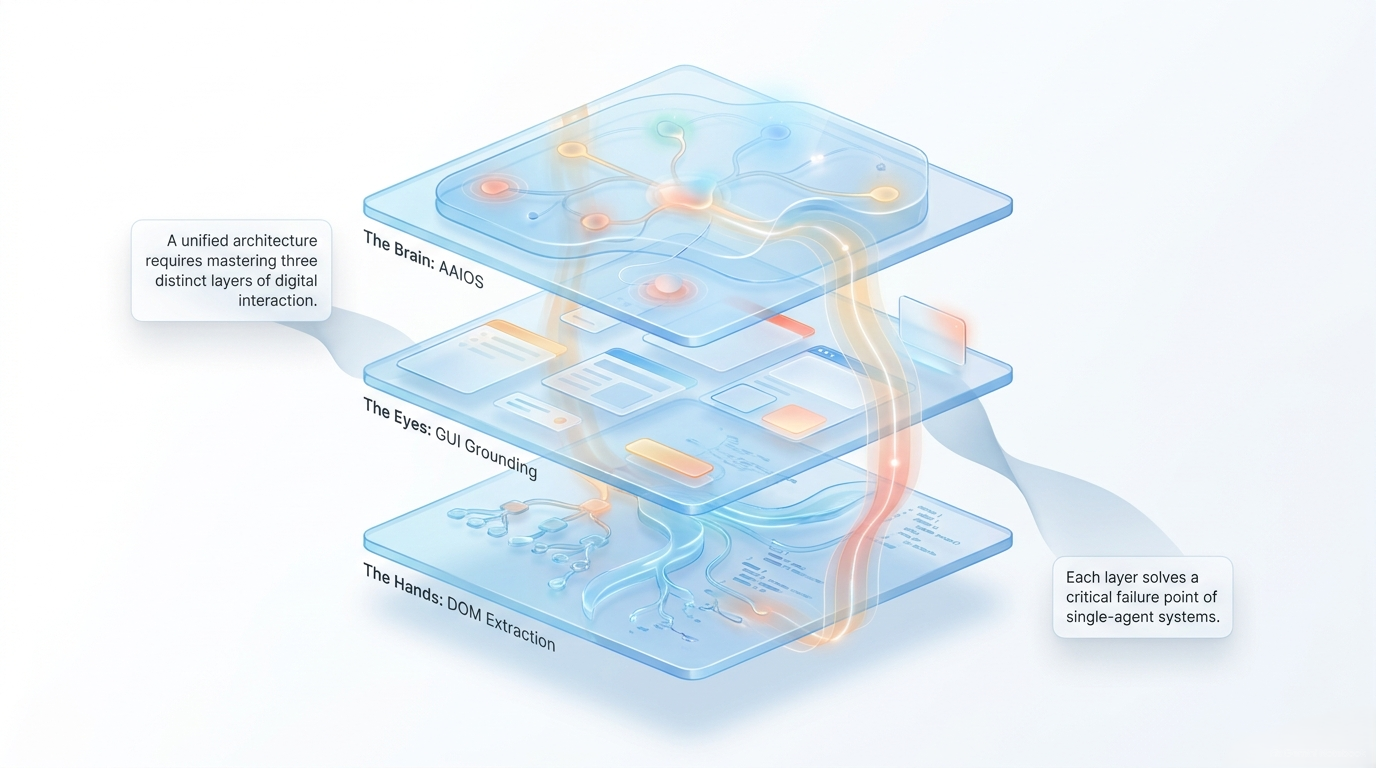
At the top sits the orchestration layer: planning, dispatch, dependency management, memory, retries, and communication among specialist agents. This layer is responsible for deciding what should happen next and which component should do it.
The middle layer is GUI grounding. It resolves abstract intent such as “open Help/FAQ” into a concrete region or target on a screen. The problem is geometric as well as semantic: the system must identify the right object and locate it accurately enough to act.
The bottom layer is DOM extraction and manipulation. Once the task becomes high-volume reading, filtering, or structured extraction, visual interaction becomes inefficient. The system needs a structural representation of the page that can preserve meaning while tolerating superficial layout changes.
These layers should cooperate, but they should not be conflated. Each one fails differently, has different latency characteristics, and benefits from different recovery mechanisms.
2. The Single-Agent Trap: Context Becomes the Bottleneck
A large model can plan, write, research, and code, but asking one agent to carry all intermediate state creates a predictable failure mode: context overflow and reasoning drift.
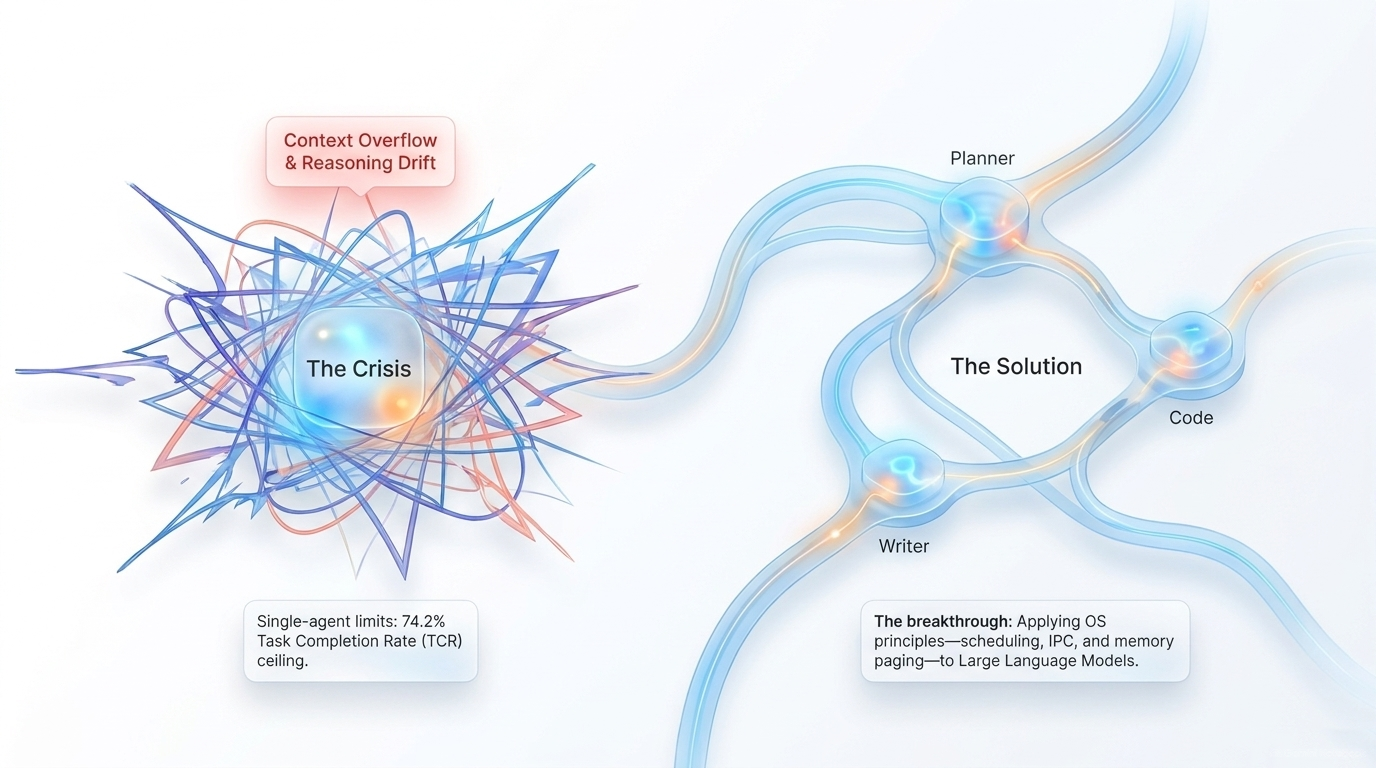
Long-running computer-use tasks accumulate screenshots, tool outputs, partial plans, extracted data, retries, and exception traces. If every artifact remains in one conversation state, the model eventually spends more of its effective context budget remembering the task than solving it.
The architecture shown here replaces that monolith with specialist agents coordinated using operating-system-like ideas: scheduling, inter-process communication, bounded working memory, and persistent memory. The key shift is conceptual. Instead of treating the LLM as the entire application, the LLM becomes one process inside a larger execution system.
The slide deck reports a 74.2% task-completion baseline for a single-agent setup. That figure should be read as a benchmark result from the presented system, not as a universal ceiling for all single-agent architectures. The more important lesson is architectural: when failures are caused by state accumulation, adding more prompt text does not fix the underlying problem.
3. AAIOS as an Autonomous Orchestration Engine
The orchestration layer is presented as AAIOS, an autonomous execution engine that decomposes objectives into a directed acyclic graph and dispatches work to specialist agents.
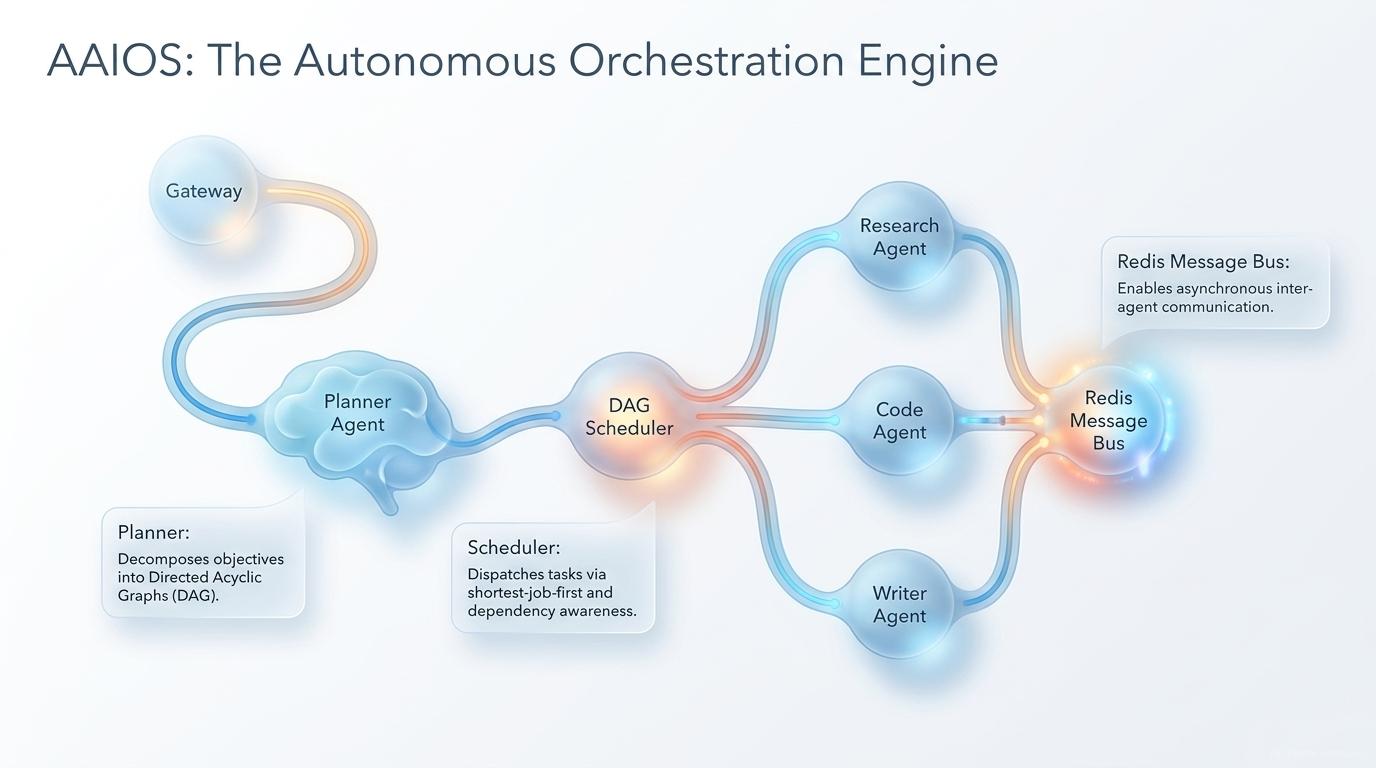
A planner converts a user objective into a DAG of tasks. A scheduler can then execute independent branches concurrently and respect dependencies where ordering matters. Research, code, and writing agents communicate through a shared message bus rather than by continually expanding a single conversation transcript.
The important production property is not the number of agents. It is the existence of an explicit execution model.
A useful scheduler needs to answer questions that a plain chat loop usually hides:
- Which tasks are ready to run?
- Which tasks depend on other outputs?
- Which work is higher priority?
- Which failures are retryable?
- Which state belongs in short-term memory versus persistent memory?
- Which events should wake another agent?
The diagram uses Redis as the asynchronous message bus. That is a practical choice for decoupling producers and consumers, but the deeper principle is transport independence: agents should communicate through explicit messages and task state, not by relying on shared prompt history as the only source of truth.
4. Scheduling, Memory, and Retry Logic Are System Features
The comparison in the deck makes a strong architectural claim: the differentiator is not simply “multi-agent” behavior but the presence of operating-system-style primitives.
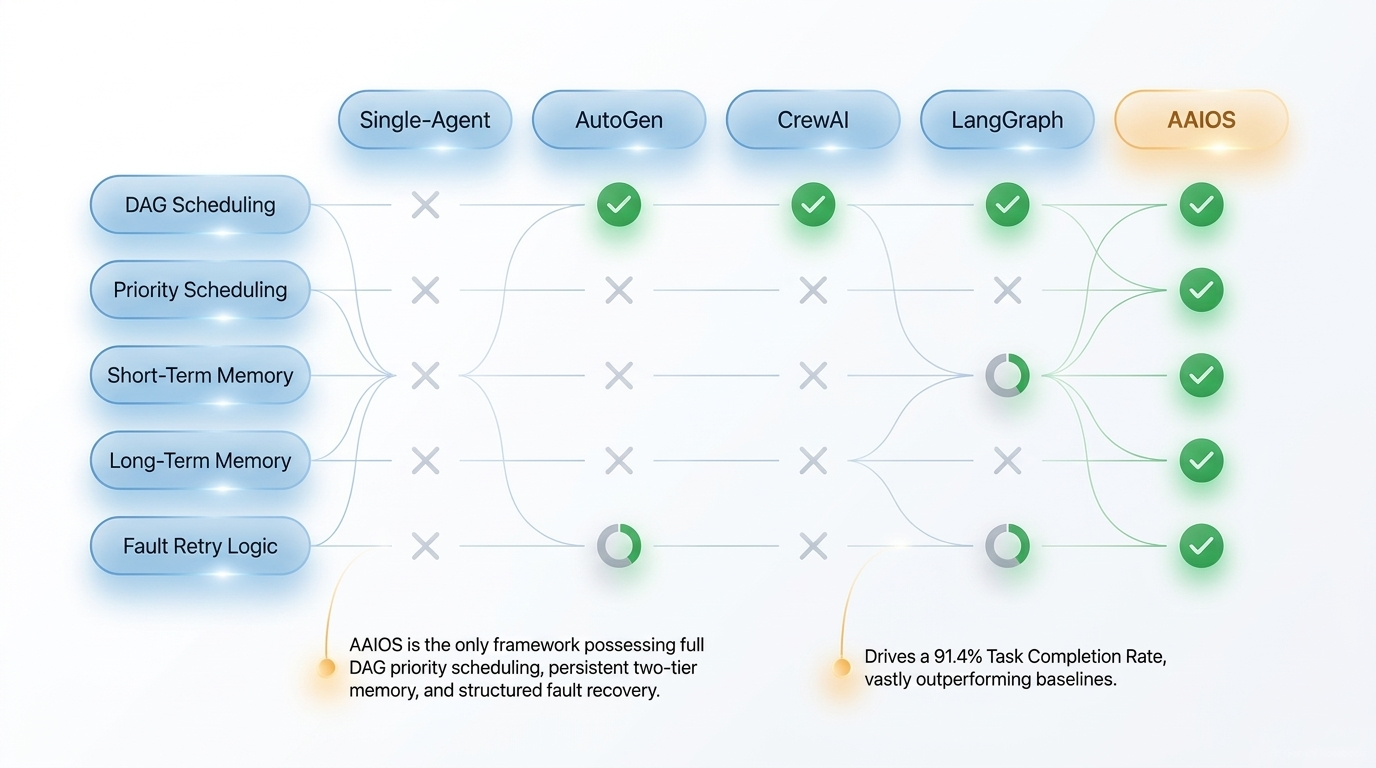
The feature set highlighted for AAIOS includes DAG scheduling, priority scheduling, short-term memory, long-term memory, and structured fault-retry logic. Whether a particular framework supports these features natively or through extension can change over time, so the comparison should be interpreted as the deck's stated configuration rather than a permanent market taxonomy.
The design point is still useful. A production digital worker needs these capabilities somewhere in the stack.
DAG scheduling prevents an agent from serializing work that could safely proceed in parallel. Priority scheduling gives urgent or blocking tasks precedence. Short-term memory keeps immediate execution state inexpensive to retrieve. Long-term memory prevents completed work from bloating the active context. Retry policies distinguish transient failure from structural failure.
The deck reports a 91.4% task-completion rate for the AAIOS configuration. The value matters less than what it is meant to demonstrate: reliability is improved when orchestration, memory, and recovery are designed as infrastructure rather than improvised inside prompts.
5. Two-Tier Memory: Keep Immediate State Fast and Historical State Selective
The memory design separates short-term execution state from long-term semantic memory.
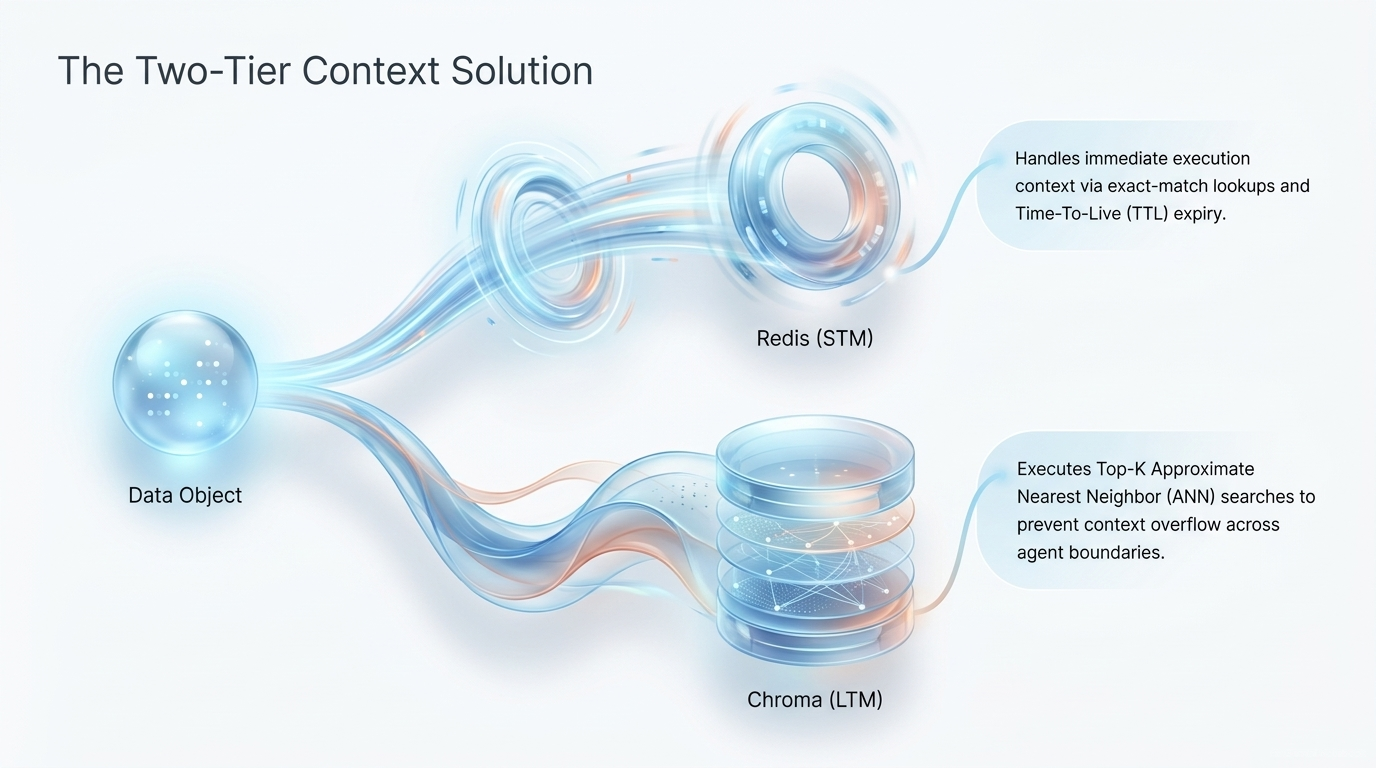
In the depicted architecture, Redis holds short-lived context with exact-match lookup and time-to-live expiration. This is where task-local state belongs: current identifiers, recent outputs, transient locks, checkpoints, or intermediate results that are useful now but should not live forever.
Long-term memory is represented using Chroma and approximate nearest-neighbor search. Instead of replaying every historical item into the model, the system retrieves only the most relevant prior context for the current task.
That split addresses two different retrieval problems:
- Operational lookup: “What is the current state of task X?” Exact, fast, deterministic retrieval is preferable.
- Semantic recall: “Which prior artifact is most relevant to this new step?” Similarity search is useful because the match may be conceptual rather than exact.
The failure mode to avoid is indiscriminate memory. Persisting everything is easy; retrieving the right subset is the real design challenge. Long-term memory should reduce active context, not become a second unbounded context window.
6. GUI Grounding Is a Semantic-to-Geometric Translation Problem
Computer-use models do not fail only because they misunderstand intent. They also fail because they know what to click but not where it is.
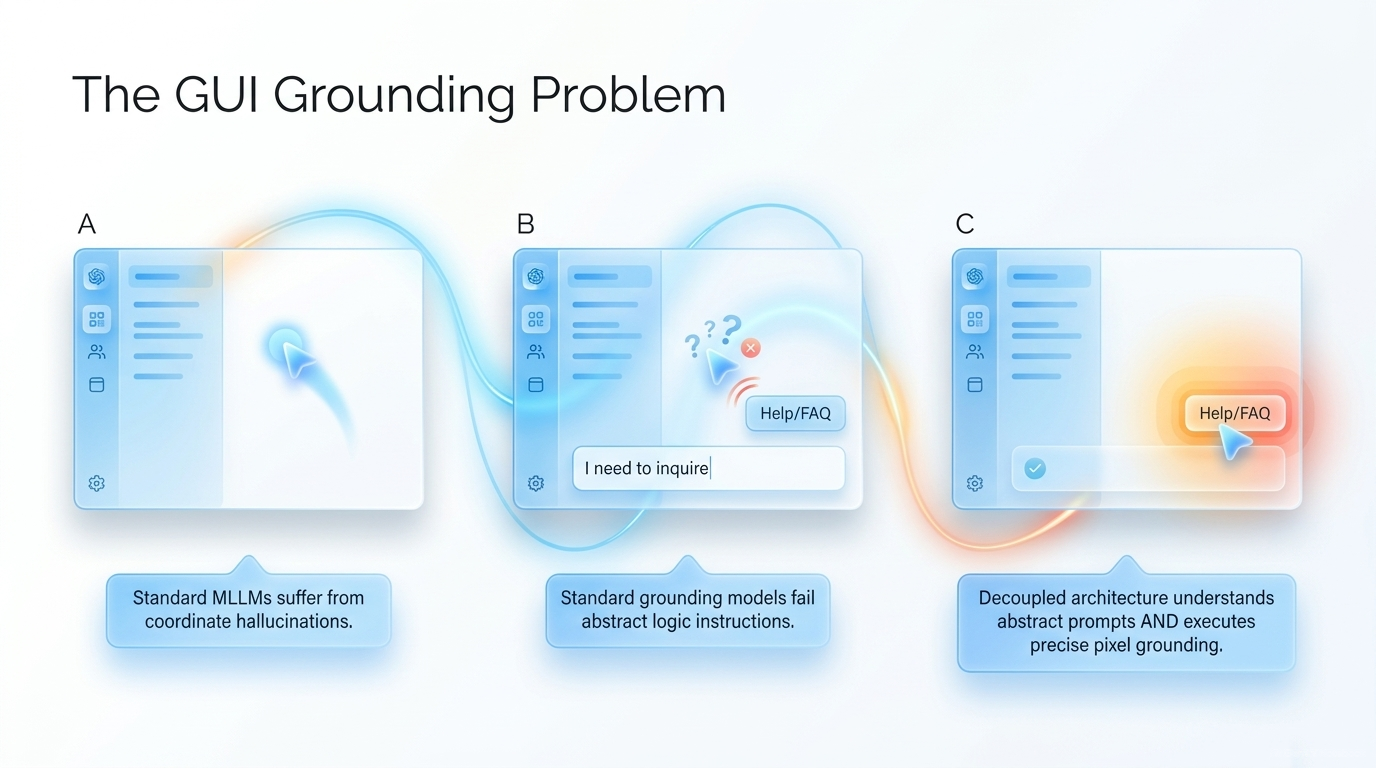
The deck distinguishes three cases. In the first, a model produces an imprecise or hallucinated coordinate. In the second, a grounding model struggles when the instruction is semantically abstract. In the third, reasoning and geometry are separated: one component interprets the intent and another resolves it to a precise target.
This separation is important because semantic reasoning and coordinate prediction place different demands on a model. A large multimodal model may be excellent at understanding that “I need to inquire” implies the Help/FAQ area, yet still be unreliable when asked to regress exact pixel coordinates across varying resolutions and layouts.
A robust computer-use stack should therefore treat grounding as a dedicated subsystem rather than a side effect of natural-language reasoning.
7. Decouple Semantic Reasoning from Geometric Grounding
The proposed grounding architecture freezes the multimodal language model and delegates localization to a lightweight geometric fusion stage.
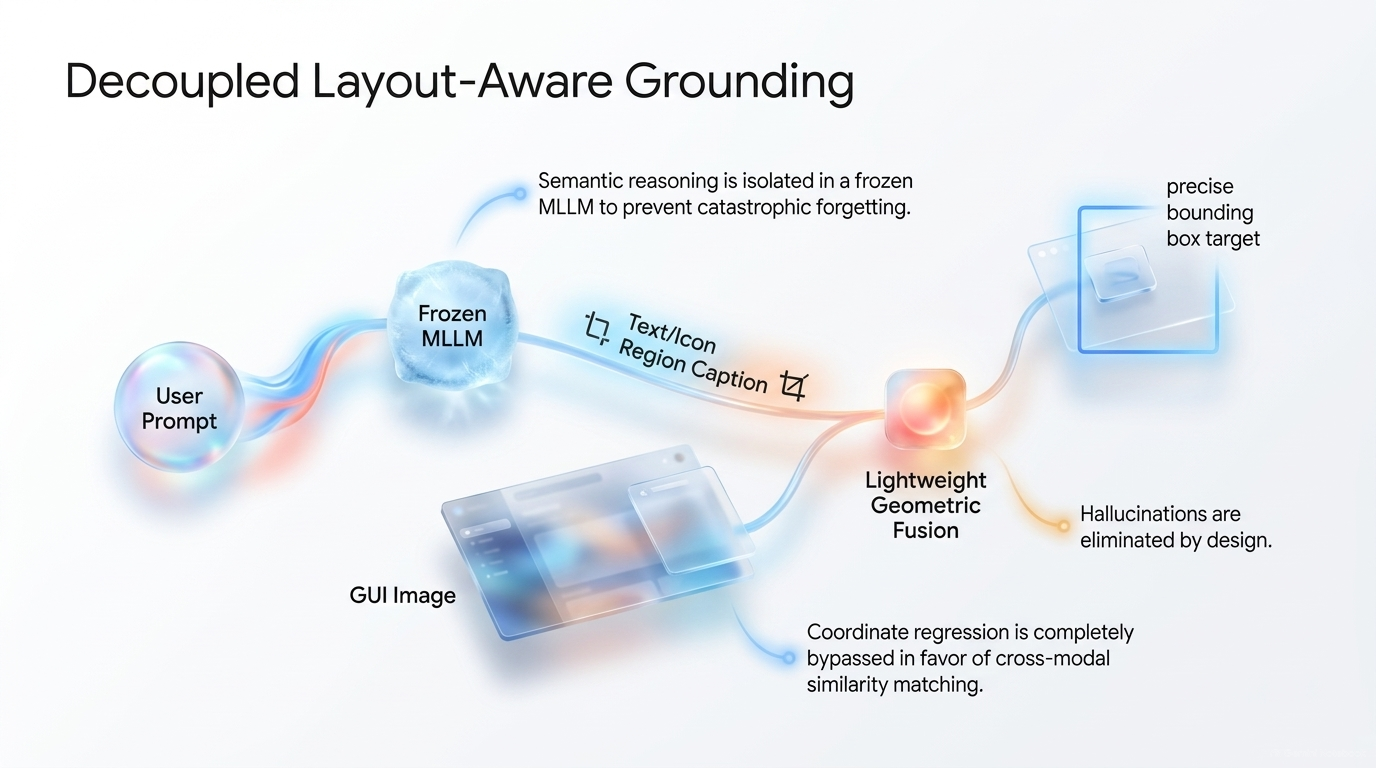
The frozen MLLM provides a semantic description of the intended text or icon region. A separate geometric component combines that semantic target with the GUI image and identifies the most likely bounding box.
This design avoids asking the large model to learn or continually relearn direct coordinate regression. In practical terms, it turns the workflow into two explicit questions:
- What visual object satisfies the user's intent?
- Where is that object in this specific frame?
The slide describes the result as eliminating hallucinations “by design.” That wording is stronger than most production systems can guarantee. A more defensible interpretation is that decoupling removes one major source of coordinate hallucination by constraining the localization stage to a bounded geometric matching problem.
The architecture also reduces catastrophic-forgetting risk if the semantic model remains frozen while a smaller grounding component adapts to layout-specific data.
8. Bound the Visual Processing Space
Grounding accuracy depends on the size and resolution of the visual search space.
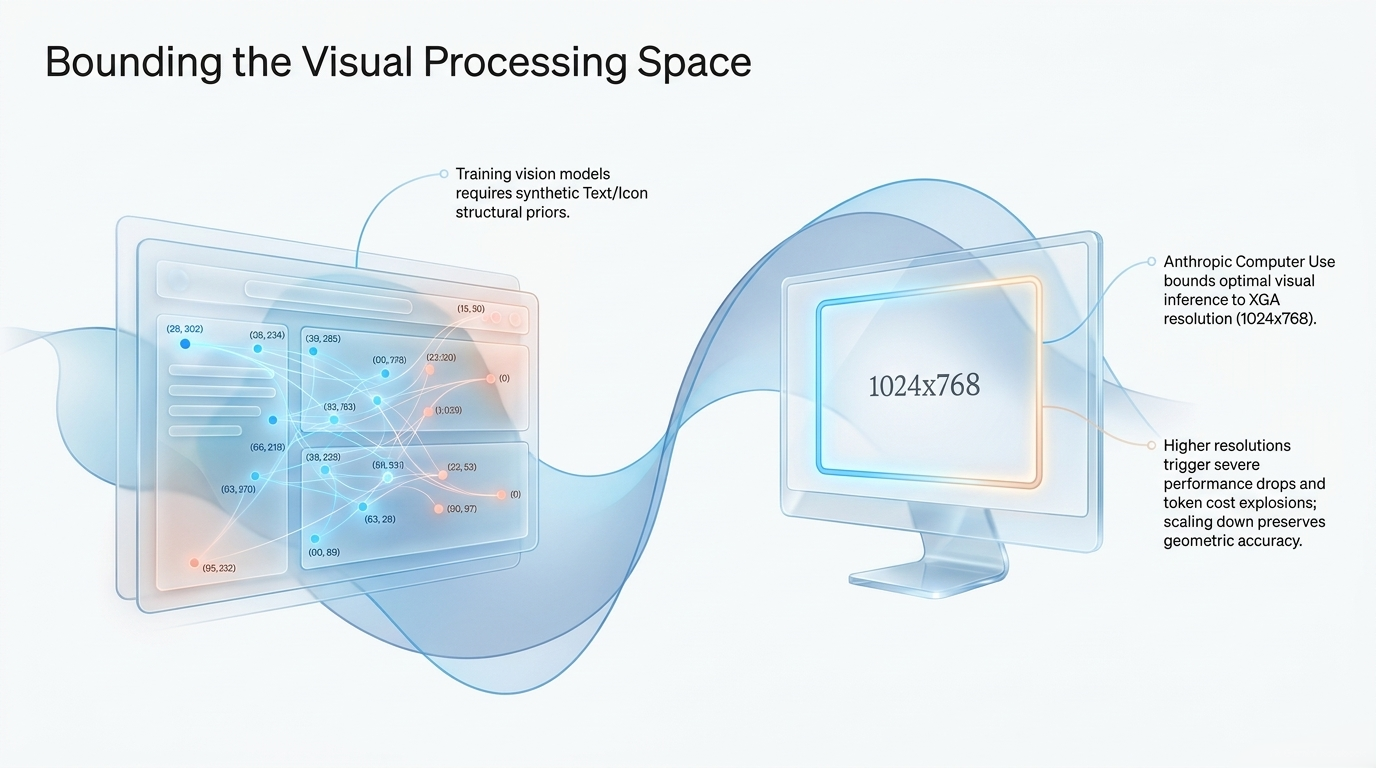
The deck proposes normalizing computer-use inference to 1024×768 (XGA). The rationale is practical: higher resolutions increase token or patch cost and can make the geometric search problem harder without proportionally improving target selection.
There is an engineering trade-off here. Downscaling can improve throughput and standardize coordinates, but it can also erase small text, dense controls, or fine-grained state. A production system should therefore treat resolution as a policy, not a dogma. The right pipeline may use a normalized frame for coarse grounding and selectively crop or zoom when a target remains ambiguous.
The broader principle is sound: do not expose an agent to an arbitrarily large visual state space if the task can be solved inside a smaller, normalized one.
9. Execution Should Use a Small, Bounded Action Vocabulary
Once a target is grounded, execution should be constrained to a narrow set of actions.
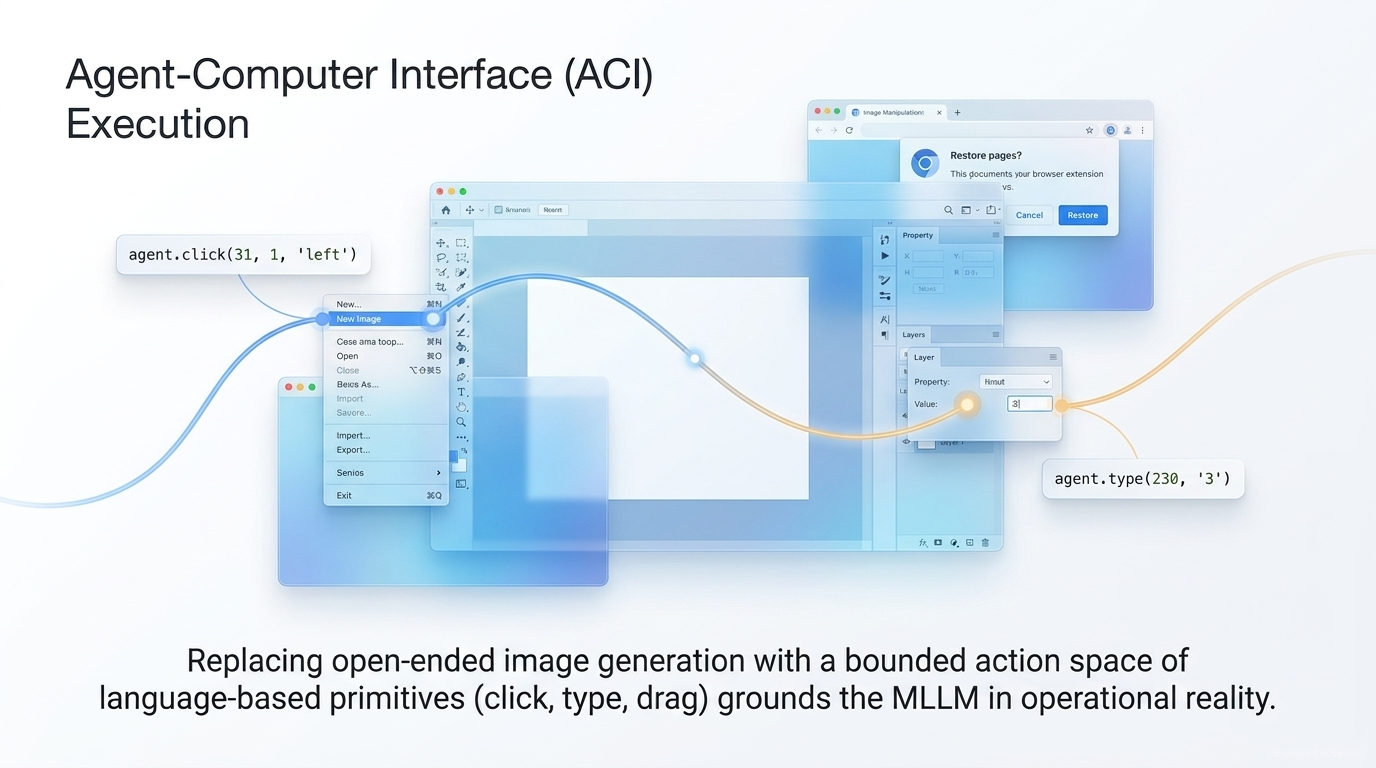
The deck calls this the Agent-Computer Interface (ACI). Instead of asking the model to generate an open-ended image transformation or an unconstrained script, it emits operational primitives such as click, type, and drag.
This creates an important control boundary. A planner can express high-level intent, but the executor accepts only known actions with explicit parameters. That makes the system easier to validate, audit, simulate, and retry.
Bounded actions also make failures legible. A failed click(target) can be retried after re-grounding. An incorrect type(value) can be detected by checking field state. A drag can be validated against a resulting UI change. Open-ended generation provides far fewer deterministic checkpoints.
For production use, the action layer should also enforce permissions and safety policies. The architecture in the deck does not specify a governance model, but the ACI boundary is a natural place to implement one because every consequential interaction passes through it.
10. Vision Is the Wrong Tool for High-Volume Structural Extraction
Visual automation is useful when the interface itself is the object of interaction. It scales poorly when the objective is to extract large amounts of structured page content.
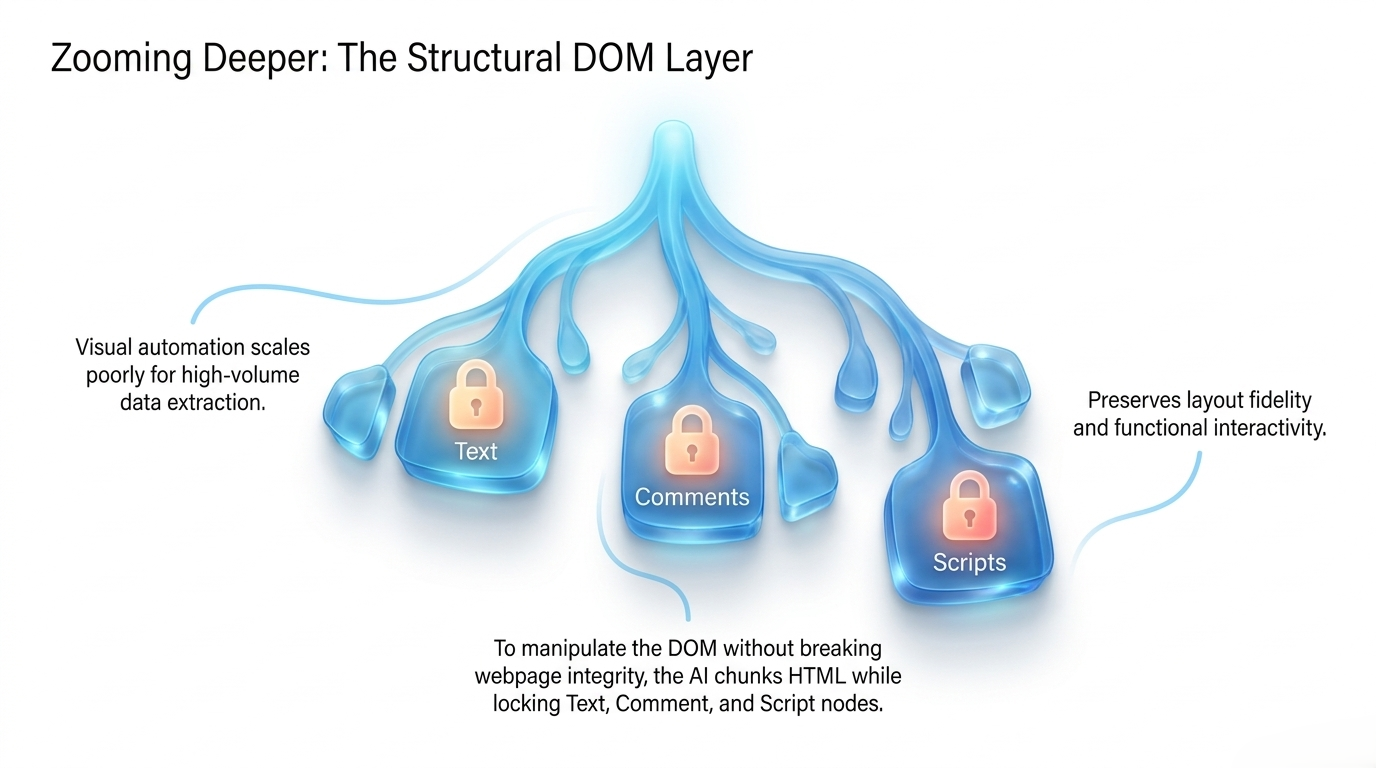
The deck's “hands” layer moves down into the DOM. The central idea is to chunk the HTML structure while preserving nodes that are important for semantic and functional integrity, including text, comments, and scripts.
This allows the system to operate on a structural representation rather than repeatedly reading screenshots. It also preserves relationships that are awkward to infer visually: hierarchy, attributes, hidden state, element roles, and programmatic content.
The practical rule is simple: use vision to understand the rendered interface; use structure when the task is fundamentally about data.
A hybrid computer-use agent should be able to switch modes. It may visually locate a table, then structurally extract its rows. It may visually verify that a modal opened, then inspect the DOM for the underlying fields. It may use the DOM to identify a semantic target, then return to the ACI layer for an interaction that must occur through the user interface.
11. Stop Treating CSS Selectors as Permanent Contracts
Traditional browser automation often depends on hardcoded CSS selectors. Those selectors are efficient when they work and brittle when a frontend changes class names, nesting, or component structure.
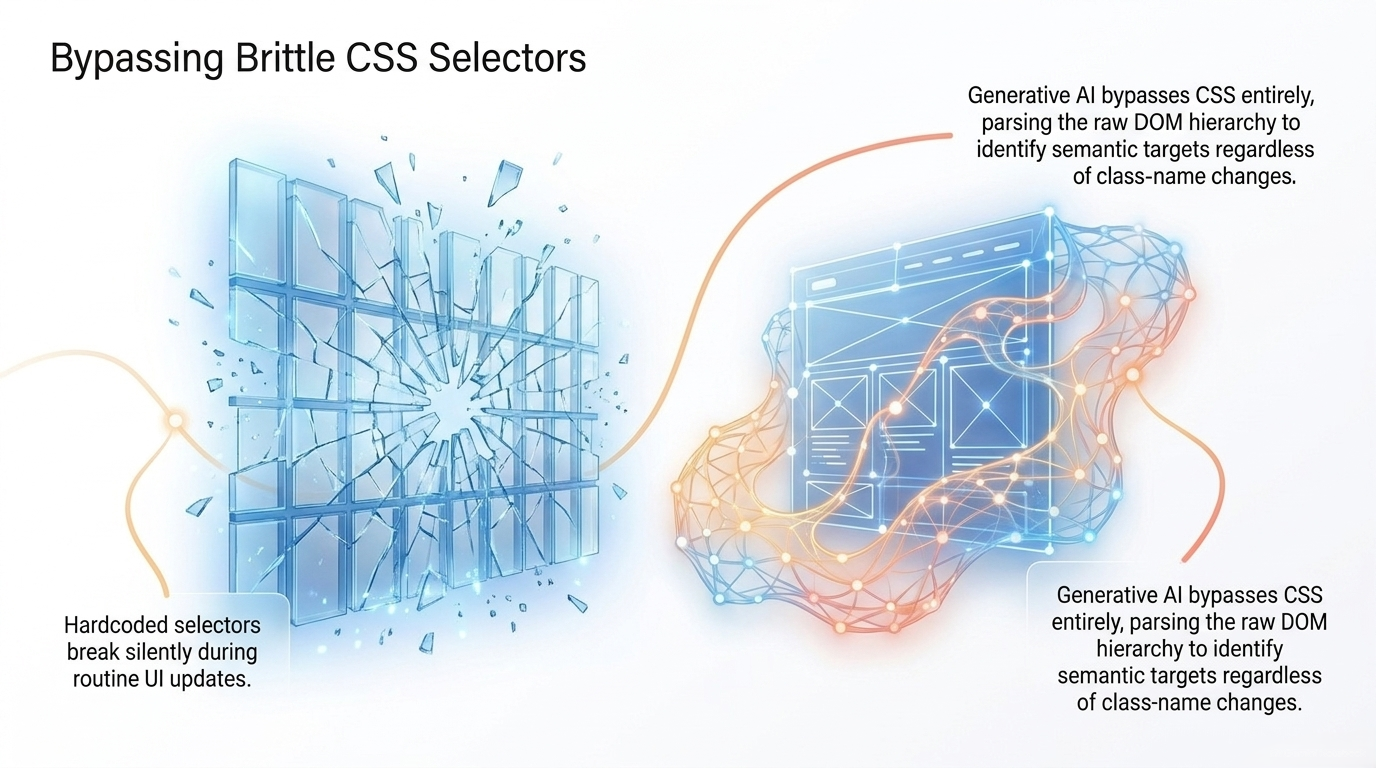
The alternative shown here is to parse the raw DOM hierarchy and identify targets semantically rather than assuming that a selector remains stable forever.
This is not an argument to discard deterministic selectors. If a stable selector is known and validated, it is still the fastest path. The better pattern is to treat selectors as cached structural knowledge, not as immutable truth.
That distinction enables self-healing automation. A selector can be used while it remains fresh. If the page drifts, the system can regenerate a target from the new structure instead of failing permanently.
The strongest architecture is therefore hybrid: deterministic when the page is known, model-assisted when the structure changes.
12. Self-Healing Should Be a Controlled Fallback, Not the Default Path
The deck's extraction pipeline formalizes that hybrid approach.
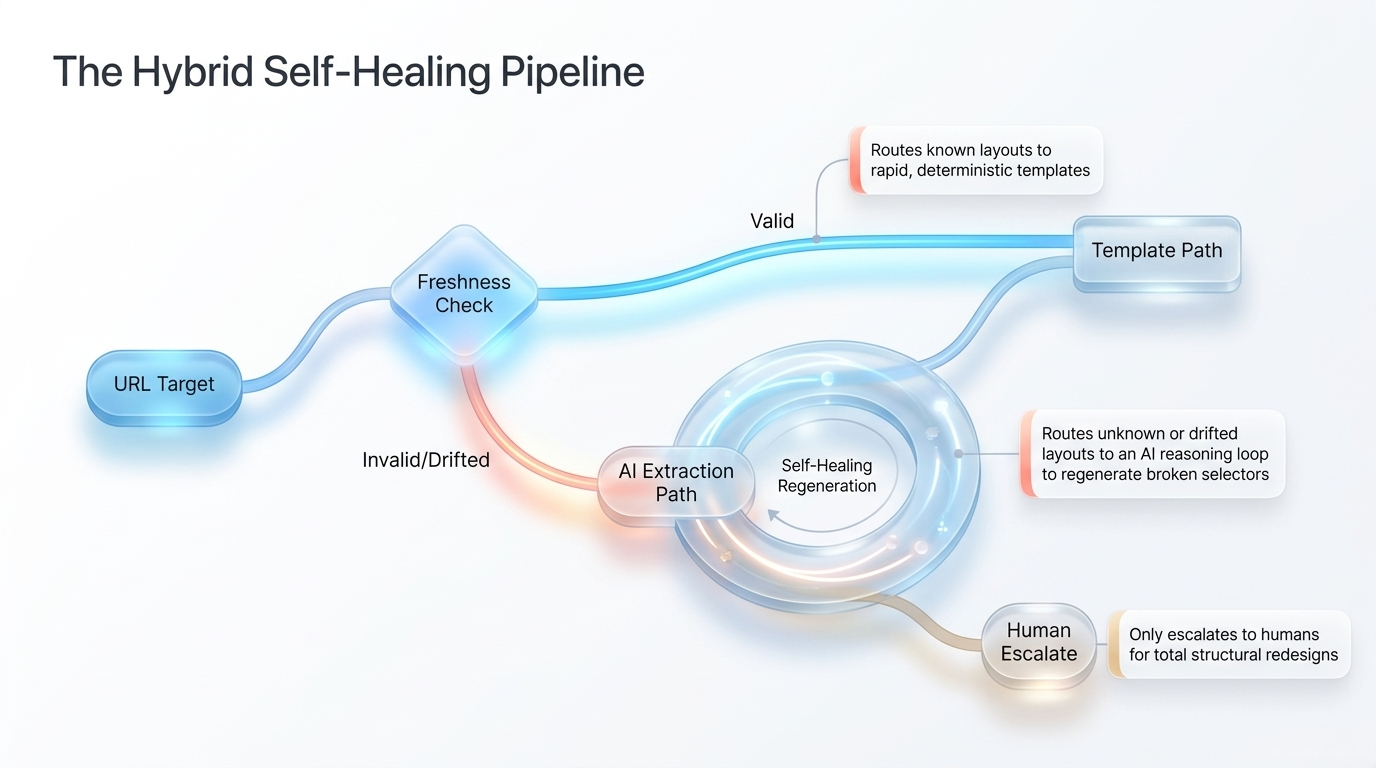
A URL target first passes through a freshness check. If the known layout is still valid, the system follows a fast template path. If the layout is invalid or has drifted, execution moves to an AI extraction path that reasons about the changed structure and regenerates the broken mapping.
Human escalation is reserved for cases where the structural change is too large to repair automatically.
This is a better production pattern than sending every page through a model. Deterministic templates are cheaper, faster, and easier to test. AI is most valuable as an exception handler for the cases that deterministic automation cannot confidently resolve.
A robust implementation should attach confidence and validation to each regeneration step. “Self-healing” without a verification gate can silently convert one broken selector into a different wrong selector. Recovery should therefore include post-conditions such as expected element counts, schema checks, content signatures, or known invariants.
13. Benchmark the Layers Independently
The deck summarizes performance across orchestration, memory, and grounding rather than relying on a single end-to-end score.
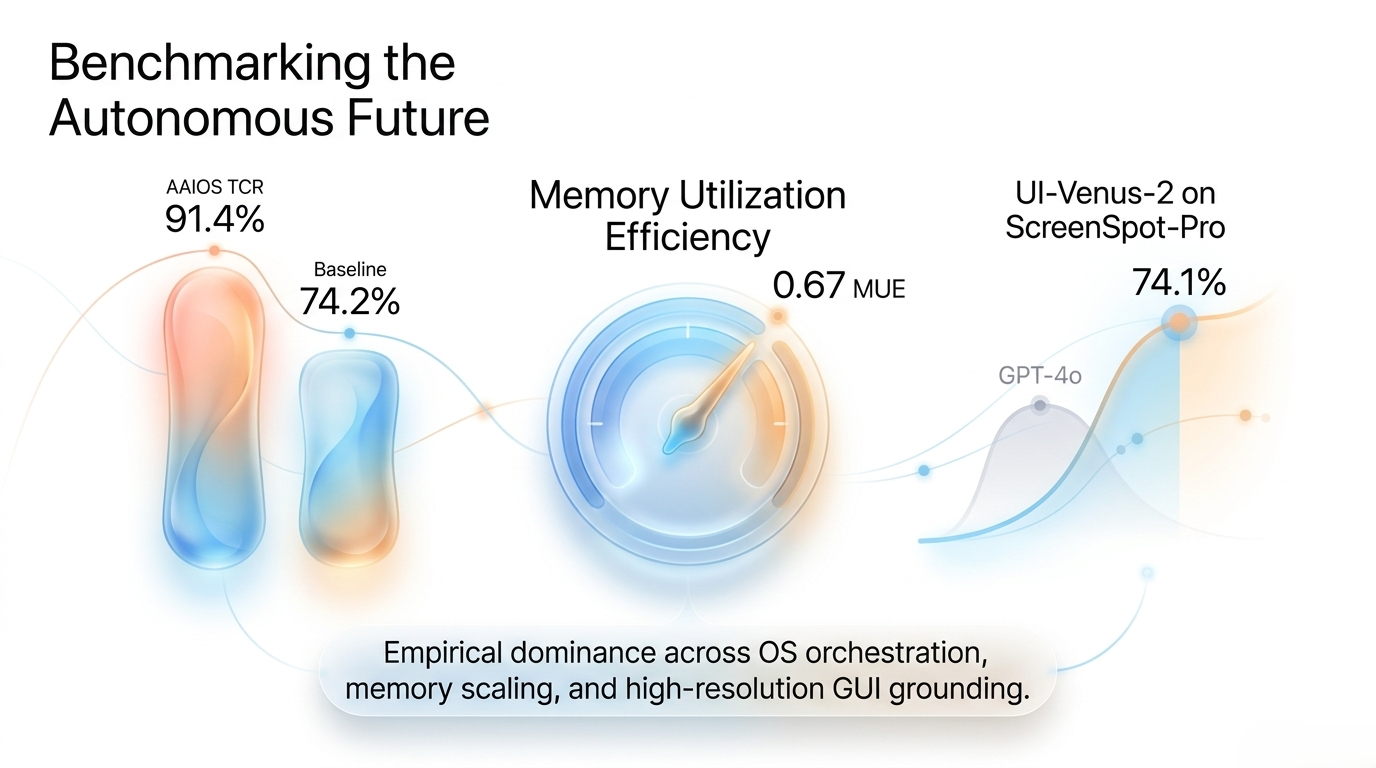
The reported figures are:
- 91.4% AAIOS task-completion rate, compared with a 74.2% baseline in the presented benchmark.
- 0.67 memory-utilization efficiency (MUE) as reported by the deck.
- 74.1% for UI-Venus-2 on ScreenSpot-Pro, with GPT-4o shown as a lower comparison point in the visual.
These numbers are useful only if their evaluation protocols are preserved. A production team should record dataset versions, task definitions, failure criteria, model versions, inference settings, and confidence intervals where appropriate. Without that context, benchmark values become marketing numbers rather than engineering evidence.
The more durable evaluation strategy is layered. Measure orchestration separately from grounding. Measure grounding separately from extraction. Then test the whole workflow under realistic interface drift, latency, retries, and partial failures.
This makes regressions diagnosable. If end-to-end completion falls, the team can tell whether the problem came from the scheduler, the memory system, target localization, or structural extraction.
Engineering Principles
The architecture ultimately depends on several principles:
-
Decompose by failure mode
Orchestration, GUI grounding, and DOM extraction should be separate components because they fail for different reasons and require different recovery paths. -
Treat context as a managed resource
Short-term state should remain small and fast. Long-term memory should be retrieved selectively rather than replayed wholesale. -
Prefer bounded execution interfaces
A small action vocabulary makes behavior easier to validate, audit, retry, and govern. -
Use deterministic paths when they are still valid
Templates and known selectors should remain the fast path. Model-based reasoning should repair or extend them when structural drift occurs. -
Benchmark components, not just demos
End-to-end success matters, but component-level metrics are what make failures actionable.
Production Implications: Reliability Needs More Than Models
The visual architecture is convincing, but a production deployment would still need explicit controls around it.
Security and governance. The ACI should enforce which applications, domains, actions, and data classes an agent may access. Credentials should not be stored in model context. High-impact actions should support approval gates or policy checks before execution.
Observability. Every task should produce traceable events: planner decisions, DAG state transitions, messages, grounding candidates, chosen coordinates, DOM targets, retries, and validation outcomes. Without this, a multi-agent system becomes difficult to debug precisely because its execution is distributed.
Idempotency and recovery. A retry must not accidentally repeat a consequential action such as submitting a form twice. Tasks need stable identifiers, checkpoints, and post-condition checks so the scheduler can resume safely after interruption.
Model and interface drift. Both sides can change. Model upgrades may alter reasoning or grounding behavior; applications may redesign their interfaces. Regression suites should therefore capture representative UI states and expected actions, not just textual outputs.
Human escalation. Escalation is not a failure of autonomy. It is a reliability mechanism for cases where the system's confidence is low or the environment has changed beyond known recovery rules.
Final Synthesis
The complete design looks less like a chatbot with tools and more like a small operating environment for autonomous work.
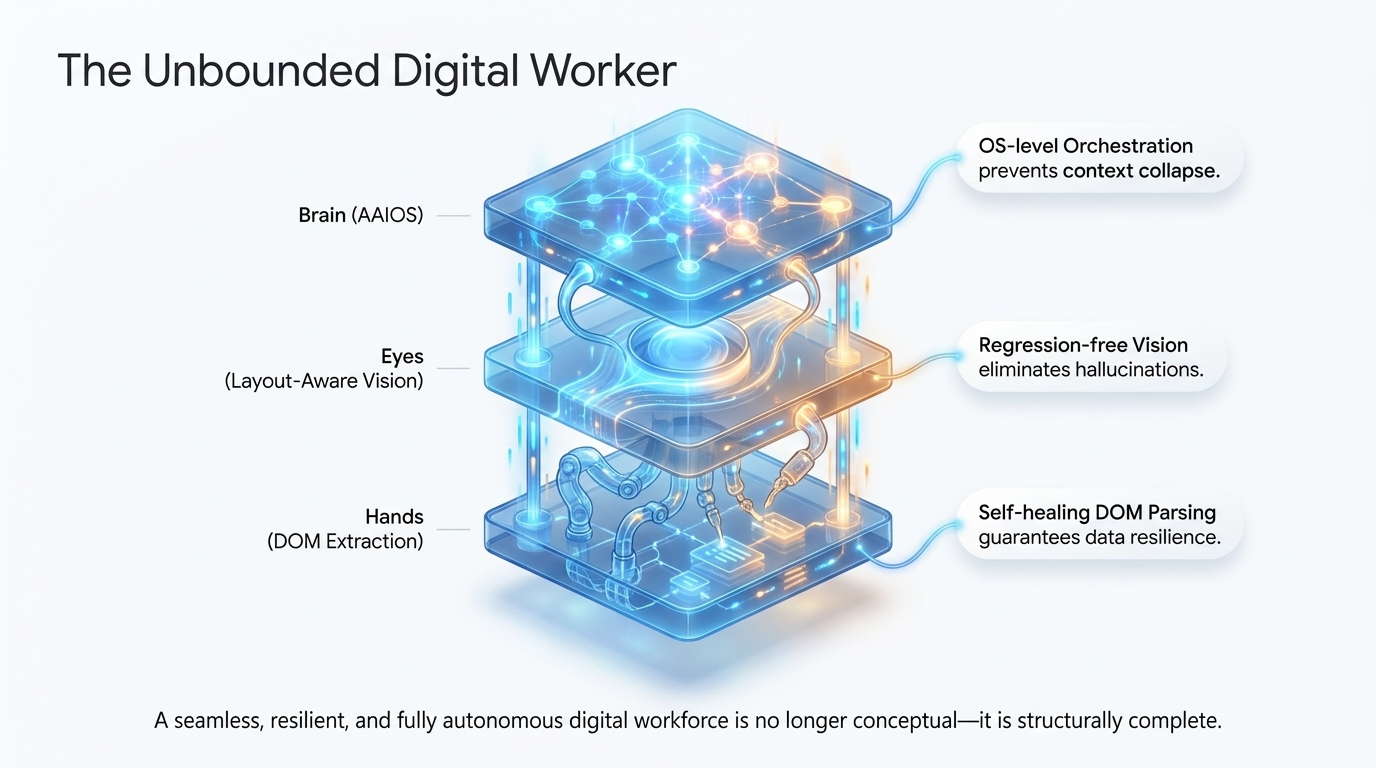
The brain handles decomposition, scheduling, messaging, memory, and retries. The eyes turn semantic intent into layout-aware targets while keeping the geometric problem bounded. The hands use DOM structure and self-healing extraction when pixel-based interaction is no longer the right abstraction.
The production-ready system combines:
- Deterministic foundations: task graphs, templates, known selectors, explicit action primitives, and validation rules.
- Testing layers: component benchmarks for orchestration, grounding, extraction, and end-to-end task completion.
- Agent and AI layers: planners, specialist agents, semantic grounding, and AI-assisted regeneration for drifted layouts.
- Security and governance: permissions, action policies, credential isolation, and approval gates for consequential operations.
- Observability: distributed traces across task state, messages, model decisions, target selection, retries, and outcomes.
- Operational resilience: bounded context, selective memory, self-healing fallbacks, and human escalation when confidence is insufficient.
The system is “unbounded” only from the user's perspective. Internally, reliability comes from doing the opposite: bounding context, bounding actions, bounding visual search, and bounding failure recovery with explicit architecture.
Closing Thought
The path from chatbot to digital worker is not primarily about making a model more autonomous. It is about giving autonomy a reliable substrate.
A capable agent reasons; a dependable digital worker is orchestrated, grounded, observable, and recoverable.