
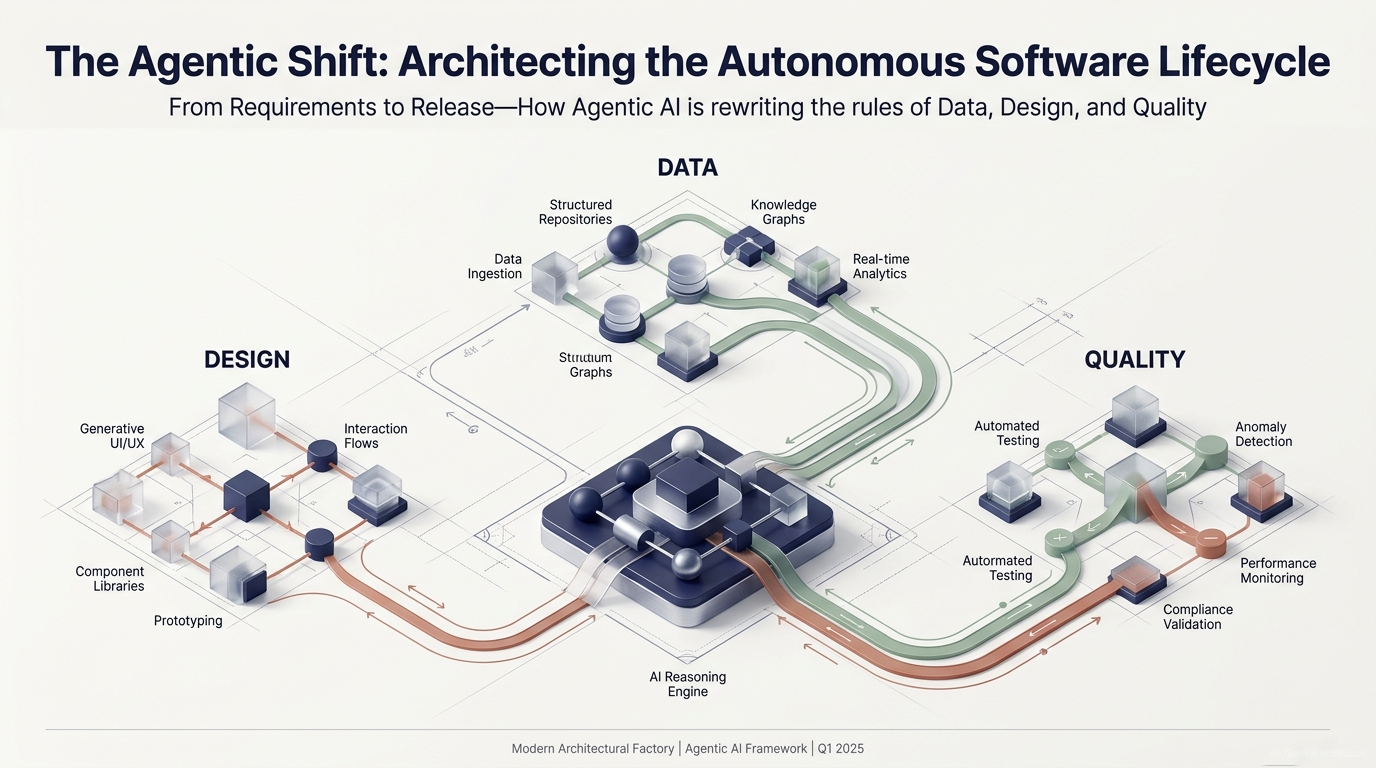
The Agentic Shift: Architecting the Autonomous Software Lifecycle
Software teams have spent years automating individual tasks, yet the hardest work often remains stubbornly manual: turning ambiguous intent into executable requirements, keeping data-quality rules aligned with changing systems, maintaining brittle test suites, and deciding which machine-generated changes can safely reach production.
Agentic AI changes the shape of that problem. Instead of treating AI as a faster interface for human-directed steps, the architecture shown here treats agents as goal-led participants in a governed software lifecycle. Specialized agents gather context, reason over machine-readable contracts, execute bounded workflows, observe outcomes, and feed what they learn back into the next cycle.
The central engineering challenge is therefore not simply adding an LLM to existing automation. It is building a system in which autonomous components have clear definitions of “good,” reliable context, observable actions, explicit boundaries, and human approval where risk demands it.
1. The Scale-Speed Paradox
The first pressure point is the widening gap between machine throughput and human rule-writing capacity. AI-assisted development, fast release cycles, and growing data volumes can change a system faster than teams can manually author and maintain every validation rule, test condition, and exception path.
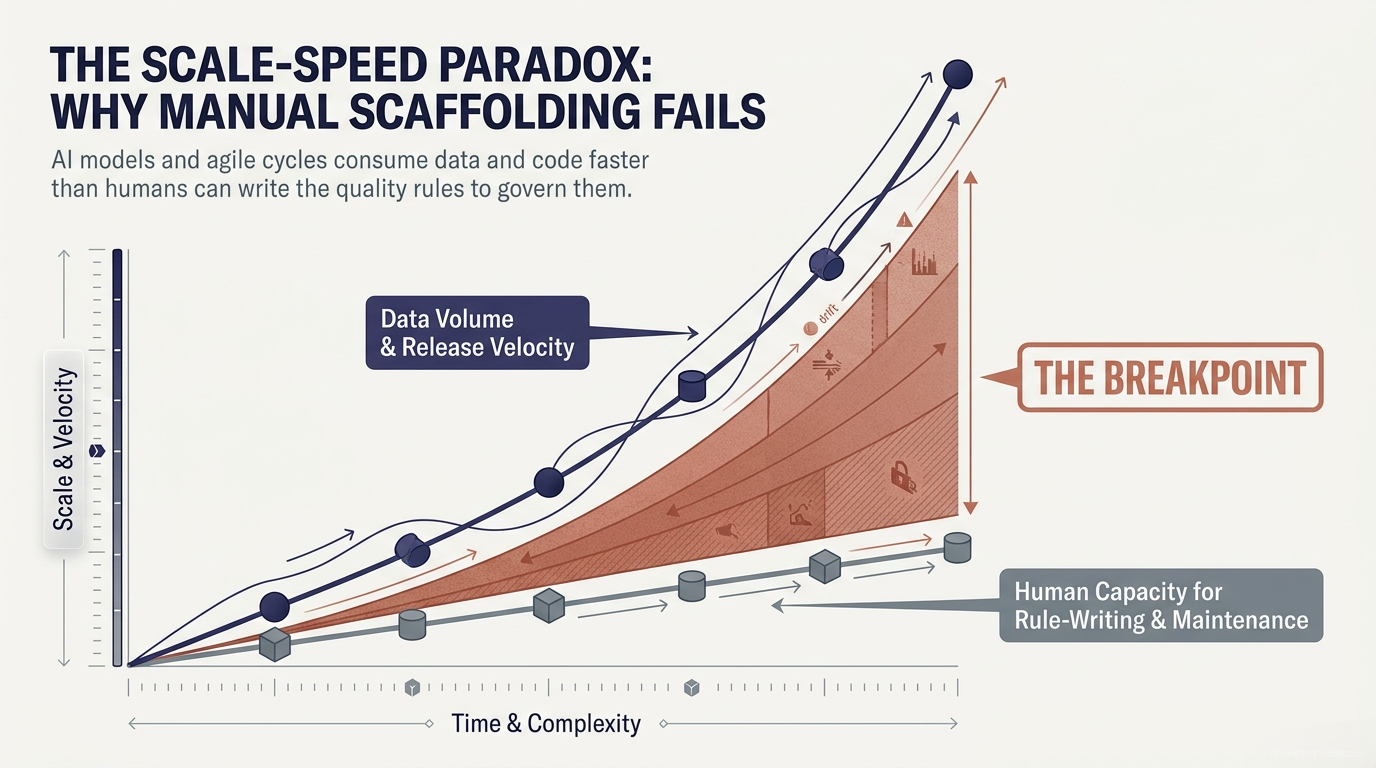
The diagram frames a breakpoint: data volume and release velocity accelerate while human capacity for rule-writing and maintenance grows much more slowly. That gap is where traditional quality scaffolding begins to fail. Static rules still have value for stable, well-understood invariants, but they do not scale gracefully when schemas drift, interfaces change, requirements are revised, or novel failure modes appear.
The architectural implication is important: quality cannot remain a downstream activity that expands linearly with system complexity. It needs reusable contracts, automated context gathering, adaptive detection, and continuous feedback.
2. From Copilot to Autonomous Agent
Assistive AI and agentic AI differ less in model capability than in operating model.
In the assistive pattern, the human initiates each step, remains in the driver’s seat, and uses AI to propose syntax, text, or local changes. In the agentic pattern, the human sets a goal, the system plans a bounded workflow, and the human shifts toward approval, exception handling, and governance.
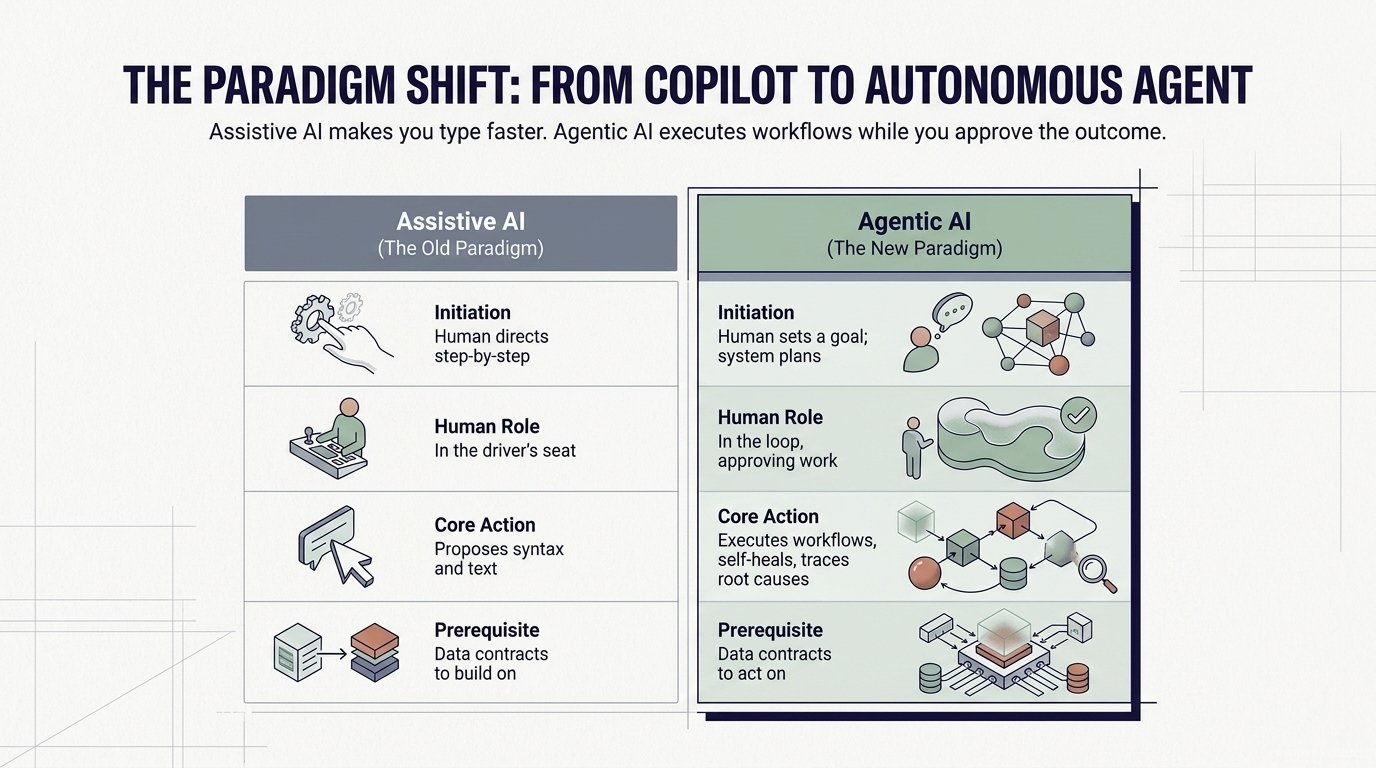
That change introduces a new prerequisite: the system needs machine-readable foundations it can act on. The visual calls out data contracts in both paradigms, but their role becomes more critical under autonomy. A copilot can ask a human what “correct” means. An autonomous agent needs that definition encoded in a form it can evaluate during execution.
This is why “agentic” should not be treated as a synonym for “more automation.” The meaningful distinction is a controlled transfer of initiative from step-by-step human instruction to goal-directed machine execution.
3. Three Pillars of Agentic Transformation
The material organizes the transformation around three connected pillars:
- Design and requirements — converting fragmented human intent into precise, machine-readable requirements and testable specifications.
- Data management — replacing purely static quality gates with contract-driven, anomaly-aware monitoring and remediation.
- Quality assurance — generating, executing, observing, and maintaining tests as a continuous intelligence loop.
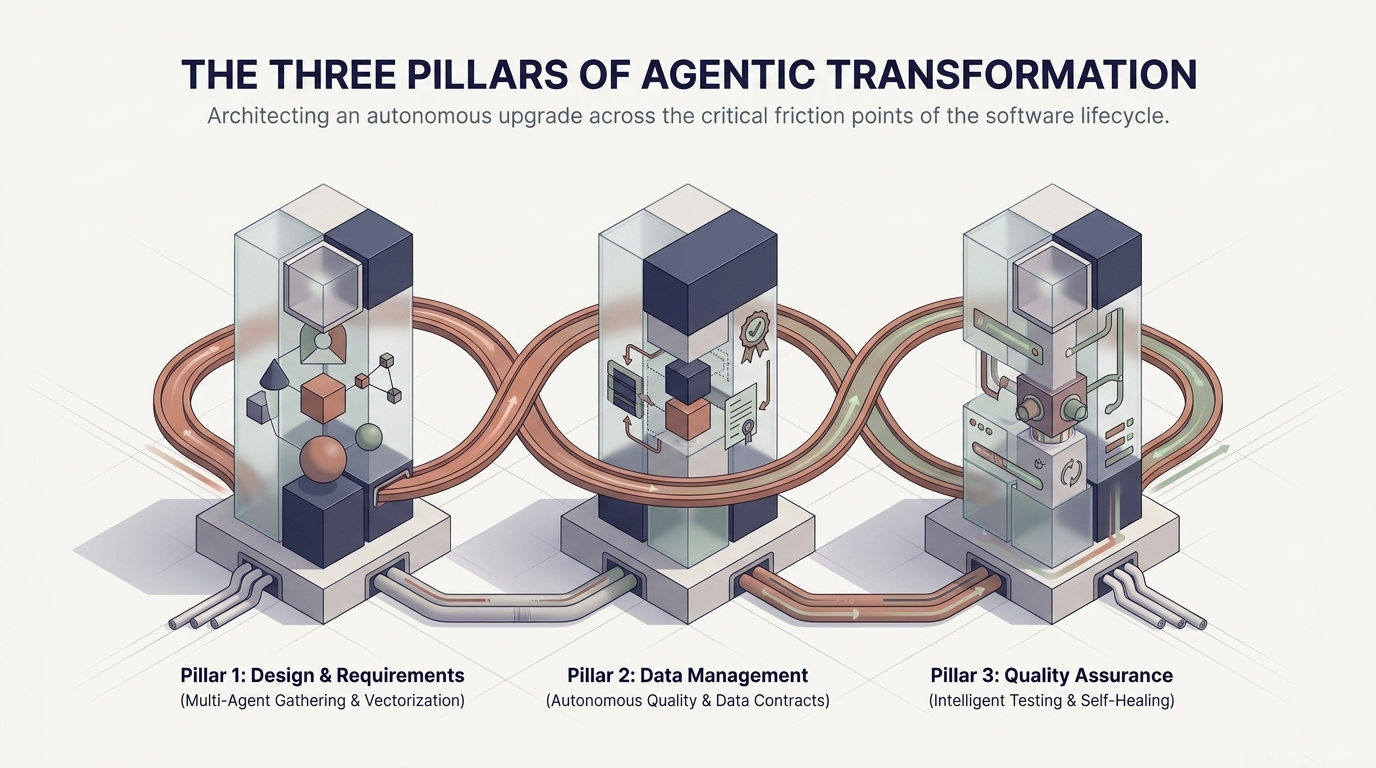
These are not independent workstreams. Requirements define expected behavior. Data contracts encode valid structure and quality thresholds. Testing proves that the implementation satisfies intent under real operating conditions. When the three are connected, each stage can provide context and evidence to the next.
The shared architectural theme is closed-loop execution: perceive context, reason over explicit constraints, act through controlled interfaces, observe the result, and refine the next decision.
4. Pillar 1: Requirements as an Executable Interface
Ambiguous requirements are expensive because ambiguity compounds. A vague statement in a meeting can become an unclear Jira ticket, an inconsistent implementation, and eventually a fragile test that captures the wrong behavior.
The proposed agentic pattern starts by gathering requirements from the places they already exist: messages, tickets, meeting transcripts, documentation, code, and stakeholder interviews. The goal is not to generate more prose. It is to converge on artifacts that are explicit enough to drive downstream work.
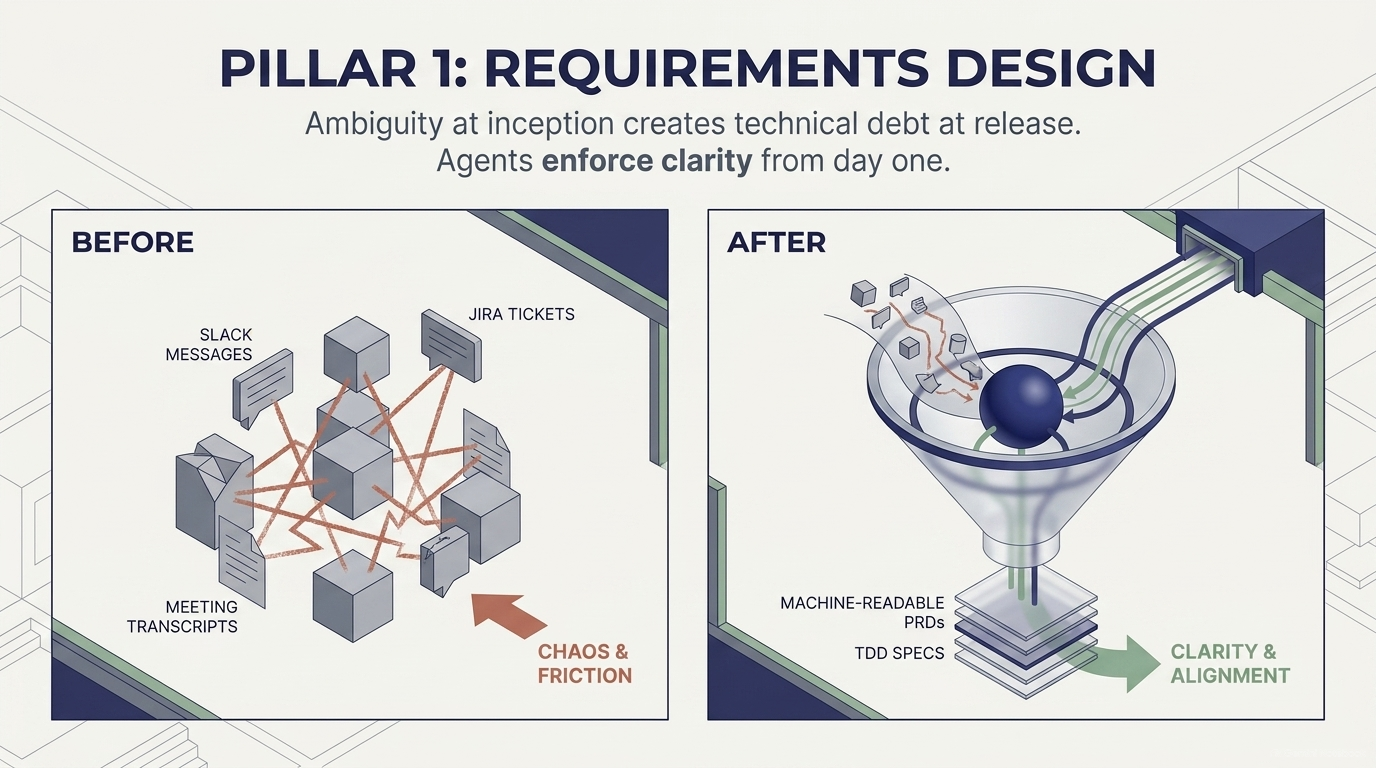
The “after” state emphasizes machine-readable PRDs and TDD specifications. That shift matters because executable structure creates a common interface between people, agents, and delivery tooling. Acceptance criteria can be validated. Missing information can be detected. Test scenarios can be derived from the same source of truth used during implementation.
A practical guardrail is to separate extraction from approval. Agents can collect, normalize, cross-reference, and propose requirements, but ambiguity that affects product behavior should be surfaced for resolution instead of being silently guessed.
5. A Multi-Agent Requirements Engine
The requirements-engine architecture uses several specialized agents around an asynchronous message hub:
- a documentation agent parses knowledge sources;
- a code analysis agent scans the codebase for implementation context;
- a stakeholder interview agent captures intent from conversations;
- a feedback coordination agent resolves conflicts and prioritizes open questions.
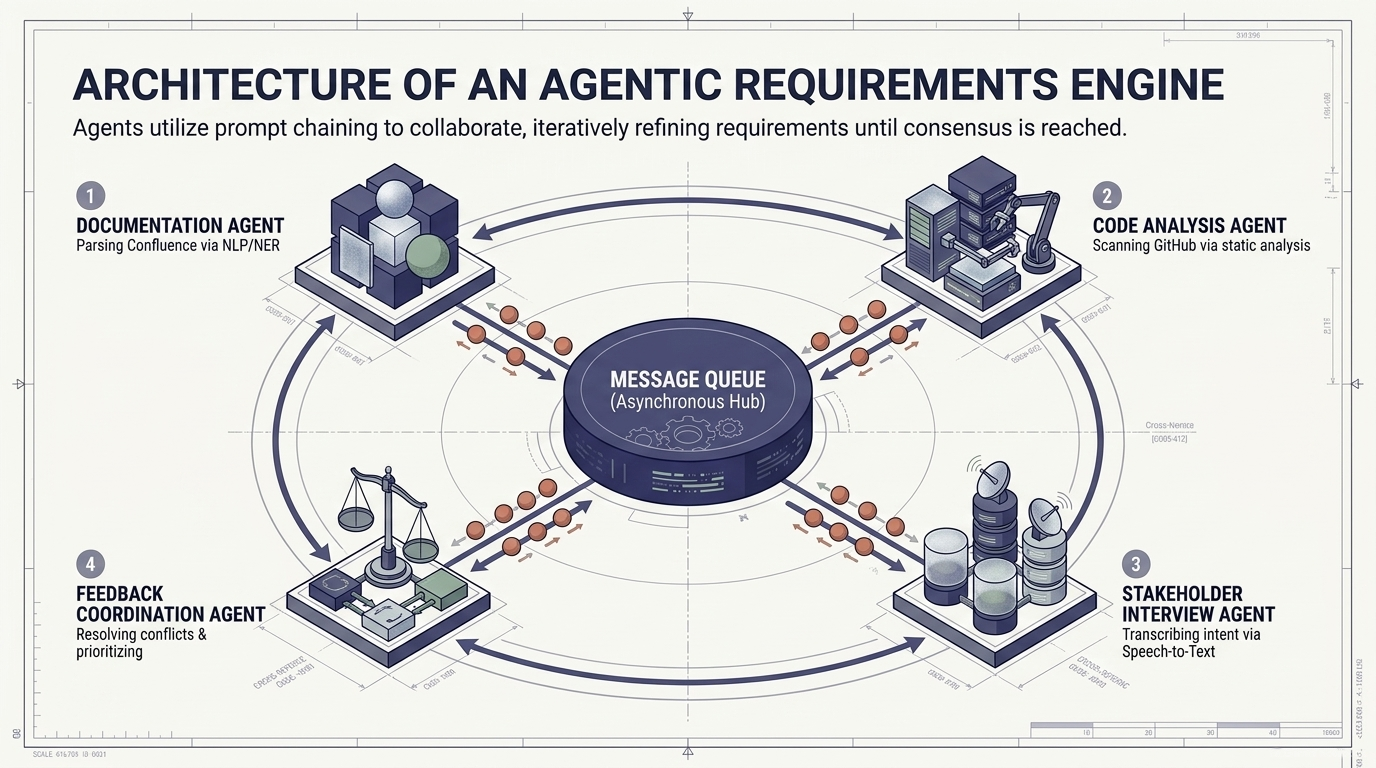
The message queue is more than a transport detail. It decouples the agents so that each can operate at its own pace, retry independently, and contribute partial evidence without requiring one giant prompt to contain the entire problem. This also creates a natural place to add audit records, correlation identifiers, rate limits, and policy checks.
Prompt chaining can then be used as an iterative refinement mechanism: one agent extracts evidence, another challenges it against code or existing specifications, and a coordinator decides whether the requirement is complete enough to advance.
Production validation should focus on traceability. Every generated requirement should be linked back to its supporting evidence, and every conflict should remain visible until a human or an explicit policy resolves it.
6. Pillar 2: Data Quality Beyond Static Rules
Traditional data-quality gates are effective when the failure is known in advance. They are weaker when the failure appears as a novel distribution shift, a silent null pattern, or schema drift that still satisfies a superficial type check.
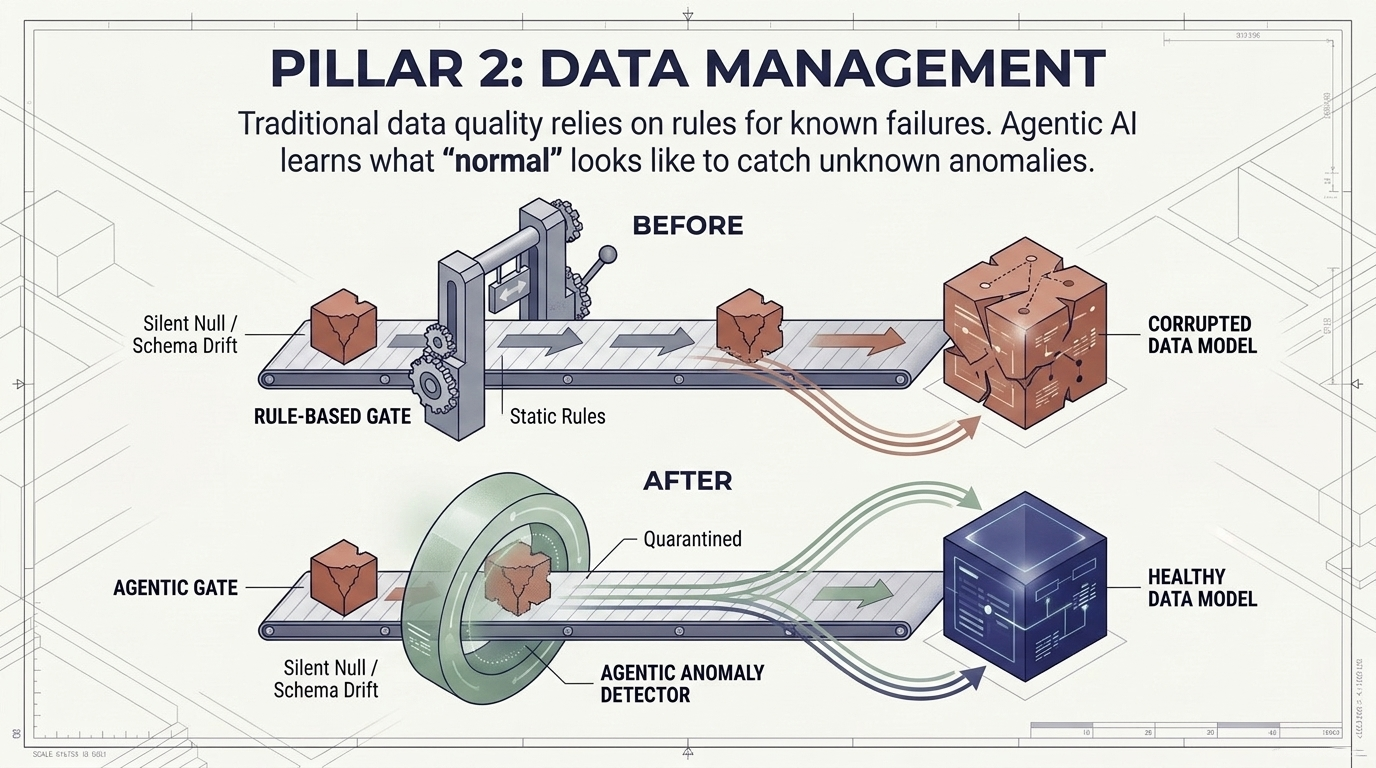
The proposed “after” state adds an agentic anomaly detector that learns a representation of normal behavior, quarantines suspicious changes, and prevents them from silently propagating into a corrupted data model.
This should not be interpreted as replacing deterministic checks. Known invariants remain valuable because they are explainable and cheap to evaluate. Agentic monitoring is strongest as a complementary layer for detecting conditions that were not pre-enumerated.
A robust design therefore combines:
- deterministic schema and business-rule validation;
- statistical or model-based anomaly detection;
- quarantine or holdback paths for uncertain changes;
- root-cause evidence and lineage;
- explicit promotion criteria before remediated data returns to the trusted path.
7. Data Contracts Are the Keystone
Autonomy becomes safer when “good” is encoded rather than implied. The data-contract visual describes a bridge from human intent to agentic execution through version-controlled, executable specifications with strict quality thresholds.
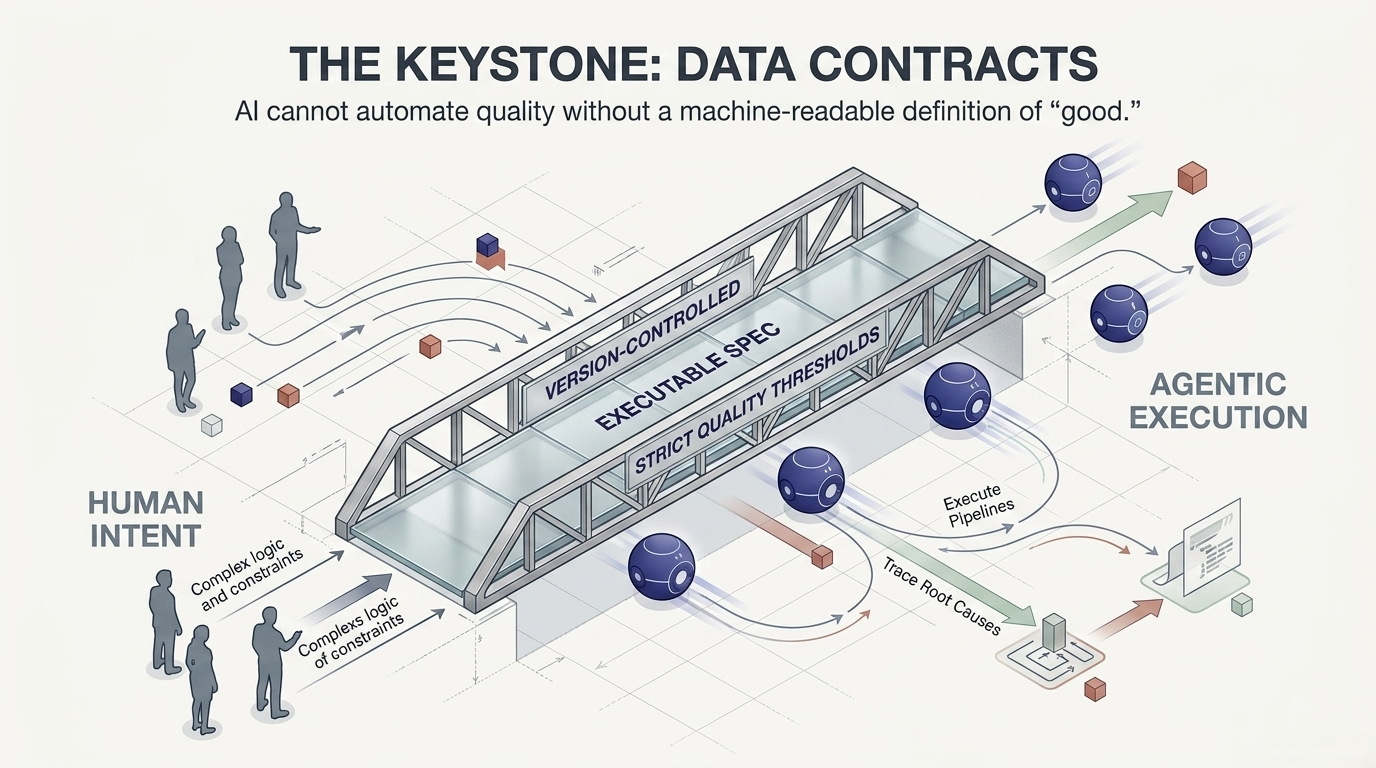
A useful contract can define schema, required fields, allowed ranges, freshness expectations, ownership, semantic constraints, and quality thresholds. Version control makes changes reviewable; executability makes them testable; ownership makes escalation possible.
This is the foundation for bounded agent behavior. An agent can propose a remediation, execute a pipeline, or trace a root cause because it has a contract against which to judge the outcome.
The most important design principle is that contracts should be treated as product interfaces, not documentation attachments. They need lifecycle management: change review, compatibility rules, deprecation, observability, and test coverage.
8. Choosing Where Agentic Data Quality Lives
The ecosystem landscape in the supplied visual is organized along two axes: pipeline integration and agentic autonomy. It distinguishes several operating patterns rather than claiming that one category fits every organization.
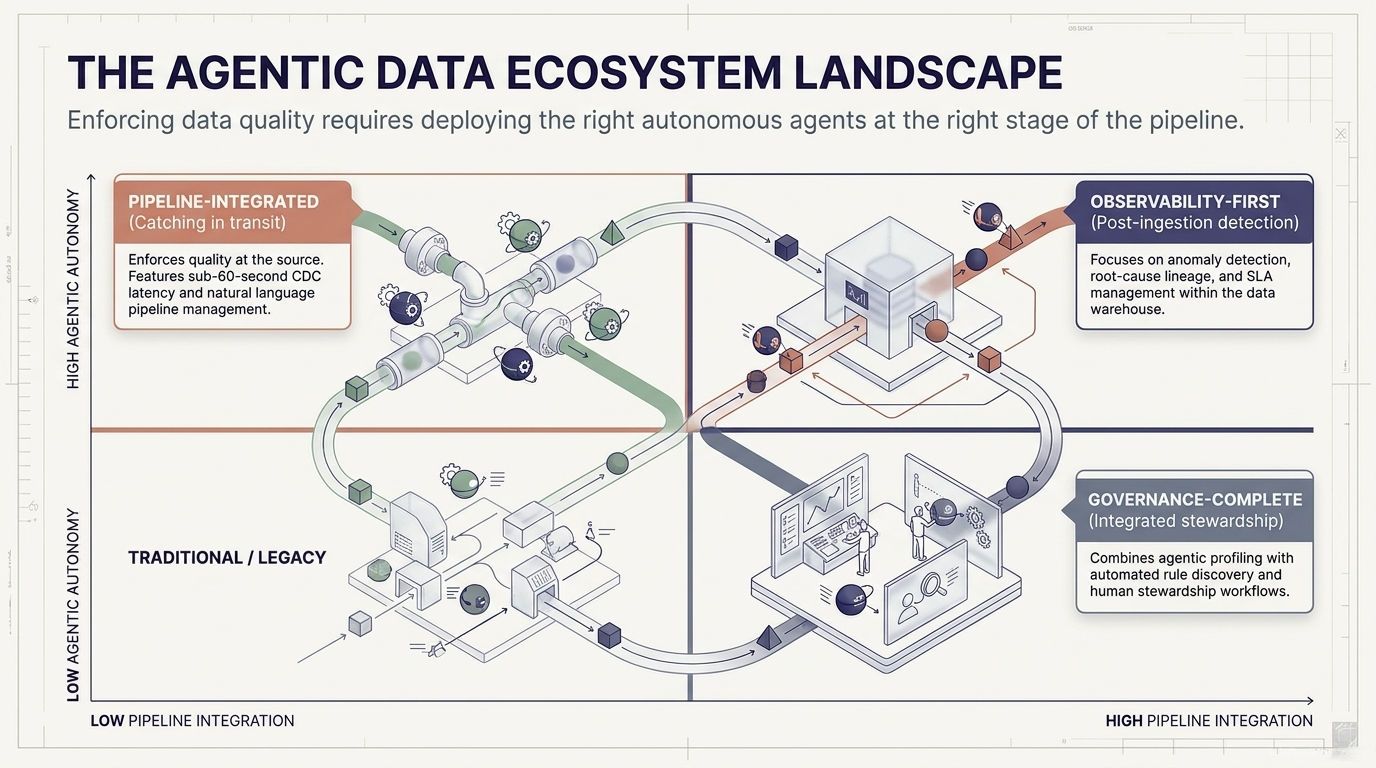
The visual names four patterns:
- Pipeline-integrated systems catch issues close to the source and emphasize rapid change-data capture and pipeline interaction.
- Observability-first systems focus on post-ingestion anomaly detection, lineage, root-cause analysis, and service-level management.
- Governance-complete systems combine automated profiling or rule discovery with stewardship workflows.
- Traditional or legacy systems provide lower levels of pipeline integration and autonomy.
This taxonomy is useful as an architecture decision, not just a tooling decision. Teams should ask where detection must happen, what latency is acceptable, which remediation actions may be automated, what lineage is required, and who owns approval when the agent is uncertain.
The overview material also names examples such as Integrate.io, Monte Carlo, Acceldata, Prizm by DQLabs, Soda, and Great Expectations. Those names are presented here only as examples from the supplied source material, not as a current ranking or independent product assessment.
9. Pillar 3: Quality Assurance as a Self-Healing System
Conventional UI tests often encode the implementation too literally. A small interface change can break selectors even when the user-visible behavior is still correct, creating a maintenance trap.
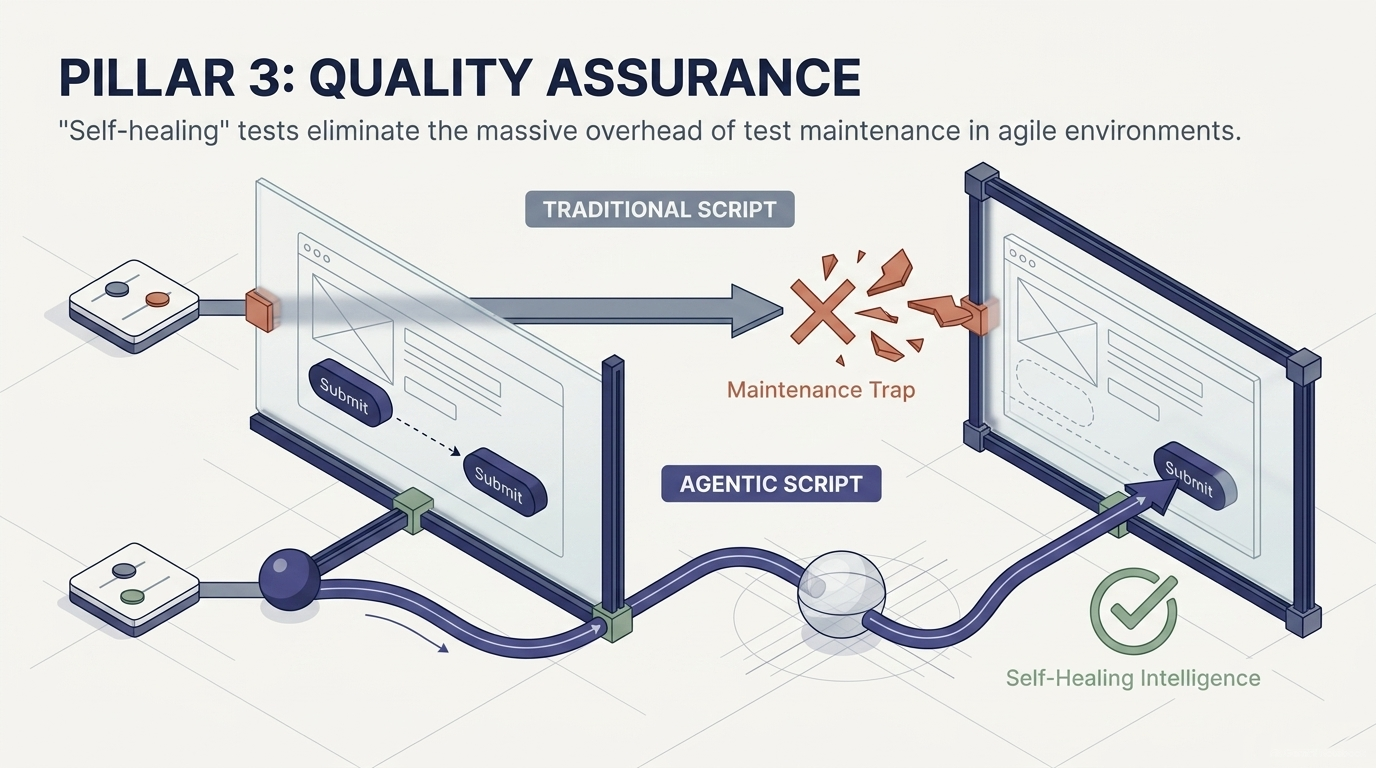
The agentic pattern reframes test maintenance as a diagnosis problem. When a test fails, the system should determine whether the product is actually broken, the test is stale, the environment is unhealthy, or the baseline itself needs review.
Self-healing therefore requires more than automatically changing selectors. Safe remediation needs evidence:
- what changed in the interface or DOM;
- whether the user intent and acceptance criteria are still satisfied;
- whether the proposed fix alters the meaning of the test;
- what confidence the agent has in the repair;
- whether the repair can be auto-applied or must be approved.
A self-healing test that silently weakens an assertion is worse than a broken test. The repair path must preserve the semantic contract.
10. The Agentic Testing Lifecycle
The testing lifecycle is presented as a continuous four-stage loop:
Ingest → Generate → Execute & Observe → Learn
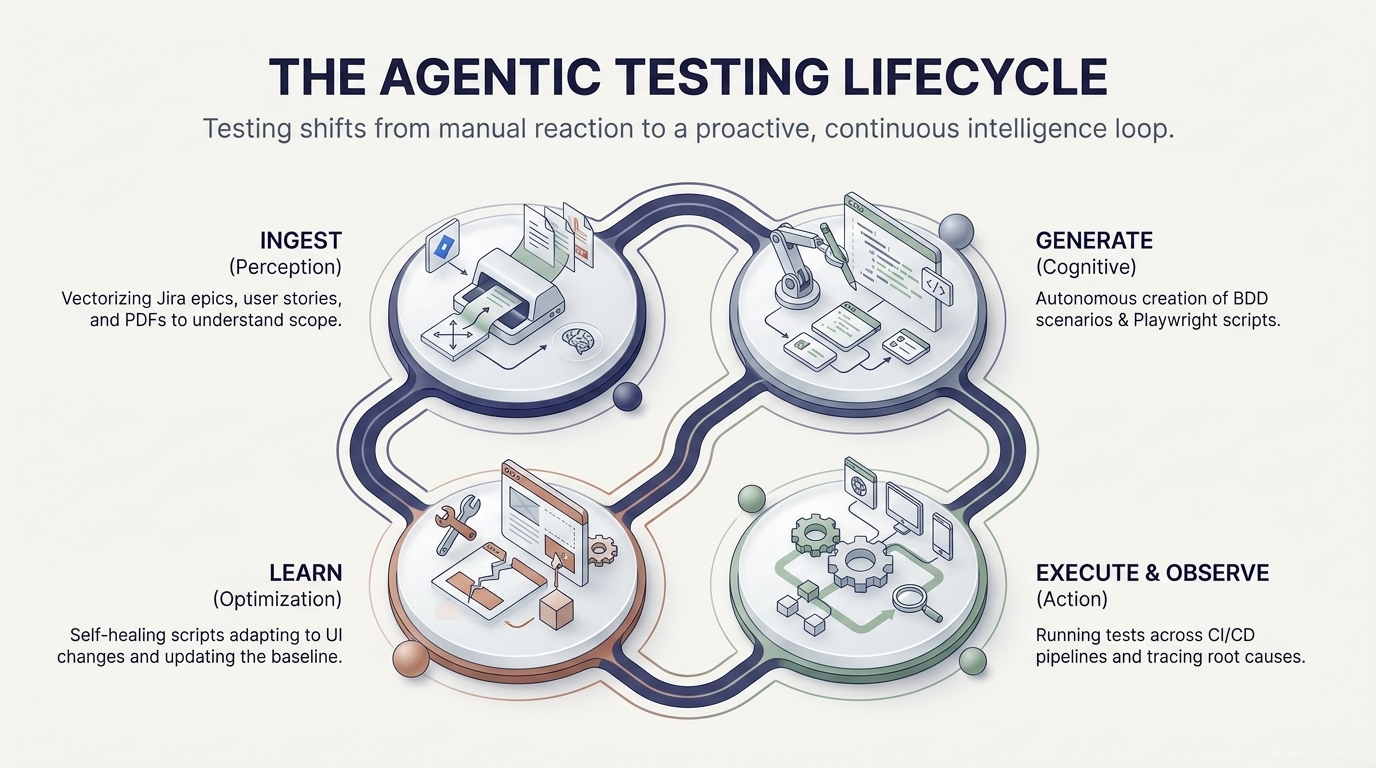
During ingest, the system vectorizes Jira epics, user stories, PDFs, and related scope material. During generate, it creates BDD scenarios and automation such as Playwright scripts. During execute and observe, it runs tests through CI/CD and traces failures or root causes. During learn, it adapts scripts to product changes and updates its baseline.
The loop is valuable because it connects test generation to production evidence. Failures are not merely reported; they become new context for the next cycle.
For production use, each transition should emit structured telemetry: artifact version, input provenance, model or agent version, execution result, confidence, remediation decision, and approval state. That turns the loop into an auditable engineering system rather than an opaque automation chain.
11. Governance and Trust: Keep Humans at the Decision Boundary
Higher autonomy increases the importance of boundaries. The governance visual places a control gate between an AI agent and the environment, with a proposed remediation packet, resource-based access controls, identity controls, and a human approve/reject decision.
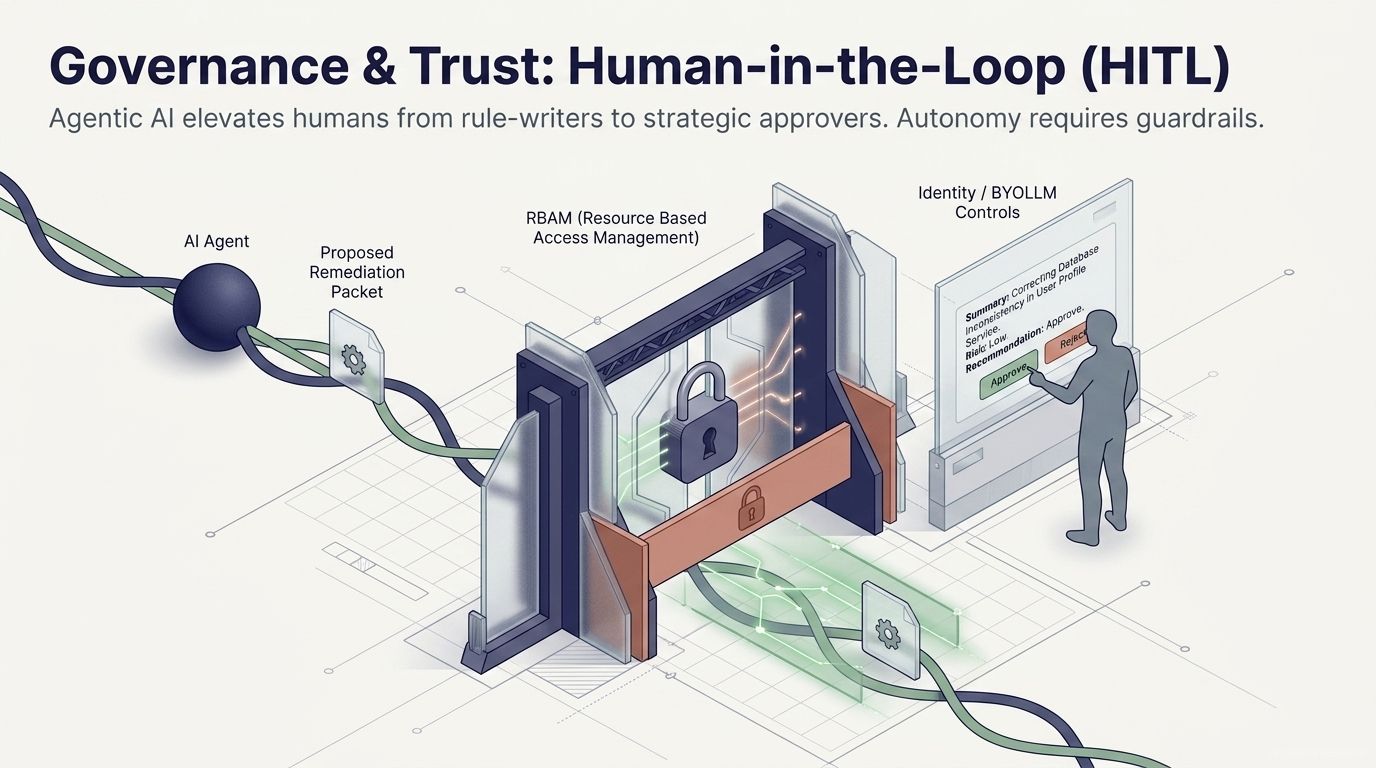
This is the right place to separate low-risk autonomy from high-risk change. The agent can investigate broadly and prepare a remediation, but execution privileges should be scoped by resource, action, environment, and confidence.
A production governance model should answer four questions before an agent acts:
- Can this identity perform this action?
- Is this action permitted on this resource in this environment?
- Does the proposed change satisfy policy and contract checks?
- Does the risk level require explicit human approval?
The human role shifts from repeatedly writing rules to approving exceptions, policy changes, and high-impact actions. That is a more scalable use of expertise, but only if the system preserves enough evidence for an informed decision.
12. The Agentic SDLC as an Infinity Loop
The synthesis visual connects design, data, and QA through a shared reasoning engine. The point is architectural: these capabilities should not live as isolated copilots with separate context and separate definitions of correctness.
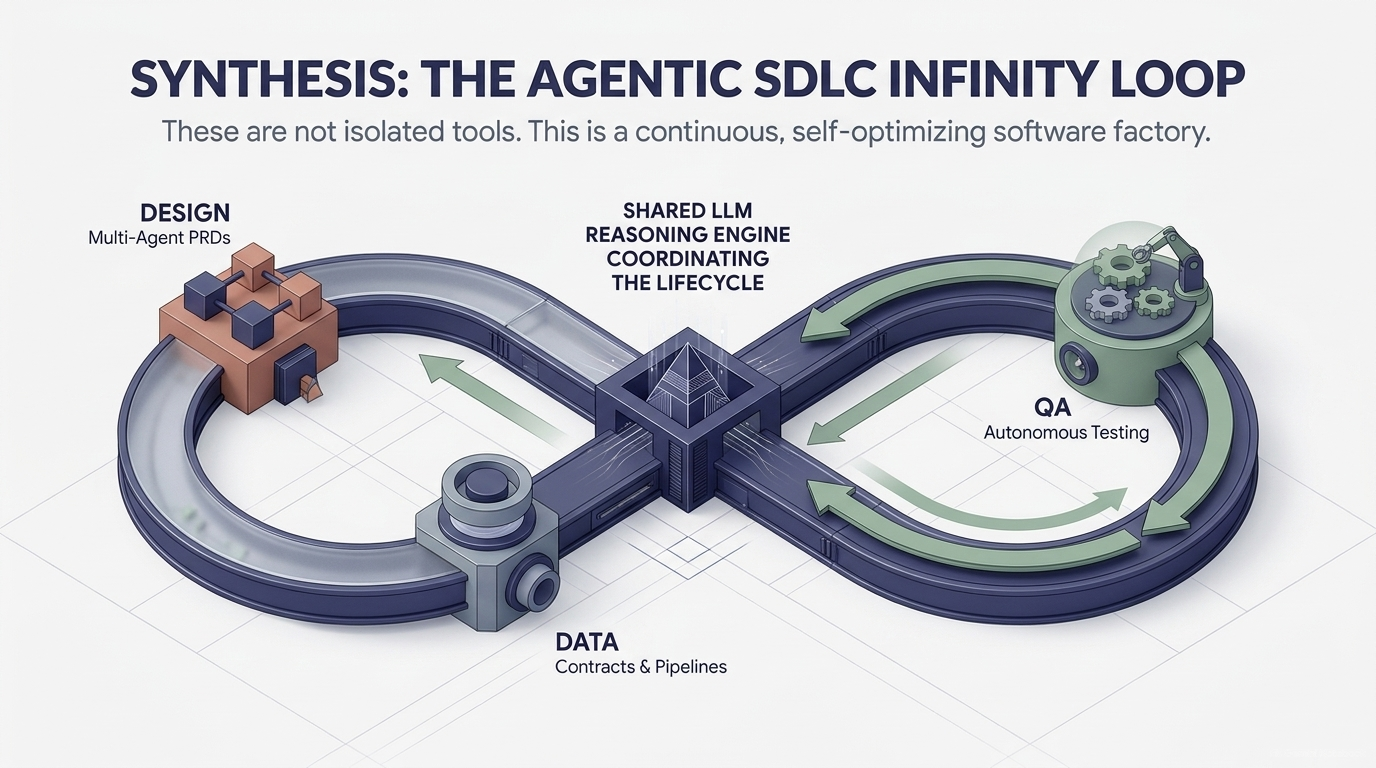
Requirements inform tests. Data contracts inform both pipeline validation and test data. Test failures produce evidence that can refine requirements or expose data issues. A shared reasoning layer coordinates the lifecycle while specialized agents perform bounded work in their domains.
The most useful mental model is a software factory with feedback, not a set of AI features. Every cycle should make the system easier to verify because contracts, evidence, traces, and learned baselines accumulate.
This also changes observability requirements. Teams need to observe not only services and pipelines, but agent decisions: what context was read, what plan was selected, what action was attempted, what changed, and what policy allowed it.
13. Business Impact Must Be Measured as an Engineering Outcome
The supplied business-impact slide frames the value of agentic AI through three metrics: 10× faster test development, 90% reduction in manual QA and data effort, and 70% fewer false-positive alerts. It also references scanning one billion rows in 64 seconds as a scale demonstration.
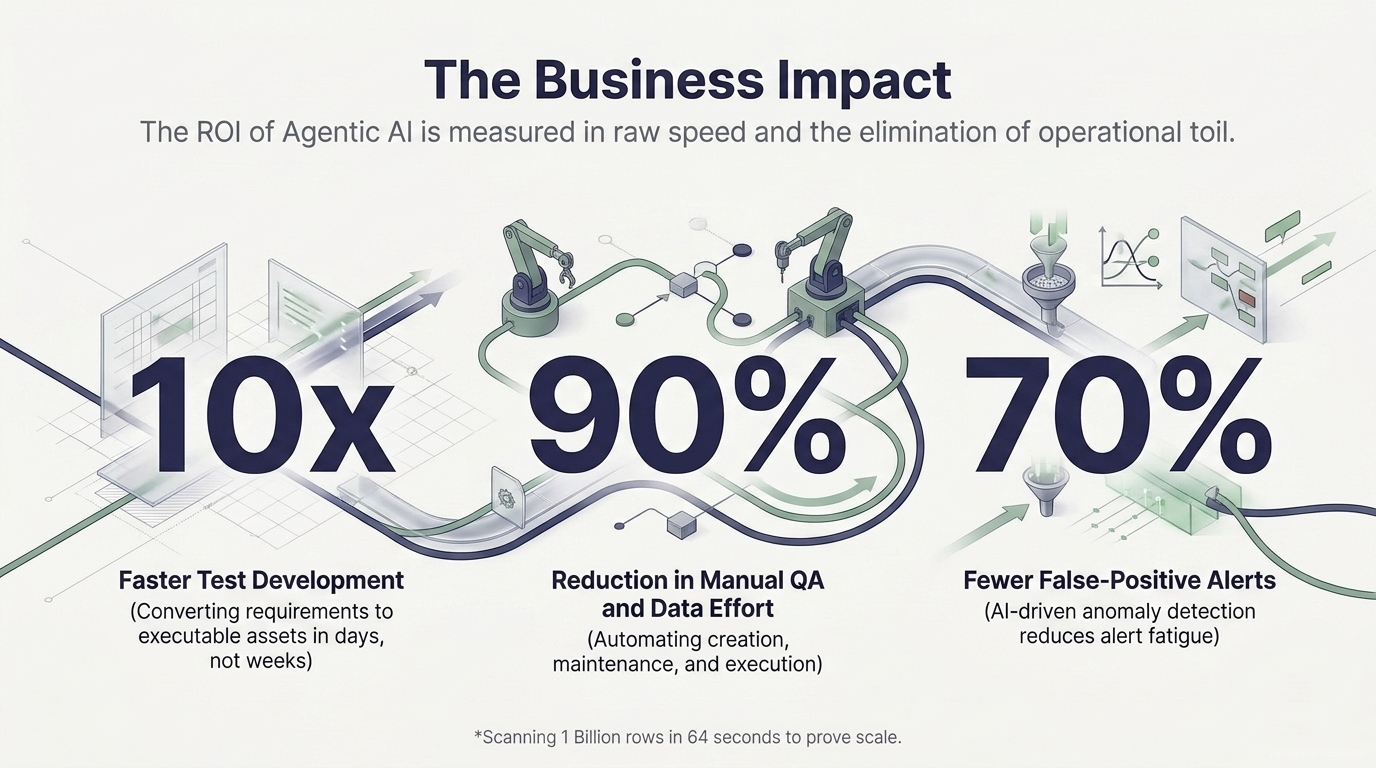
Those numbers should be treated as claims or targets from the source material, not as universal expectations. A production program needs its own baseline and controlled measurement.
The strongest metrics map directly to engineering toil:
- elapsed time from requirement to executable test;
- human hours spent creating and maintaining tests;
- number of manual data-quality rules maintained;
- false-positive and false-negative alert rates;
- mean time to diagnose a failed pipeline or test;
- percentage of agent remediations auto-approved versus escalated;
- rollback or rework caused by incorrect autonomous actions.
The value case becomes credible when the organization can show that autonomy reduces repetitive work without weakening correctness, auditability, or control.
14. Operating Model for an AI-Ready Enterprise
The closing operating model reduces the transformation to three actions:
Define contracts. Deploy targeted agents. Shift humans to governance.
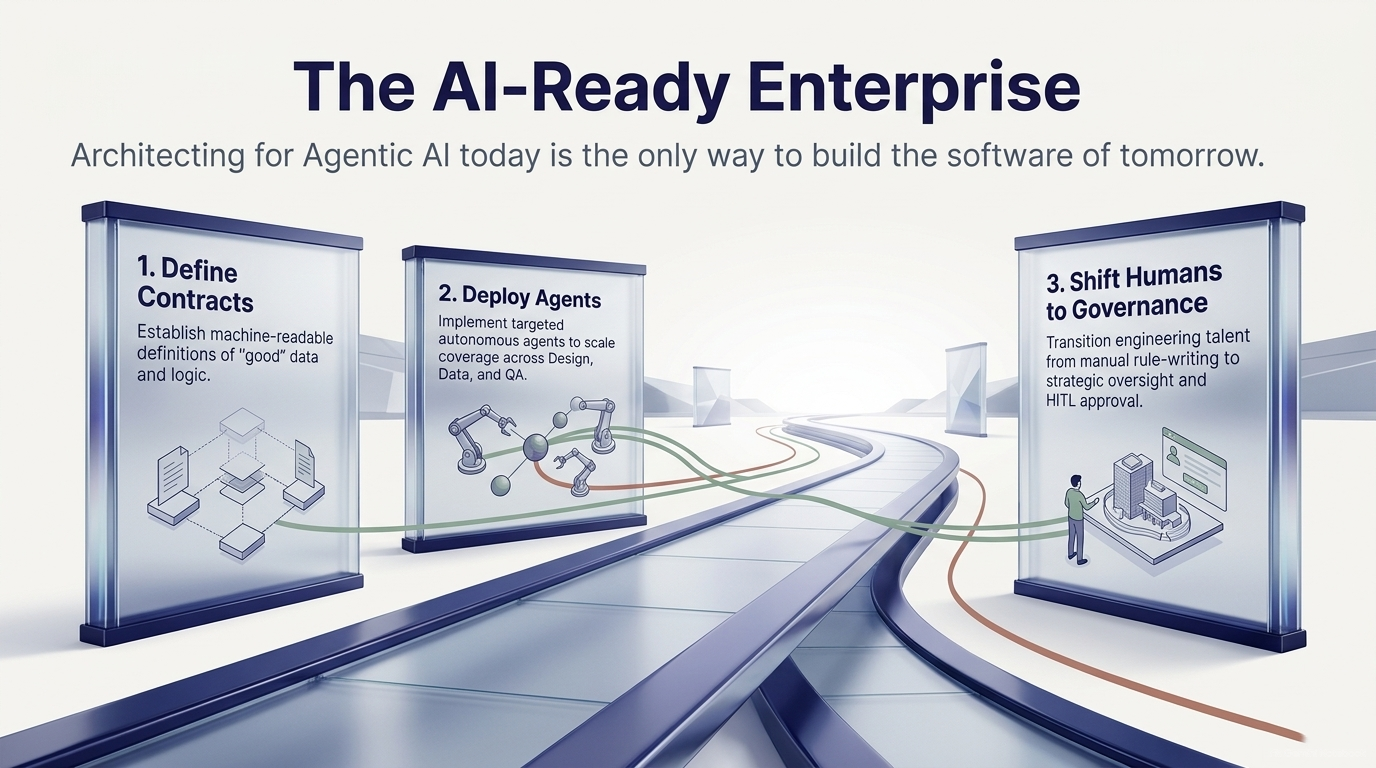
The sequence matters. Starting with agents before contracts creates autonomy without a stable definition of quality. Starting with governance before useful execution creates control without leverage. The architecture works when the layers are introduced together:
First, define contracts. Encode data quality, interface behavior, acceptance criteria, permissions, and escalation thresholds.
Second, deploy targeted agents. Give each agent a bounded purpose, explicit tools, observable actions, and clear failure behavior. Prefer specialized components over one all-powerful agent.
Third, shift human effort toward governance. Humans review policy, ambiguous intent, high-impact changes, and low-confidence remediations instead of repeating deterministic maintenance work.
This is the transition from AI as an individual productivity tool to AI as part of the enterprise execution fabric.
15. A Compact Reference Model
The final overview image compresses the same architecture into one page: the evolution from manual to agentic quality, automated requirements gathering, anomaly-aware data management, intelligent QA, and a perception–reasoning–action agent architecture.
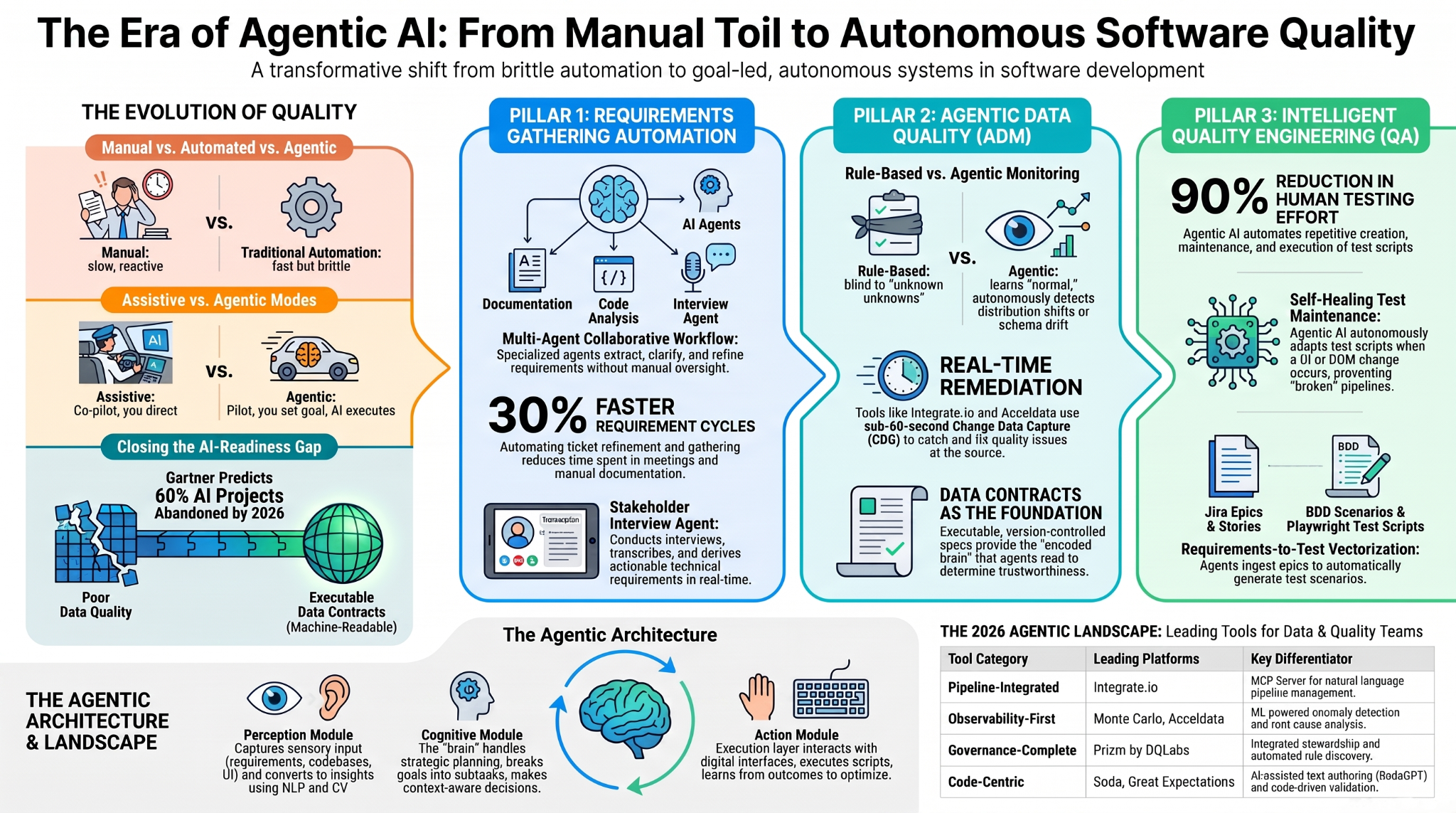
It also reinforces a crucial connection across the lifecycle: requirements become testable context, data contracts become executable quality definitions, and QA becomes an adaptive feedback system.
The tool and metric labels in the visual are best read as examples from the supplied material. The durable engineering ideas are the architecture patterns underneath them: specialized agents, machine-readable contracts, real-time observation, self-healing workflows, and governance.
Engineering Principles
The architecture ultimately depends on several principles:
-
Encode intent before automating execution
Machine-readable requirements, data contracts, acceptance criteria, and policies give agents a testable definition of success. -
Use specialized agents with explicit boundaries
Separate documentation, code analysis, interviews, anomaly detection, testing, and coordination so that permissions and failure modes remain understandable. -
Keep deterministic controls where they are strongest
Agentic detection should complement schema checks, business invariants, access policies, and other rules that are already precise and reliable. -
Make every autonomous action observable and reversible
Capture provenance, decisions, tool calls, artifacts, confidence, and approvals. High-impact actions should have rollback paths and human escalation. -
Treat human oversight as an architecture layer
Human-in-the-loop approval is not a temporary weakness. It is the mechanism that allows autonomy to expand safely as evidence and confidence improve.
Final Synthesis
The agentic software lifecycle is a coordinated system, not a collection of AI features. It begins with human intent, turns that intent into executable contracts, assigns bounded work to specialized agents, observes every action, and feeds production evidence back into design, data, and testing.
The production-ready system combines:
- Deterministic foundation — version-controlled requirements, data contracts, policies, and quality thresholds.
- Testing layer — generated BDD scenarios, executable automation, CI/CD integration, and semantic validation of repairs.
- Agent or AI layer — specialized perception, reasoning, coordination, anomaly-detection, and remediation agents.
- Security and governance — scoped identities, resource permissions, approval thresholds, and human review of high-risk actions.
- Observability layer — traces for agent decisions, lineage, anomaly evidence, execution telemetry, and rollback signals.
- Production outcome — a closed-loop lifecycle that reduces repetitive maintenance while keeping correctness and control explicit.
The architecture becomes genuinely agentic only when the system can act on clear intent, explain what it did, detect when reality diverges from expectation, and know when to hand control back to a human.
Closing Thought
The strategic shift is not from manual work to “AI everywhere.” It is from brittle, human-maintained scaffolding to contract-driven, observable, governed autonomy.
Autonomous software quality starts when “good” becomes executable.