
The Agentic Shift: Automating Quality in Software and Data
AI changes the economics of software and data consumption. A human analyst may notice a suspicious dashboard, stop, investigate, and ask for clarification. An AI consumer can ingest the same flawed input and act immediately. That difference compresses the time available to detect, diagnose, and contain quality failures.
The engineering response is not simply to add more tests. It is to change the operating model: quality must become a continuous control loop that can perceive context, reason about intent, take bounded action, and learn from outcomes. The source material calls this the agentic shift—from automation that follows predefined rules to autonomous systems that pursue goals within explicit constraints.
This article connects that shift across three domains: requirements, software testing, and data management. The recurring pattern is the same in each: make intent machine-readable, give agents enough context to reason, constrain actions with policy and identity, observe everything, and preserve a human approval path where risk demands it.
1. Quality Becomes a Runtime Capability
The central architectural idea is a move from fragmented, end-of-process quality gates toward an always-on system that sits between messy inputs and production-ready outputs. The agent is not merely another consumer in the pipeline. It becomes a reasoning layer that can inspect signals from multiple sources, detect anomalies, coordinate specialized workers, and route results into structured outputs.
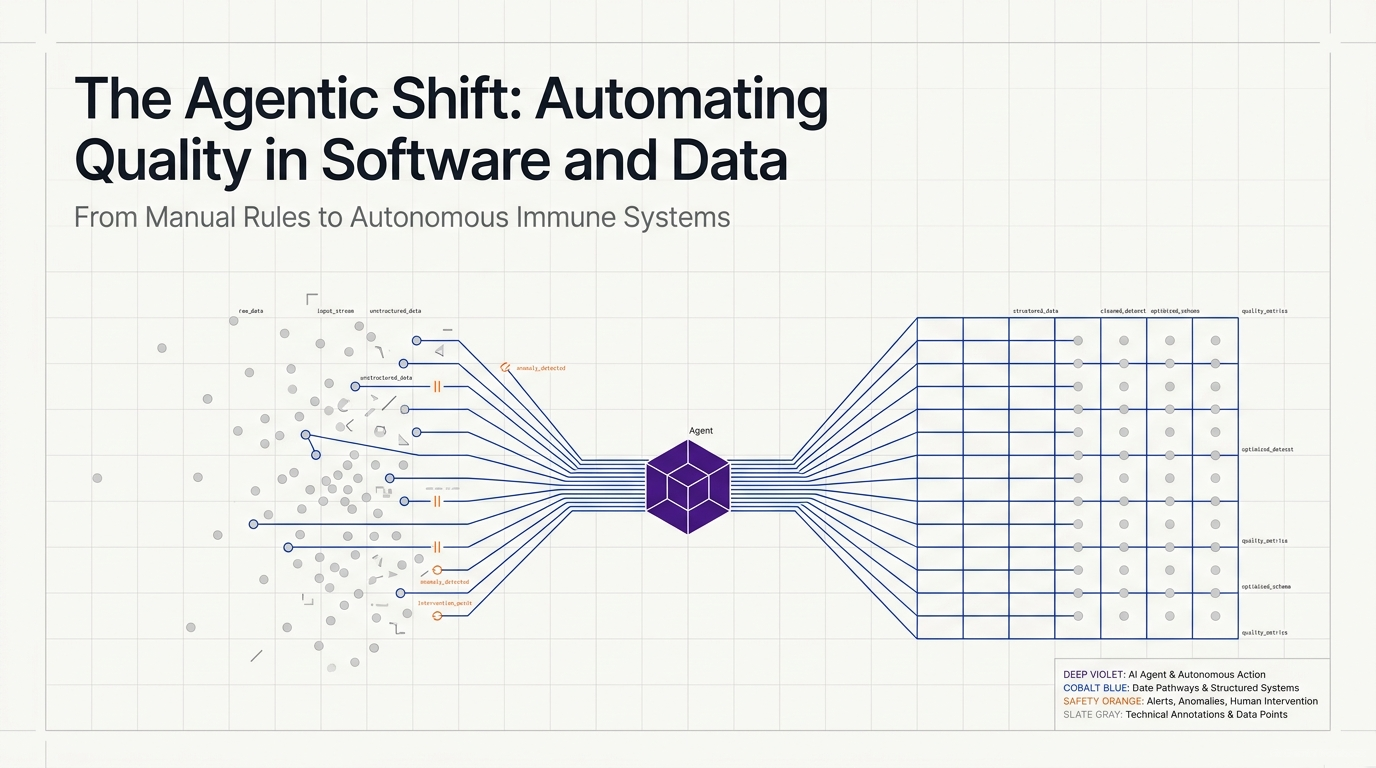
The image depicts noisy, heterogeneous inputs converging on a central agent and emerging as structured data, cleaned assets, optimized schemas, and quality artifacts. That is an important reframing. Traditional quality engineering assumes that validation is a discrete stage. Agentic quality treats validation, remediation, and optimization as continuous behavior embedded in the flow of work.
This does not eliminate deterministic systems. It gives them a coordinator. Schemas, tests, contracts, access controls, lineage, and CI/CD remain the machinery that makes quality enforceable. The agent adds context-sensitive orchestration around those controls.
2. Why Quality Must Move at the Speed of AI
Human consumers and AI consumers fail differently. People often hesitate when something looks inconsistent. They cross-check context, notice formatting anomalies, and ask questions. Automated consumers are optimized to proceed. If the input is syntactically valid but semantically wrong, a model or agent may still generate a confident downstream action.
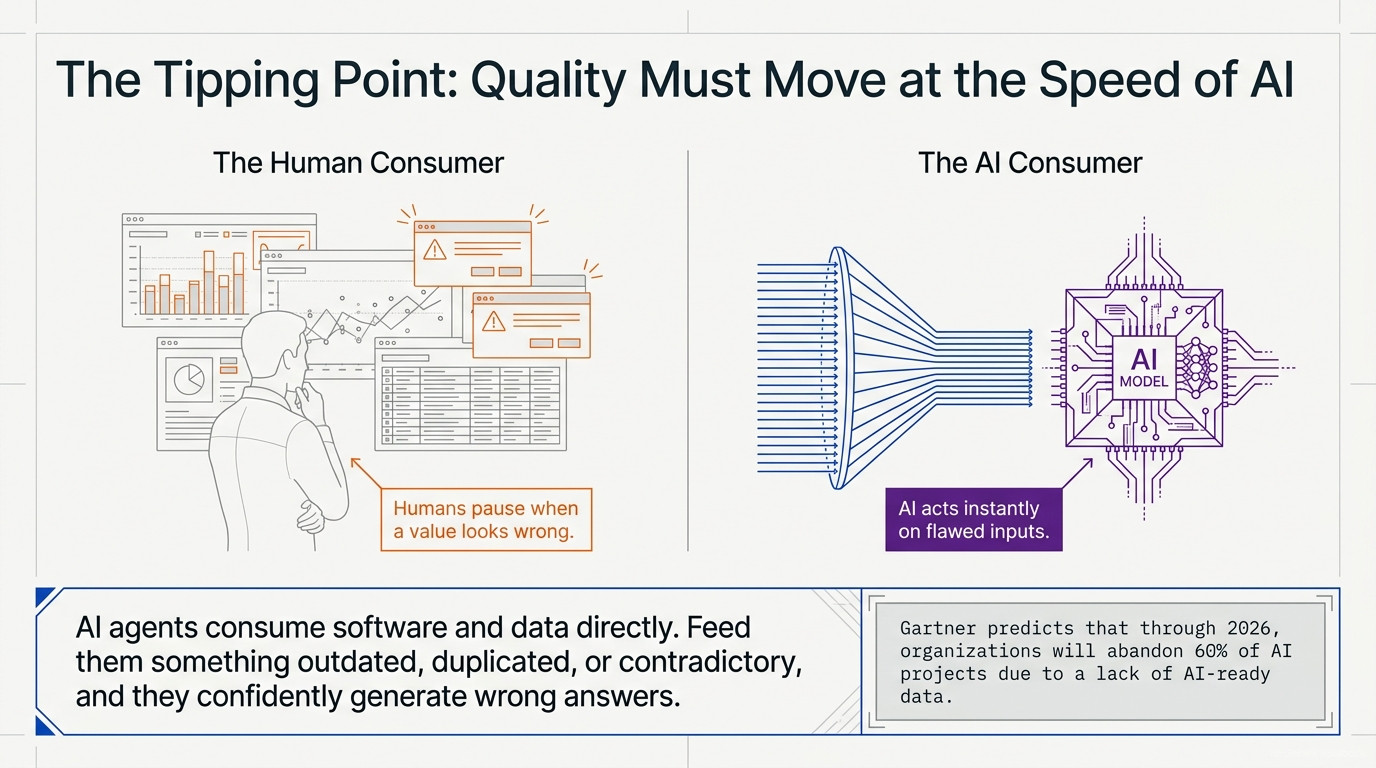
That creates a new failure mode: latency between defect creation and defect consumption collapses. Outdated reference data, duplicated records, contradictory requirements, or a subtle schema change can propagate before a human notices the symptoms.
The slide frames this risk with a Gartner-attributed prediction about projects being abandoned because data is not AI-ready. Whether or not any organization adopts that exact forecast, the engineering implication is clear: AI readiness is not an abstract maturity label. It is a measurable property of the inputs that autonomous systems are allowed to consume.
A useful design test is therefore: Can a machine distinguish trusted, current, contract-compliant inputs from merely available inputs before taking action?
3. From Rules to Assistance to Autonomy
The source material separates three operating models:
- Traditional automation encodes static thresholds and explicit rules. Humans write and maintain the logic; the system waits when a rule fails.
- Assistive AI accelerates drafting and analysis, but the human remains in the driver’s seat and advances the workflow step by step.
- Agentic AI accepts goals and boundaries, creates or adapts a plan, executes within those limits, and escalates or requests approval when needed.
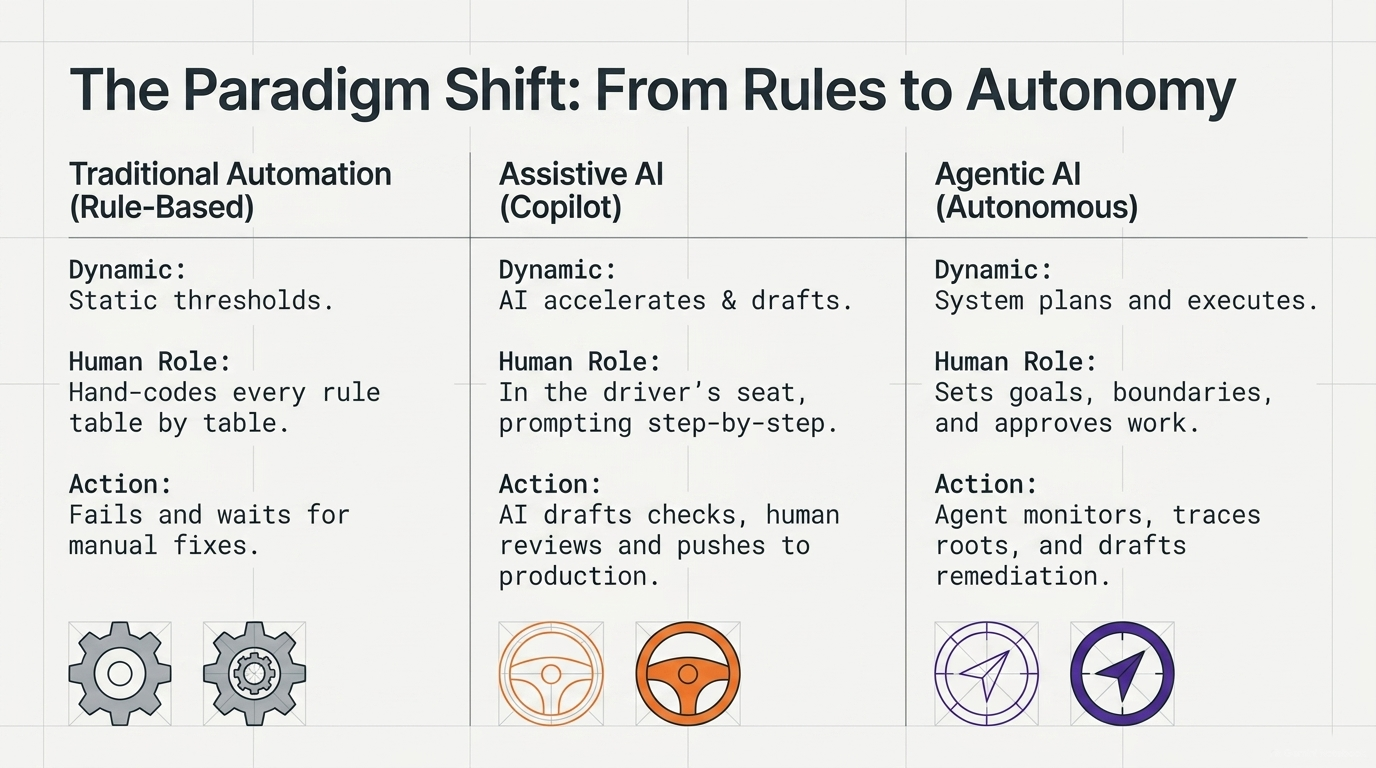
The shift is not simply “more AI.” It is a transfer of control over sequencing and local decision-making. In rule-based systems, the workflow is encoded ahead of time. In assistive systems, the human chooses the next step. In agentic systems, the machine can choose the next step from a constrained action set.
That means the critical design question changes from What rule should I write? to What goal, evidence, permissions, and stopping conditions should I give the agent?
Autonomy without boundaries is not an architecture. Production agent systems need explicit permissions, reversible actions where practical, checkpoints for material changes, and an audit trail that explains what the system observed and why it acted.
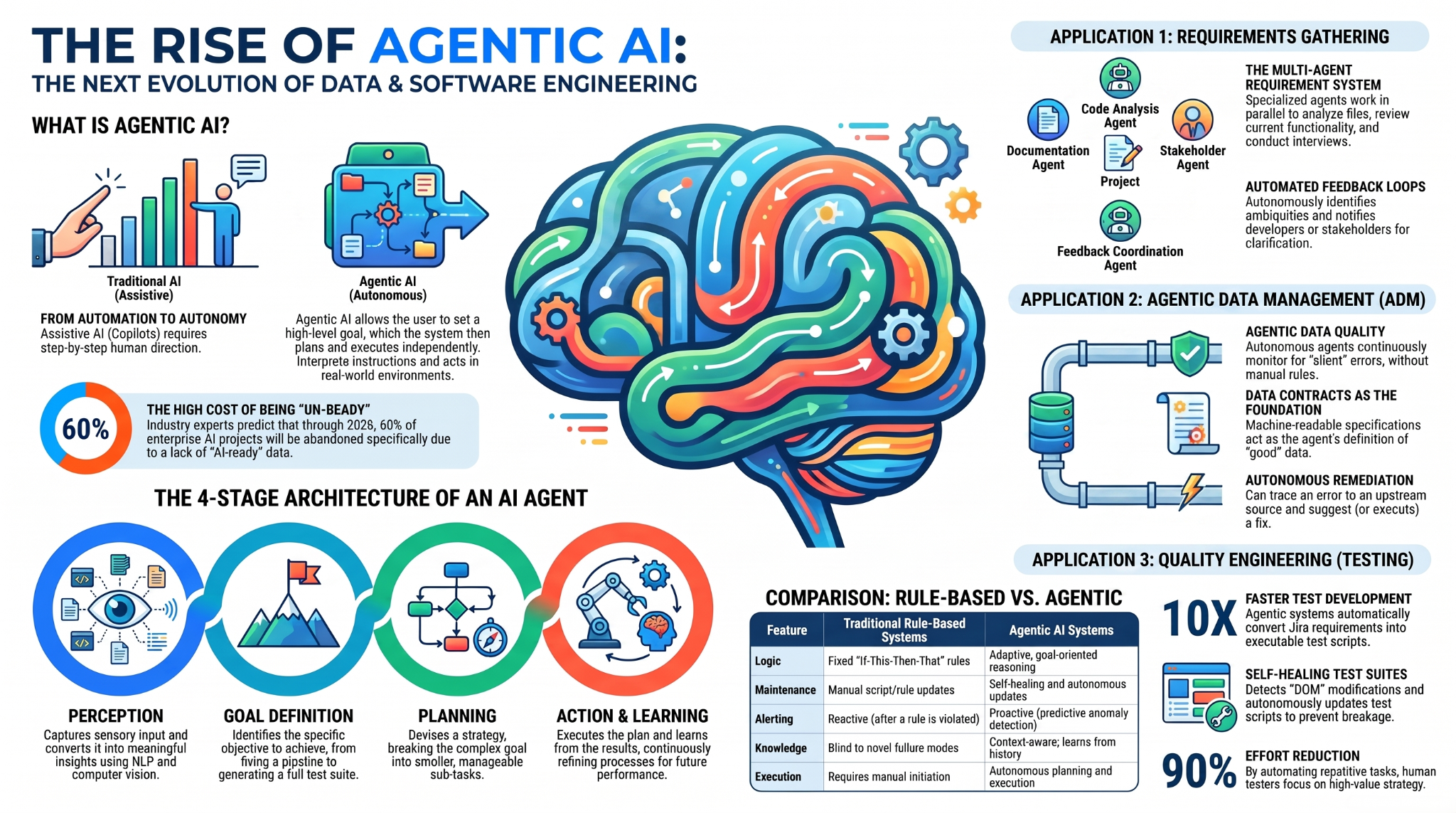
4. The Anatomy of an AI Agent
The agent model in the source material can be read as a layered control loop. The outer layer gathers context; inner layers transform that context into decisions and actions; feedback closes the loop.
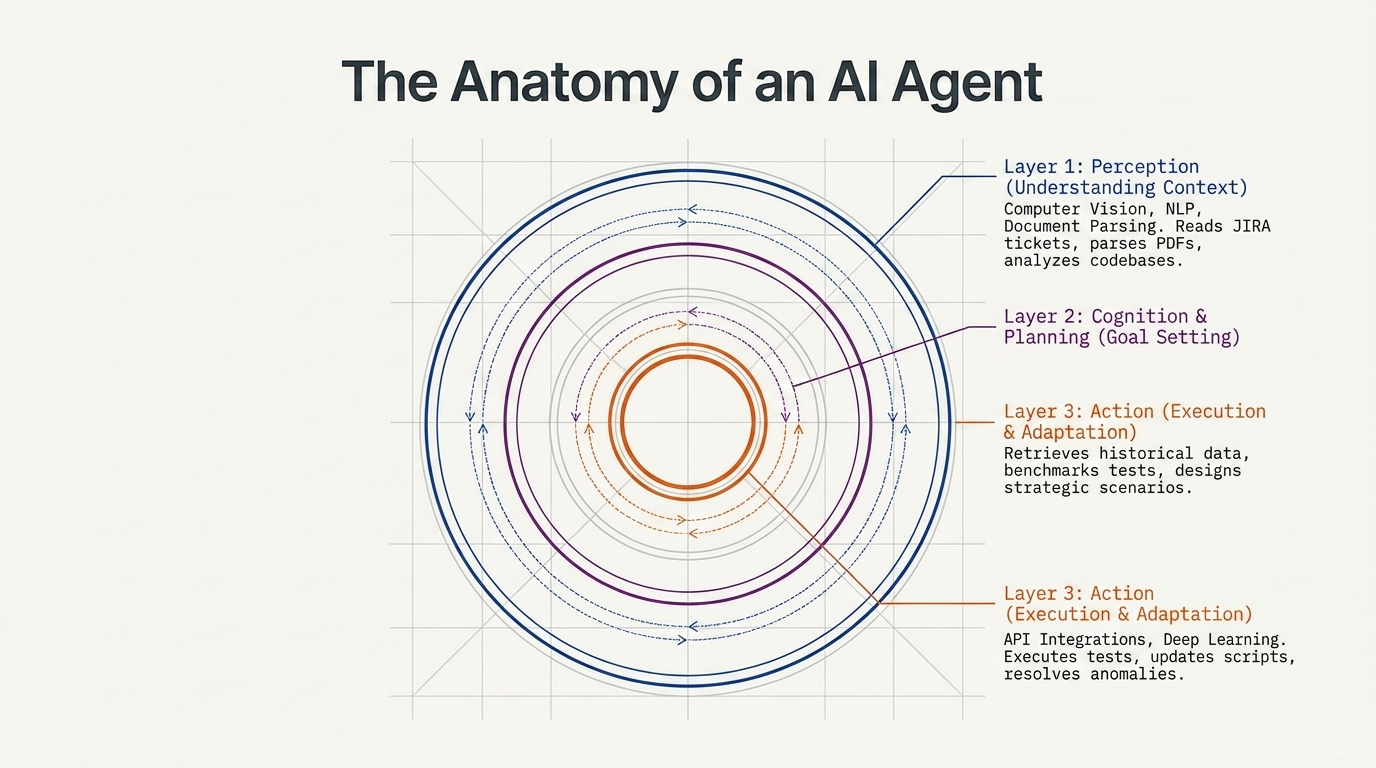
Perception turns raw operational artifacts into usable context. In this material that includes computer vision, NLP, document parsing, JIRA tickets, PDFs, and codebases. For an engineering agent, perception should also carry provenance: where the information came from, how current it is, and whether it is authoritative.
Cognition and planning translate goals into a sequence of work. This is where an agent chooses which evidence to inspect, which tool to call, and which sub-task to delegate.
Action and adaptation connect reasoning to execution: retrieving historical data, benchmarking tests, integrating with APIs, updating test scripts, or resolving anomalies. Once an agent can modify production-adjacent artifacts, the action layer becomes the primary security boundary.
A reliable agent therefore needs more than a capable model. It needs a tool layer, policy layer, state, telemetry, and an explicit mechanism for separating recommendation from execution.
5. Domain 1: Multi-Agent Requirements Gathering
Requirements are often fragmented across documentation, code, tickets, and stakeholder conversations. A single assistant can summarize those sources, but a multi-agent design can separate concerns and make disagreement visible.
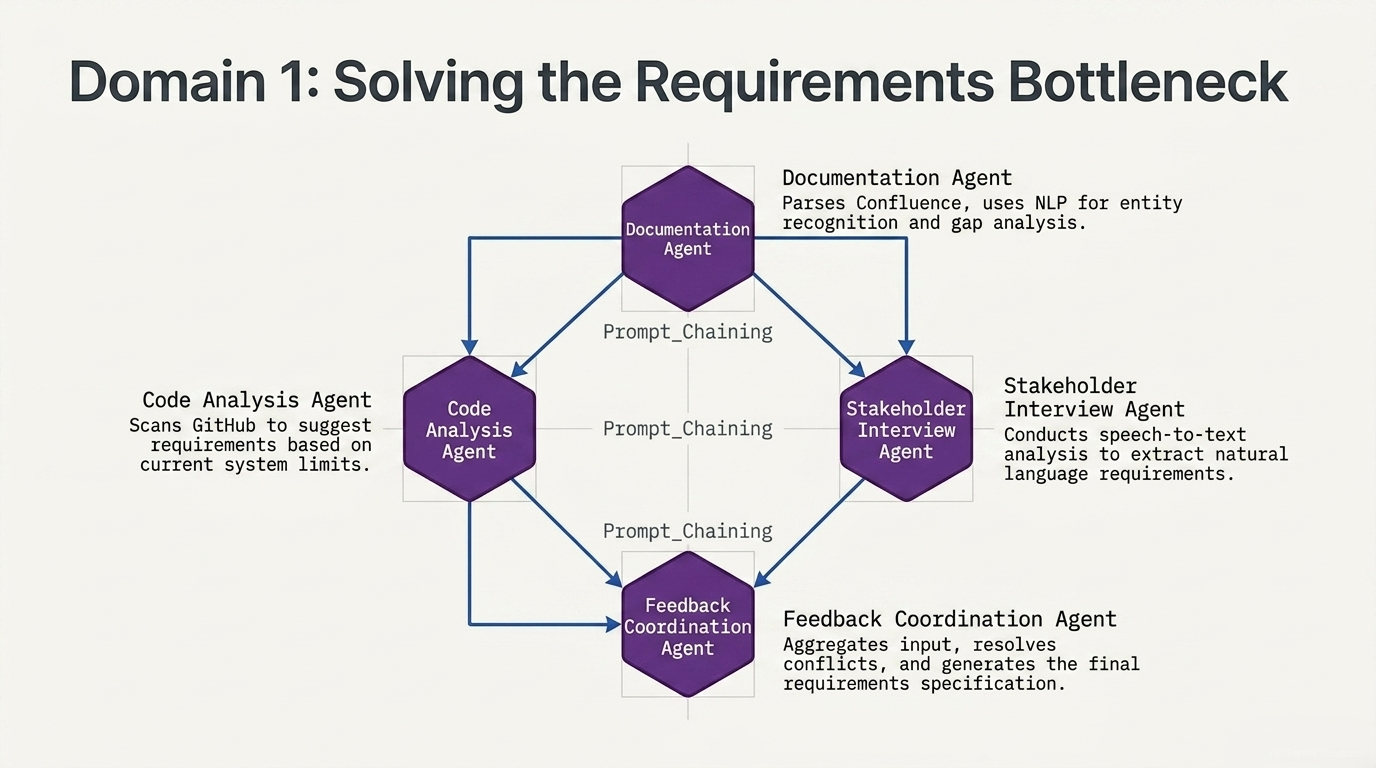
The source material proposes four roles:
- A Documentation Agent parses Confluence and performs entity recognition and gap analysis.
- A Code Analysis Agent inspects GitHub to infer constraints from the current implementation.
- A Stakeholder Interview Agent extracts requirements from natural-language conversations.
- A Feedback Coordination Agent aggregates findings, resolves conflicts, and produces a final requirements specification.
This decomposition is useful because requirements failures are frequently conflicts of evidence. Documentation may say one thing, current code may support another, and stakeholder intent may have changed again. By preserving those streams separately before synthesis, the system can surface ambiguity rather than silently averaging it away.
The coordination agent should not treat all sources as equally authoritative. A production design needs source ranking, timestamps, ownership metadata, conflict flags, and a clear escalation path for unresolved questions. The objective is not to eliminate stakeholder review; it is to concentrate that review on genuinely ambiguous decisions.
6. Agentic Software Testing: From Epic to Execution
The testing workflow extends the same control-loop pattern into quality engineering. Instead of starting from manually authored test scripts, the agent begins with intent-bearing artifacts such as epics, user stories, and acceptance criteria.
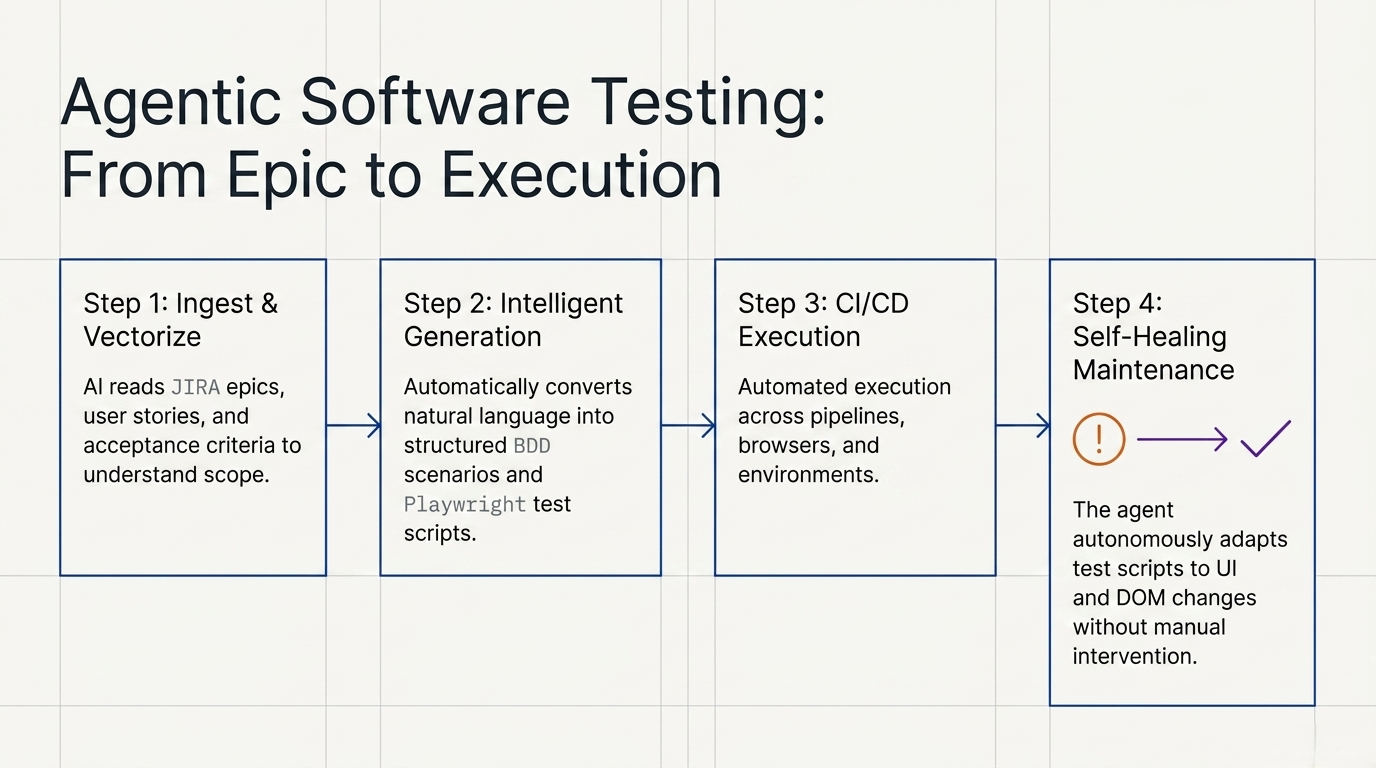
The depicted pipeline has four stages. First, the system ingests and vectorizes requirements to establish scope and retrievable context. Second, it converts natural language into structured BDD scenarios and Playwright tests. Third, those tests run through CI/CD across browsers and environments. Fourth, the agent adapts tests when UI or DOM changes would otherwise break the suite.
Self-healing is powerful, but it introduces a subtle risk: a test can “heal” itself into accepting the wrong behavior. A safe implementation needs to distinguish locational drift from semantic drift. Replacing a changed selector may be low risk. Reinterpreting an acceptance criterion or changing the expected business outcome is high risk and should require stronger review.
Testing agents should therefore record what changed, why it changed, what evidence supports the change, and whether the modification affects only execution mechanics or the meaning of the test.
7. Domain 2: Agentic Data Management
Traditional data quality stacks often grow as separate tools for cataloging, observability, data-quality rules, lineage, and incident handling. The material contrasts that fragmented model with a unified reasoning engine connected to storage, compute, and BI.
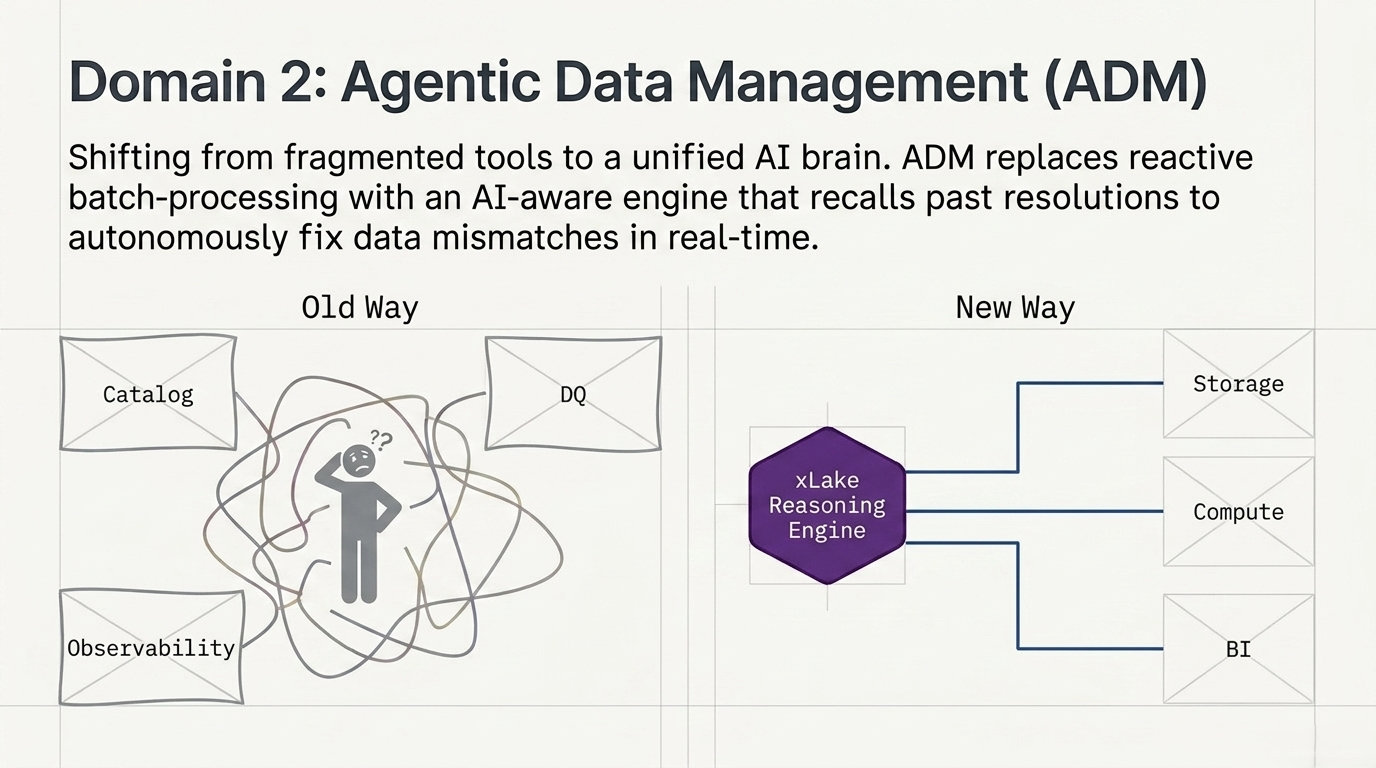
The proposed xLake Reasoning Engine acts as the coordinating brain in this design. The important concept is not the product name but the architectural role: an agent should be able to correlate symptoms across the data stack, recall prior resolutions, trace upstream dependencies, and propose or execute remediation in context.
This is where memory becomes operationally valuable. If a recurring mismatch has been resolved safely before, the agent can use that resolution as evidence. But learned remediation must still be versioned and bounded. Historical success does not guarantee current correctness when schemas, policies, or business definitions change.
For production use, autonomous remediation should be coupled to blast-radius estimation. A low-impact correction may be auto-applied; a change that affects many downstream assets should require approval or staged rollout.
8. Data Contracts Are the Foundation of Trust
Autonomous quality cannot reason from vague expectations. It needs executable definitions of “good.” The source material expresses that with a simple sequence: human intent becomes an executable specification, which becomes machine-enforced behavior.
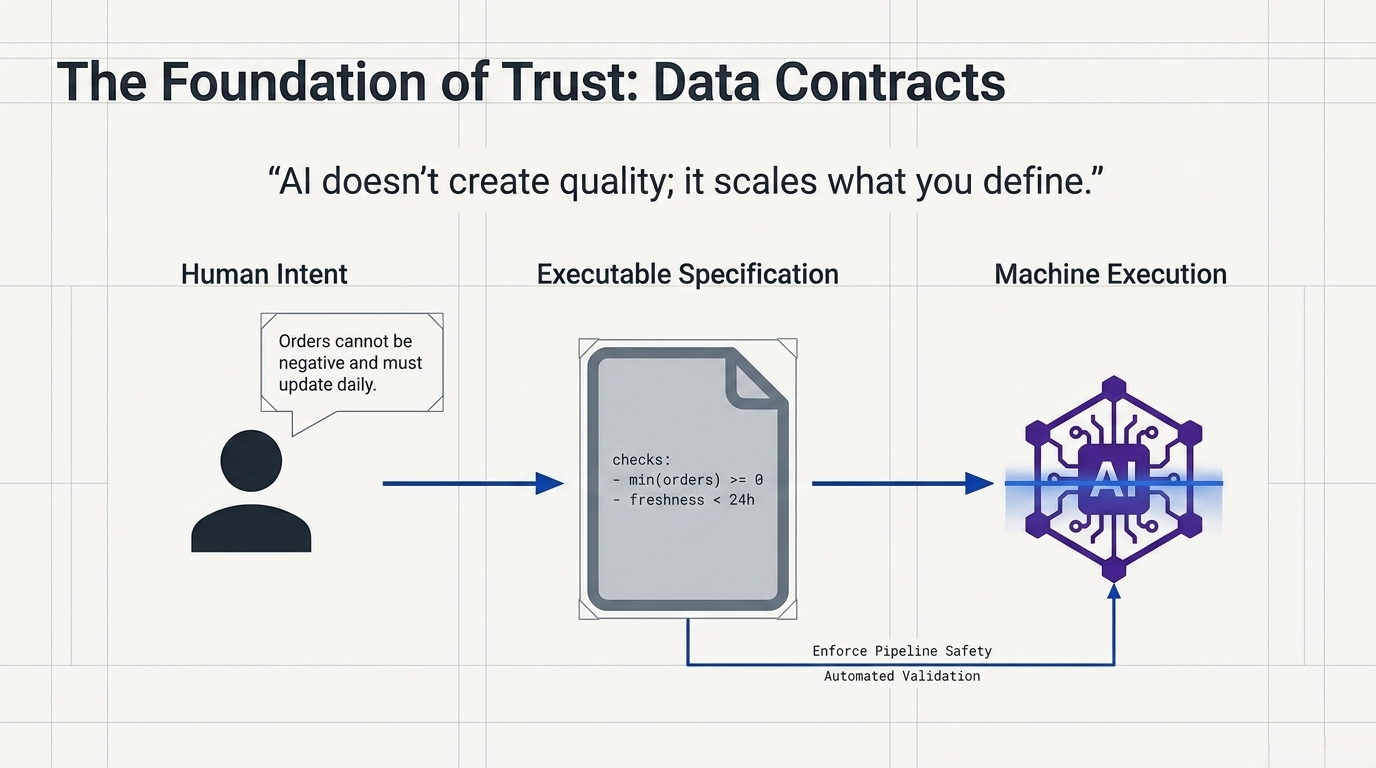
A statement such as “orders cannot be negative and must update daily” is understandable to a person but not yet enforceable. A contract turns that intent into concrete checks—for example, a non-negative order constraint and a freshness threshold.
This matters because agents should not be allowed to invent correctness criteria on the fly. The agent can choose how to investigate a violation, but the contract should define what counts as a violation. That separation protects business intent from model variability.
Useful contracts also include ownership, schema expectations, freshness, accepted value ranges, nullability, lineage requirements, and severity. The more explicit the contract, the more confidently an agent can triage failures and the less it must infer from incomplete context.
AI does not create quality; it scales what you define.
9. Where Agentic Data Quality Fits in the Tooling Landscape
The source material organizes the data-quality landscape into four categories: pipeline-integrated, observability-first, governance-complete, and code-driven.
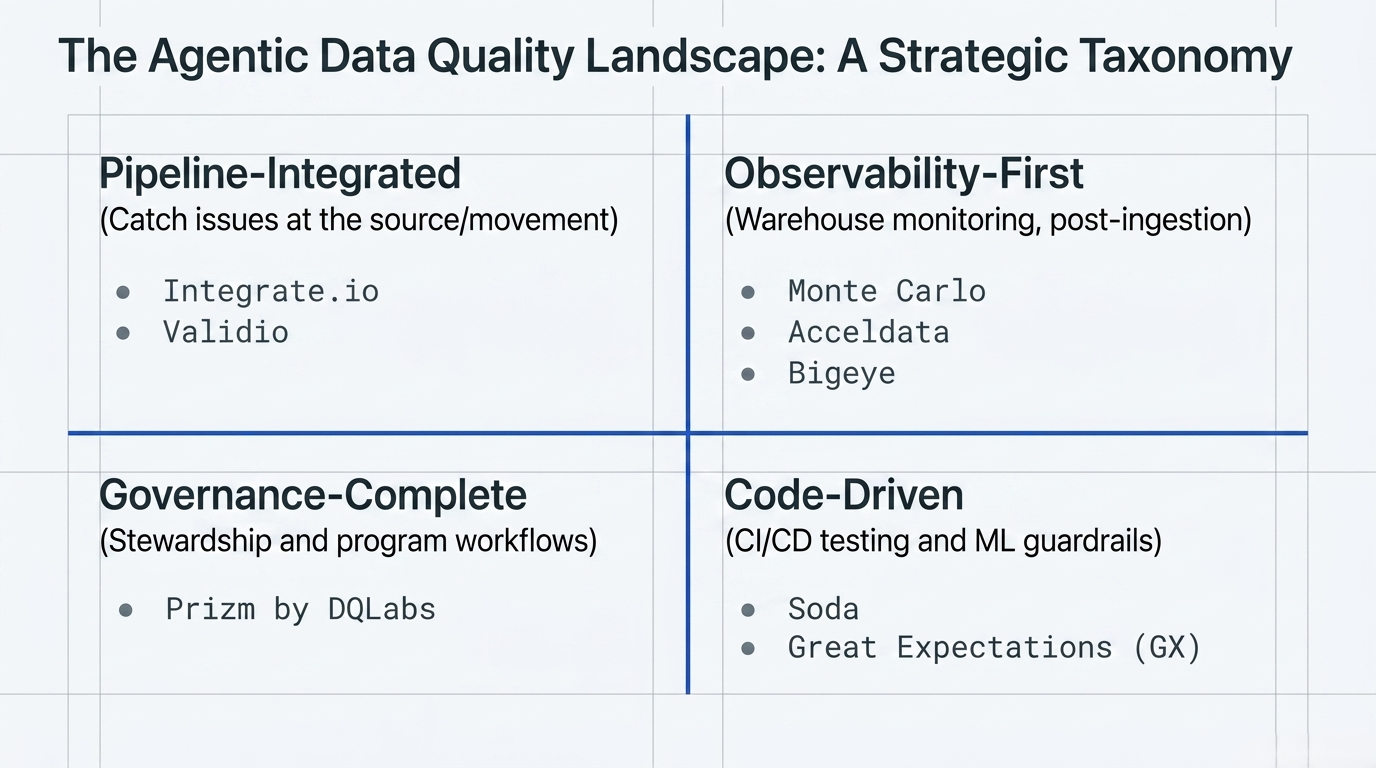
The examples shown are:
- Pipeline-integrated: Integrate.io and Validio
- Observability-first: Monte Carlo, Acceldata, and Bigeye
- Governance-complete: Prizm by DQLabs
- Code-driven: Soda and Great Expectations (GX)
The taxonomy is useful because “data quality” is not one insertion point. Controls can run at movement time, after ingestion, within governance workflows, or directly in CI/CD. Agentic orchestration does not make those distinctions disappear. It should understand them so it can select the right control for the right failure mode.
A practical architecture often combines categories. Pipeline checks prevent bad data from moving forward, observability detects emergent behavior in production, governance provides ownership and decision rights, and code-driven checks make expectations versionable and testable alongside software changes.
10. Pipeline-Integrated Quality and MCP
The pipeline-integrated deep dive places the agent close to the data path. Change-data-capture events flow through infrastructure that can inspect schema changes and unexpected values before they reach downstream warehouses or models.
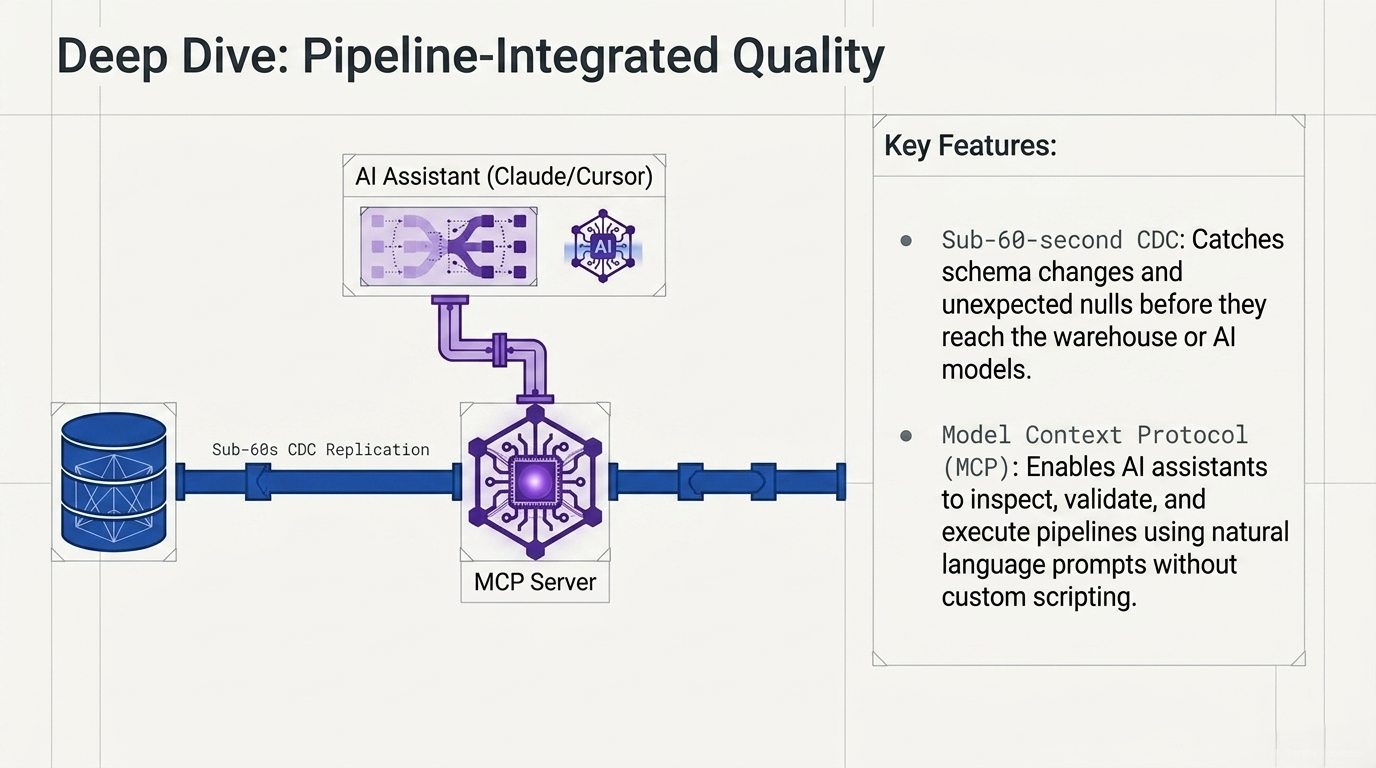
The slide also introduces Model Context Protocol (MCP) as the interface through which an AI assistant can inspect, validate, and execute pipeline operations. Architecturally, this is a tool boundary: the model does not need direct, ad hoc access to every backend. It interacts with a constrained server that exposes approved capabilities.
That boundary should be designed like any other production API. Tool calls need authentication, authorization, typed inputs, predictable outputs, timeouts, rate limits, idempotency where relevant, and complete logs. Natural-language convenience should never bypass operational controls.
The source material also highlights sub-60-second CDC as a target characteristic. Treat such performance figures as environment-specific until reproduced in your own stack. What matters most is the design principle: detect quality failures before they become model context or business decisions.
11. Enterprise Security: BYOLLM, Identity, and Human Control
Autonomy raises the stakes for access control. The security architecture in the source material keeps raw or sensitive data inside an enterprise VPC or VNet while allowing a bring-your-own-LLM layer to reason over metadata.
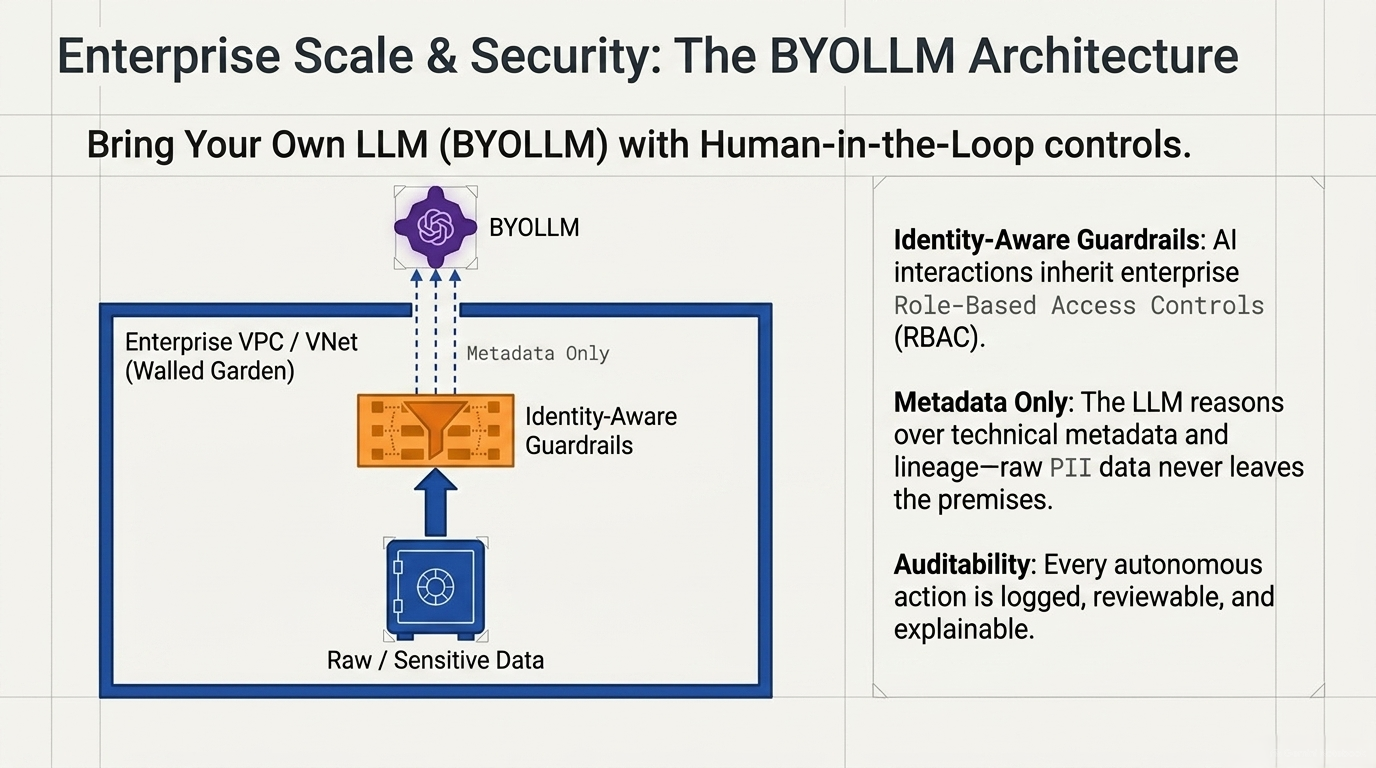
Three controls stand out.
Identity-aware guardrails ensure agent actions inherit role-based access controls rather than operating as a universal super-user. The identity attached to the action should be traceable to a service principal, user, workflow, or delegated authority.
Metadata-only reasoning reduces data exposure by giving the model technical metadata and lineage while keeping raw PII inside the protected boundary. That design can materially reduce the amount of sensitive content exposed to the reasoning layer.
Auditability makes every autonomous action reviewable. Logs should capture the triggering event, evidence consulted, policy decision, tool call, result, and any human approval. For high-risk actions, auditability is not enough by itself; approval gates and rollback paths are also required.
Human-in-the-loop is therefore best treated as a policy decision, not a blanket mode. Low-risk repetitive actions can be automated. High-impact, ambiguous, or irreversible actions should stop for review.
12. Measure Outcomes, Not Agent Activity
The source material presents business-impact figures across software, data, and scale: faster test development, reduced manual QA effort, faster issue resolution, fewer false positives, and high-volume scanning.
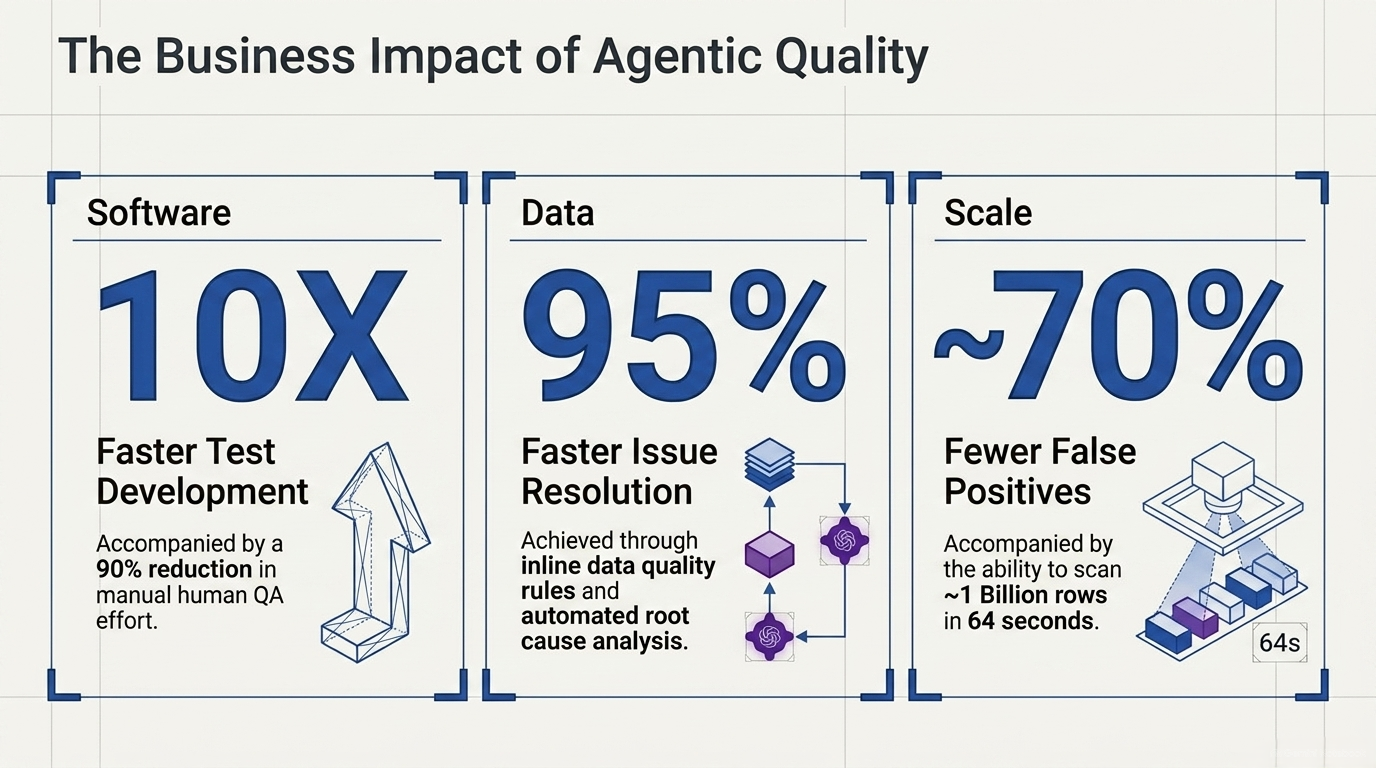
These figures are useful as candidate outcome metrics, not as universal promises. A production program should reproduce them against a baseline in its own environment before treating them as evidence of value.
For software testing, measure lead time from requirement to executable test, escaped defects, flaky-test rate, maintenance effort, and the percentage of self-healing changes that required human rollback.
For data quality, measure mean time to detect, mean time to identify root cause, mean time to remediate, false-positive rate, contract coverage, and downstream incidents prevented.
For scale, measure throughput and latency under realistic cardinality, while also measuring accuracy. A system that scans a billion rows quickly but produces noisy or low-confidence findings is not operationally better.
The strongest metric is not “how many agent actions ran.” It is how much reliable engineering work reached production with less rework and no loss of control.
13. An AI-Readiness Scorecard
Before adding autonomy, the source material proposes a compact readiness test based on four questions.
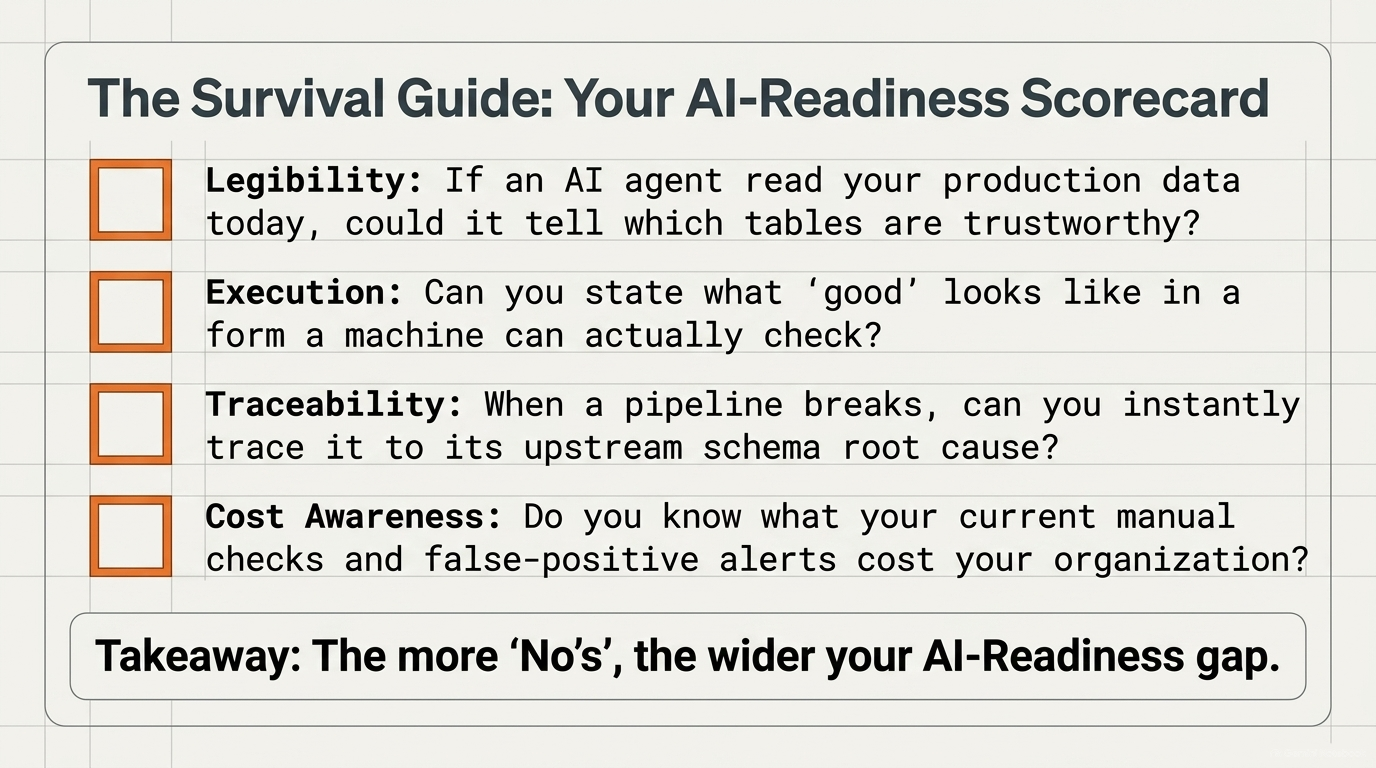
Legibility: Can an agent determine which production assets are trustworthy? This requires discoverable metadata, ownership, freshness, and status.
Execution: Can the organization express “good” in a machine-checkable form? This is the domain of contracts, tests, policies, and schemas.
Traceability: When something breaks, can the system connect the symptom to upstream lineage, schema changes, deployments, or ownership?
Cost awareness: Does the organization know the operational cost of manual checks, noisy alerts, triage, and rework?
The more “no” answers, the wider the readiness gap. That is a valuable sequencing principle. Organizations should not begin with maximum autonomy. They should first make their environment legible and executable, then add traceability, and only then widen the action permissions granted to agents.
Engineering Principles
The architecture ultimately depends on several principles:
-
Encode intent before automating action
Data contracts, acceptance criteria, schemas, and policies must define correctness. Agents should reason over those definitions, not replace them. -
Separate perception, reasoning, and execution
Give each layer explicit interfaces. This makes it easier to test what the agent observed, why it chose an action, and whether the action was allowed. -
Bound autonomy by risk
Use permissions, approvals, blast-radius checks, reversible operations, and staged rollout. Autonomy should expand only where evidence shows it is safe. -
Preserve provenance and observability
Every recommendation and action should be reconstructable from source evidence, timestamps, tool calls, policy decisions, and outcomes. -
Optimize the closed loop, not a single task
The goal is not merely faster test generation or faster anomaly detection. The goal is a reliable loop that can detect, diagnose, remediate, verify, and learn without hiding failures.
Final Synthesis
The source material ends with the image of an autonomous immune system linking software engineering and data engineering. That metaphor is useful because an immune system is not a single checker. It is a distributed loop that continuously monitors, distinguishes normal from abnormal, responds proportionally, and adapts without stopping the whole organism.
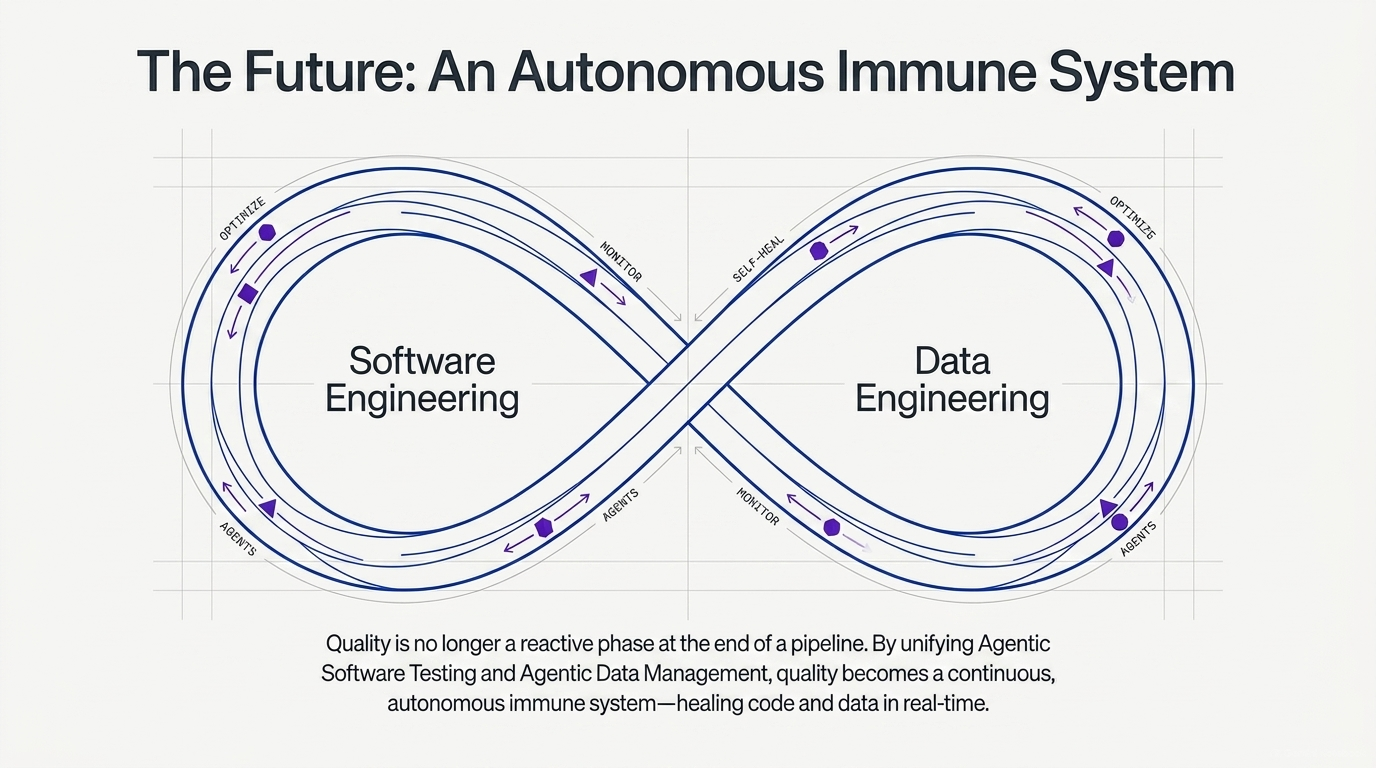
In a production architecture, requirements agents establish intent and expose ambiguity. Software-testing agents transform that intent into executable checks and keep those checks aligned with implementation changes. Data-management agents enforce contracts, correlate quality signals, trace root causes, and perform bounded remediation. Security and governance constrain what those agents can see and do. Observability records the evidence needed to understand every automated decision.
The production-ready system combines:
- Deterministic foundation: contracts, schemas, rules, acceptance criteria, and versioned policies
- Testing layer: BDD scenarios, executable tests, CI/CD checks, and validation after remediation
- Agent or AI layer: perception, planning, tool use, coordination, memory, and adaptive workflows
- Security and governance: RBAC, identity-aware guardrails, protected data boundaries, approvals, and audit trails
- Observability layer: lineage, telemetry, anomaly signals, provenance, and root-cause evidence
- Production outcome: continuous quality that can monitor, diagnose, self-heal where safe, and escalate where human judgment is required
The mature destination is not “AI replaces QA” or “AI replaces data engineering.” It is a system in which quality is no longer a late-stage inspection function. It becomes a continuous property of the delivery and data planes.
Closing Thought
Agentic systems move faster because they can decide and act without waiting for a person at every step. That advantage becomes dangerous when quality is still manual, implicit, or disconnected.
The path to trustworthy autonomy is therefore straightforward in principle: make quality definitions executable, make context observable, make actions governable, and close the feedback loop.
When software and data become machine-consumed, quality must become machine-operable.