
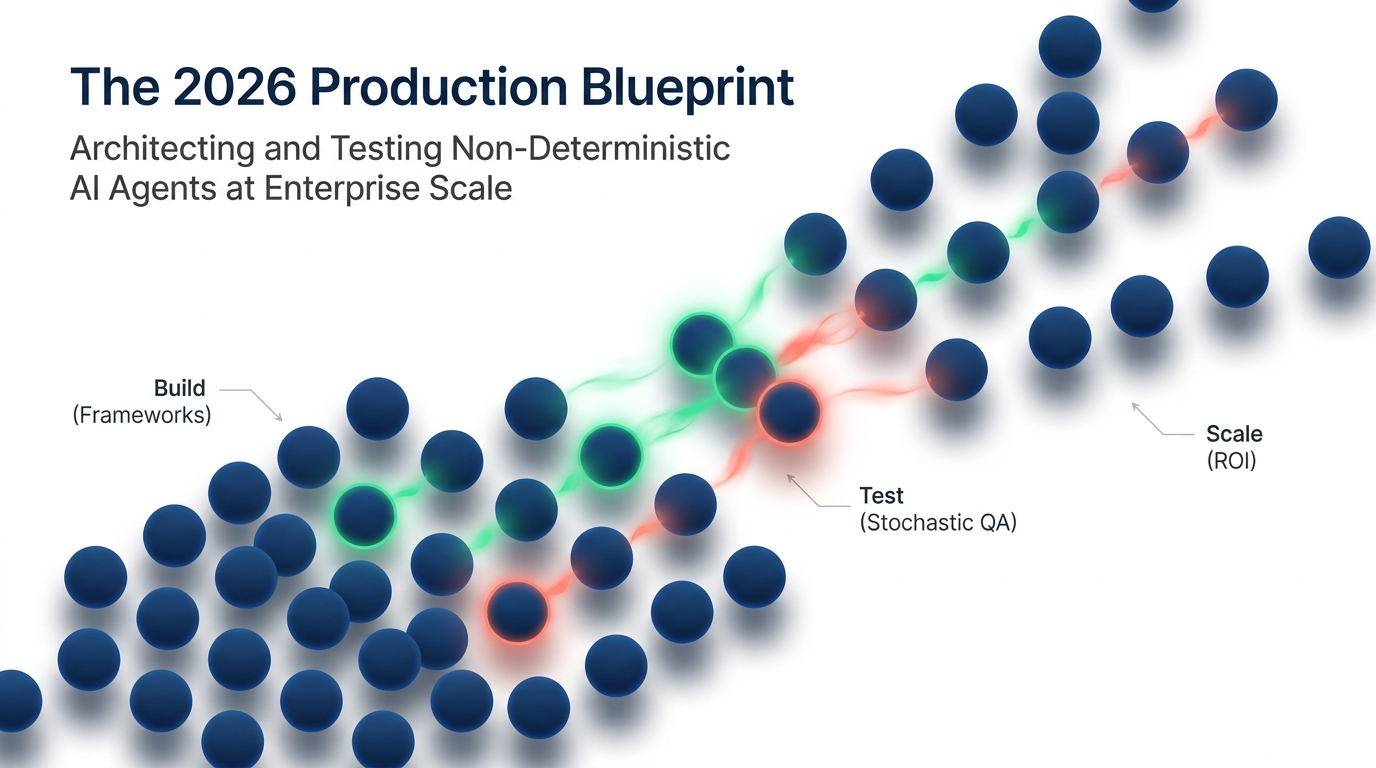
The 2026 Production Blueprint: Architecting and Testing Non-Deterministic AI Agents at Enterprise Scale
Enterprise agent systems force a change in what “correct” means. A conventional software component is usually expected to map a given input to a reproducible output. An agent may instead choose different tools, take different reasoning paths, spend different amounts of time or tokens, and still arrive at an acceptable outcome.
That makes production readiness less about proving one exact output and more about controlling a distribution of behaviors. The architecture must expose state, constrain handoffs, preserve contracts, record execution traces, and evaluate repeated runs statistically. The testing system must distinguish a real regression from ordinary behavioral variance, while the deployment system needs an explicit answer when the evidence is not yet strong enough.
The blueprint in these diagrams connects those concerns into one operating model: build with explicit orchestration, test behavior probabilistically, and deploy through statistically sound gates.
1. From Deterministic Code to Stochastic Behavior
Traditional test design assumes a mostly deterministic relationship:
[ f(x) = y ]
For a fixed input, the program should return the expected output. A branching agent network changes that assumption. Model sampling, tool availability, context, memory, retries, and inter-agent messages can alter the path even when the initial request is the same.
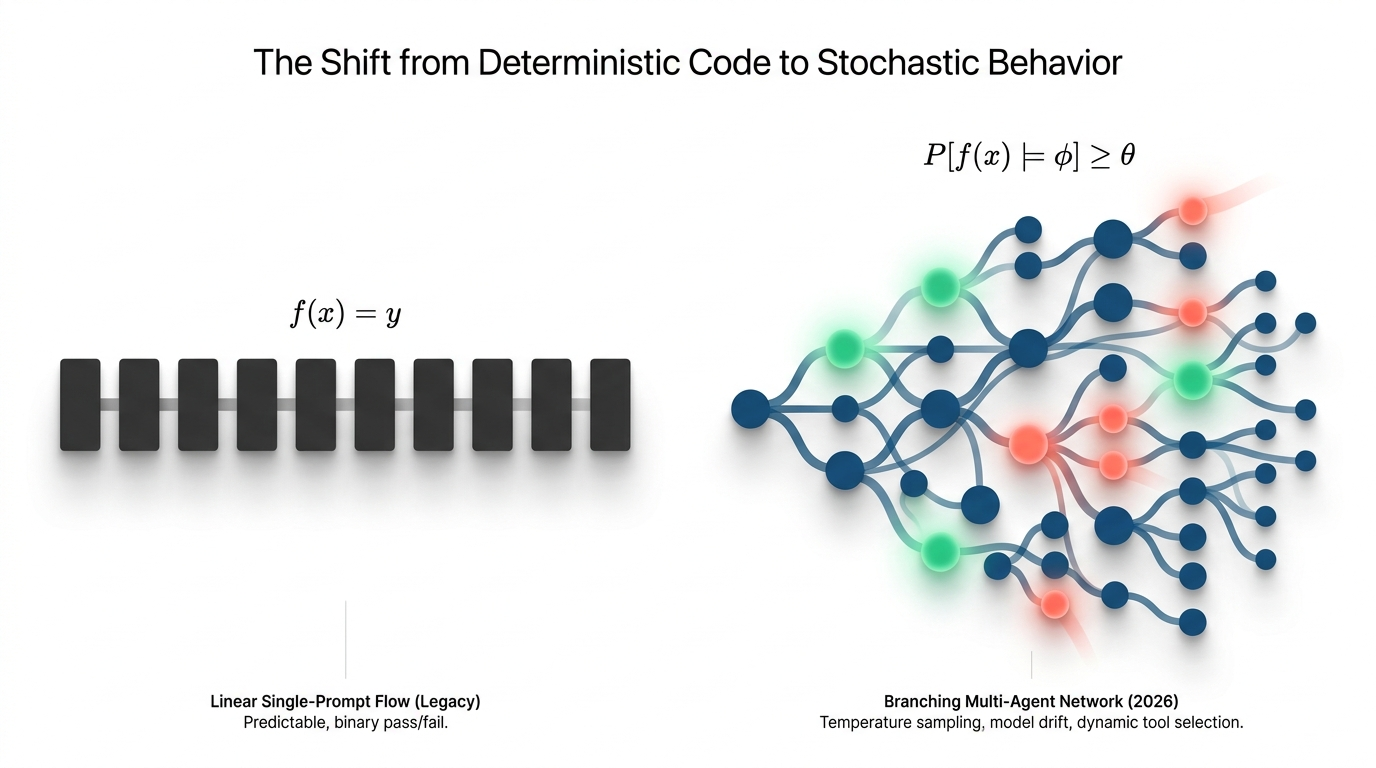
The important distinction is not that agent systems are “unreliable by definition.” It is that their behavior is better modeled as a distribution over possible executions. A useful acceptance statement therefore looks more like:
[ P[\text{behavior satisfies requirement}] \ge \theta ]
where (\theta) is the minimum acceptable success probability.
This has immediate engineering consequences. One test run no longer proves much about a probabilistic system. A passing sample can be lucky; a failing sample can be an outlier. Quality assurance must reason about repeated trials, confidence, variance, and behavioral shape rather than treating every generated string as a deterministic contract.
2. Choose an Orchestration Mental Model Before Choosing a Framework
The diagrams present three useful mental models for multi-agent orchestration: the org chart, the state machine graph, and the debate roundtable.
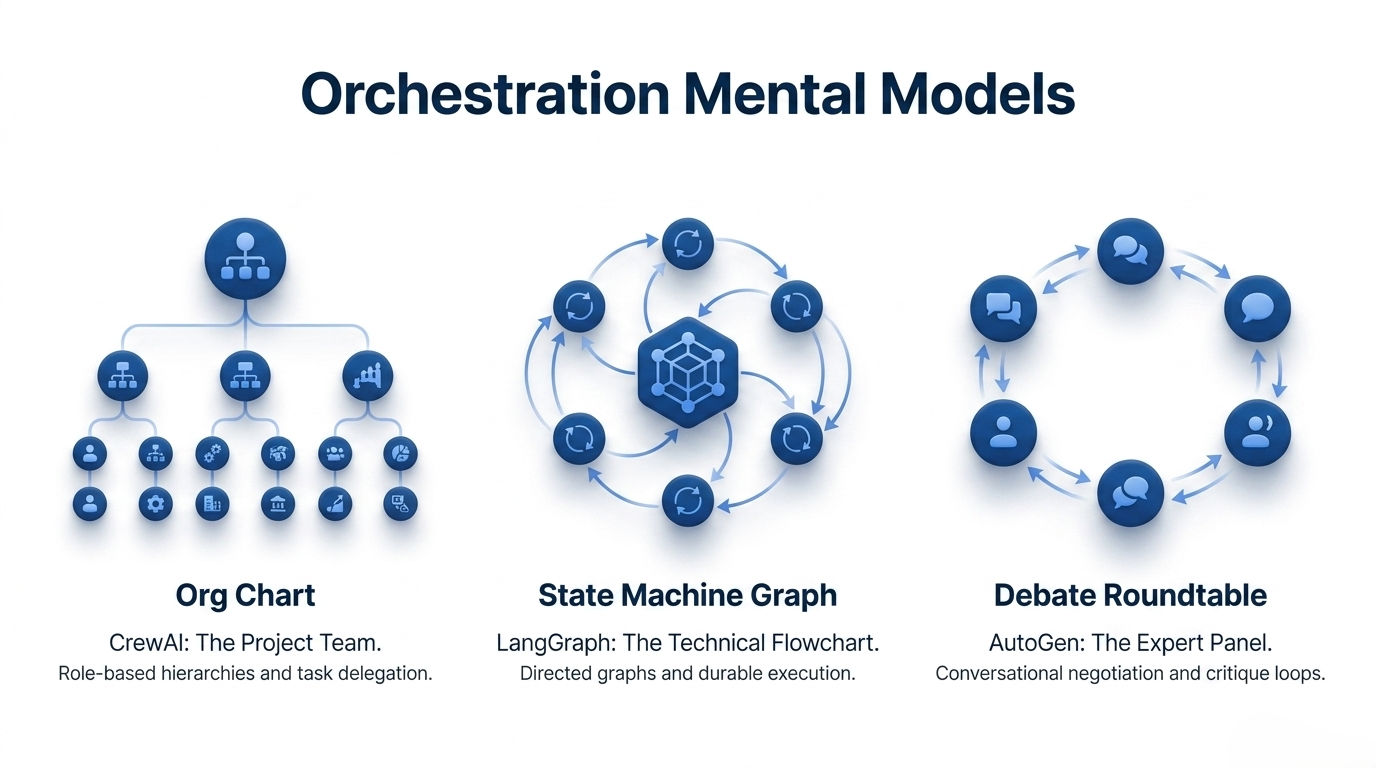
An org-chart model emphasizes roles, delegation, and management. A state-machine model emphasizes explicit state, transitions, recovery, and durable execution. A debate model emphasizes conversational critique and convergence among peers.
These are not cosmetic implementation choices. Each model determines where complexity lives:
- Role hierarchy: complexity is concentrated in task assignment, manager behavior, and context passing.
- State graph: complexity is concentrated in explicit transitions, persisted state, and restart semantics.
- Conversational roundtable: complexity is concentrated in turn-taking, stopping conditions, and disagreement resolution.
A production team should decide which coordination semantics it needs before adopting framework abstractions. Otherwise, framework defaults can become accidental architecture.
3. Framework Selection Is a Workload Decision
The framework comparison slide positions LangGraph, CrewAI, AutoGen, and Pydantic AI around different strengths. The star counts shown are a point-in-time snapshot from the source material, not a durable ranking.
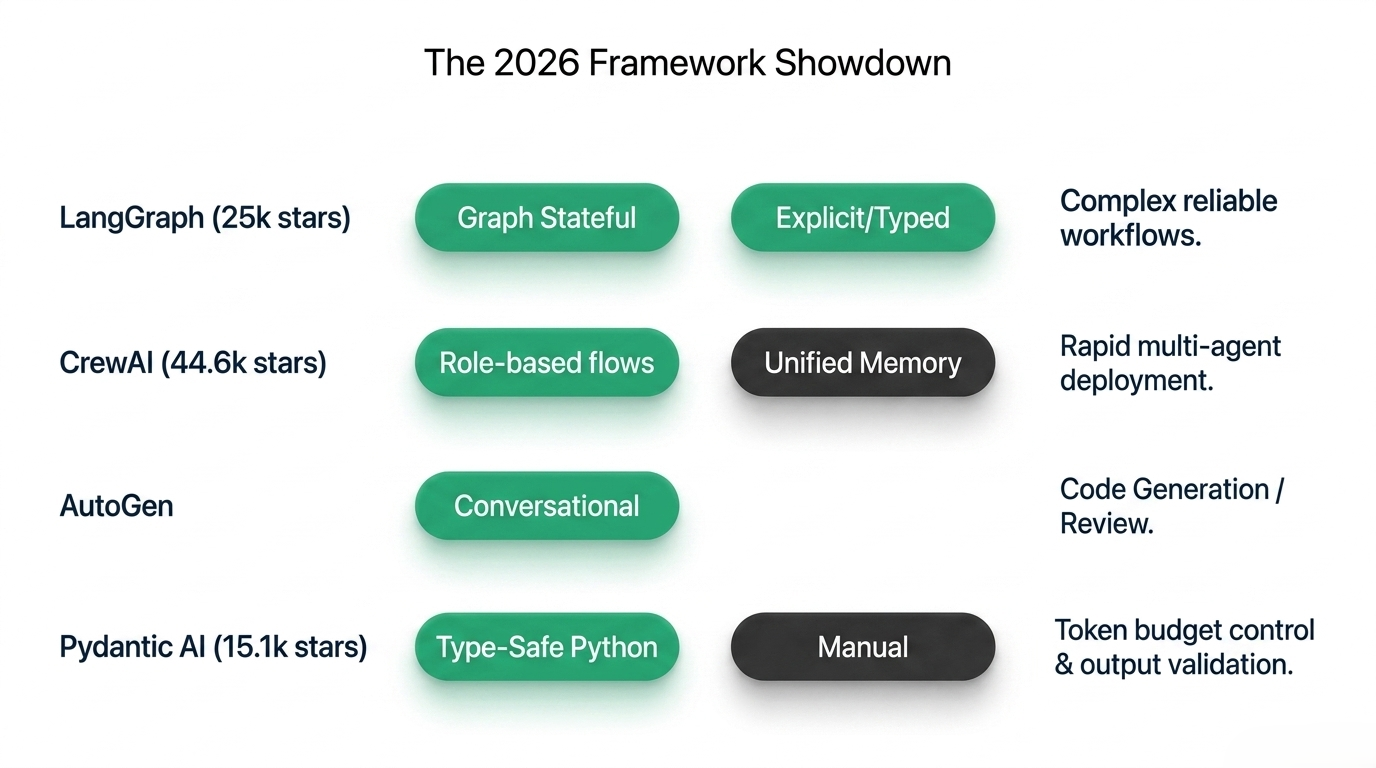
The more useful comparison is architectural:
- LangGraph fits systems that need explicit, stateful workflows and durable execution.
- CrewAI fits role-oriented workflows that resemble teams with managers and specialists.
- AutoGen fits conversational collaboration and critique loops.
- Pydantic AI fits Python-centric systems that benefit from strong typing, structured outputs, and validation boundaries.
The right question is not “Which framework is best?” but “Which failure modes must the runtime make explicit?” A workflow that must resume after partial failure needs a different abstraction from a workflow whose main challenge is assigning work to specialized agents.
Framework choice should therefore be made together with observability, testing, and recovery design—not as a separate library-selection exercise.
4. Durable Execution Makes Failure a Recoverable State
For stateful agent workflows, the most important production feature is often not model quality but recoverability. The LangGraph diagram illustrates an execution that crashes mid-run, persists state, and resumes from a breakpoint instead of restarting from the beginning.
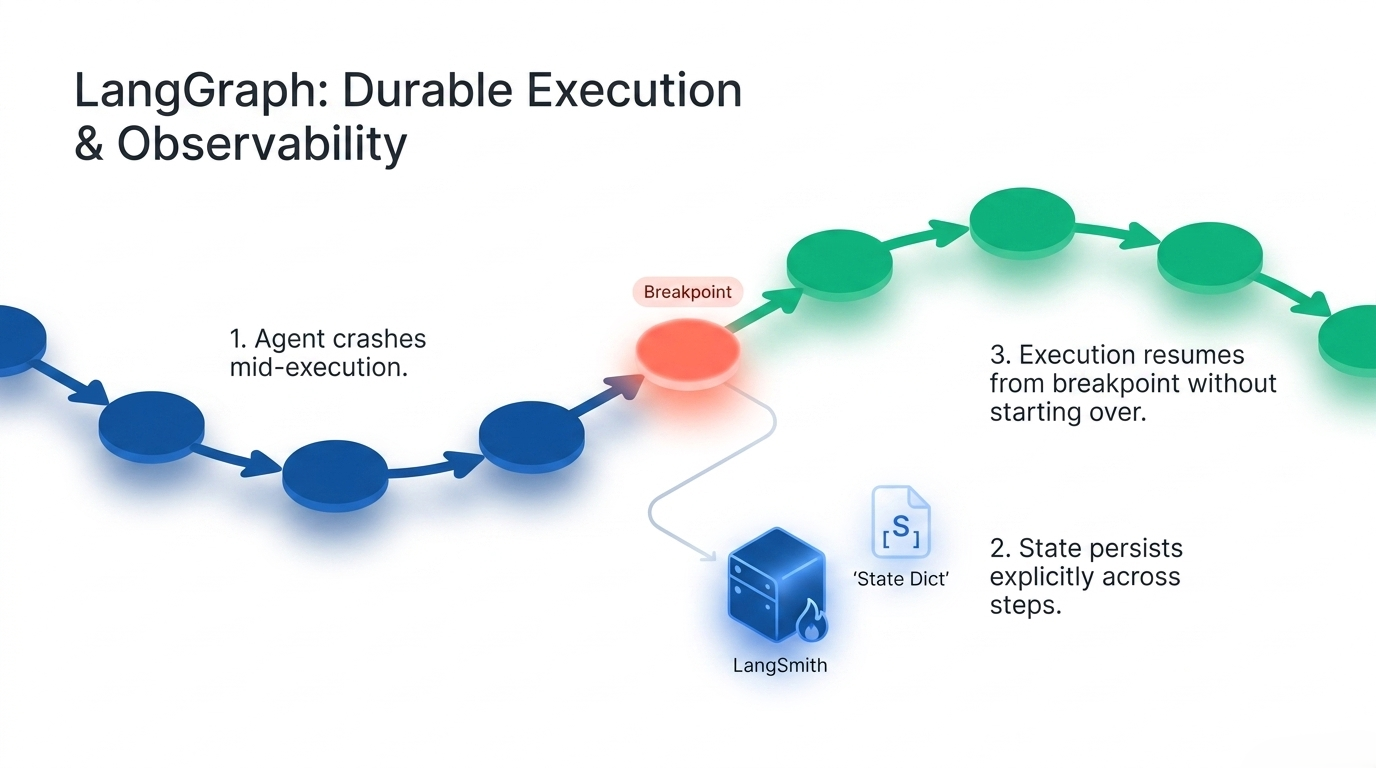
This pattern turns a transient failure into a known workflow state. To make it dependable, the system needs:
- Explicit application state so each step knows what has already happened.
- Checkpointing so completed work can survive process failure.
- Idempotent or guarded side effects so resuming does not duplicate external actions.
- Traceability so operators can reconstruct the path that led to the breakpoint.
- Resume semantics that are deterministic even when the downstream model behavior is not.
Observability and durability belong together. A persisted state object without a trace explains where execution stopped but not necessarily why. A trace without durable state explains what happened but may not let the runtime continue safely.
The stronger design is a workflow whose state, events, tool calls, and checkpoints can all be correlated.
5. Hierarchies Need Explicit Delegation Contracts
The CrewAI diagram shows a manager agent delegating work to specialist nodes such as a research analyst and a strategic writer.
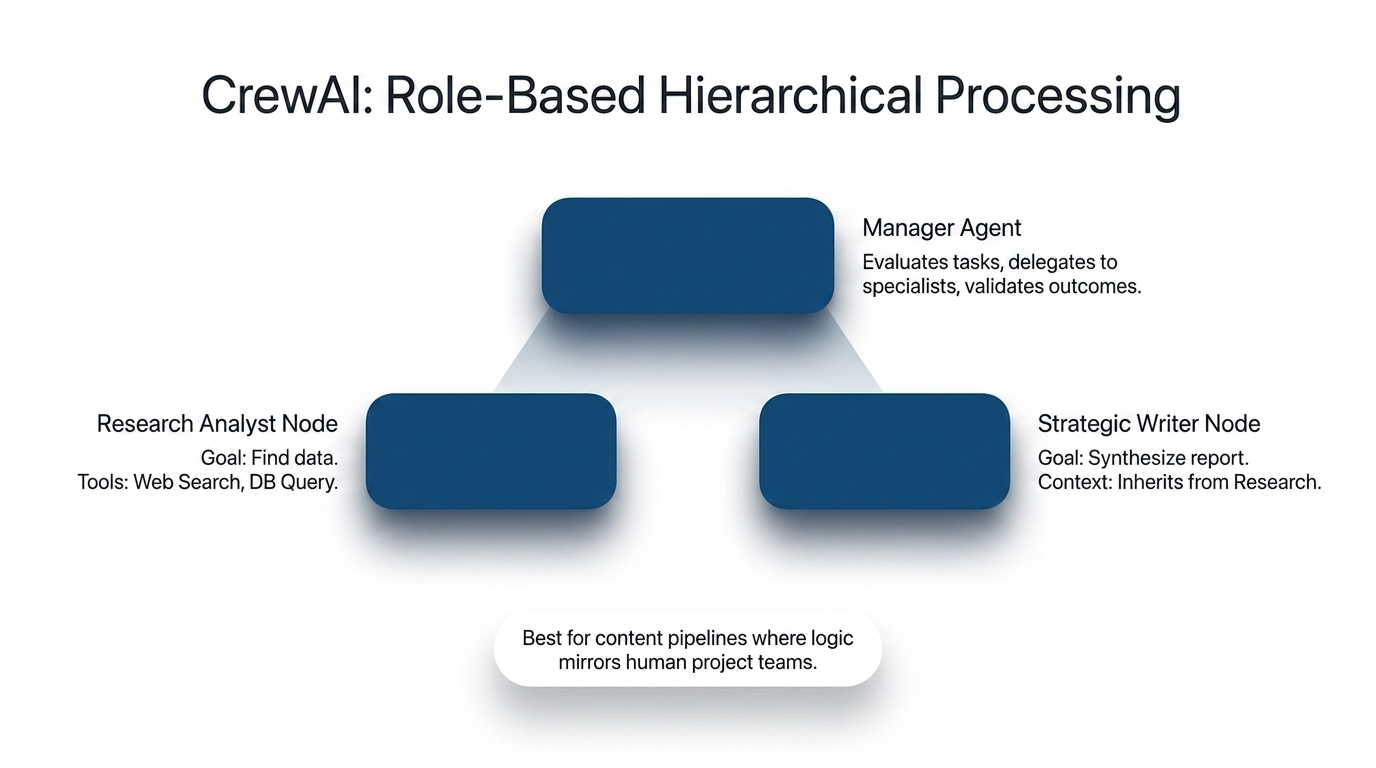
This model is intuitive because it mirrors human project teams, but it introduces a critical technical risk: every delegation is an interface boundary.
A manager that asks a research node to “find data” still needs to define what a valid result looks like. The writing node should not have to infer whether the research output is complete, whether sources are present, or whether a field is optional. The manager should validate the specialist result before passing it downstream.
In practice, a role-based pipeline becomes far more reliable when each handoff has:
- a typed or schema-validated payload,
- a clear success/failure contract,
- bounded retry semantics,
- provenance for tool-derived facts,
- and a record of the decision that triggered the delegation.
Human-looking organization charts are useful mental models, but production correctness comes from machine-checkable contracts between the boxes.
6. The Reliability Bottleneck Is Often Between Steps
The reliability slide identifies three failure classes: silent contract drift, compounding error, and delegation loops.
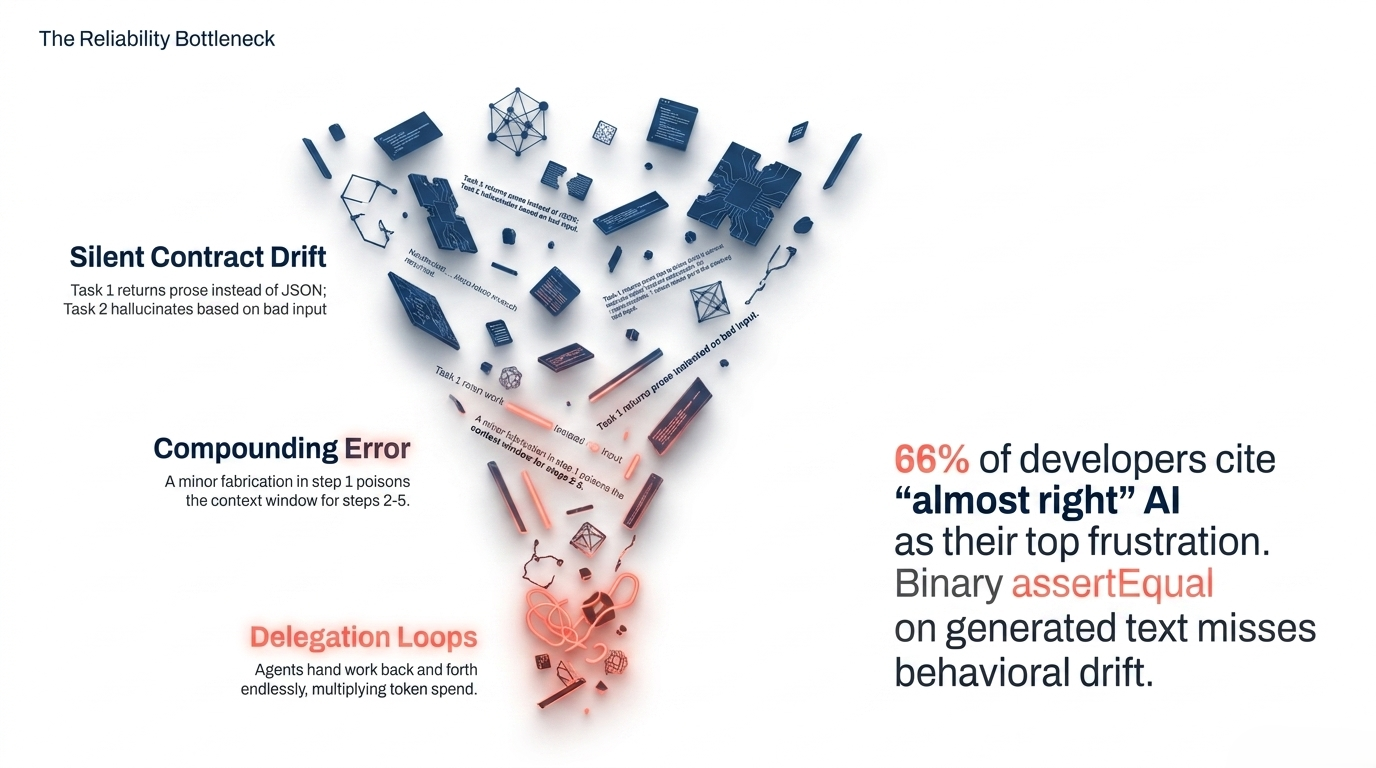
Silent contract drift happens when one component returns a syntactically plausible but semantically incompatible result—for example, prose where the next task expects JSON. Compounding error happens when a small false assumption contaminates later steps. Delegation loops happen when agents keep handing work back and forth without meaningful progress.
The slide also cites a developer-frustration statistic about “almost right” AI output. Because no external source is included in the deck, that number should be treated as a presentation claim rather than a verified benchmark. The engineering lesson does not depend on the exact percentage: binary string equality is too weak to detect many agent regressions.
A robust system therefore validates at several levels:
- Syntax: Is the result parseable?
- Contract: Does it satisfy the expected schema and invariants?
- Semantics: Does it satisfy the task requirement?
- Process: Did the agent use acceptable tools and routes?
- System behavior: Did the execution stay within cost, latency, retry, and safety limits?
This is the bridge from conventional unit testing to agent quality engineering.
7. QA Becomes a Statistical Decision Problem
The QA paradigm shift is captured by crossing out the assumption that one deterministic assertion is sufficient. In agent testing, the objective becomes estimating whether the probability of acceptable behavior remains above a required threshold.
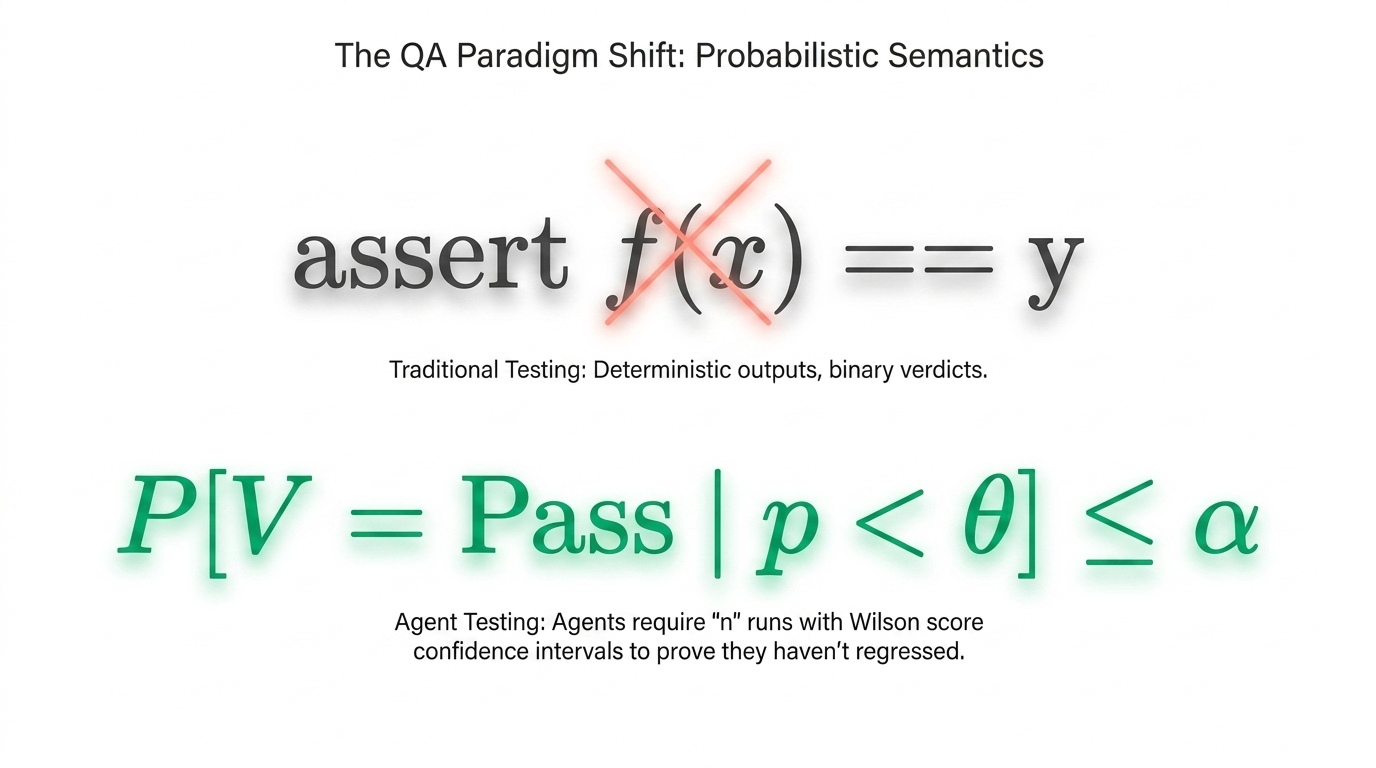
Repeated trials create an empirical success rate. But the observed rate alone is not enough; a small sample can look excellent by chance. A confidence interval gives the decision process a measure of uncertainty.
The slide specifically references Wilson score confidence intervals, which are useful for binomial pass/fail observations because they behave better than a simple normal approximation near 0 or 1 and for smaller sample sizes.
The practical decision is not “Did this run pass?” but something closer to:
- Is there enough evidence that the true pass rate is above the required threshold?
- Is there enough evidence that it is below the threshold?
- Or is the sample still too uncertain?
That third outcome is essential.
8. Use a Three-Valued Verdict: Pass, Fail, or Inconclusive
A probabilistic test system should not force every finite sample into a binary answer. The three-valued verdict slide introduces an explicit Inconclusive region between Fail and Pass.
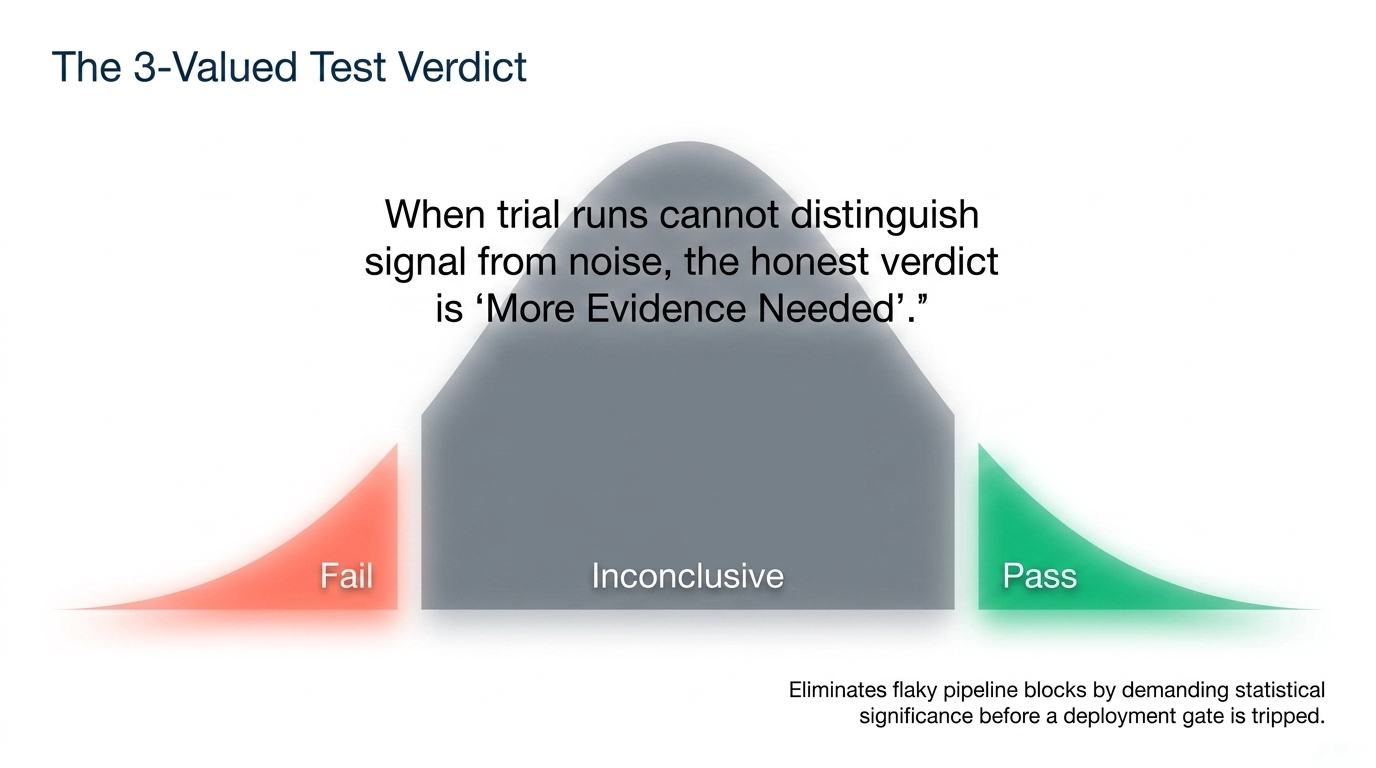
This is more than statistical hygiene. It changes CI/CD behavior.
If a confidence interval clearly satisfies the acceptance requirement, the test can pass. If it clearly violates the requirement, the test can fail. If the interval overlaps the decision boundary, the correct response is to collect more evidence.
That avoids two common mistakes:
- False blocks: one noisy sample stops a deployment even though the underlying behavior has not regressed.
- False confidence: one good sample allows a deployment even though the evidence is weak.
“Inconclusive” is not indecision. It is an explicit operational state with a defined next action: run more trials, inspect variance, or escalate to human review.
9. Build an Agent Testing Pyramid, Not One Giant End-to-End Suite
The four-layer testing pyramid separates cheap deterministic checks from expensive stochastic evaluation.
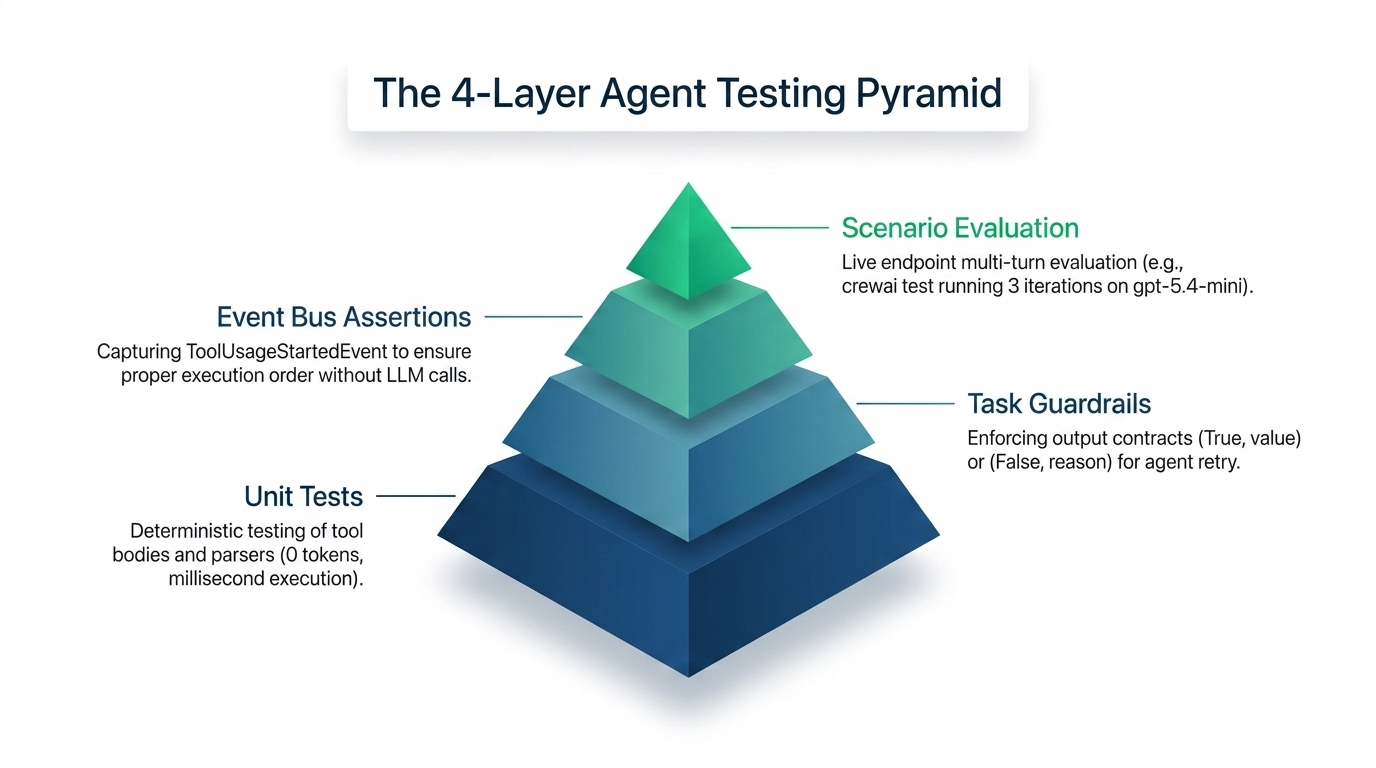
The layers are:
- Unit tests for deterministic tool bodies, parsers, transformations, and pure functions.
- Event-bus assertions for execution order and workflow events, without requiring a model call for every check.
- Task guardrails for structured output contracts and retry logic.
- Scenario evaluation for live, multi-turn behavior against an actual endpoint.
This layering matters because cost and nondeterminism increase toward the top. A parsing bug should fail in milliseconds, not after an expensive multi-agent scenario run. A missing tool-call event should be caught by event assertions, not inferred from final prose.
The pyramid also improves debugging. When a scenario test fails, lower layers can rule out deterministic components first, narrowing investigation to model behavior, orchestration, or external dependencies.
10. Test the Behavioral Fingerprint, Not Only the Final Text
Two executions can produce equally acceptable final answers while behaving very differently internally. The behavioral fingerprint diagram turns execution traces into a vector of properties such as tool usage, reasoning depth, total cost, error recovery, output length, and action distribution.
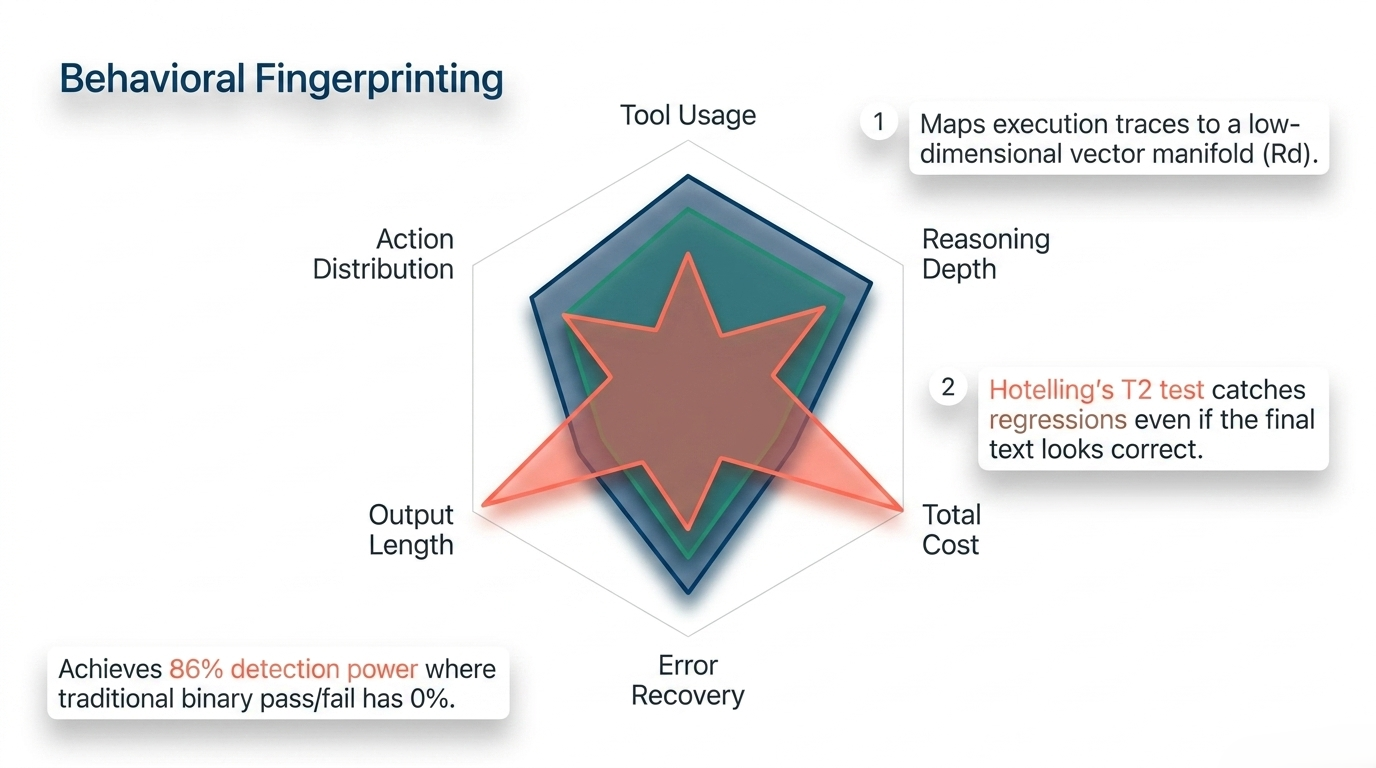
This is powerful because many production regressions appear first in the shape of execution rather than in the user-visible answer. An agent may still answer correctly while:
- using an expensive tool far more often,
- taking many more steps,
- recovering from errors less effectively,
- generating much longer outputs,
- or shifting its action distribution.
The slide proposes mapping trace features into a low-dimensional space and using Hotelling’s (T^2) to detect multivariate distribution shifts. The exact detection-power percentage shown in the slide is an unverified source claim, but the statistical pattern is sound: a multivariate test can detect coordinated changes across several behavioral dimensions that a binary final-answer check would miss.
Behavioral fingerprinting therefore acts as an early-warning system for regressions in cost, efficiency, and strategy.
11. Close the QA Loop with Agents, but Keep the Gates Explicit
The agentic QA system introduces three roles: a Test Generation Agent, an Execution & Analysis Agent, and a Review & Optimization Agent operating in a closed loop.
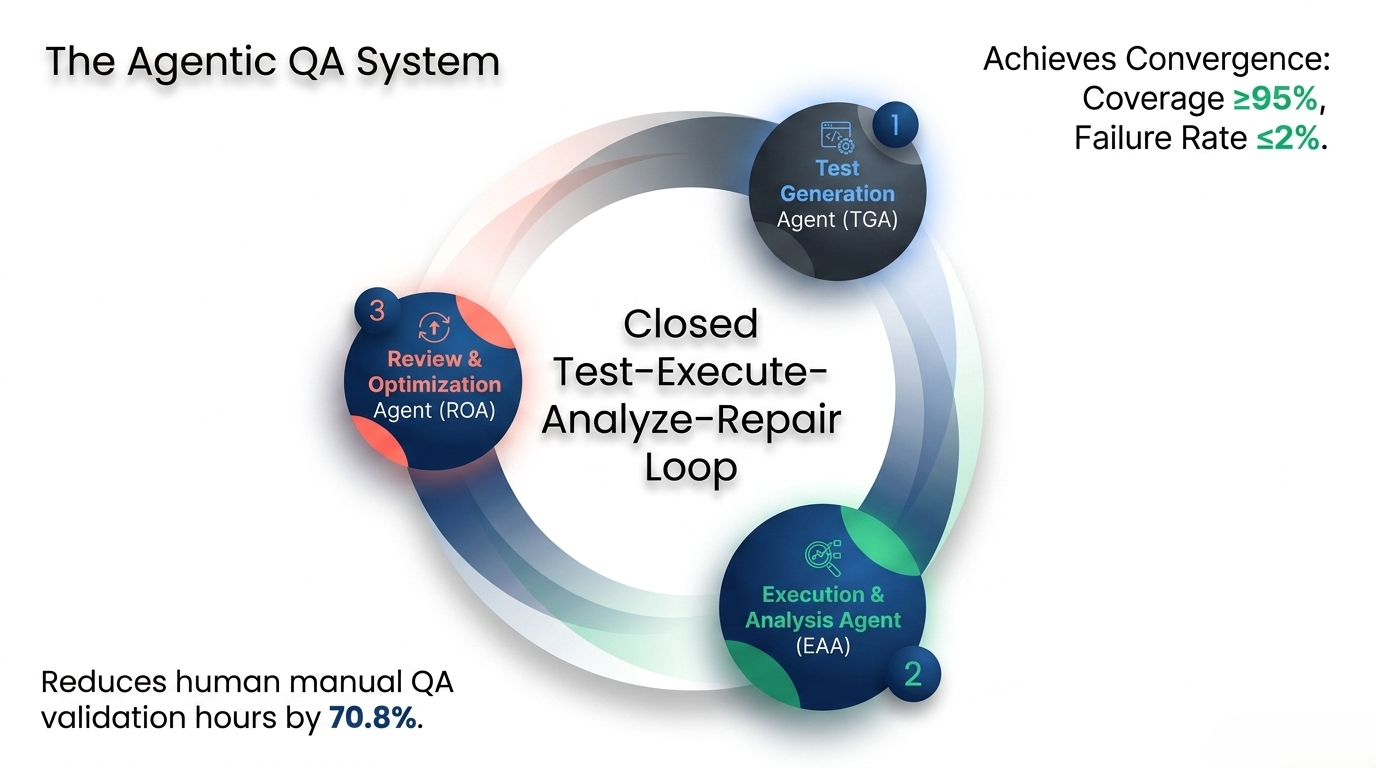
This is a useful architecture when test cases themselves need to evolve with the product. The generator proposes or updates tests, the execution agent runs them and analyzes outcomes, and the review agent identifies gaps or optimizations before the next cycle.
However, the loop should not be allowed to redefine success silently. Human-governed policy still needs to own:
- acceptance thresholds,
- protected invariants,
- high-risk scenarios,
- model and tool allowlists,
- maximum budgets,
- escalation rules,
- and audit requirements.
The slide presents convergence targets and a reduction in manual QA time. Those figures should be read as objectives or reported deck results, not as universal expectations. The reusable principle is that automation can generate evidence, but governance defines what evidence is sufficient.
12. The Maintenance Cliff Comes from Encoding Behavior in Brittle Scripts
The maintenance-cost diagram contrasts a manually maintained browser-testing approach with an AI-native testing approach that derives tests more directly from the codebase.
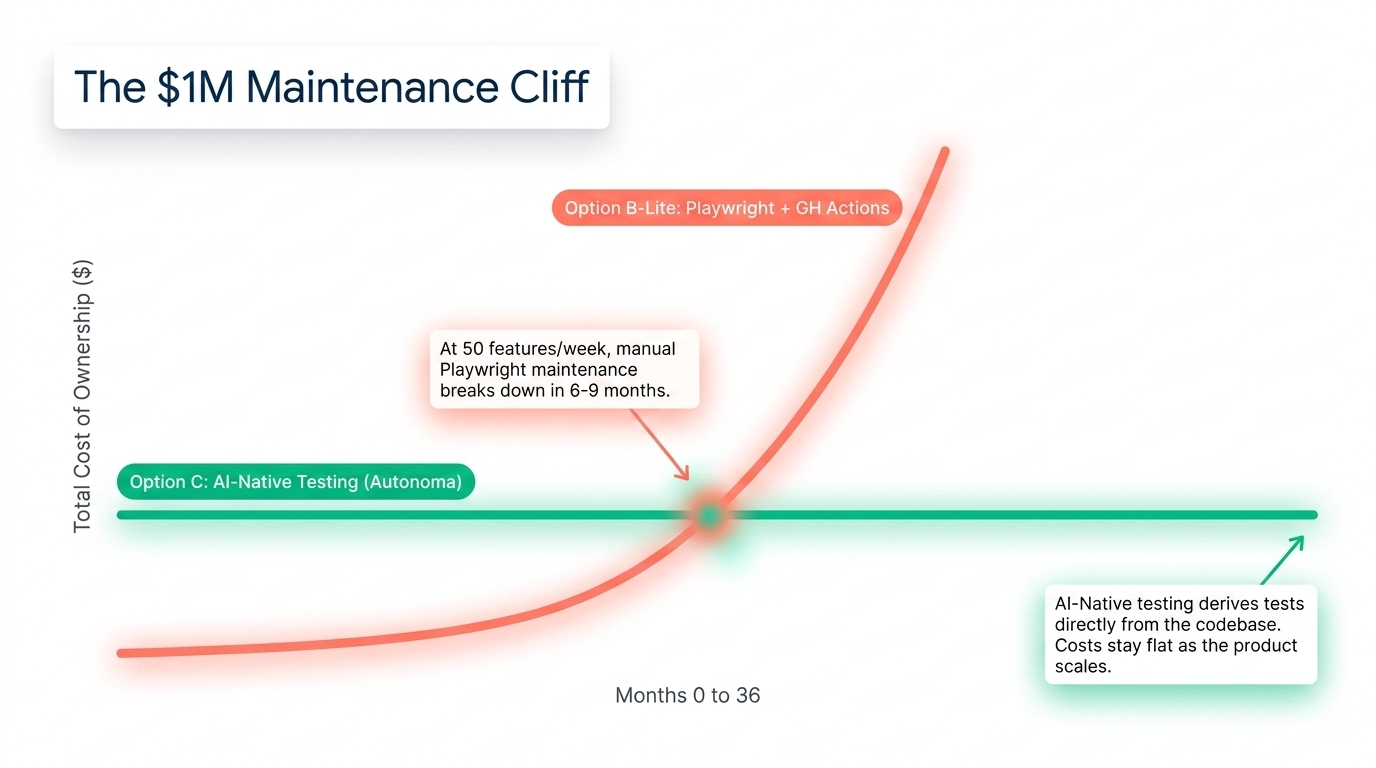
The source frames this as a “$1M maintenance cliff” and includes a scenario where high feature throughput causes manual Playwright maintenance to break down after several months. Without supporting data, those numbers should be treated as scenario-specific claims.
The architectural point is still important: maintenance cost grows rapidly when test intent is duplicated across fragile selectors, flows, fixtures, and hand-authored scripts. As product behavior changes, the test suite accumulates repair work.
AI-native test generation can reduce that duplication if it is anchored to stable sources of truth such as:
- application schemas,
- API contracts,
- code structure,
- event definitions,
- accessibility roles,
- and explicit behavioral requirements.
The goal is not to remove deterministic tests. It is to reserve hand-authored determinism for stable invariants while generating or adapting higher-level scenario coverage where manual maintenance would otherwise dominate.
13. Deployment Gates Should Spend Evidence Efficiently
The continuous-deployment diagram places a Sequential Probability Ratio Test (SPRT) between a merged pull request and three outcomes: Deploy, Manual Review, or Block.
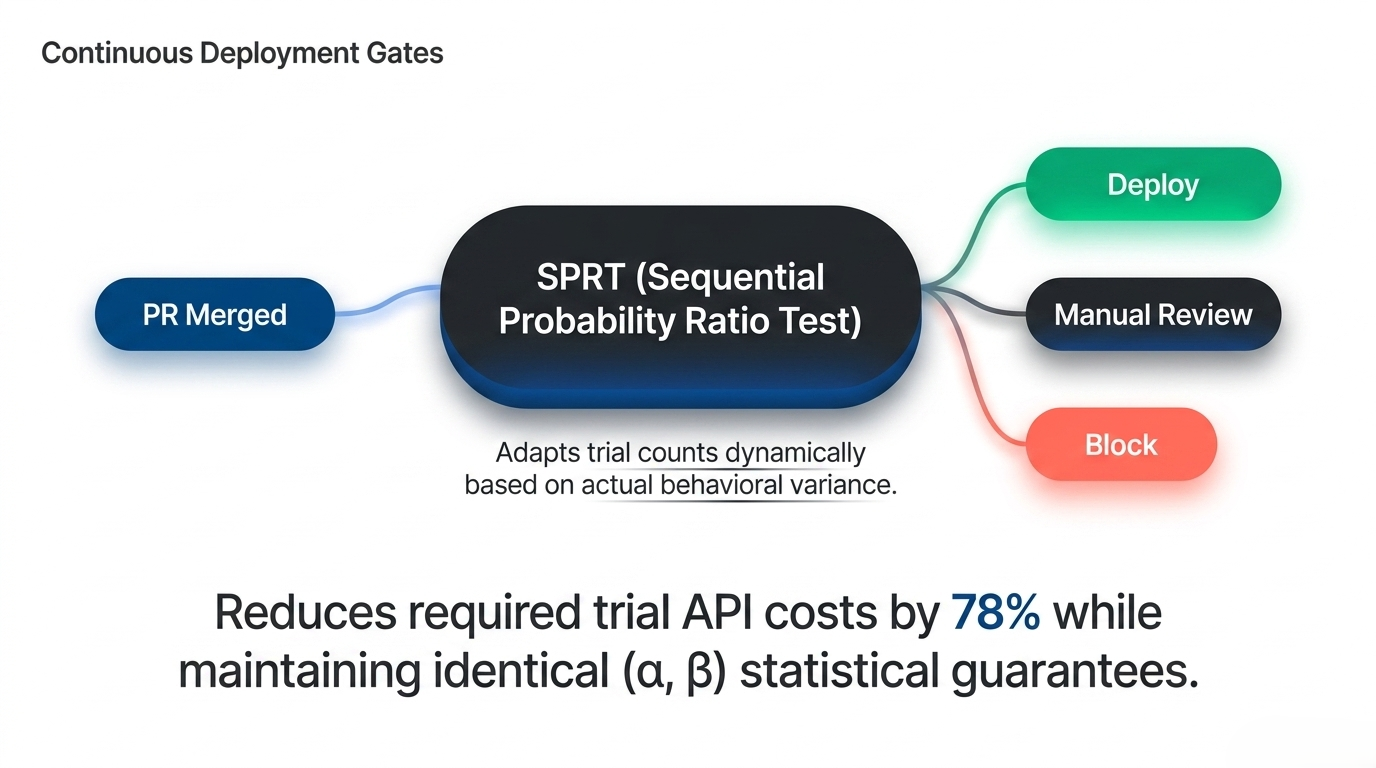
SPRT is useful because it evaluates evidence as trials arrive instead of fixing the sample size in advance. If the observed behavior strongly supports the acceptable hypothesis, testing can stop early and deploy. If it strongly supports the unacceptable hypothesis, the gate can block early. If evidence remains ambiguous, more trials continue until a boundary is reached or an operational cap triggers manual review.
This maps naturally onto the three-valued verdict:
- Deploy when evidence is sufficiently strong for the acceptable region.
- Block when evidence is sufficiently strong for regression.
- Manual review / continue testing when the evidence is not decisive.
The slide reports a large reduction in required trial API cost while preserving the same ((\alpha,\beta)) error guarantees. That percentage is presented without independent support in the source material, so it should be treated as a deck claim. The general benefit of sequential testing is nevertheless clear: do not pay for more trials once the evidence is already sufficient.
Engineering Principles
The architecture ultimately depends on several principles:
-
Model agent behavior as a distribution
A single successful run is a sample, not proof. Define acceptance in terms of rates, intervals, and behavioral boundaries. -
Keep deterministic foundations deterministic
Parsers, tool bodies, schemas, event order, state transitions, and policy checks should be verified with ordinary fast tests wherever possible. -
Make state and contracts explicit
Durable execution, delegation, retries, and recovery are safer when inputs, outputs, checkpoints, and ownership are machine-checkable. -
Observe execution, not just outcomes
Cost, tool selection, depth, retries, recovery, and action distributions are part of system behavior and can regress before final answers do. -
Treat uncertainty as a first-class deployment state
“Inconclusive” should trigger more evidence or review rather than being coerced into pass or fail. -
Separate automation from governance
Agents may generate tests and analyze traces, but deployment policy, protected scenarios, thresholds, and escalation rules should remain explicit and auditable.
Final Synthesis
The source material resolves into a three-phase production blueprint: Build, Test, Scale.
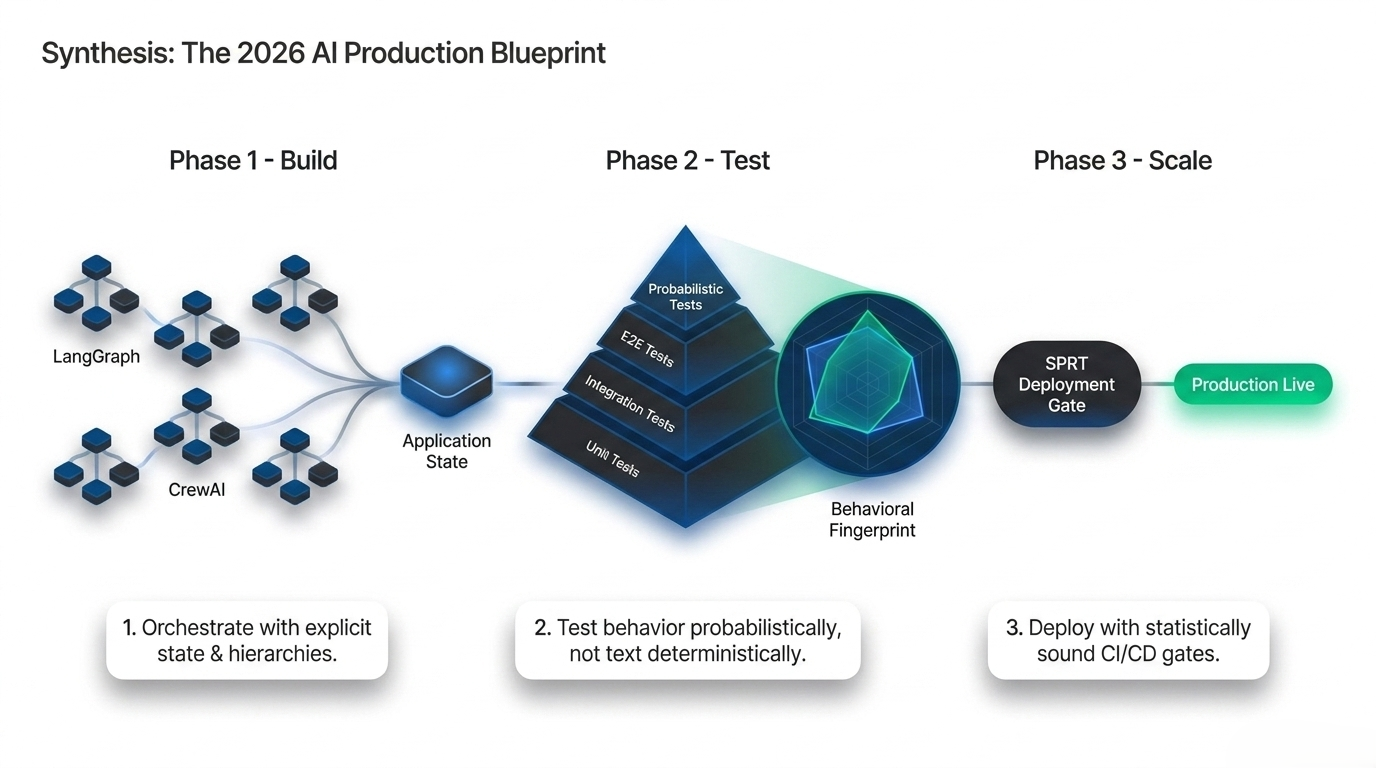
In the build phase, choose an orchestration model that makes the system’s coordination semantics explicit. Role hierarchies and state graphs can both work, but they should expose durable state and clear interfaces rather than relying on implicit conversational behavior.
In the test phase, keep a deterministic base of unit tests and contract checks, then add stochastic scenario evaluation for behaviors that genuinely depend on model choice. Use repeated runs, confidence intervals, three-valued verdicts, and behavioral fingerprints to detect both obvious failures and subtle drift.
In the scale phase, turn those statistical judgments into CI/CD policy. Sequential tests can adapt trial counts to the strength of the evidence, while manual review remains available for ambiguous or high-risk cases. Observability connects all three phases by making execution traces available for diagnosis, trend analysis, and audit.
The production-ready system therefore combines:
- Deterministic foundation: unit tests, schema validation, tool tests, event assertions, and stable state transitions.
- Testing layer: repeated trials, Wilson intervals, scenario evaluation, behavioral fingerprints, and multivariate regression detection.
- Agent layer: explicit orchestration through state graphs, role hierarchies, or conversational collaboration where appropriate.
- Security and governance: constrained tools, validated handoffs, policy-owned thresholds, protected scenarios, bounded retries, and escalation.
- Observability layer: correlated traces, checkpoints, tool-call history, cost, latency, and recovery signals.
- Production outcome: deployment decisions that are evidence-based rather than dependent on one sampled output.
Closing Thought
The central production challenge of agentic software is not making randomness disappear. It is making stochastic behavior measurable, bounded, observable, and governable.
When the system is probabilistic, confidence—not a single assertion—becomes the unit of release engineering.