
The 2026 AI Agent Framework Architecture Guide: From Hype to Production Reality
AI agent architecture is no longer mainly a question of which framework has the most features. The harder question is whether the system can keep its behavior understandable when state persists, agents delegate, tools fail, context grows, and a workflow loops longer than expected.
The source material frames the 2026 landscape as a move away from framework proliferation toward a smaller set of tools with distinct architectural niches. That changes the selection problem. Instead of asking which framework is “best,” an architect needs to identify the dominant control model, state requirements, language constraints, validation needs, and operational boundaries of the workload.
The central thesis is simple: the framework should make the system easier to reason about in production, not merely faster to prototype.
1. From Framework Proliferation to Architectural Niches
The landscape diagram contrasts a crowded 2024 field with a more differentiated 2026 picture. It highlights LangGraph, CrewAI, Pydantic AI, and Mastra as examples of frameworks that have carved out distinct roles.
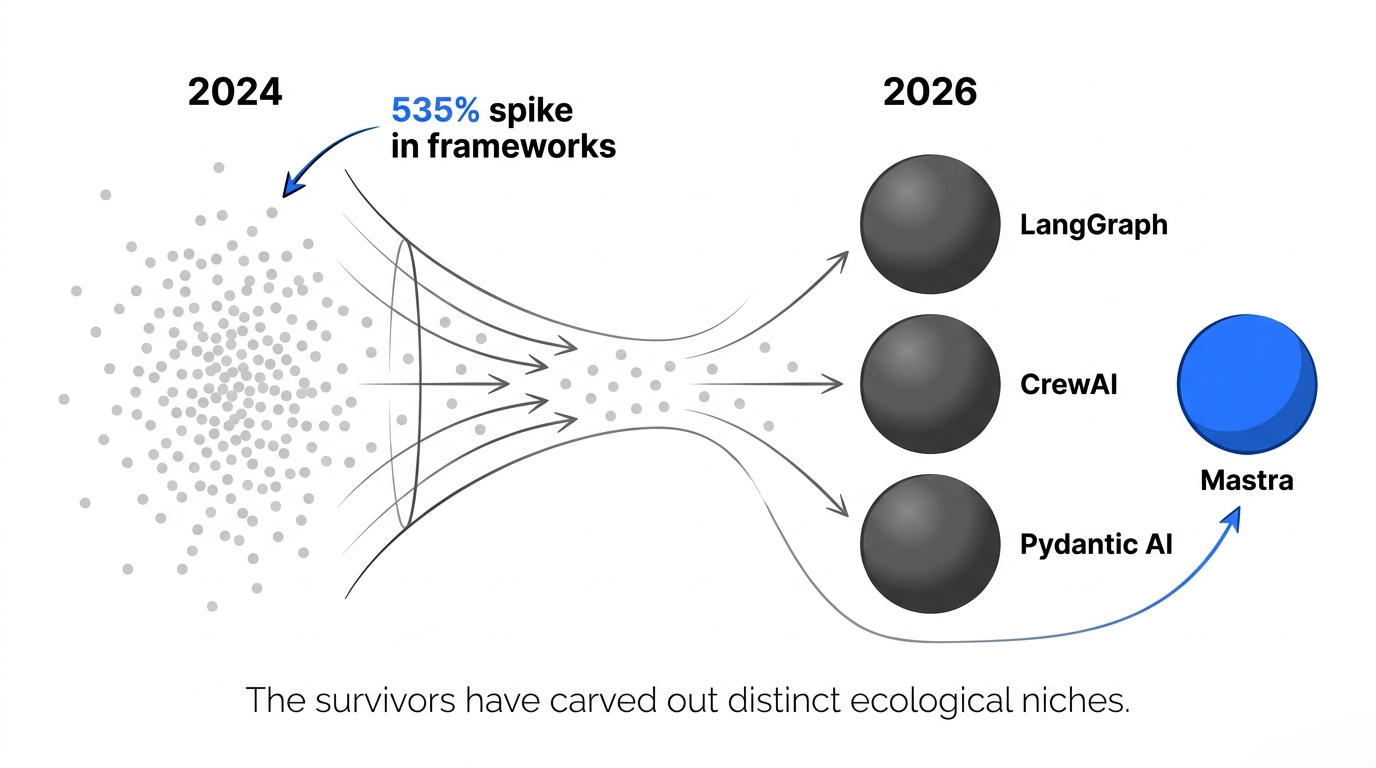
The slide calls out a 535% spike in frameworks during the earlier wave. Whether evaluating that figure as a market statistic or simply as the source material’s framing, the architectural implication is the same: an exploding tool landscape creates pressure to choose by capability labels rather than by system shape.
The 2026 framing is more useful. The surviving options are presented as occupying different niches rather than converging on one universal abstraction. That is the first decision principle for production teams: start with the workload’s control and state model, then choose the framework whose native primitives match it.
This also reduces a common form of accidental complexity. If a role-based delegation problem is forced into a state-machine abstraction, or a durable graph workflow is forced into loosely coordinated autonomous roles, much of the implementation becomes glue code that compensates for the mismatch.
2. Orchestration and Choreography Are Different Control Models
The next architectural split is between orchestration and choreography.
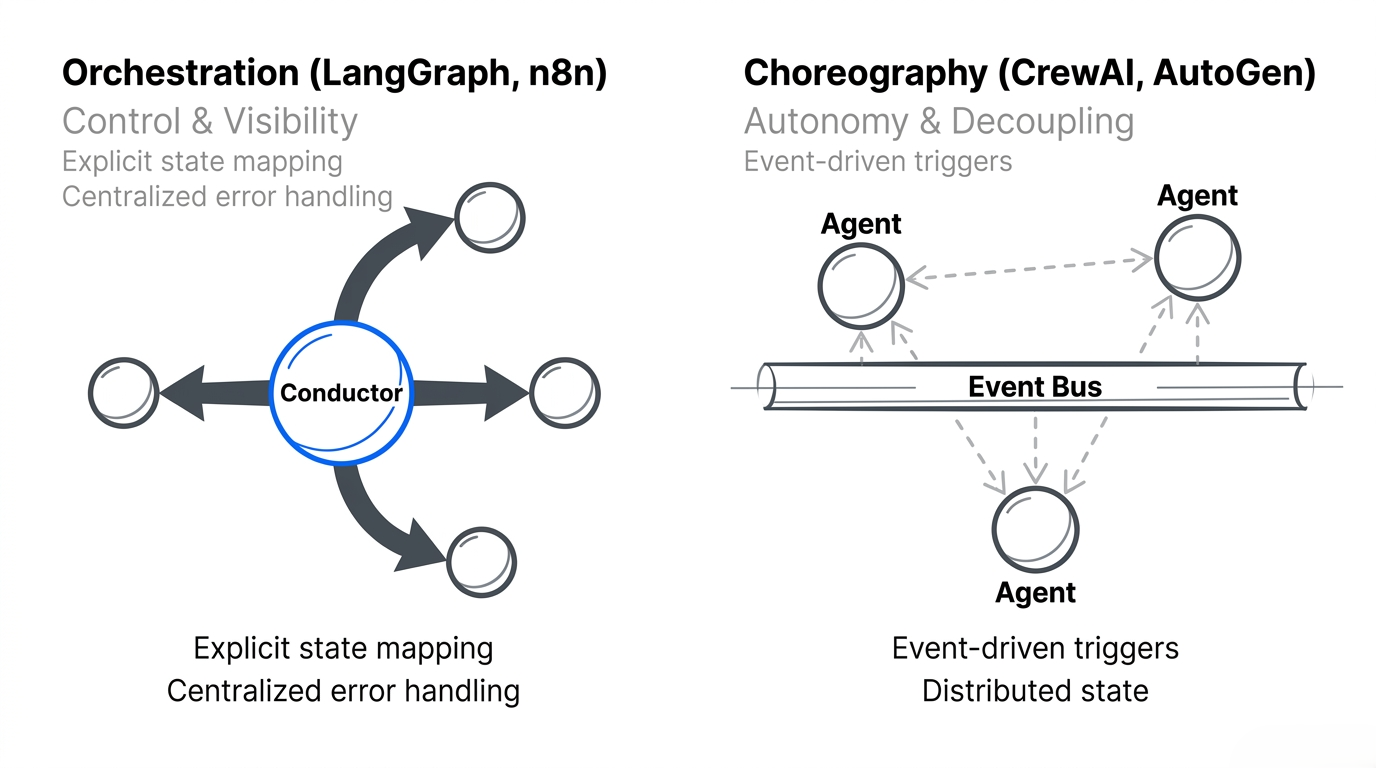
In an orchestrated system, a conductor coordinates work. The source associates this pattern with LangGraph and n8n, emphasizing explicit state mapping and centralized error handling. The advantage is control and visibility: the execution path has a center, and the system has an obvious place to inspect transitions, retries, and failures.
In a choreographed system, agents respond to events and to one another rather than to a single central coordinator. The source associates this with CrewAI and AutoGen, emphasizing autonomy, decoupling, event-driven triggers, and distributed state.
Neither pattern is automatically superior. They optimize for different kinds of reasoning about the system:
- Orchestration makes execution paths and recovery policies easier to centralize.
- Choreography can reduce coupling between participants and make delegation feel more natural.
- Orchestration concentrates responsibility in the control plane.
- Choreography distributes both autonomy and the burden of understanding global state.
The production question is therefore not “How autonomous should the agents be?” in the abstract. It is where should control live, and how will an operator reconstruct what happened after a failure?
3. Three Agent Interaction Patterns
The source material then makes the abstractions concrete with three patterns: a stateful graph, a role-based crew, and a conversational critique loop.
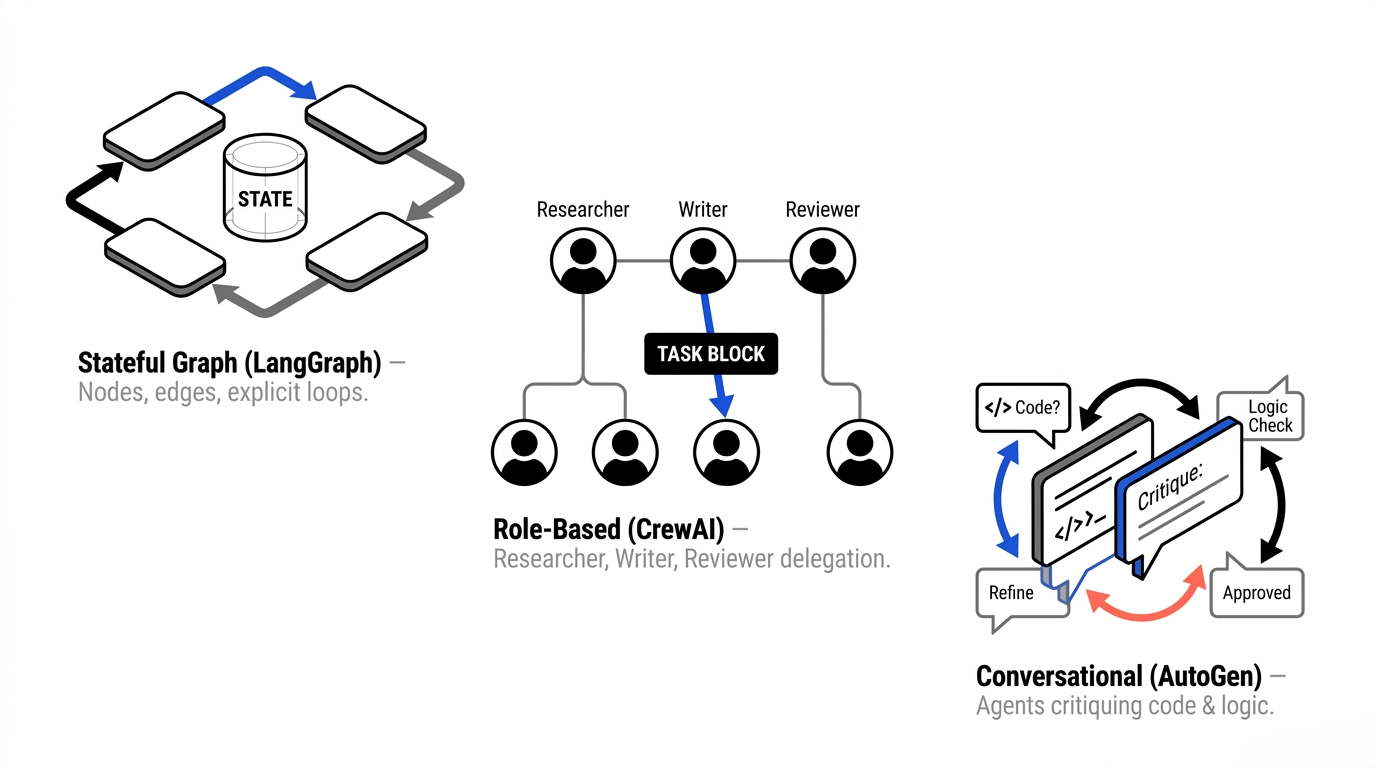
A stateful graph models work as nodes and edges with explicit loops around shared state. This is a strong fit when the workflow itself is the primary artifact to reason about.
A role-based system assigns responsibilities such as researcher, writer, and reviewer. The task structure is expressed through delegation and handoff rather than through graph topology.
A conversational system coordinates through iterative critique: produce, inspect, refine, approve, and loop. The source illustrates this through agents reviewing code and logic.
The practical distinction is where the architecture stores its meaning. In graph systems, meaning lives in transitions and state. In role systems, it lives in responsibilities and delegation. In conversational systems, it lives in the message loop and the acceptance criteria.
Choosing among them is not merely a library preference. It determines the unit of debugging: a node transition, a role handoff, or a conversational turn.
4. LangGraph: Explicit State as the Engineer’s Canvas
LangGraph is presented as the framework for workflows where state, branching, pausing, and recovery must be explicit.
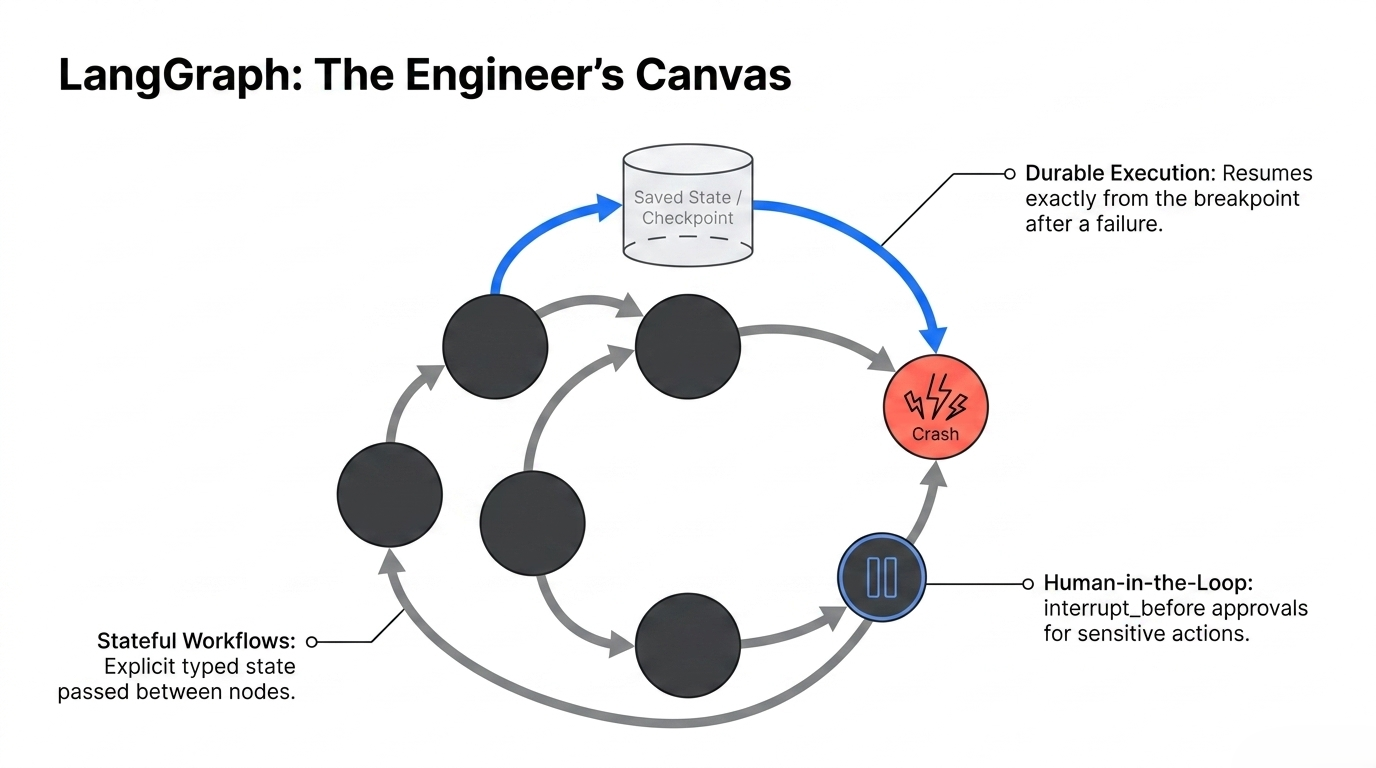
The diagram emphasizes three production properties.
First, stateful workflows pass explicit typed state between nodes. This makes the graph more than a sequence of prompts; the workflow has an inspectable execution model.
Second, durable execution is tied to checkpoints. A failure does not have to imply starting from the beginning if the system can resume from a saved breakpoint.
Third, human-in-the-loop controls can interrupt execution before sensitive actions. The source calls out an interrupt_before style approval point as a deliberate part of the graph rather than as an external emergency stop.
Together, these properties make LangGraph a strong fit for complex workflows where the graph itself must survive real operational conditions. The value is not that every workflow becomes a graph. The value is that workflows that already behave like state machines gain a native place to express persistence, branching, and controlled intervention.
The failure mode to watch is unnecessary graph complexity. If every small action becomes a node, the graph can become a visual transcription of code rather than a useful model of business state. The useful boundary is to make state transitions explicit where they matter for recovery, approval, or branching.
5. CrewAI: Role-Based Collaboration for Fast Multi-Agent Pipelines
CrewAI is framed around specialized roles, goals, tools, and autonomous handoffs.
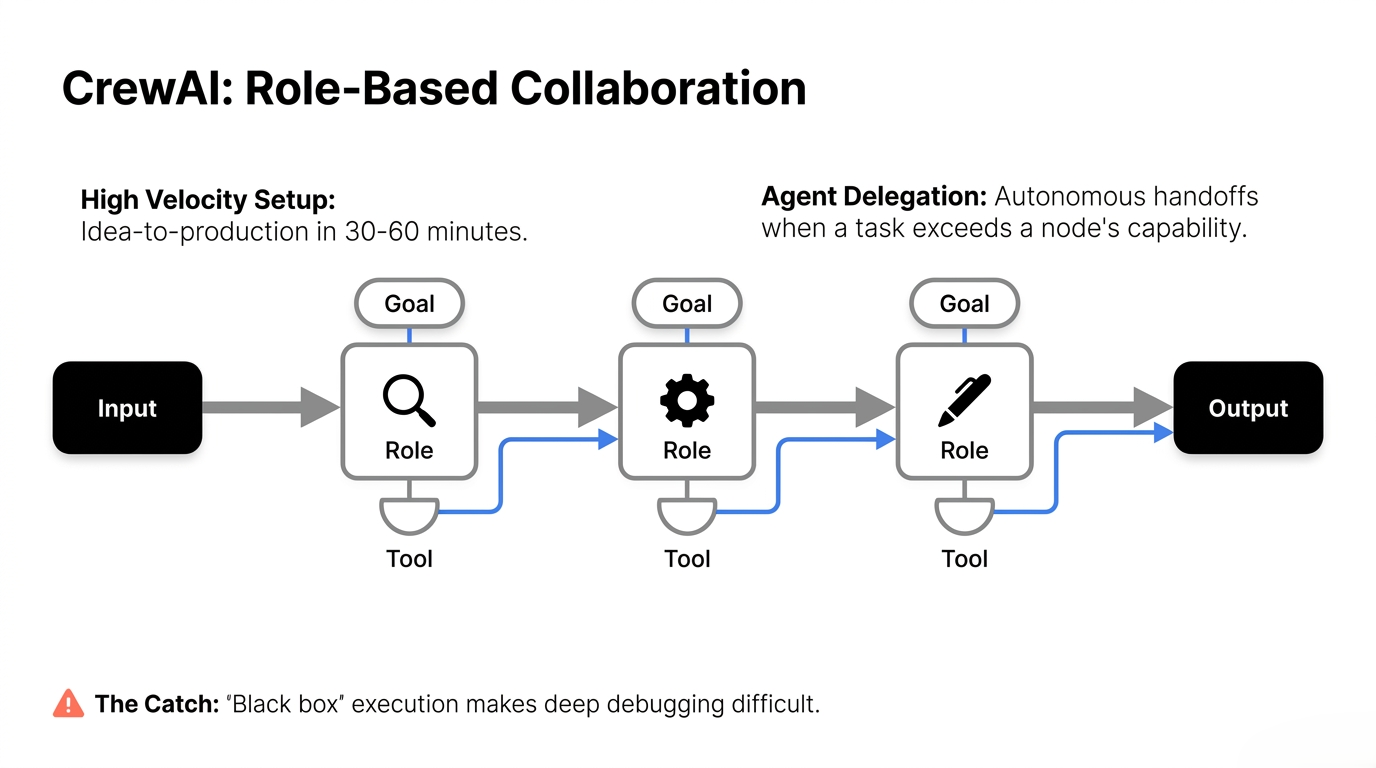
The diagram shows a linear input-to-output path passing through multiple role nodes. Each role has a goal and access to tools, while delegation allows a task to move when it exceeds a node’s capability.
The source highlights high-velocity setup and gives an “idea-to-production in 30–60 minutes” claim. It also warns about the other side of that abstraction: black-box execution can make deep debugging difficult.
That tension is important. Role abstractions are appealing because they map closely to how people describe collaborative work: researcher, writer, reviewer, analyst, planner. But production debugging eventually needs lower-level answers. Which handoff occurred? What context was passed? Which tool call changed the result? What terminated the loop?
CrewAI is therefore a natural fit when role boundaries are the clearest representation of the process, but the operational design still needs a way to expose delegation history and intermediate decisions.
6. Pydantic AI: Type Safety at the Code-to-Execution Boundary
Pydantic AI is presented as a Python-centric option where validation and code quality are primary concerns.
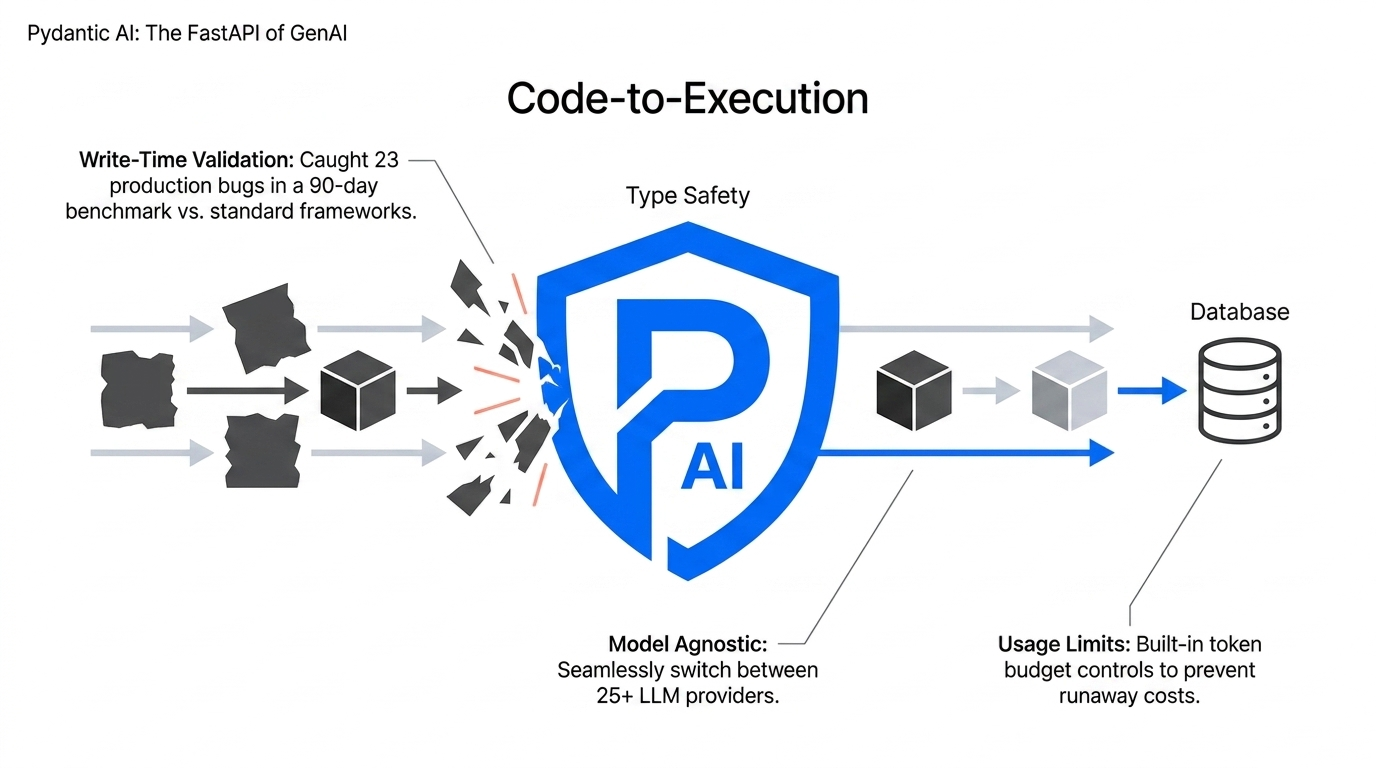
The source describes it as “The FastAPI of GenAI” and places type safety directly between model-produced structures and downstream execution. It also highlights model-agnostic operation across many LLM providers and built-in usage limits intended to constrain runaway cost.
The most important architectural idea here is not a framework slogan. It is the location of the trust boundary. Model output should not become application state simply because it is syntactically convenient. A typed validation layer gives the application a formal place to reject malformed or incompatible data before it reaches databases, tools, or business logic.
The slide also includes a benchmark claim that write-time validation caught 23 production bugs in a 90-day comparison. The source does not provide the benchmark methodology, so that figure should be treated as a source claim rather than as an independently established result. The architectural point does stand on its own: validate agent output before execution, especially when downstream systems assume a stable schema.
Usage limits belong in the same boundary layer. Validation protects correctness; explicit budgets protect operational scope.
7. The Web-Native Stack: Mastra and the Vercel AI SDK
For TypeScript and Next.js-oriented systems, the source separates workflow concerns from UI streaming concerns.
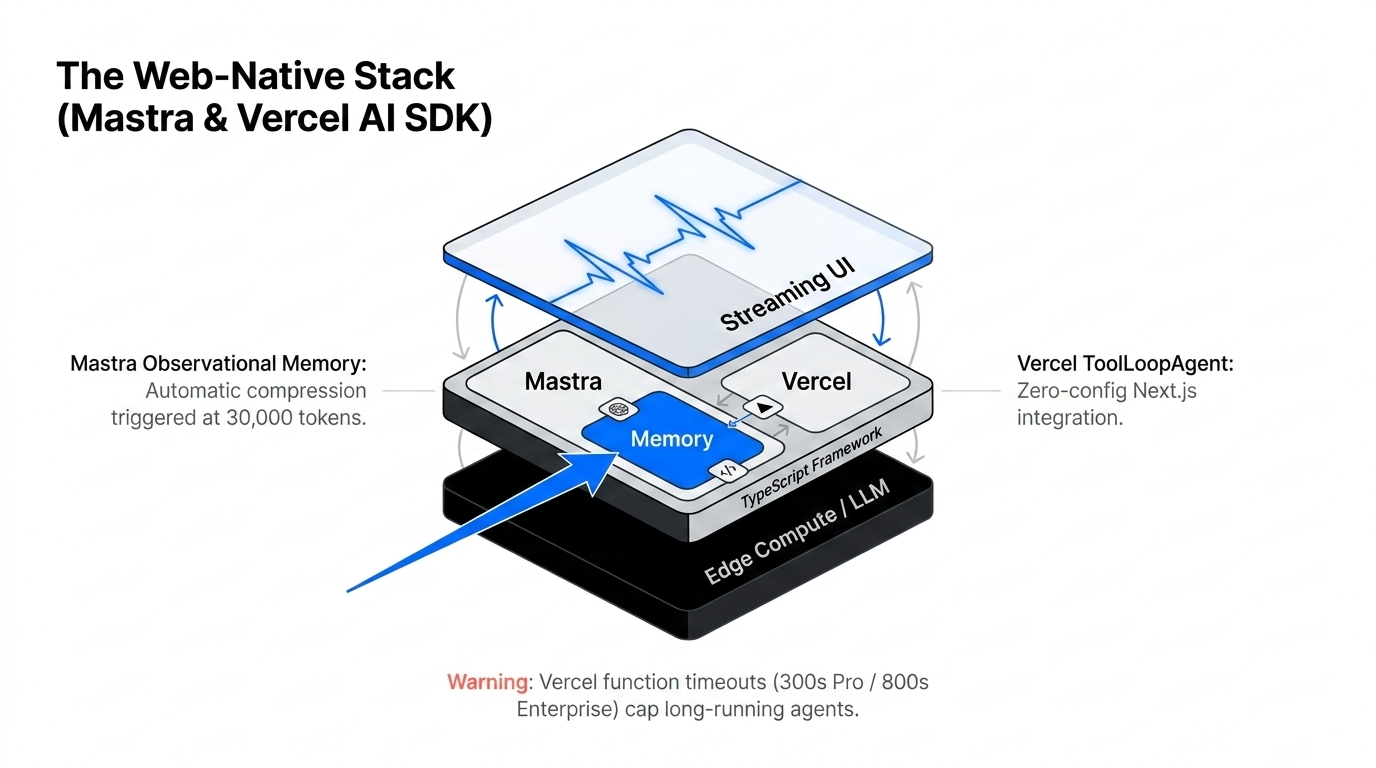
Mastra is positioned as the workflow-oriented TypeScript option, while the Vercel AI SDK is presented as the UI-streaming layer. The stack illustration places memory and agent behavior inside a TypeScript framework layer, with streaming UI above it and edge compute or LLM infrastructure below it.
The source also calls out two operational details:
- Mastra observational memory is shown using automatic compression at 30,000 tokens.
- Vercel function timeouts are shown as 300 seconds for Pro and 800 seconds for Enterprise, warning that long-running agents can hit platform ceilings.
Those figures are part of the source material rather than independently verified platform limits in this article. Their role in the architecture is to make a broader constraint visible: a web-native agent stack inherits the execution limits of its hosting environment.
This matters because streaming a user interface and durably executing a long-running workflow are different concerns. A good web architecture can use one tool for interactive delivery and another for workflow control without pretending they are the same layer.
8. Choose by Constraint, Not by a Universal Score
The comparison matrix reduces the framework landscape to several decision dimensions: mental model, setup time, an indicative quality rating, and best-fit workload.
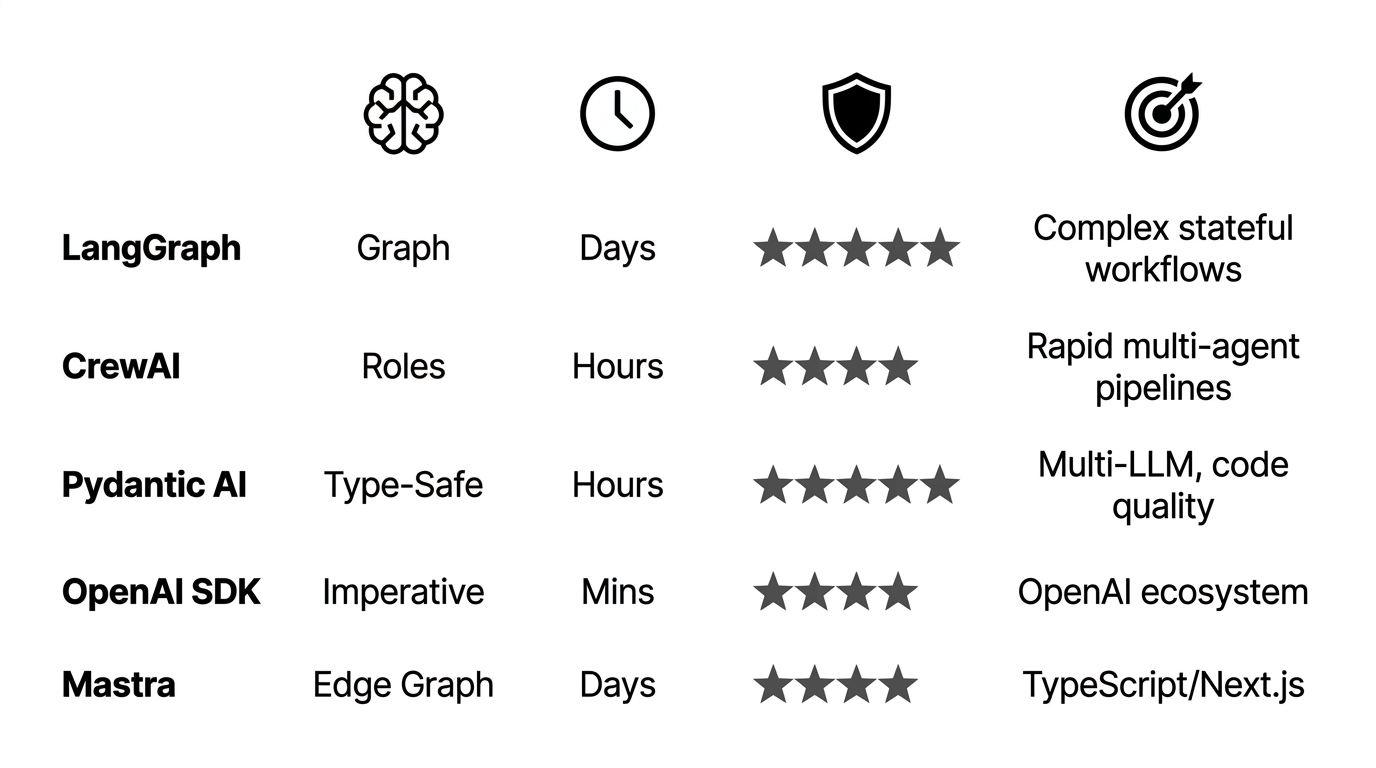
The source characterizes the options as follows:
| Framework | Primary mental model | Setup framing | Best-fit emphasis in the source | | --- | --- | --- | --- | | LangGraph | Graph | Days | Complex stateful workflows | | CrewAI | Roles | Hours | Rapid multi-agent pipelines | | Pydantic AI | Type-safe | Hours | Multi-LLM, code quality | | OpenAI SDK | Imperative | Minutes | OpenAI ecosystem | | Mastra | Edge graph | Days | TypeScript / Next.js |
The star ratings in the visual are best read as the source’s comparative shorthand, not as an objective benchmark. More useful are the architectural categories beside them.
A framework should be selected because its model lines up with the thing the team most needs to control. If the core problem is durable state, graph semantics matter. If it is role delegation, role semantics matter. If it is schema correctness, type safety matters. If it is direct imperative access, a thinner SDK may be more appropriate. If the delivery environment is TypeScript and Next.js, the web-native stack becomes a first-class constraint.
9. Memory Is a Budgeted System, Not an Infinite Transcript
The memory diagram separates context into three concentric concerns: the immediate context window, short-term session or buffer memory, and longer-term storage such as vector or SQLite-backed memory.
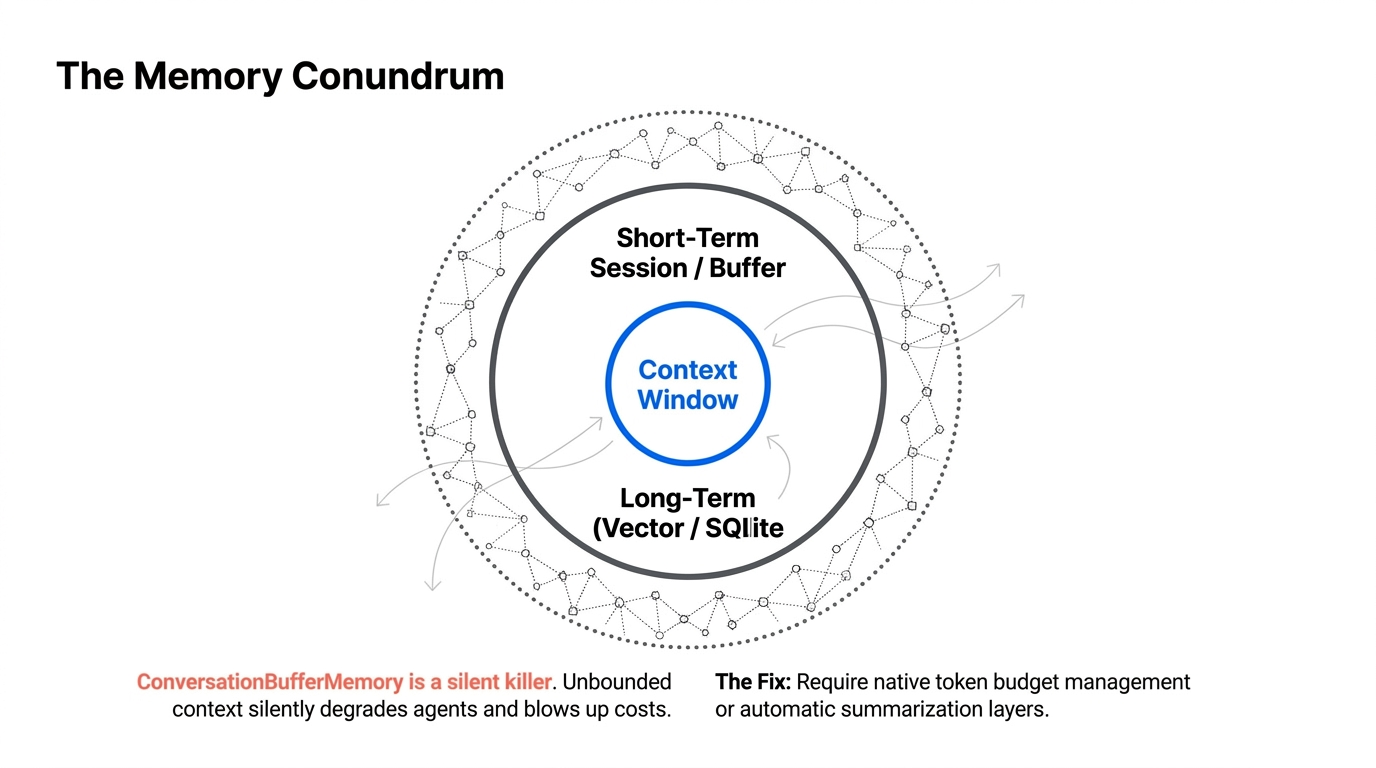
The source warns that unbounded conversational buffer memory silently degrades agent behavior while increasing cost. Its proposed fix is native token-budget management or automatic summarization.
This is a useful production model because “memory” is often discussed as one feature when it is actually several mechanisms with different lifetimes:
- The context window is the model-visible working set for the current invocation.
- Short-term memory carries relevant session information across nearby steps.
- Long-term memory persists information beyond the immediate execution and must be selectively retrieved.
The architecture should make transitions between these layers deliberate. If every prior interaction is carried forward, context becomes an ever-growing operational liability. If too much is summarized, important distinctions can disappear. The system therefore needs explicit policies for what is retained, compressed, retrieved, and discarded.
Memory design is ultimately another form of state design. It should have boundaries, budgets, and observability just like any other production subsystem.
10. Production Reality: Tracing, Guardrails, Permissions, and Cost Control
The production reality diagram places the framework at the center and wraps it with operational layers.
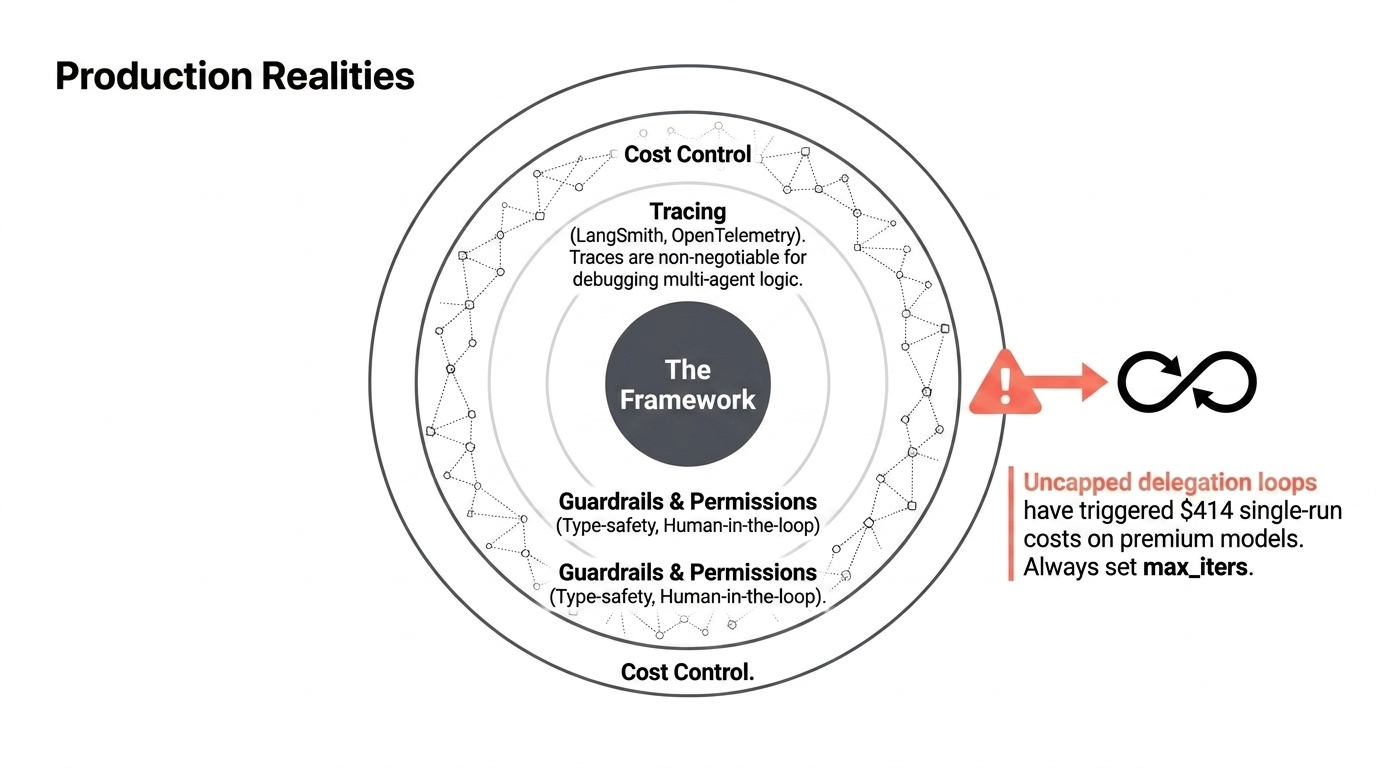
The strongest message is that the framework is not the production architecture. It is only the central execution layer.
Around it, the source calls for:
- Tracing, naming LangSmith and OpenTelemetry, because multi-agent behavior is difficult to debug without a record of what executed.
- Guardrails and permissions, including type safety and human-in-the-loop controls.
- Cost control, applied as a system boundary rather than as an afterthought.
The source includes a concrete warning: uncapped delegation loops have produced $414 single-run costs on premium models, and it recommends always setting max_iters. That figure is a source claim, but the engineering lesson is unambiguous: a loop that is logically valid can still be operationally unsafe if it has no termination or budget boundary.
A production agent system therefore needs at least three forms of boundedness: bounded actions, bounded iterations, and bounded spend. Tracing tells you what happened; guardrails constrain what may happen; cost controls constrain how far execution may continue.
11. A Practical Framework Decision Tree
The decision tree starts with the primary language and then asks what kind of capability the application needs most.
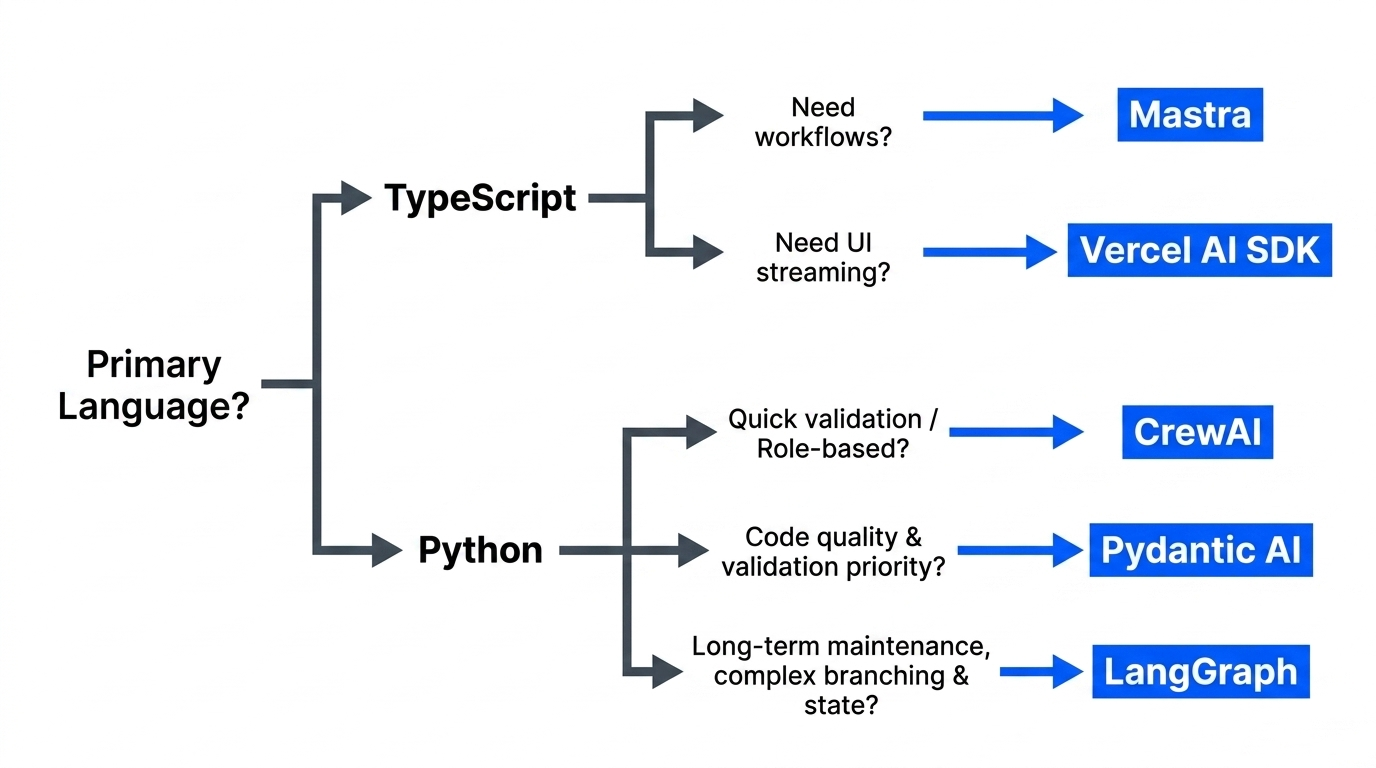
For TypeScript, the source routes workflow needs toward Mastra and UI-streaming needs toward the Vercel AI SDK.
For Python, it routes quick role-based validation toward CrewAI, code-quality and validation priorities toward Pydantic AI, and long-term maintenance with complex branching and state toward LangGraph.
This is deliberately simpler than a feature matrix, and that is its value. Framework choice becomes a sequence of architectural questions:
- Which language and runtime will the team own?
- Is the dominant problem workflow control, role delegation, validation, or UI streaming?
- Does the system need durable state and complex branching?
- Does the framework’s native abstraction match the unit the team will debug?
A decision tree cannot capture every edge case, but it prevents a common mistake: choosing a framework because it demos well, then discovering that its core abstraction fights the production workload.
12. The Architect’s Golden Rules
The final source slide condenses the guide into three rules.
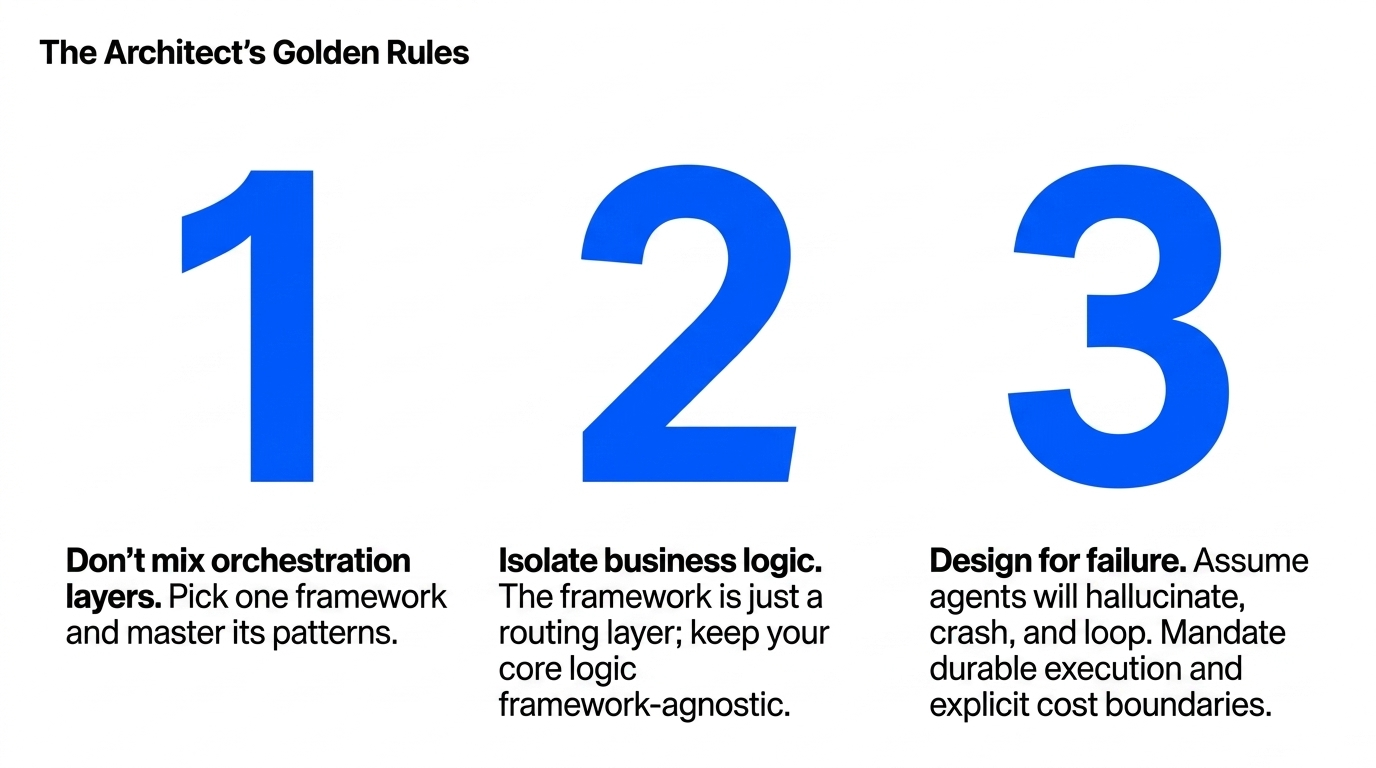
Rule 1: Do not mix orchestration layers
Pick one primary framework and master its patterns. Combining multiple orchestration systems usually creates overlapping responsibility for state, retries, routing, and lifecycle.
Rule 2: Isolate business logic
Treat the framework as a routing or execution layer, not as the permanent home of domain logic. Keeping the core rules framework-agnostic makes them easier to test, reuse, and preserve if the orchestration layer changes.
Rule 3: Design for failure
Assume agents will sometimes hallucinate, crash, or loop. The source therefore mandates durable execution and explicit cost boundaries rather than treating failure handling as an edge case.
These rules are the architectural counterweight to framework churn. They preserve the parts of the system that should outlive any individual library.
Engineering Principles
The visuals together imply a compact set of production principles:
-
Model the workflow with the abstraction that best exposes its real control structure.
Graphs, roles, conversations, and imperative SDK calls are not interchangeable mental models. -
Make state explicit where recovery or branching depends on it.
Checkpoints, typed state, and deliberate memory tiers turn hidden execution context into something engineers can reason about. -
Validate before side effects.
Type-safe boundaries and approval gates reduce the distance between model uncertainty and application consequences. -
Instrument the execution path.
Multi-agent logic needs traces that preserve delegation, tool use, transitions, and failures. -
Budget loops, context, and cost.
An agent can be functionally correct and still be unsafe to operate if it has no iteration, token, time, or spend limits.
Final Synthesis
The architecture in these slides is not a contest between LangGraph, CrewAI, Pydantic AI, Mastra, the Vercel AI SDK, or a thin imperative SDK. It is a layered design problem.
At the center sits the framework that best represents the workload’s control model. Around it sit the structures that make execution trustworthy: typed state or validated outputs, durable checkpoints where needed, memory policies, human approval boundaries, tracing, permissions, and explicit limits.
The production-ready system combines:
- A deterministic foundation for business rules and side-effect boundaries
- A validation layer for typed data, approvals, and controlled execution
- An agent orchestration layer matched to graph, role, conversational, or imperative semantics
- Security and governance controls that constrain permissions and sensitive actions
- Observability that makes multi-agent execution reconstructable
- Operational budgets for iterations, context, runtime, and cost
The specific framework can change. Those responsibilities do not.
Closing Thought
The most durable AI agent architecture is not the one with the most autonomy. It is the one whose state, transitions, permissions, failures, and costs remain legible when the system is under real production pressure.
Choose the framework for its control model; design the surrounding system for reality.