
Prototypes Are Easy, Production Is Hard: The 2026 AI Engineering Playbook
Agent prototypes are deceptively forgiving. A prompt, a model, and a few tool calls can produce an impressive demonstration without answering the questions that determine whether the system can survive production: Who owns state? How does execution recover from failure? What context reaches the model? How is retrieval quality measured? What does a test mean when the same input can produce multiple acceptable outputs?
The engineering problem is therefore larger than model selection. The source material frames production readiness around three pillars: architecture, context, and validation. Those pillars turn an LLM from a compelling component into a controllable software system.
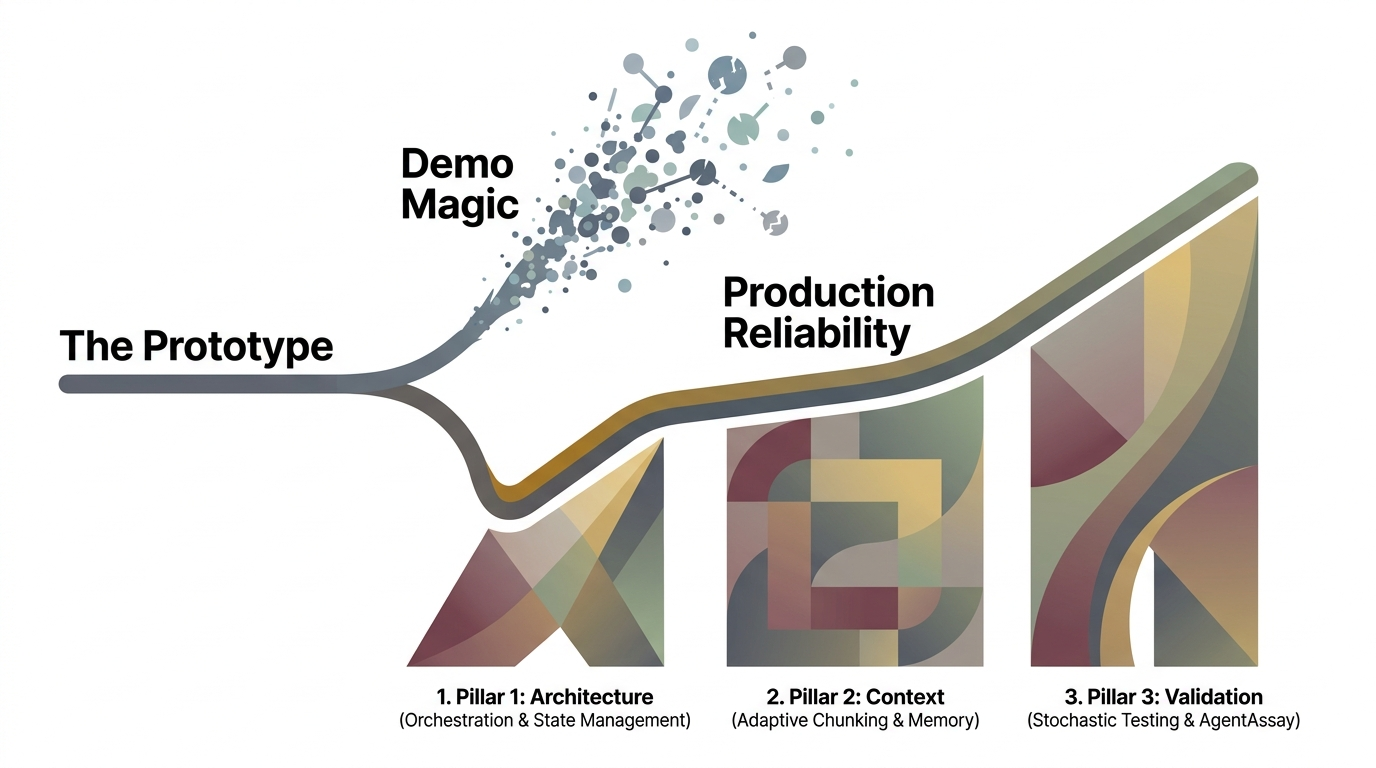
The central thesis is simple: production reliability is not created by adding more agents. It comes from making agent execution explicit, preserving the information structure agents depend on, and validating probabilistic behavior with statistical discipline.
1. Architecture: An Agent Is a Stateful Loop
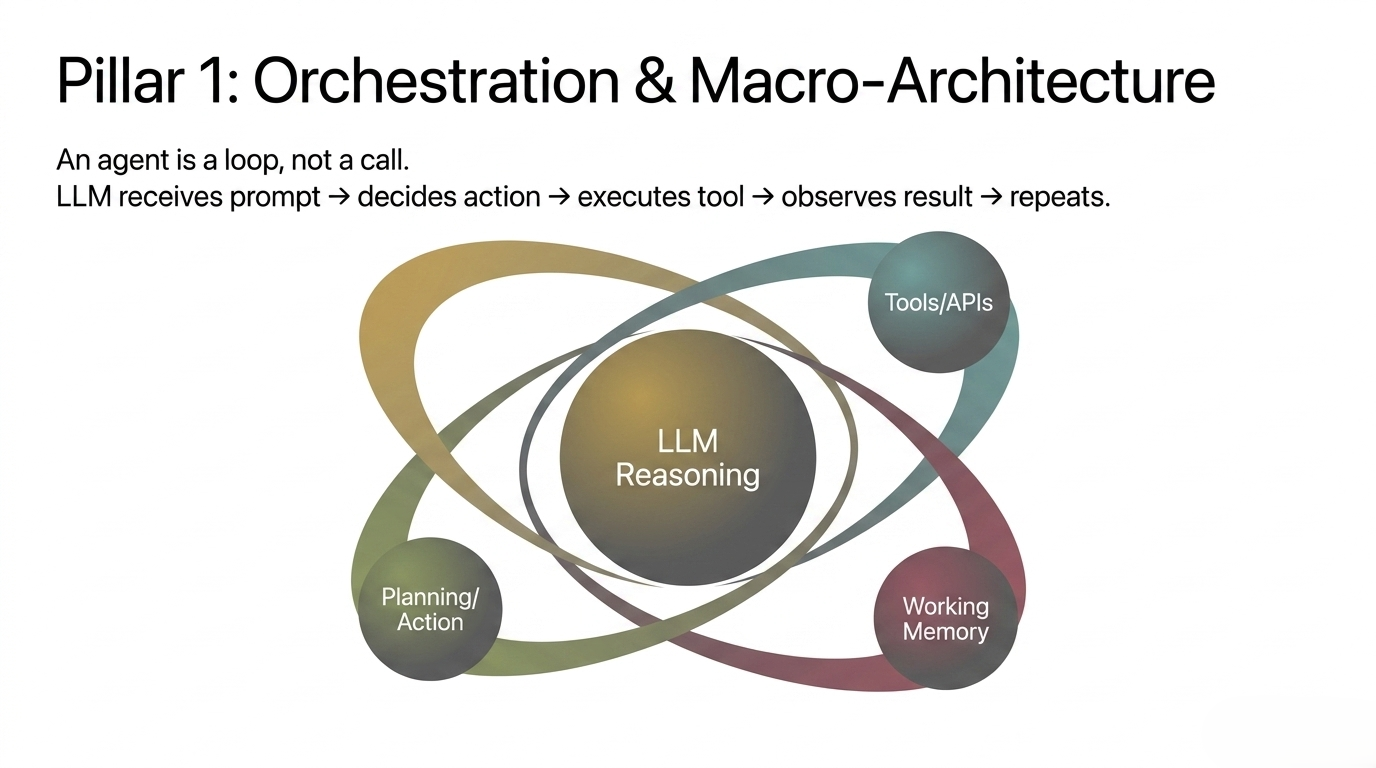
The first architectural shift is to stop modeling an agent as a single model call. The playbook represents an agent as an execution loop:
receive input → decide an action → execute a tool → observe the result → update state → repeat
That loop puts the LLM inside a larger control structure. Reasoning is only one participant. Planning, tool access, working memory, state transitions, retry logic, and termination criteria are equally important because they determine whether the system behaves coherently over time.
This has immediate production implications. Tool calls become side effects that may need idempotency. State must survive retries without corrupting the workflow. Long-running tasks need checkpoints. Timeouts and budgets need explicit ownership. Failures need to be classified as transient, recoverable, or terminal instead of being thrown back into an undifferentiated prompt.
A reliable agent system therefore behaves more like a workflow engine with probabilistic decision points than like a chatbot with plugins.
Choosing the control model: orchestration vs. choreography
The next decision is where control lives. The slides contrast two abstractions:
- CrewAI-style choreography favors role-based teams, event-driven interaction, and higher agent autonomy.
- LangGraph-style orchestration favors directed graphs, explicit state, typed transitions, and tighter control over execution paths.
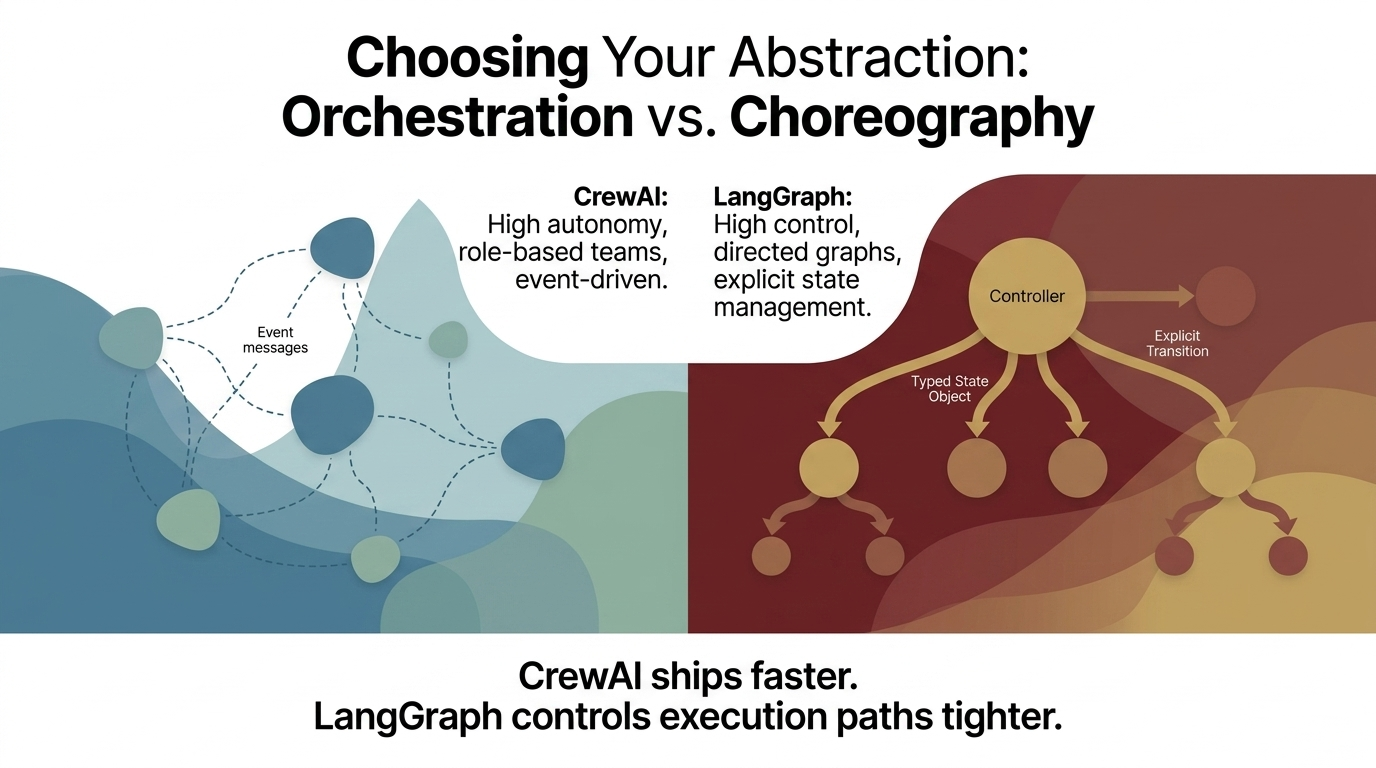
Neither abstraction is universally superior. Choreography can reduce the amount of central coordination needed when agents are loosely coupled and collaboration patterns are fluid. Explicit orchestration is easier to reason about when the workflow has branching rules, durable state, approval gates, compensating actions, or hard operational constraints.
The engineering criterion is therefore not “Which framework is most agentic?” It is “How much nondeterminism can this workflow tolerate, and where must control be explicit?”
Frameworks are implementation choices, not the architecture itself
The framework matrix in the source material positions several libraries by paradigm and perceived production fit: LangGraph for state graphs, CrewAI for multi-agent teams, the OpenAI Agents SDK for imperative loops, PydanticAI for type-safe Python, and AutoGen for conversational multi-agent patterns.
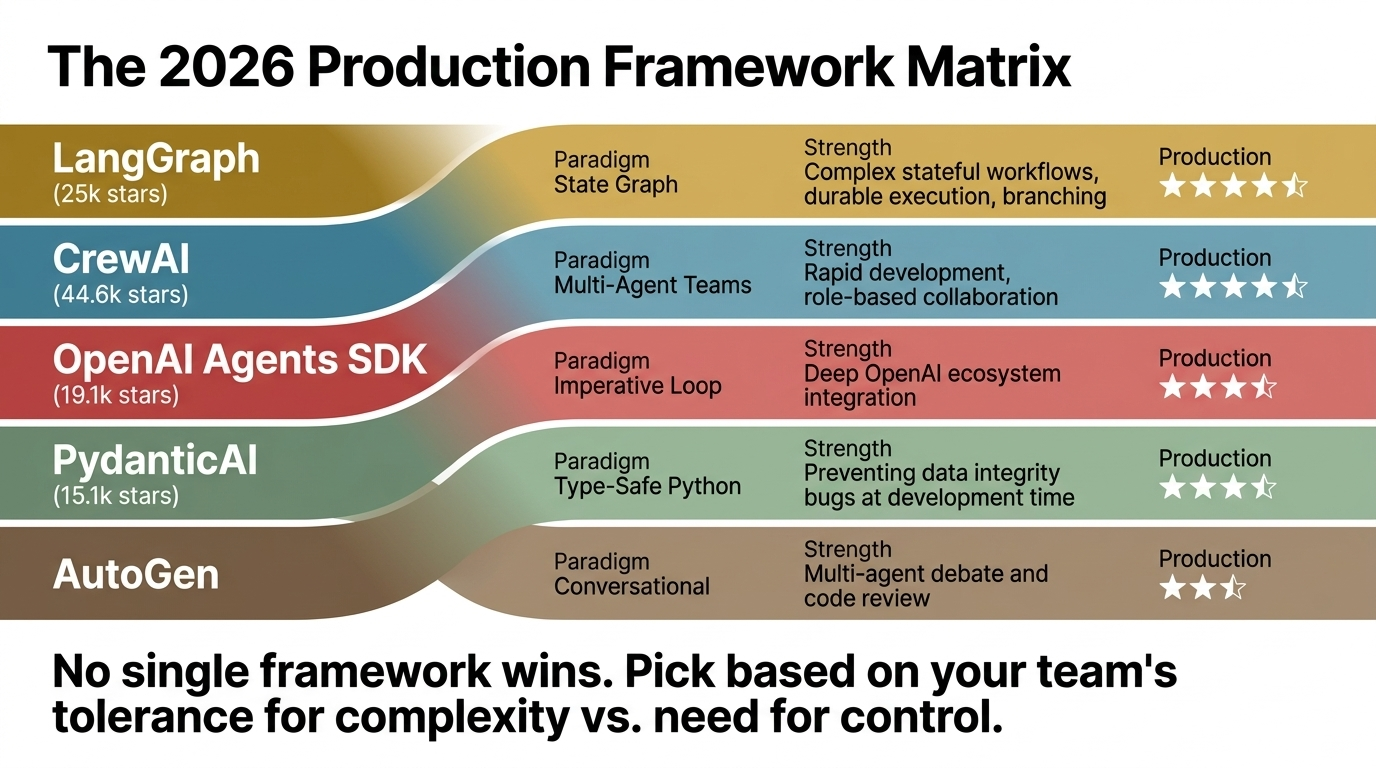
The useful lesson is the decision axis rather than the ranking. A team that needs durable branching and explicit state will optimize for different properties than a team prioritizing fast role-based experimentation or type safety.
The star counts and production ratings shown in the visual are snapshots from the source material, not durable facts. They should not be treated as current benchmarks without independent verification. The architectural questions age better:
- Can the framework represent state explicitly?
- Can execution be resumed or replayed?
- Can transitions be inspected and constrained?
- Can tool access be isolated?
- Can the runtime expose enough telemetry to debug a failed trajectory?
- Can the framework's abstraction be removed if the system outgrows it?
A production architecture should make those answers visible before a framework makes them convenient.
2. Context Engineering: Retrieval Quality Starts Before Retrieval
Once execution is stateful, the next failure surface is context. The playbook's “RAG crisis” is not framed primarily as a vector database problem. It is a document anatomy problem.
Naive chunking often treats all documents as flat token streams. Fixed-size windows satisfy a length constraint while severing the relationships that make the text meaningful: a heading from its section, a table from its caption, an entity from the pronouns that refer to it, or a conclusion from the evidence immediately before it.
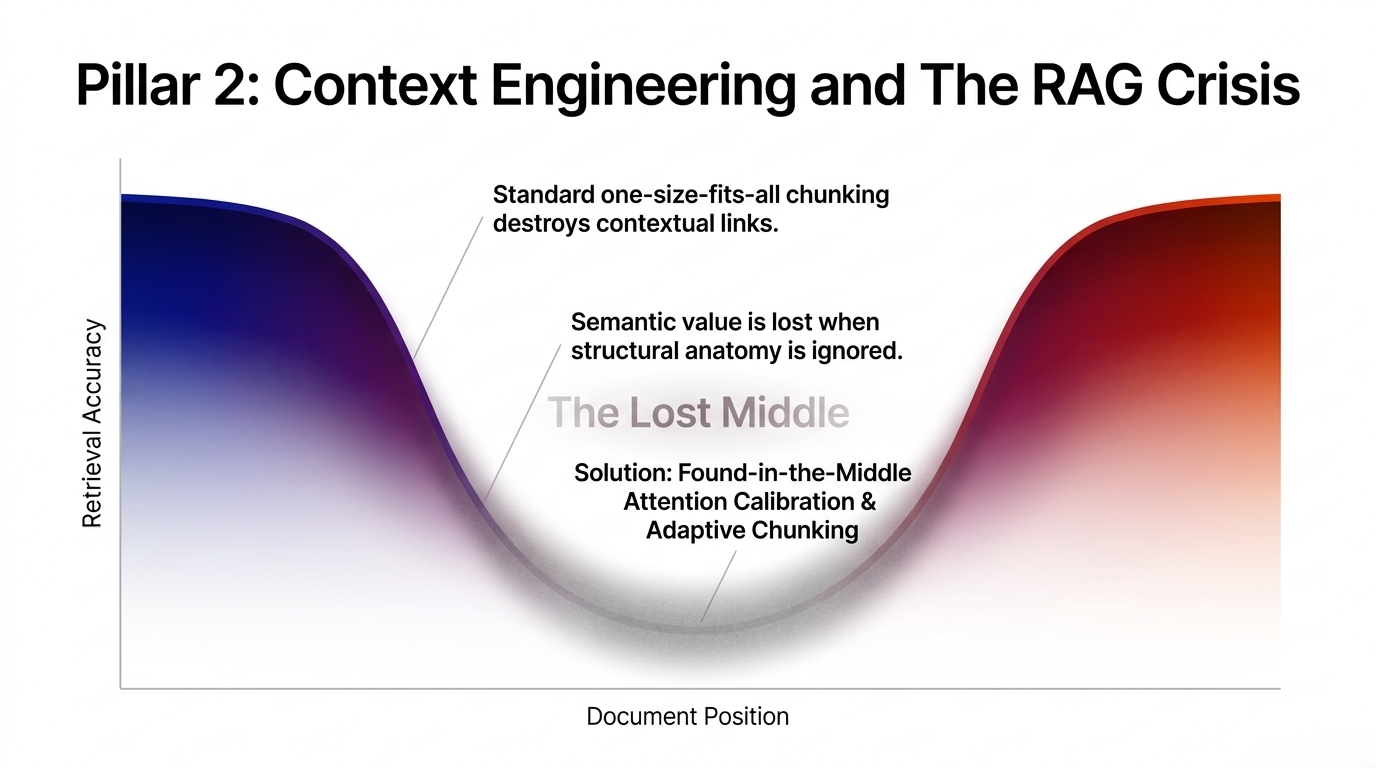
The source visual emphasizes a “lost middle” effect: retrieval accuracy is weakest when relevant material loses the structural context that tells the model what it means. The engineering response is not merely “use bigger chunks.” Oversized chunks can dilute relevance, consume context budget, and mix unrelated concepts.
The more robust objective is to preserve meaning while controlling size.
Adaptive chunking preserves document anatomy
The source presents two complementary chunking paths.
Path A starts from raw Markdown and uses an LLM-assisted or regex-guided splitter to identify structural boundaries such as articles and tables, informed by token counting.
Path B recursively splits using a hierarchy of separators, merges adjacent segments up to a target size, and backtracks to introduce overlap when needed.
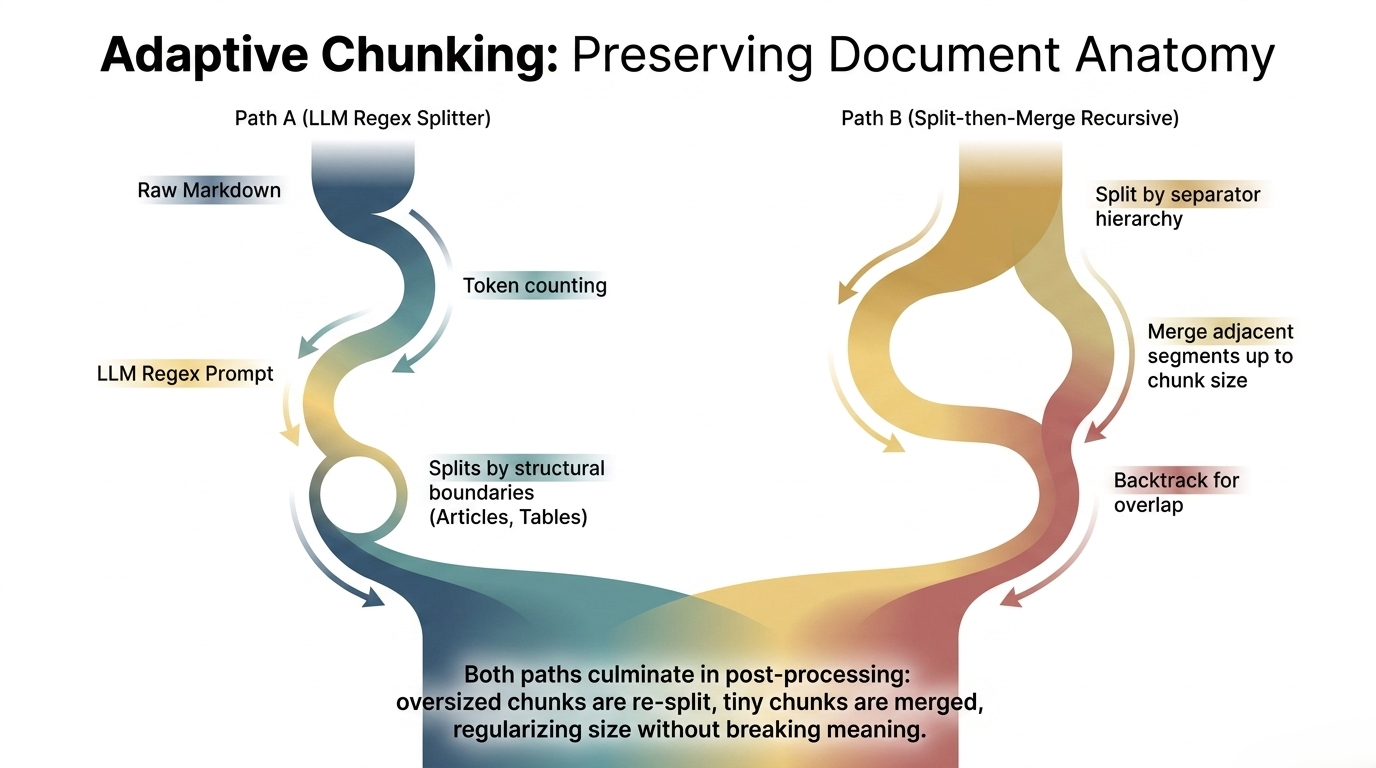
Both paths end in post-processing. Oversized chunks are re-split, tiny chunks are merged, and the final sizes are regularized without intentionally breaking semantic units.
That last step matters. Chunking is not a one-shot parser operation. It is a constrained optimization problem: preserve structure, preserve references, maintain local coherence, and still fit the retrieval and model context budgets.
Measure chunk quality across multiple dimensions
A single “average chunk size” metric cannot tell whether the document survived ingestion. The playbook proposes five dimensions:
- RC — References Completeness: references such as entity–pronoun relationships remain intact.
- ICC — Intrachunk Cohesion: content inside a chunk is semantically consistent.
- DCC — Document Contextual Coherence: a chunk remains aligned with its broader local context.
- BI — Block Integrity: tables, figures, and paragraphs are not accidentally fragmented.
- SC — Size Compliance: chunks stay within upper and lower token bounds.
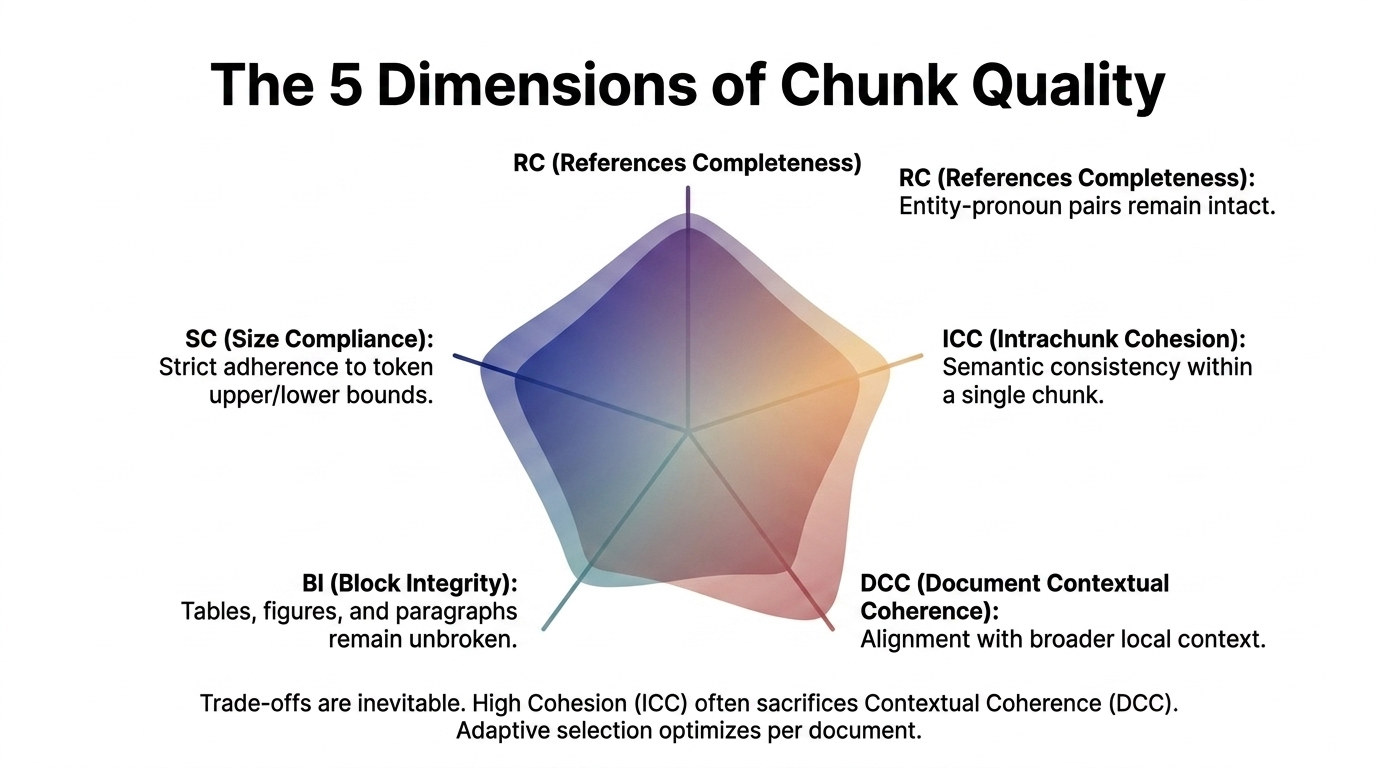
These dimensions are intentionally in tension. Maximizing intrachunk cohesion can reduce the wider context carried into the chunk. Preserving an entire table can violate size limits. Overlap can protect references while increasing retrieval duplication.
This is why adaptive chunking should be evaluated on a corpus, not judged from a single example. The right splitter is the one that preserves the information structure of the documents the system actually serves.
3. Validation: Nondeterministic Systems Need Probabilistic Tests
Traditional software testing assumes that a function maps an input to an expected output. Under that model, a failing equality assertion is meaningful because repeated executions should produce the same result.
Agent systems break that assumption. Sampling, model updates, tool timing, retrieval variation, and multi-step decision paths can all change the trajectory while the final behavior remains acceptable.
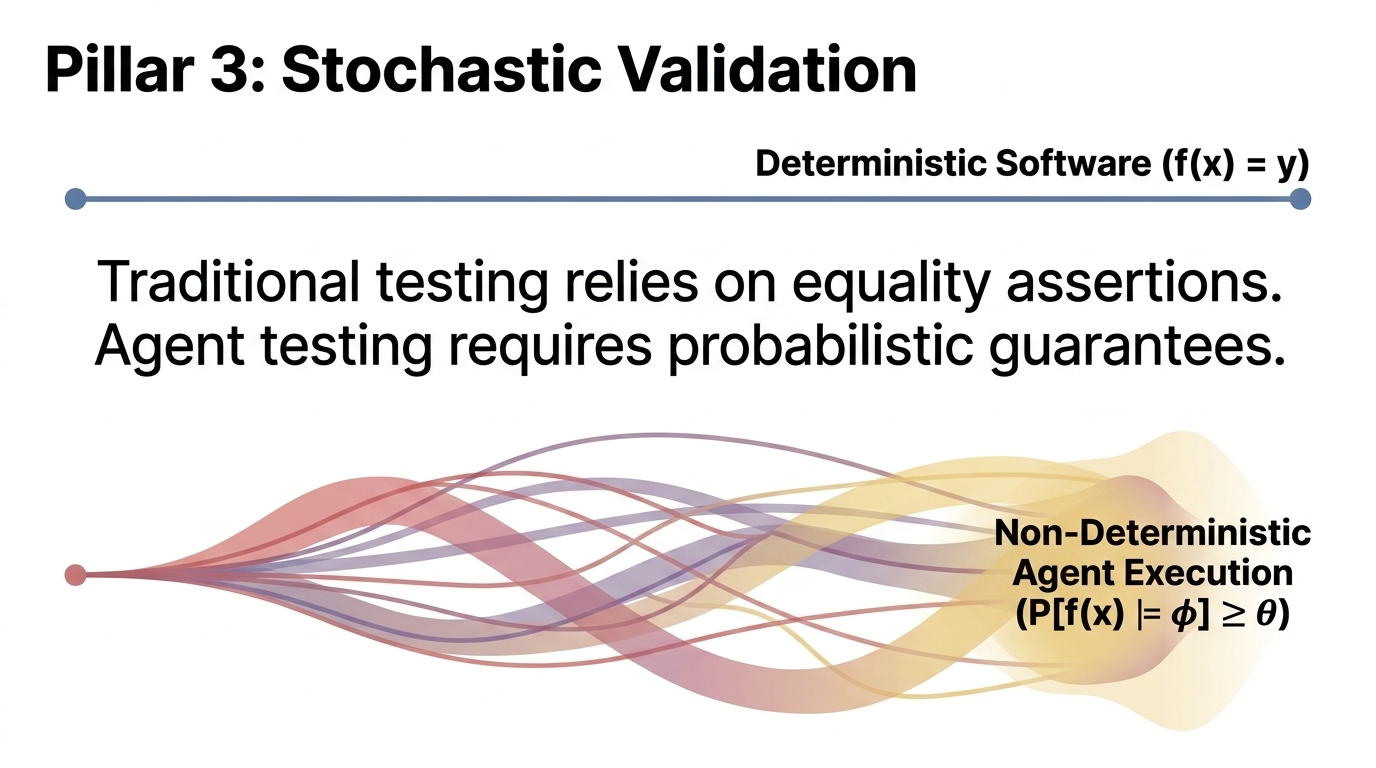
The source material therefore reframes the testing question. Instead of asking whether one run exactly equals a golden output, ask whether the observed behavior satisfies a property with enough confidence.
That moves validation from isolated assertions toward distributions, thresholds, confidence intervals, and repeated trials.
Replace binary verdicts with pass, fail, and inconclusive
A single successful run may be luck. A single failure may be noise. The playbook's alternative is a three-valued testing model:
- Pass when the evidence supports an acceptable success rate with statistical significance.
- Fail when the evidence supports a meaningful regression.
- Inconclusive when confidence intervals overlap and the available evidence cannot separate the hypotheses.
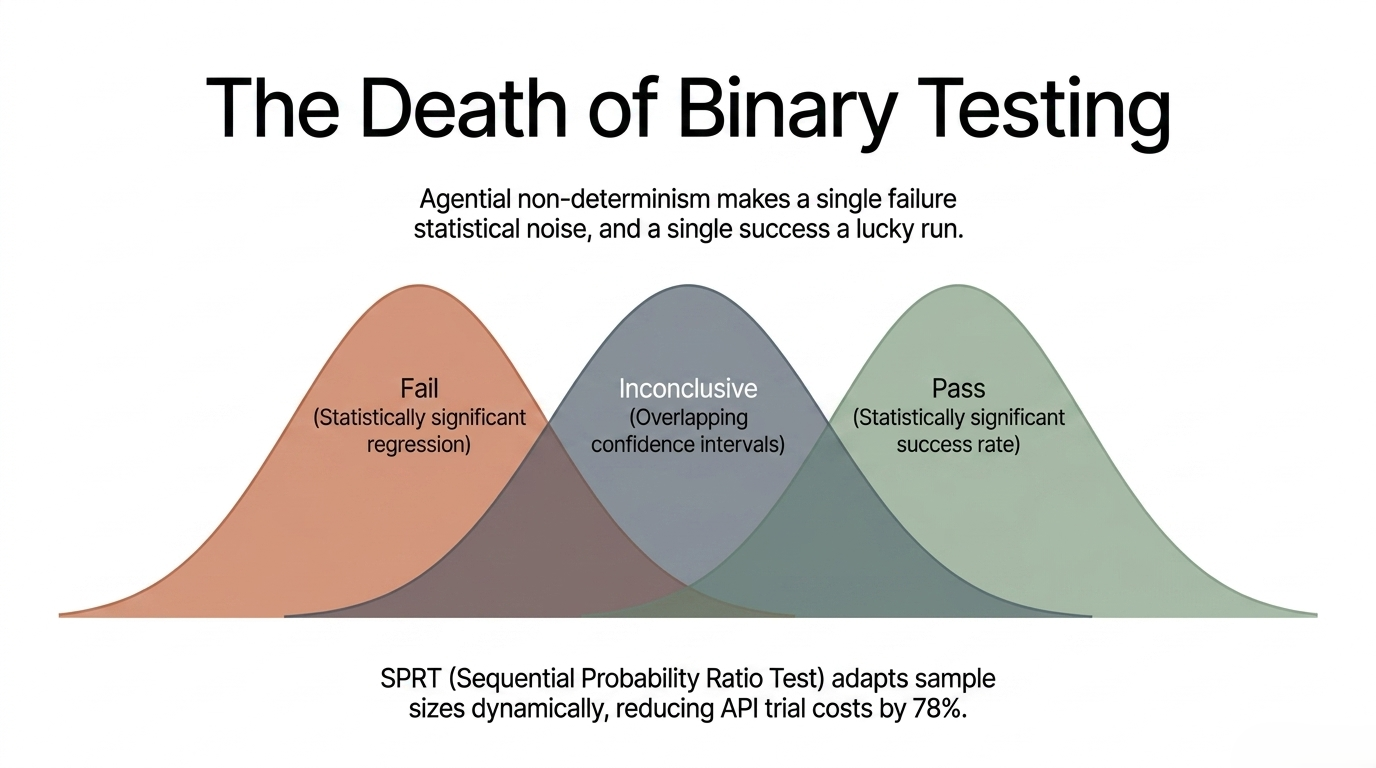
This is operationally important because “inconclusive” is a real state. It prevents CI from forcing a false binary judgment when the sample is too small or the effect is too subtle.
The slide also proposes the Sequential Probability Ratio Test (SPRT) as a way to adapt sample size dynamically rather than precommitting to a fixed number of expensive trials. It claims a 78% reduction in API trial costs in the depicted scenario. The material does not provide the experiment design, baseline, or derivation behind that percentage, so the number should be treated as a source claim rather than a general benchmark.
The durable idea is stronger than the percentage: stop testing once the evidence is sufficient, and continue sampling when it is not.
Test behavior, not just final text
Exact-output comparison is particularly weak for agents because many regressions happen before the final answer. An agent can still produce plausible text while becoming slower, using the wrong tools, taking more steps, following a riskier execution path, or consuming substantially more context.
The behavioral fingerprinting slide proposes turning execution traces into vectors that capture properties such as tool-usage distribution, structural complexity, reasoning depth, and efficiency.
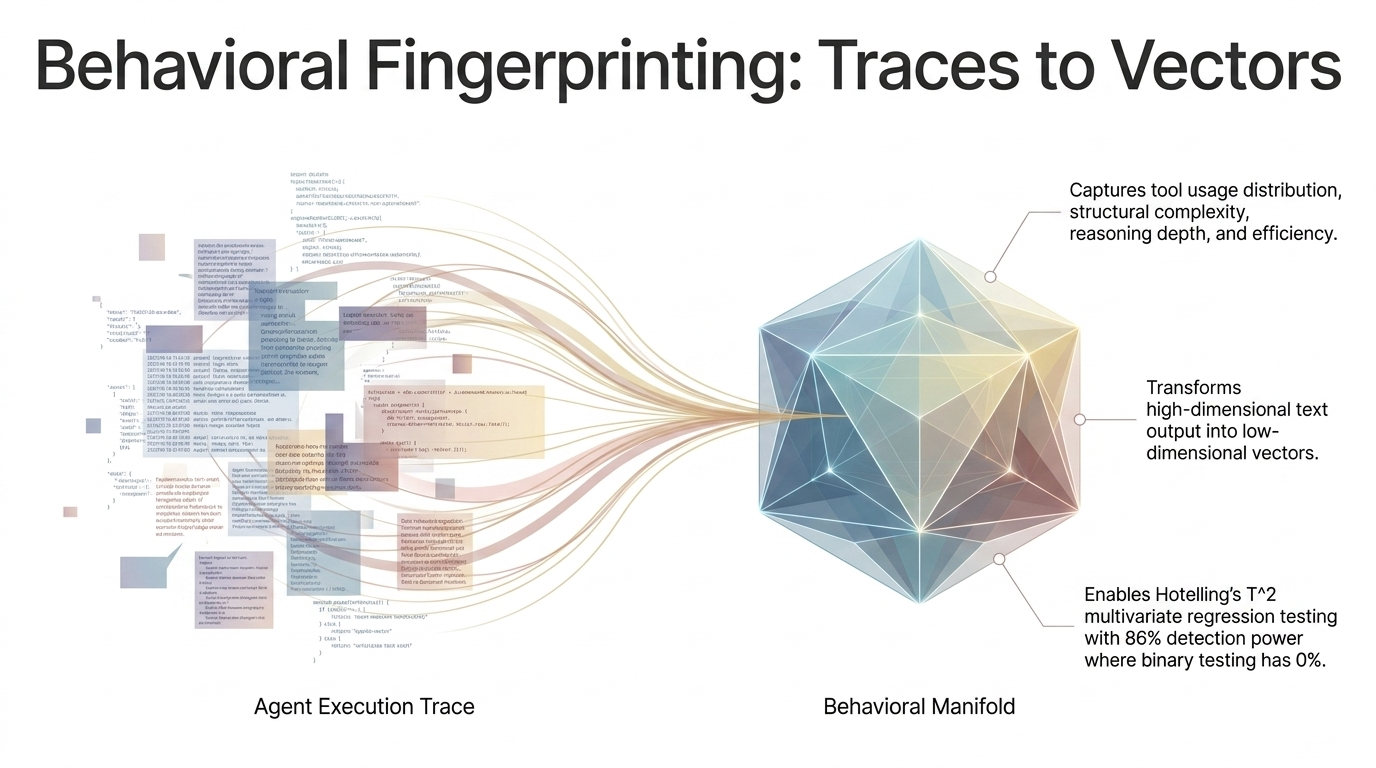
Once traces are represented as feature vectors, multivariate methods can compare a candidate build against a baseline distribution. The source specifically names Hotelling's T² for multivariate regression testing and depicts 86% detection power in a scenario where binary testing shows 0%. As with the SPRT percentage, the underlying experiment is not included, so the figure should be read as the slide's reported scenario rather than an independently established benchmark.
The production pattern is still valuable: define behavioral features, store trace-level evidence, compare distributions over time, and alert on statistically meaningful changes that output snapshots cannot see.
4. Agentic QA: Make Testing a Feedback System
Validation becomes more powerful when it is part of the development loop instead of a final gate. The playbook depicts a self-healing QA cycle with three cooperating responsibilities:
- TGA — Test Generation Agent: generates test artifacts.
- EAA — Execution & Analysis Agent: executes tests, records failures, and tracks coverage.
- ROA — Review & Optimization Agent: interprets error logs, refines scripts, and routes the result back to generation.
A shared orchestrator and vector database connect the loop.
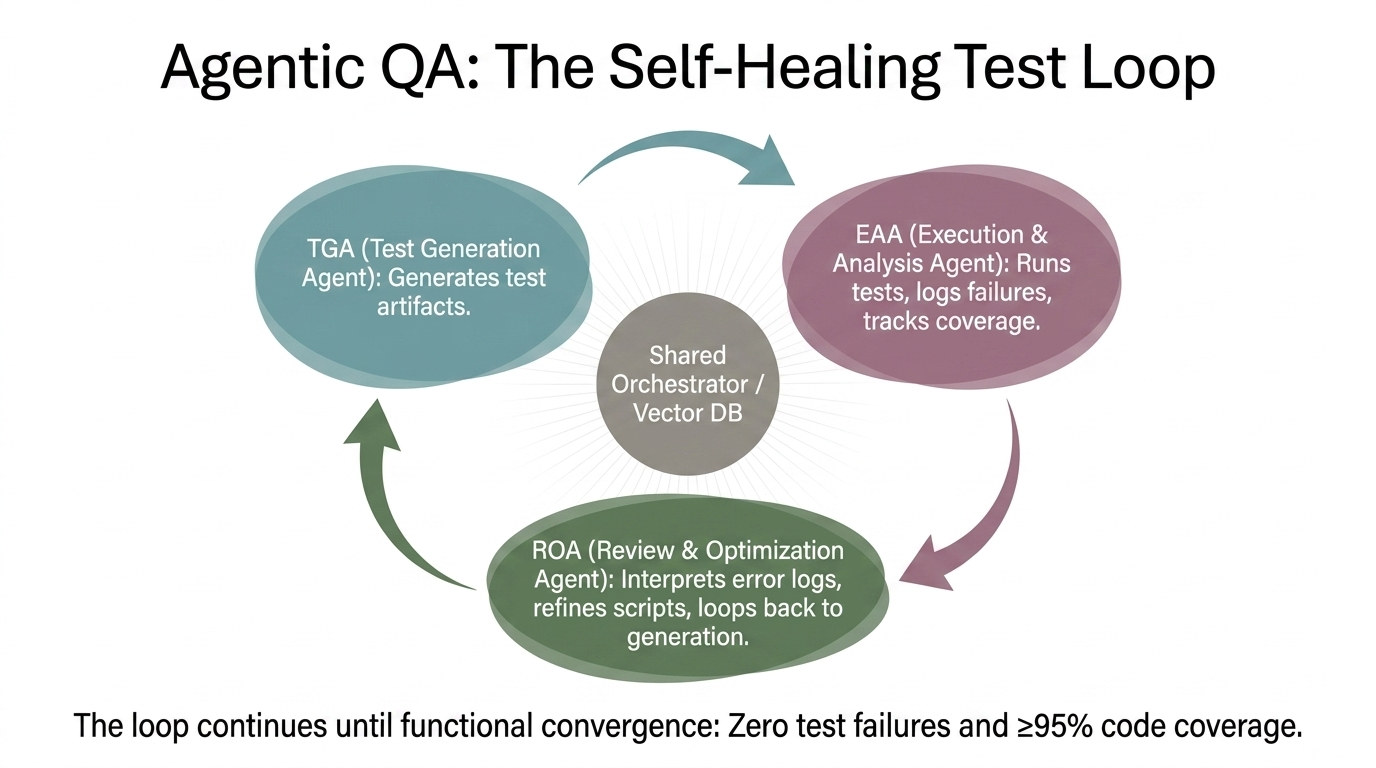
The architecture is important because every stage produces evidence for the next one. Test generation uses prior failures and requirements. Execution produces structured results rather than free-form feedback. Review converts those results into targeted changes. The loop then repeats.
The source proposes functional convergence at zero test failures and at least 95% code coverage. That is a concrete stopping condition for the depicted workflow, not a universal definition of production readiness. Coverage can show which code ran; it cannot prove that the right behaviors were asserted, that stochastic outcomes are stable, or that unsafe tool actions are impossible.
A stronger implementation would combine structural convergence criteria with probabilistic behavior tests and trace-level regression checks.
5. Economics: Automation Must Change the Shape of QA
The source argues that AI coding tools increase code production faster than traditional QA headcount can scale. It illustrates the point with a three-year cost model.
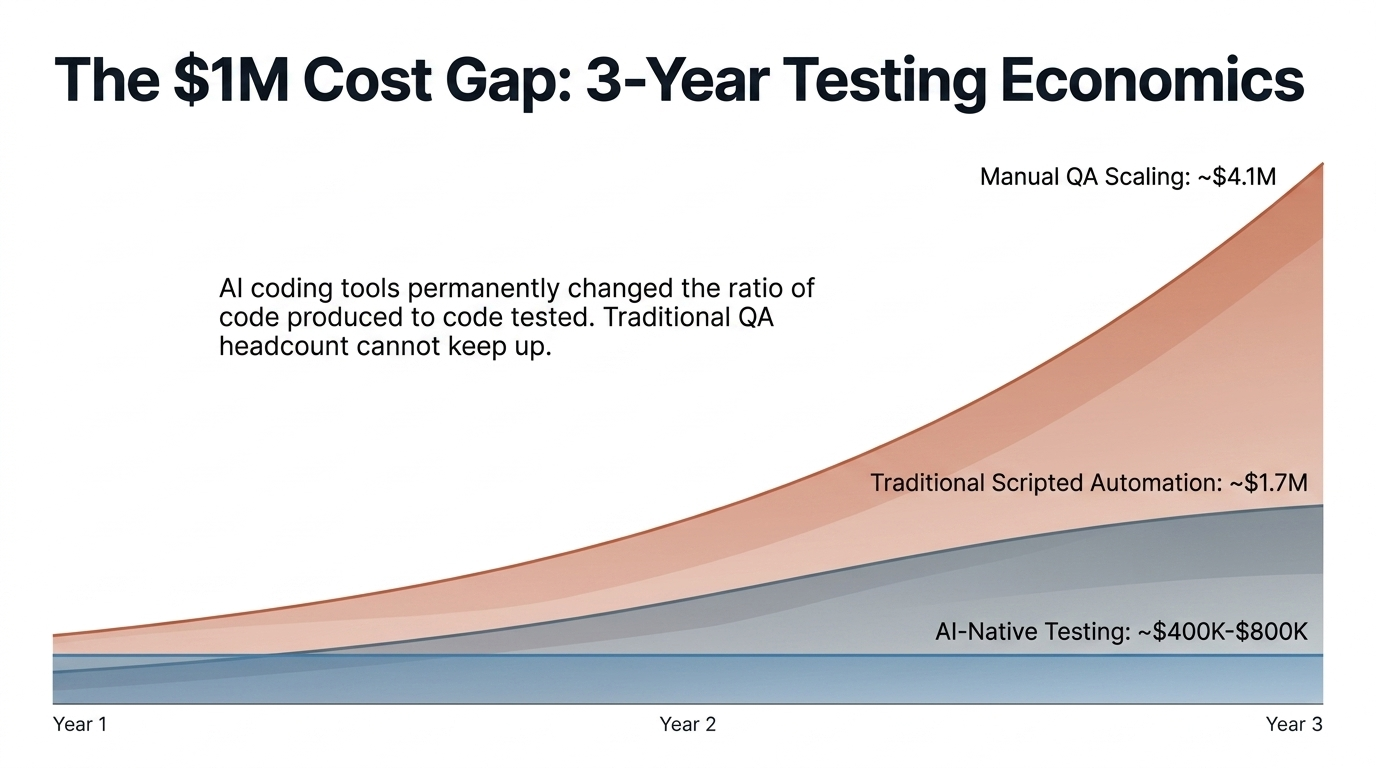
The depicted estimates are approximately:
- Manual QA scaling: ~$4.1M by year three.
- Traditional scripted automation: ~$1.7M.
- AI-native testing: ~$400K–$800K.
Those values are not accompanied by staffing assumptions, labor rates, API usage, model costs, maintenance load, or application complexity. They should therefore be treated as an illustrative economic model from the source, not as a forecast that can be transferred directly to another organization.
The engineering point is still practical. Conventional test automation reduces repeated manual work but leaves a large maintenance surface: selectors change, fixtures drift, assertions become stale, and new functionality still requires new scripts. An agentic QA loop attempts to automate part of that adaptation cycle itself.
That creates a different cost curve only if the system is disciplined about budgets. Unbounded test generation, repeated stochastic trials, verbose traces, and unconstrained agent retries can simply move cost from payroll into compute and operational complexity. The architecture must therefore expose cost per workflow, cost per accepted change, and the number of trials required to reach a statistically meaningful verdict.
6. Synthesis: A Production Agent Stack Is a Cognitive Control Loop
The playbook's synthesis reduces the production system to three layers:
- Layer 1 — The Engine: an orchestration graph manages agents and state.
- Layer 2 — The Memory: an adaptive chunking pipeline feeds useful context into the workflow.
- Layer 3 — The Checkpoint: CI/CD gates use probabilistic testing to decide whether behavior is acceptable.
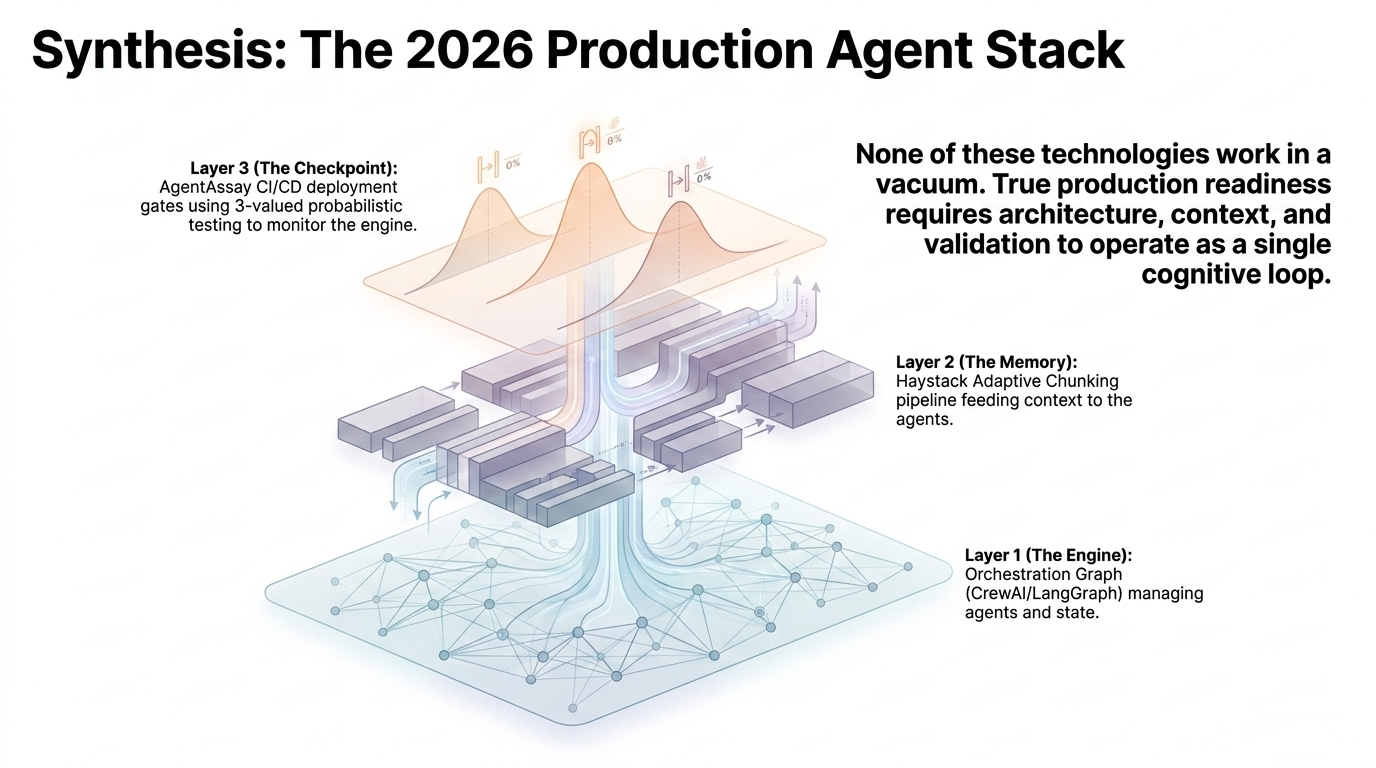
The layers are coupled. The engine emits traces that the checkpoint can analyze. The memory system changes the evidence available to the engine. Validation detects whether an orchestration or retrieval change altered behavior. Test failures then feed back into engineering decisions.
That closed loop is the core production architecture:
stateful execution → structured context → observable traces → probabilistic validation → controlled iteration
The LLM is inside that loop, but it does not own the loop.
Security, governance, and observability are implementation gaps to close
The source images do not specify a threat model, authorization boundaries, secrets handling, PII policy, audit-retention rules, telemetry stack, SLOs, or rollback strategy. Those topics therefore cannot be reconstructed from the material as if they were defined.
They are, however, necessary production concerns around the architecture shown. A concrete implementation would need to decide where tool permissions are enforced, which state and traces are retained, how sensitive context is filtered, how agent actions are audited, and which runtime signals trigger rollback or human review.
The same principle applies to observability: behavioral fingerprinting only works if traces are structured and comparable. Production debugging only works if a single request can be followed across orchestration nodes, retrieval operations, tool calls, and statistical test decisions.
The playbook provides the control loop; an implementation must still define its operational boundaries.
Engineering Principles
The architecture ultimately depends on several principles:
-
Treat the model as a component, not the system.
Reliability comes from orchestration, state, context, testing, and operations around the model. -
Make state transitions explicit where failure matters.
High-autonomy choreography is useful when flexibility is the goal; explicit graphs are preferable when execution paths, approvals, and recovery must be controlled. -
Preserve document structure before optimizing retrieval.
Chunk size is a constraint, not the objective. Reference integrity, local context, block integrity, and semantic cohesion matter together. -
Validate distributions instead of anecdotes.
Nondeterministic systems require repeated evidence, confidence-aware verdicts, and trace-level regression analysis. -
Close the feedback loop.
Test generation, execution, failure analysis, and optimization should share evidence so that each cycle improves the next one.
Final Synthesis
The production architecture described by the source is not a collection of isolated agent features. It is a disciplined loop that makes nondeterminism manageable.
Architecture determines how work progresses. Context engineering determines what evidence the system can see. Stochastic validation determines whether a new behavior is meaningfully better, worse, or still uncertain. Agentic QA feeds that evidence back into the engineering process.
The production-ready system combines:
- A stateful orchestration foundation for explicit execution and recovery.
- A structure-aware context layer that preserves document anatomy during ingestion and retrieval.
- A probabilistic testing layer with three-valued decisions and sequential sampling.
- Behavioral trace analysis for regressions that final-output checks miss.
- A feedback-driven QA workflow that turns failures into new tests and refinements.
- Operational controls still to be specified for security, governance, observability, and rollback.
The result is not “more agents.” It is software that can explain where an agent is, what context it used, what actions it took, how its behavior changed, and whether the evidence is strong enough to ship.
Closing Thought
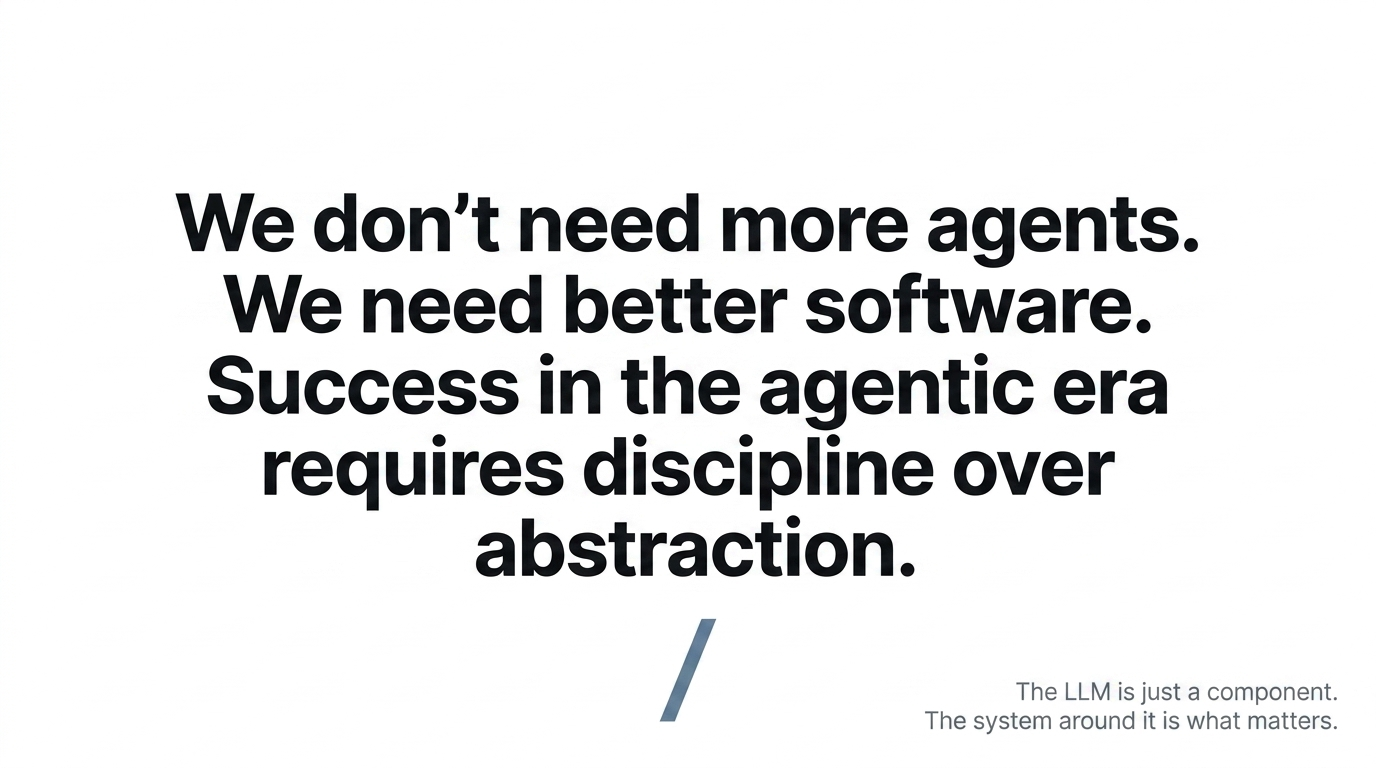
The hardest part of agentic engineering is not generating intelligent behavior once. It is building a system that can constrain, observe, test, and improve that behavior repeatedly.
In the agentic era, production reliability comes from discipline over abstraction.