
Architecting Zero-Latency Agent Memory: Beyond RAG with Cache-Augmented Generation
Autonomous agents need more than access to information. They need memory that preserves structure, stays fresh where freshness matters, and can be exercised repeatedly without paying the full retrieval and prefill cost on every turn.
The central engineering problem is that a single memory mechanism rarely optimizes all of those properties at once. Retrieval-Augmented Generation (RAG) is strong when the relevant knowledge is large, changing, and selectively accessed. But the supplied material argues that standard vector retrieval can become fragile for tightly coupled relational schemas, especially when correctness depends on keeping tables, constraints, joins, categorical mappings, and test fixtures together. Cache-Augmented Generation (CAG), in contrast, keeps a stable body of knowledge resident in model context or a reusable cache so the model can reason over intact structure without a retrieval step.
The resulting architecture is not “RAG versus CAG.” It is a tiered memory system: preload the stable laws of the system, retrieve the dynamic evidence, trace the complete agent trajectory, and validate behavior against machine-readable contracts.
1. Data Quality Becomes an Agent-System Constraint
The overview material places data quality at the center of the 2026 agent stack. Its framing is important: as systems move from manual, rule-based checks toward agents that detect, diagnose, and remediate issues, quality controls have to become executable by machines rather than remaining implicit in human process.
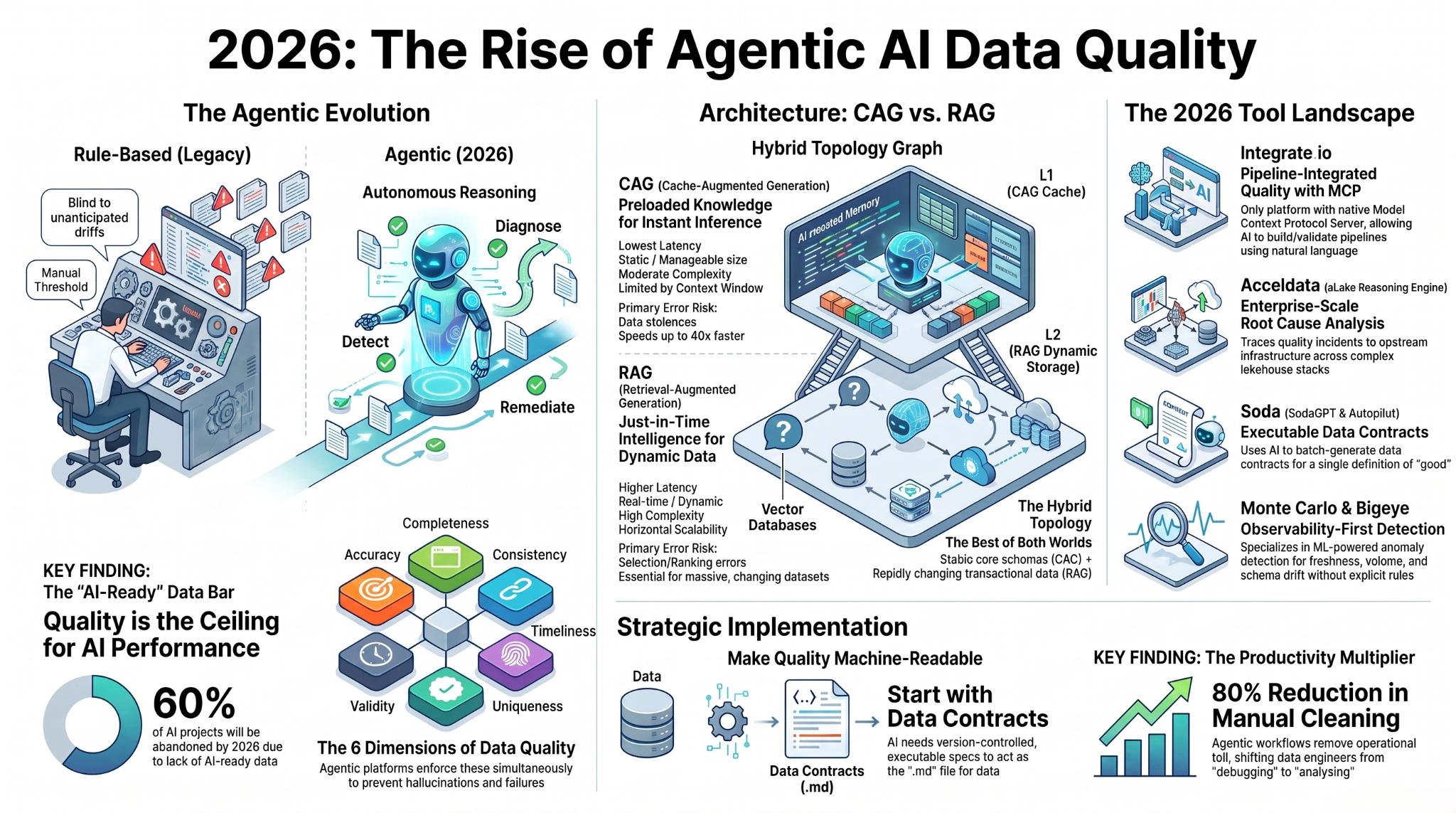
The image groups the problem around familiar quality dimensions such as accuracy, completeness, consistency, timeliness, uniqueness, and validity, then connects them to agentic workflows and data contracts. The architectural implication is that memory is not just a convenience layer. It becomes part of the correctness boundary. If an agent reasons from incomplete schema metadata, stale definitions, or disconnected relationships, the failure appears downstream as a model error even though the underlying defect is architectural.
The same image also introduces a useful split between CAG and RAG:
- CAG preloads stable knowledge for immediate inference.
- RAG supplies just-in-time information for changing data.
- A hybrid topology puts stable schemas and reusable instructions in a cache tier while leaving rapidly changing records, logs, and diffs in a retrieval tier.
That split becomes the organizing principle for the rest of the system.
2. Validate Complete Agent Trajectories, Not Final Strings
Agent systems are non-deterministic across multiple steps. A final answer can look plausible even when the path used to produce it was invalid. The material therefore treats development as a flywheel: observe real behavior, convert failures into evaluations, improve the implementation, and lock the correction into regression coverage.
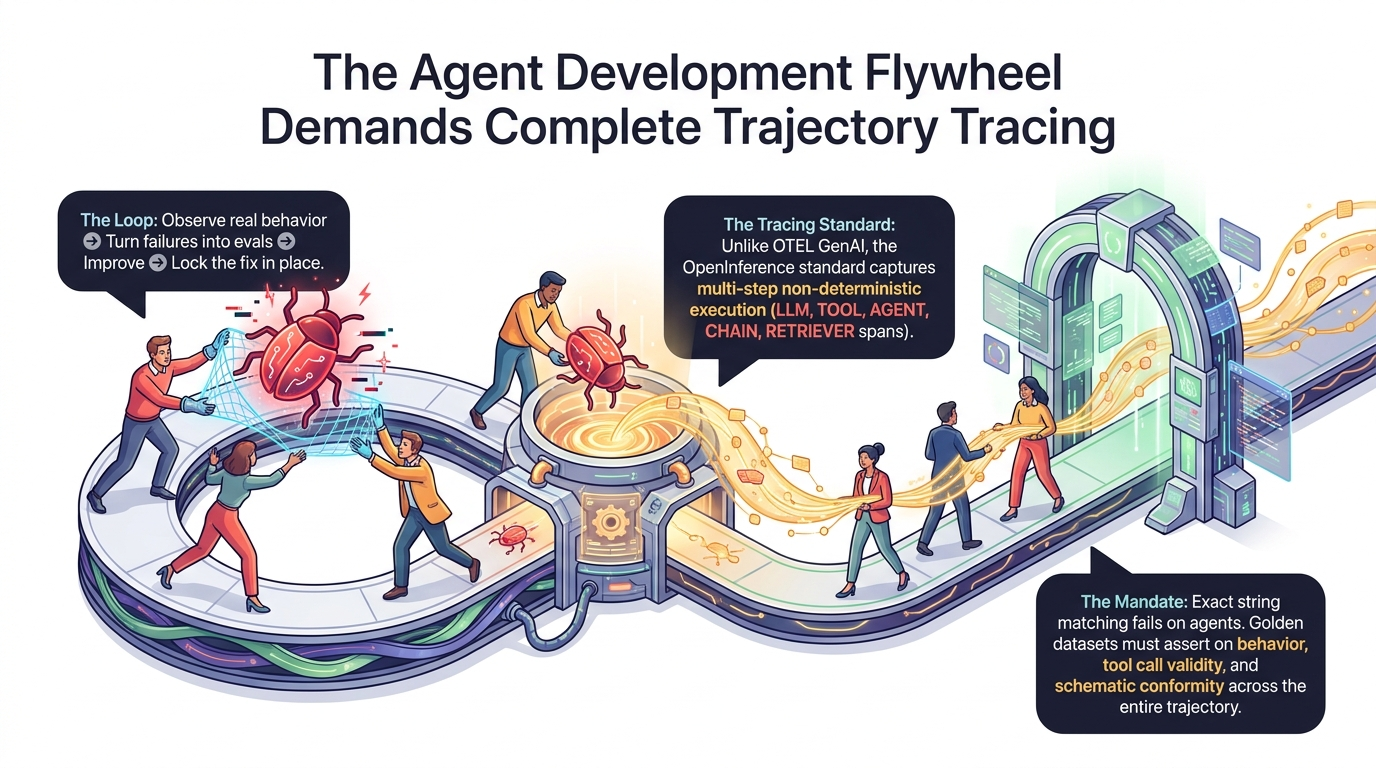
The tracing standard shown in the source emphasizes spans across LLM, TOOL, AGENT, CHAIN, and RETRIEVER activity. That framing shifts validation away from exact string matching and toward the properties that actually determine whether an agent behaved correctly.
Golden datasets should assert things such as:
- the intended tool was selected;
- tool-call arguments are valid;
- retrieved or cached context satisfies the expected schema;
- required intermediate steps occurred;
- the trajectory conforms to the system contract even when wording varies.
This has direct consequences for observability. Production telemetry must preserve enough of the trajectory to reconstruct why a result occurred. Otherwise, a memory failure, retrieval miss, invalid tool call, and reasoning failure can all collapse into the same symptom: “the answer was wrong.”
3. Why Standard RAG Can Break Relational Structure
The most pointed architectural criticism in the material is not that retrieval is inherently bad. It is that semantic chunking can destroy relationships that are essential to relational reasoning.
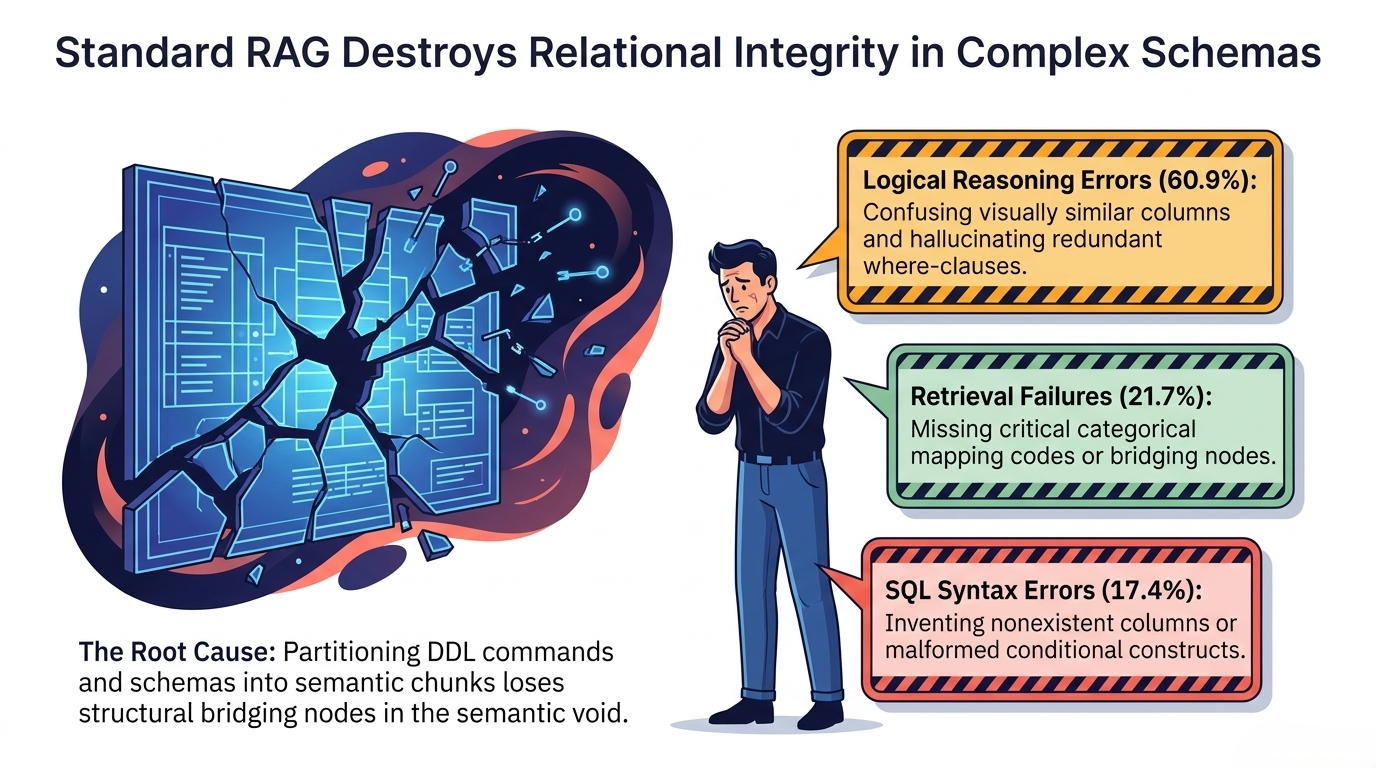
A database schema is not merely a bag of table descriptions. Correct reasoning can depend on foreign keys, bridge tables, naming conventions, categorical mappings, join paths, and constraints that may sit far apart in a text representation. If DDL and supporting documentation are partitioned into independent semantic chunks, retrieval can return individually relevant fragments while omitting the structural bridge that makes them jointly meaningful.
The source breaks failures into three broad categories: logical reasoning errors, retrieval omissions, and SQL syntax errors. The exact percentages in the slide should be read as findings from the source material rather than universal rates. The engineering lesson is broader: retrieval quality is not equivalent to structural completeness.
This is the point at which “better embeddings” stops being a sufficient answer. Metadata filters, richer chunk headers, and hand-built rules can improve retrieval, but they do not eliminate the fundamental risk that the reasoning problem requires an intact relationship graph rather than a set of nearest-neighbor passages.
4. Query Complexity Exposes the Retrieval Ceiling
The next image makes the degradation concrete by showing a steep accuracy drop as queries require more relational coordination.
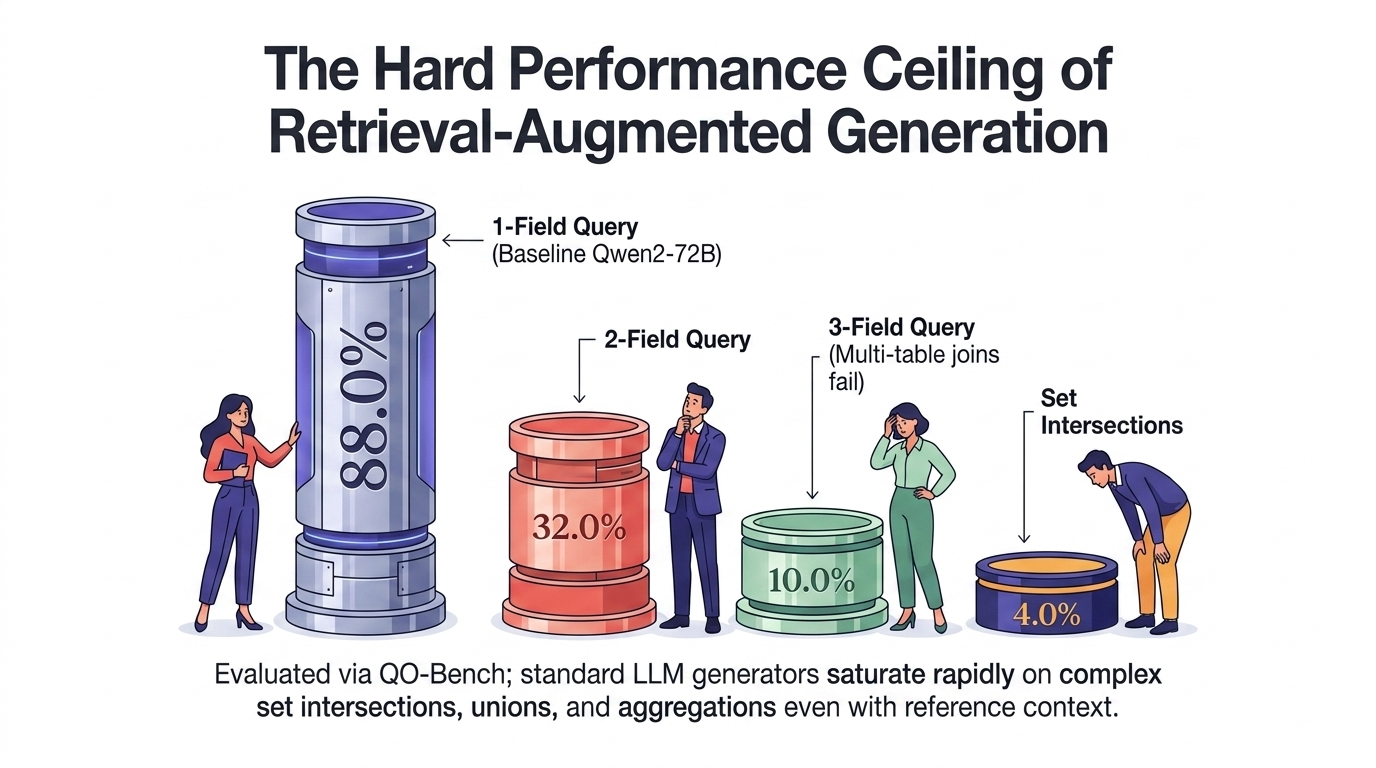
The visual reports strong performance on a one-field baseline, followed by much lower results for two-field, three-field, and set-intersection tasks. Those numbers are presented in the supplied material as benchmark results; they should not be generalized beyond that evaluation without independent reproduction.
What matters architecturally is the failure shape. Multi-table reasoning compounds several risks at once:
- the correct schema fragments must be retrieved;
- the model must preserve their relationships;
- join keys and categorical mappings must be interpreted correctly;
- aggregation, intersection, or union semantics must survive generation.
A retrieval miss early in that chain can make the remaining steps impossible. This is why relational workloads are a useful stress test for memory architecture: they expose whether the system preserves connected structure, not merely topical relevance.
5. CAG Moves Stable Knowledge Into the Active Reasoning Surface
Cache-Augmented Generation changes the order of operations. Instead of searching for schema fragments at inference time, the system preloads the stable corpus—such as DDLs, standard libraries, instructions, and representative examples—into reusable working memory.
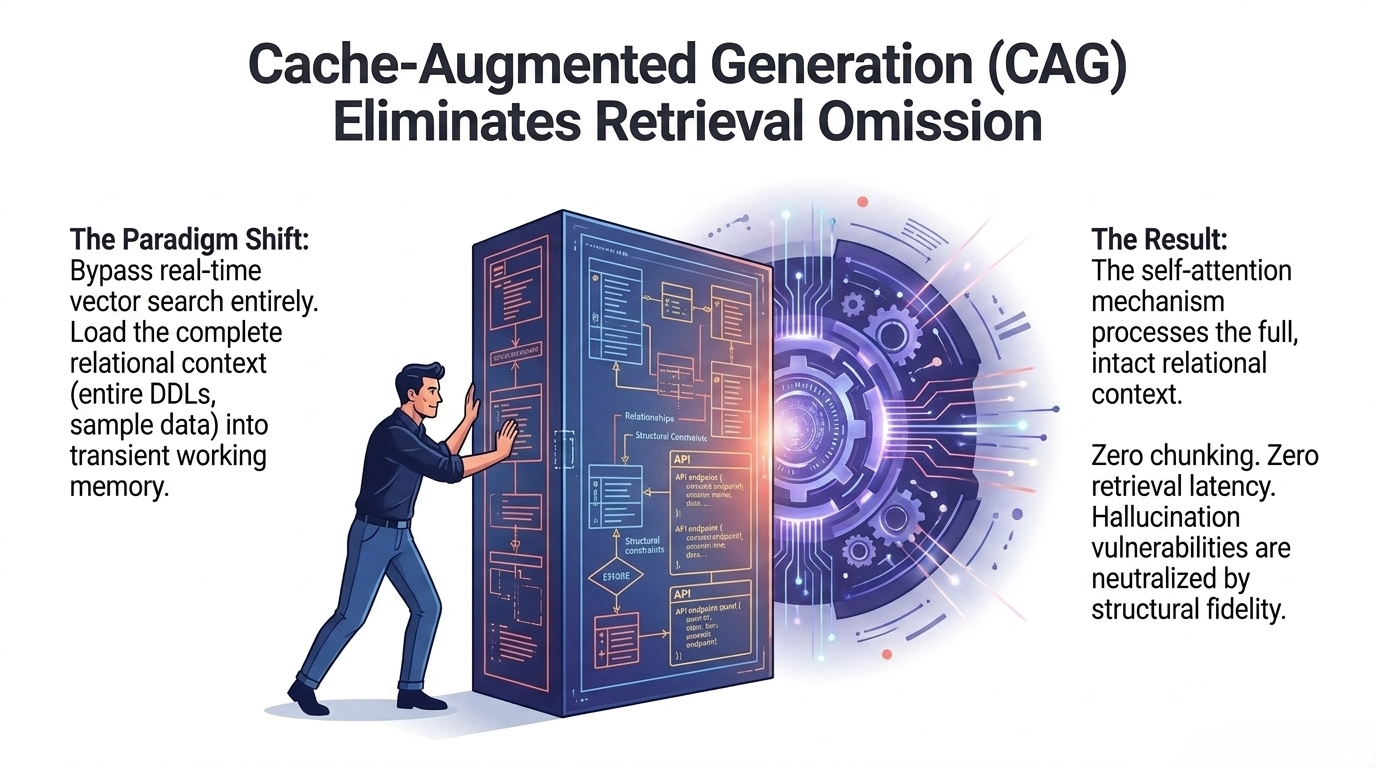
The slide describes the paradigm shift as bypassing real-time vector search for the stable portion of the knowledge base. The intended effect is not magical factuality. It is narrower and more useful: remove retrieval omission as a failure mode for information that is known in advance and small enough to keep together.
For relational workloads, the advantage is structural fidelity. A complete schema can remain intact in context, allowing attention to operate across table definitions and constraints without relying on a retrieval stage to reconstruct the graph.
That does not make CAG universally better. It trades retrieval complexity for context management, cache lifecycle, model-specific memory limits, and potential attention dilution. Those trade-offs are why a diagnostic framework is necessary.
6. Diagnose the Workload Before Choosing the Memory Pattern
The comparison in the source evaluates three options: standard RAG, metadata-optimized RAG, and CAG.
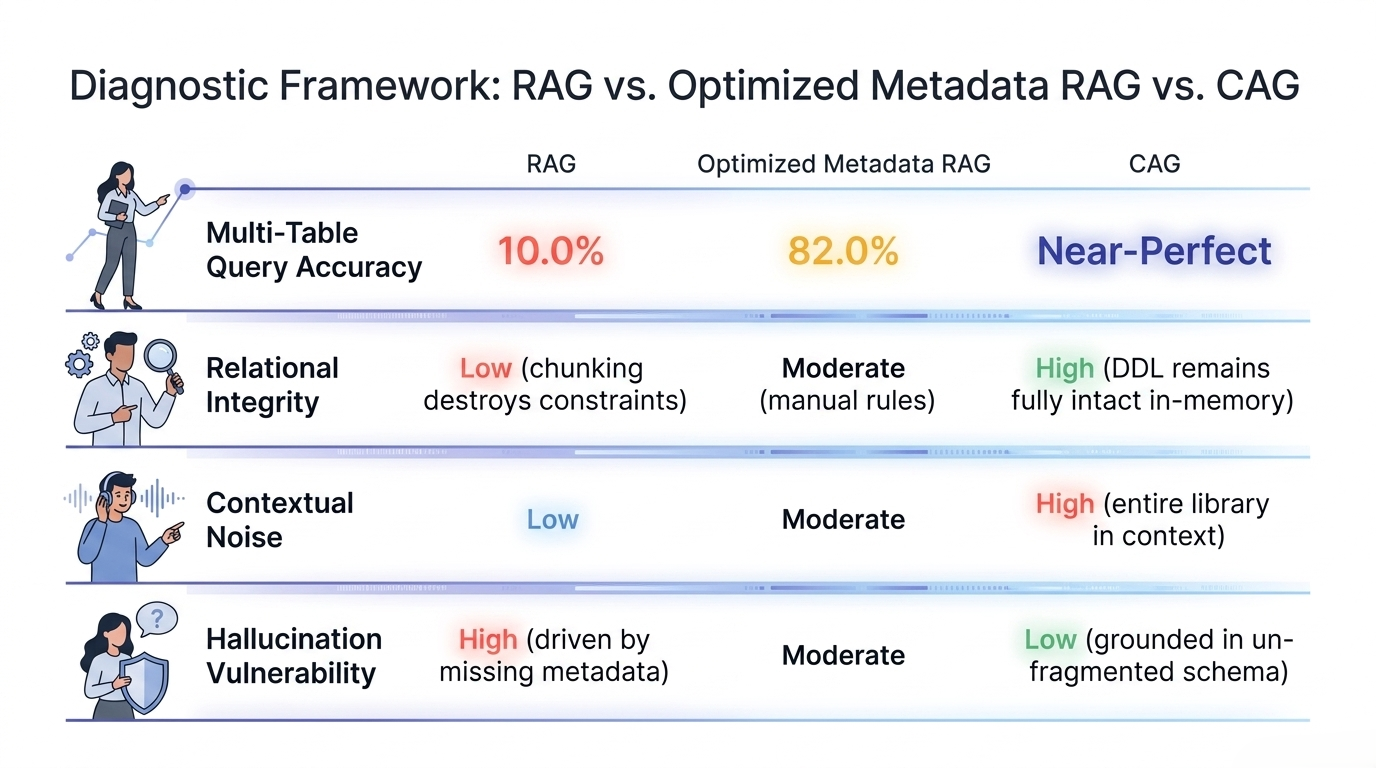
The supplied slide rates CAG highest for relational integrity and lowest for hallucination vulnerability in the specific schema-heavy use case, while also acknowledging a cost: the entire library remains in context, which creates contextual noise. Optimized metadata RAG sits between the two extremes by adding manually curated rules and structure to retrieval.
This suggests a practical decision rule:
- Use RAG when the working set is too large to preload and the relevant facts change frequently.
- Use metadata-enhanced RAG when selective retrieval is unavoidable but the data has enough structure to justify explicit routing, schema metadata, or relationship-aware filters.
- Use CAG when the stable corpus is bounded, highly relational, repeatedly reused, and expensive to reconstruct through retrieval on every request.
The key is to diagnose the failure mode you are trying to eliminate. If your main problem is retrieval omission, CAG directly attacks it. If your main problem is freshness at large scale, retrieval remains necessary.
7. The Latency Win Comes From Reusing Prefill Work
The technical mechanism behind CAG is easiest to understand as a split between offline prefill and active inference.
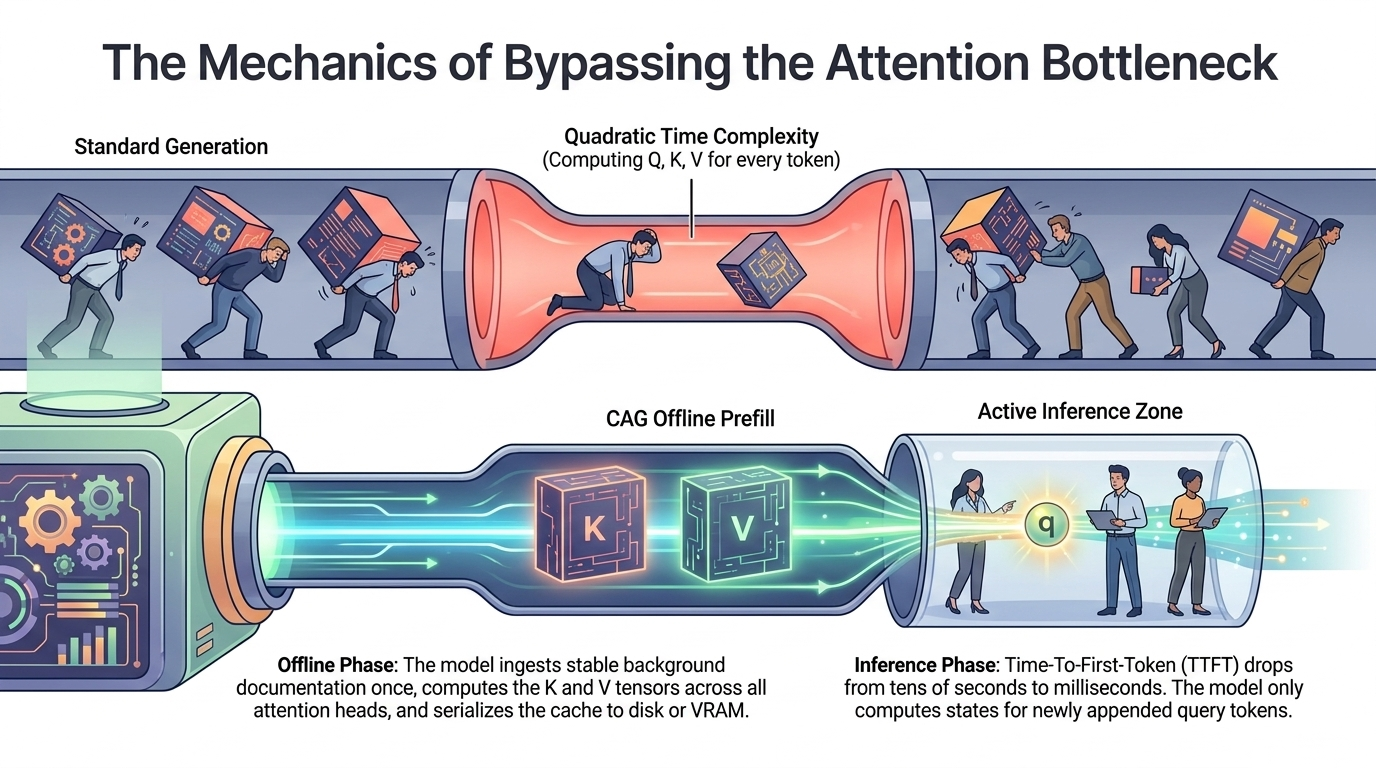
In standard transformer generation, the model processes the full prefix to create the attention states required for inference. When a large stable prompt is repeated, recomputing that prefix is wasteful. A cache-aware design performs the stable portion once, retains reusable key/value state, and computes new states only for appended query tokens.
The source characterizes this as moving the expensive background-context processing out of the request path. That distinction matters because “zero latency” should be interpreted as an architectural aspiration for the reusable prefix, not as literal zero end-to-end response time. Query ingestion, decoding, tool calls, network hops, and dynamic context still consume time.
A useful mental model is:
stable prefix → reusable cache → small dynamic suffix → active generation
The more of the request that can be made stable, deterministic, and reusable, the more work can be shifted out of the critical path.
8. Hardware Reality Limits How Much Can Stay Resident
Caching is constrained by memory. The source contrasts transformer KV-cache growth with state-space model designs that maintain a fixed-size internal state.
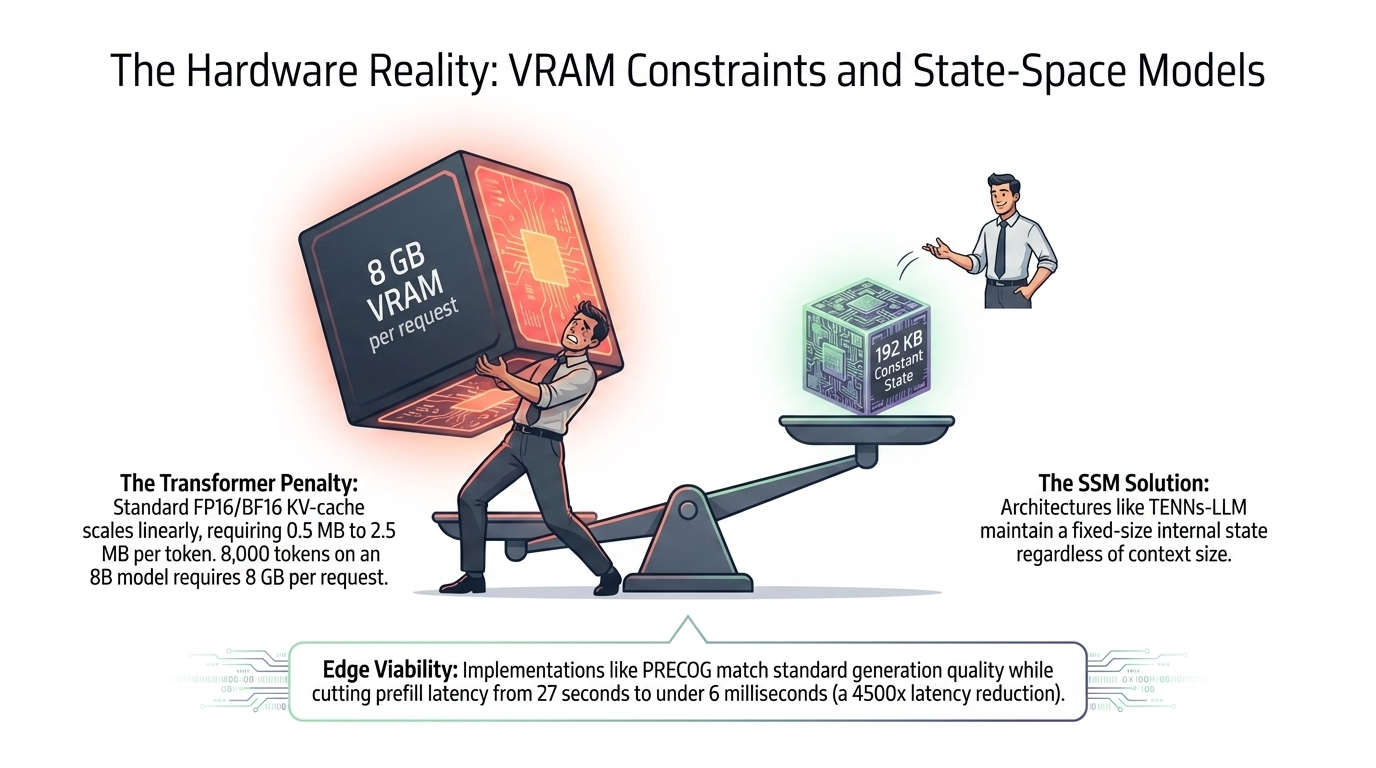
The important production implication is capacity planning. A cache design has to account for:
- model size and precision;
- sequence length;
- per-request cache footprint;
- concurrent sessions;
- cache sharing semantics;
- eviction behavior;
- the amount of dynamic context appended after the stable prefix.
The slide provides example memory figures and a state-space comparison; those values are specific to the source material and its assumptions. The broader point is robust: a latency optimization that cannot fit within the serving memory budget is not a production architecture.
This is where workload shape matters again. A small, stable schema library may be an excellent cache candidate. A massive, rapidly changing codebase may not be. The architecture has to optimize for the memory hierarchy that actually exists.
9. Advanced Cache Methods Trade Preparation for Fidelity
The source surveys several transformer-level cache optimization ideas: CacheBlend, TurboRAG, KVLink, and CoinRAG.
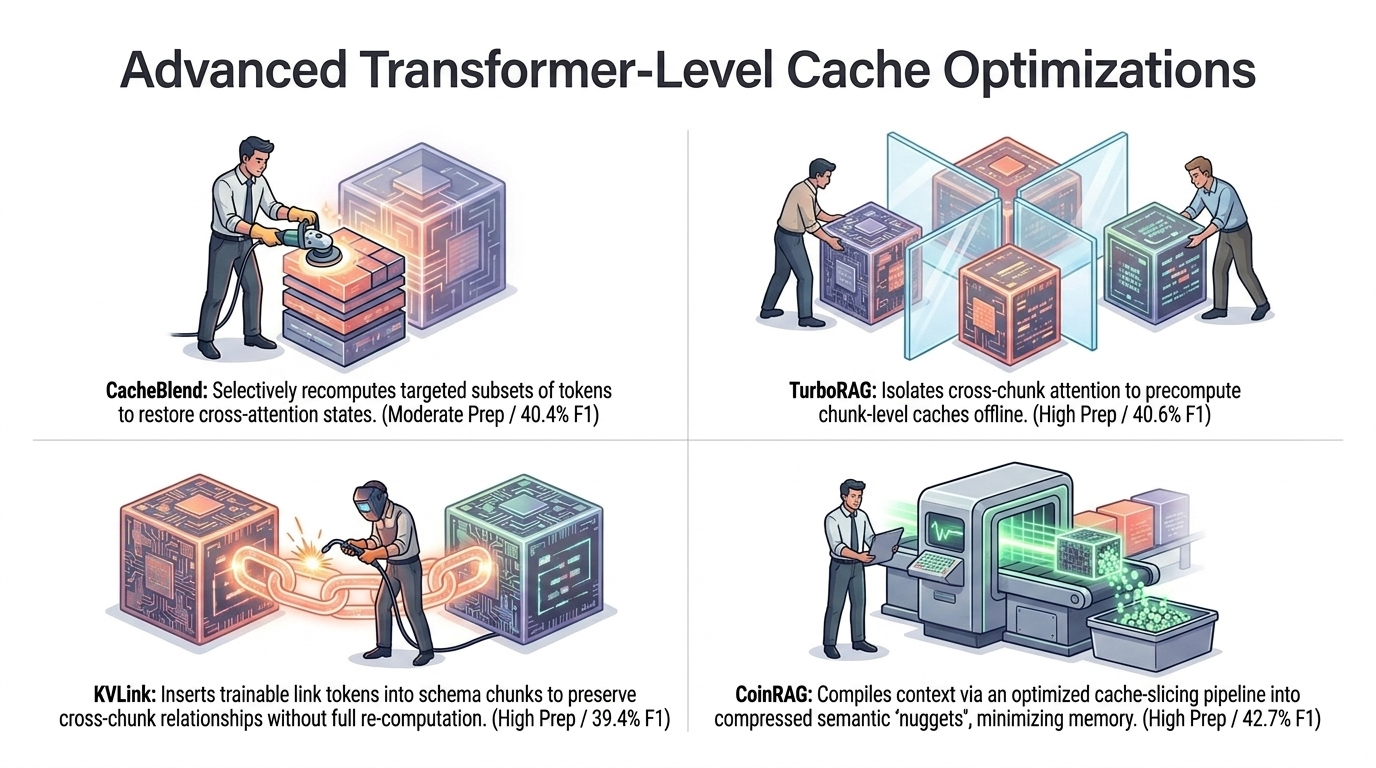
Although the techniques differ, they all attack the same tension: full-prefix caching is fast but rigid, while arbitrary chunk composition is flexible but can lose cross-chunk attention state. The methods therefore add different forms of recomputation, linking, isolation, or compression.
From an engineering perspective, they can be grouped by the cost they move offline:
- Selective recomputation restores only attention relationships that are likely to matter.
- Chunk-level precomputation isolates reusable context units so they can be assembled more cheaply.
- Link tokens or explicit connectors preserve relationships between chunks.
- Context compression reduces the amount of state that must remain resident.
The source includes preparation-cost and benchmark figures for each technique. Those should be treated as slide-specific evaluation results. The design lesson is the reusable one: every cache optimization chooses a point on the triangle of fidelity, flexibility, and preparation cost.
10. Caching Is Also an Economic Control Plane
Latency is only half the motivation. The material also frames caching as a way to reduce repeated prompt-processing cost.
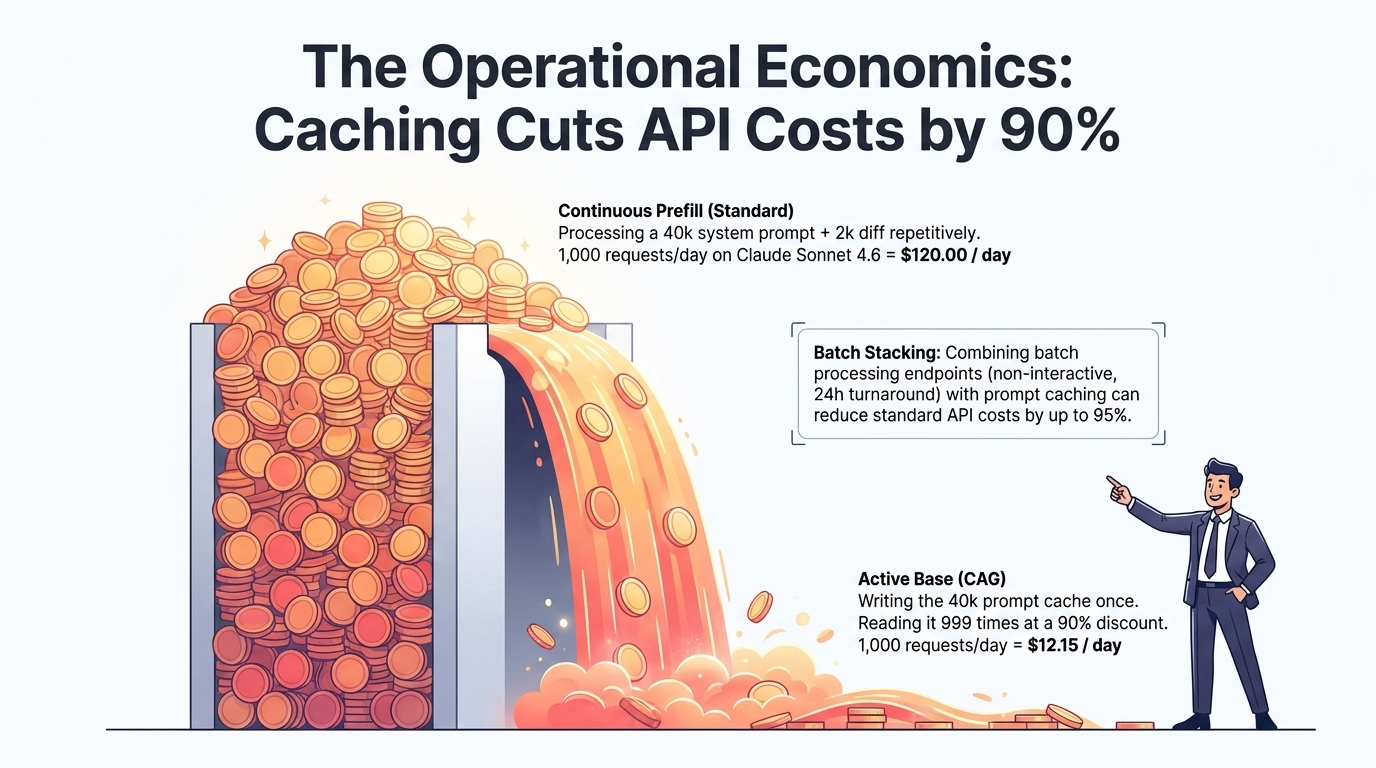
The slide compares repeatedly processing a large stable prompt with writing the stable prefix once and reusing it many times. It reports a dramatic daily cost reduction under its chosen model, request volume, and provider pricing assumptions, and notes that batch processing can lower cost further.
Those figures are scenario-specific and pricing can change. The durable design insight is to model prompt reuse as an economic variable:
[ \text{Effective cost} = \text{cache-write cost} + (\text{cache-read cost} \times \text{reuse count}) + \text{dynamic-token cost} ]
A cache only creates value when reuse is high enough to amortize creation, storage, invalidation, and operational complexity. This is why stable schemas, system instructions, test libraries, and shared domain references are strong candidates: many requests reuse the same foundation.
11. Provider Cache Semantics Belong in the Architecture
Cache behavior is not portable by default. The supplied material compares Anthropic, Google, and OpenAI and highlights differences in opt-in behavior, discounts, minimum token thresholds, TTLs, storage charging, and eviction characteristics.
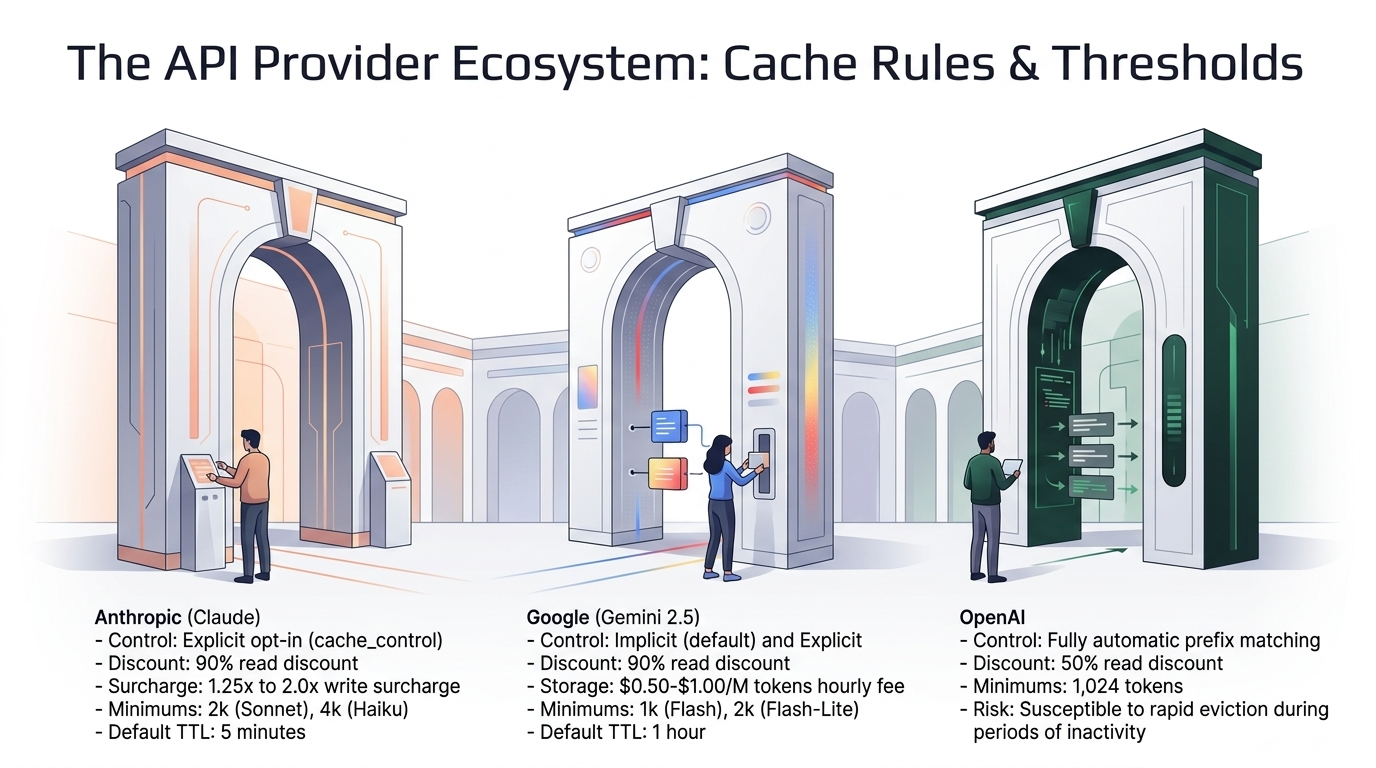
The specific thresholds and prices shown in the slide are time-sensitive provider details and should be verified against current documentation before implementation. The architectural requirement, however, is stable: provider cache semantics must be treated as part of the serving contract.
That means production code should not scatter provider-specific assumptions throughout the application. A cleaner design places them behind a cache policy layer that can answer questions such as:
- Is this prefix eligible for caching?
- What content defines the cache key?
- How long should the entry be considered warm?
- What invalidates it?
- Is a write surcharge justified by expected reuse?
- How does the system behave after eviction?
- Which metrics expose hit rate, write rate, and wasted prefill?
This is also a governance boundary. Cached prompts may contain schema definitions, instructions, or other sensitive operational context. The system should version and classify cacheable content just as deliberately as any other production artifact.
12. Hybrid RAG-CAG Topology Separates Stable Law From Dynamic Evidence
Pure CAG reaches a limit when the active corpus exceeds model context or changes too quickly. The source therefore proposes a two-tier topology.
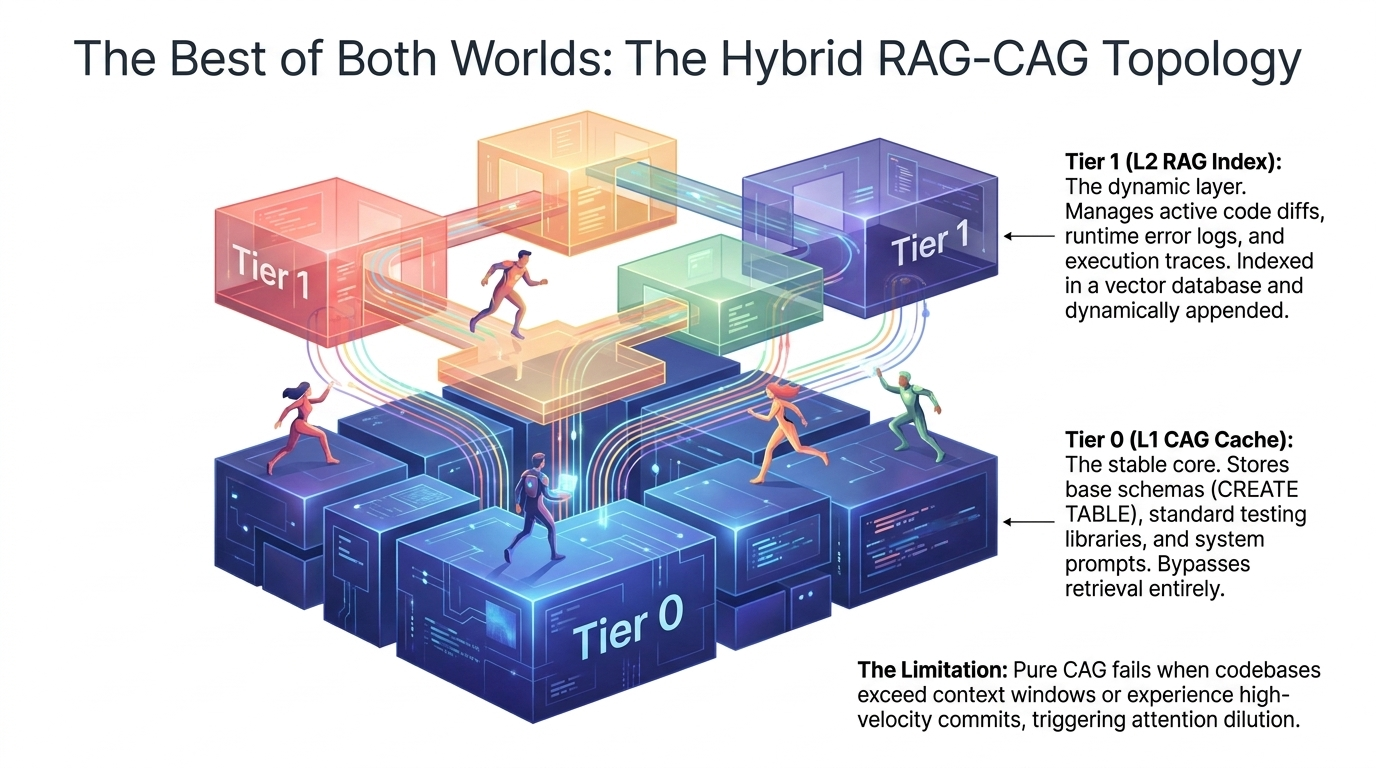
The lower tier is the stable core: base schemas, standard testing libraries, system prompts, and other material that changes infrequently. This is the CAG layer and should bypass retrieval when possible.
The upper tier is the dynamic layer: active code diffs, runtime errors, logs, traces, and other fast-moving evidence. This is the RAG layer and can be indexed, appended, and expired independently.
The architecture works because it aligns storage strategy with change rate:
- slow-changing, relationship-heavy knowledge is preloaded;
- fast-changing, selectively relevant knowledge is retrieved;
- the model receives both in a controlled context envelope.
This is the point at which RAG stops being the default memory system and becomes one tier in a larger memory hierarchy.
13. Optimize the Hybrid Data Flow, Not Just the Cache
The source closes the implementation detail with three optimization patterns: proximity-based caching, adaptive contextual compression, and keepalive behavior.
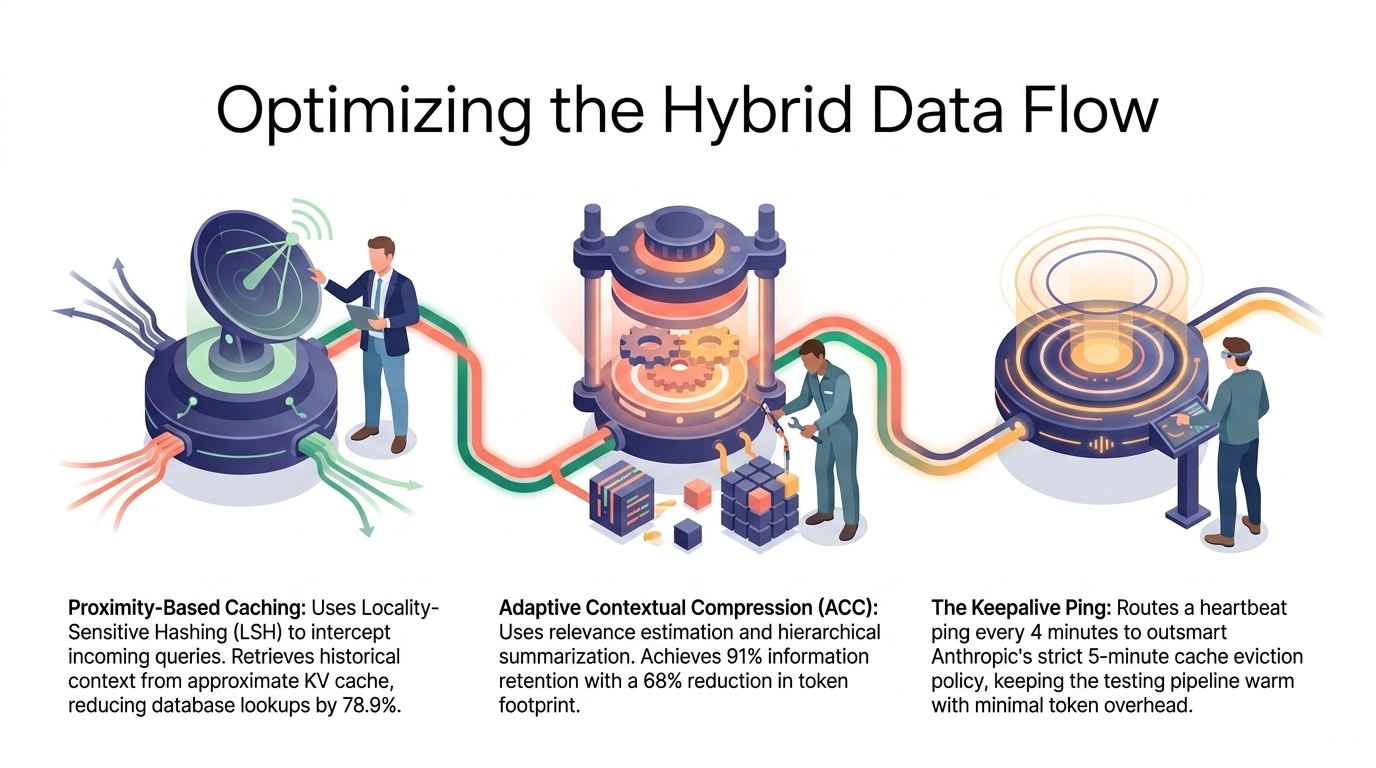
The exact percentages and heartbeat intervals shown in the image are implementation-specific claims from the material. The general strategies are broadly applicable:
Proximity-based caching attempts to reuse context from semantically or operationally similar requests. It is valuable when successive queries touch neighboring regions of a schema, codebase, or task space.
Adaptive contextual compression reduces the dynamic payload before it reaches the model. The goal is to preserve the evidence that changes the decision while removing material that only consumes attention and memory.
Keepalive behavior maintains provider-side cache residency when the economics justify it. This is a policy decision, not a universal rule: keepalive traffic should cost less than the repeated cache misses it prevents.
Together, these patterns make the hybrid topology an active data-flow system rather than a static two-box architecture.
14. A Decisional Taxonomy for What to Build
The supplied decision tree turns the previous sections into an implementation choice.
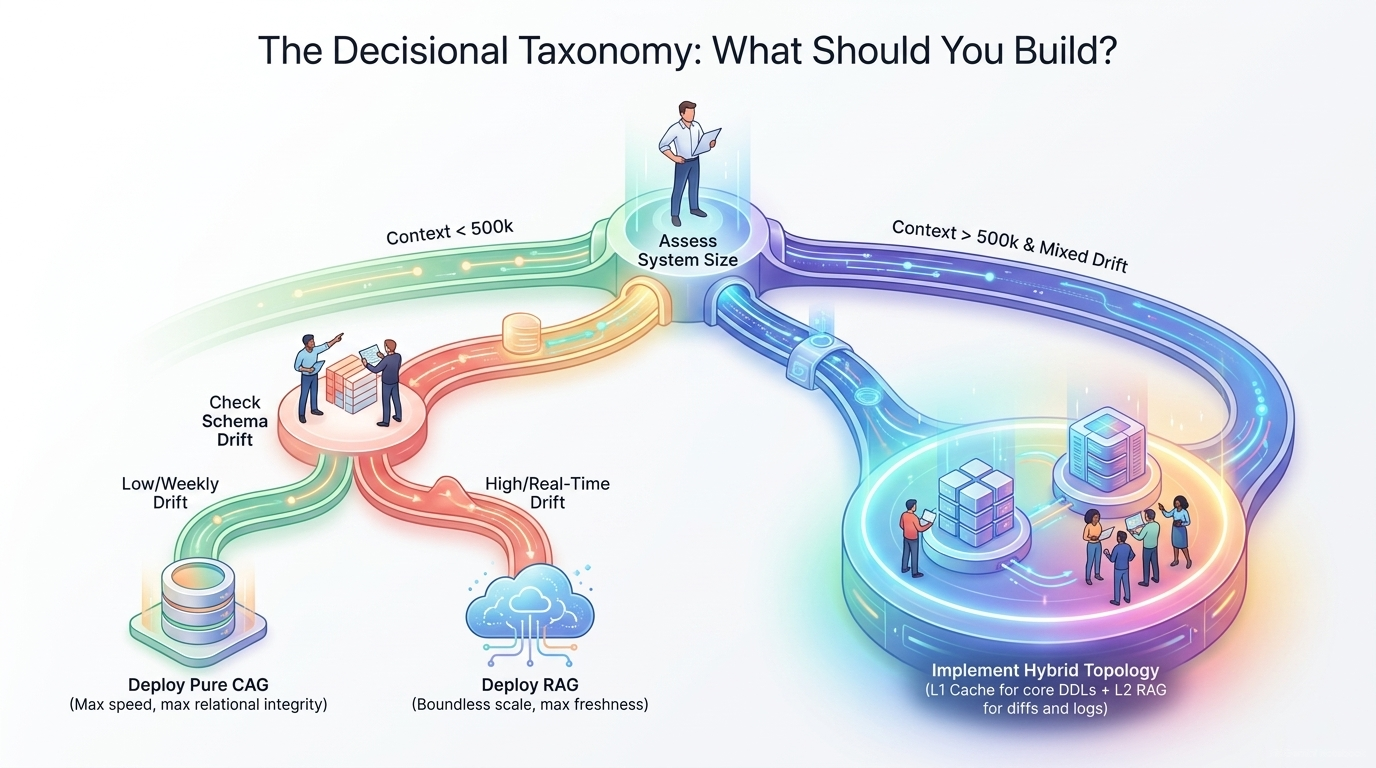
The first question is system size. If the stable knowledge base fits comfortably within the effective context and cache budget, preloading becomes feasible. The next question is schema drift. Low or weekly drift favors a pure CAG path because the stable context remains valid long enough to amortize its preparation. High or real-time drift pushes the changing portion toward retrieval.
For larger systems or mixed-drift environments, the material recommends a hybrid topology: a cached stable core plus retrieval for diffs, logs, and other high-velocity evidence.
The taxonomy can be summarized as three deployment modes:
- Pure CAG — bounded context, high relational integrity needs, low drift.
- Pure RAG — massive or unbounded corpus, high freshness needs, weak benefit from keeping the whole structure resident.
- Hybrid CAG + RAG — stable structural core plus a dynamic evidence stream.
The decision should be made from measurable workload properties: corpus size, change rate, relational coupling, cache reuse, latency target, memory budget, and failure sensitivity.
Engineering Principles
The architecture ultimately depends on several principles:
-
Preserve structure before optimizing retrieval.
If a reasoning task depends on a connected schema or relationship graph, do not destroy that structure through chunking and then expect retrieval to reconstruct it perfectly. -
Separate stable law from dynamic evidence.
Put slow-changing schemas, instructions, contracts, and test libraries in the reusable tier. Retrieve fast-changing logs, diffs, incidents, and runtime state. -
Test behavior across the full trajectory.
Validate tool selection, arguments, intermediate state, schema conformance, and final behavior rather than relying on exact output text. -
Treat cache lifecycle as production state.
Version it, invalidate it deliberately, observe it, and make provider TTL and eviction semantics explicit. -
Optimize for the serving memory hierarchy.
A design is only viable if its resident context, cache footprint, concurrency, and recomputation strategy fit the hardware and provider constraints. -
Make data quality machine-readable.
Data contracts and structured validation give agents a deterministic boundary for what “valid” means.
Final Synthesis
The strongest pattern in the material is a shift from thinking about memory as a single retrieval component to thinking about it as a hierarchy with different correctness and freshness guarantees.
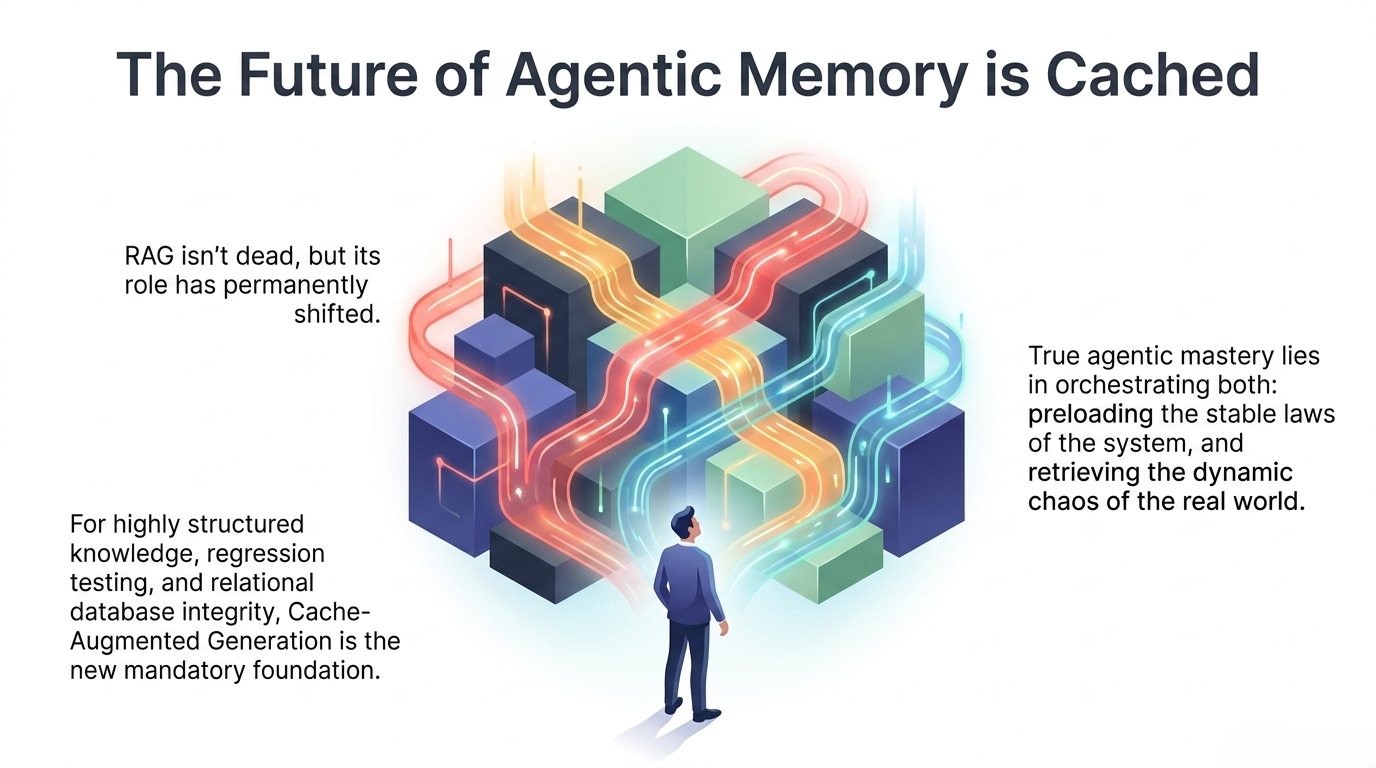
The stable layer carries the laws of the system: schemas, constraints, standard procedures, reusable prompts, and regression knowledge. CAG makes those rules immediately available and avoids retrieval omission for the knowledge that must remain structurally intact. The dynamic layer carries the changing world: current diffs, logs, runtime failures, incidents, and other evidence that cannot be safely frozen. RAG remains essential there.
Around those two memory layers sit the controls that make the architecture operational: trajectory tracing, golden datasets, data contracts, cache policy, provider-specific lifecycle handling, and observability for both reasoning behavior and cache performance.
The production-ready system combines:
- Deterministic foundation: versioned schemas, contracts, constraints, and stable instructions.
- Testing layer: golden trajectories, behavioral assertions, tool-call validation, and regression datasets.
- Agent or AI layer: cached stable context plus retrieval of dynamic evidence.
- Security and governance: controlled cache contents, explicit lifecycle rules, and auditable contract versions.
- Observability layer: full execution traces, cache hit and eviction telemetry, retrieval diagnostics, and failure classification.
- Production outcome: lower repeated prefill work without sacrificing freshness where the environment is changing.
RAG is therefore not obsolete. Its role becomes more precise. It is the dynamic memory tier in an agent system whose stable knowledge is increasingly cached, versioned, and tested as part of the application itself.
Closing Thought
The architectural question is no longer, “Which retrieval system should the agent use?” It is, “Which knowledge must be continuously retrieved, and which knowledge is important enough to keep intact and immediately available?”
Cache the laws. Retrieve the changes. Trace the trajectory.