
Engineering the Autonomous SDLC: Agentic Swarms and Environment-in-the-Loop QA
Legacy systems rarely fail because teams lack source code. They fail because too much of the system's real behavior lives outside the codebase: in undocumented integrations, operator habits, environment-specific configuration, historical workarounds, brittle test data, and execution paths nobody has written down. That hidden operational knowledge is the engineering "dark matter" that makes modernization slow and risky.
The architecture presented here treats that dark matter as something to observe, externalize, verify, and continuously re-validate. Instead of relying on a single copilot that proposes code from static context, the design uses a coordinated swarm of specialized agents, a shared blackboard state, a controlled execution environment, and reflexive repair loops.
The central thesis is straightforward: software behavior becomes more trustworthy when the environment is part of the reasoning loop, not merely the destination of generated code.
1. The Legacy Bottleneck: Engineering Dark Matter
The visible portion of a legacy system is usually the documented portion: source code, requirements, schemas, runbooks, and architecture diagrams. The harder part sits below that surface. Real behavior accumulates through years of operational friction, undocumented dependencies, environment-specific assumptions, production-like data shapes, and manual QA knowledge.
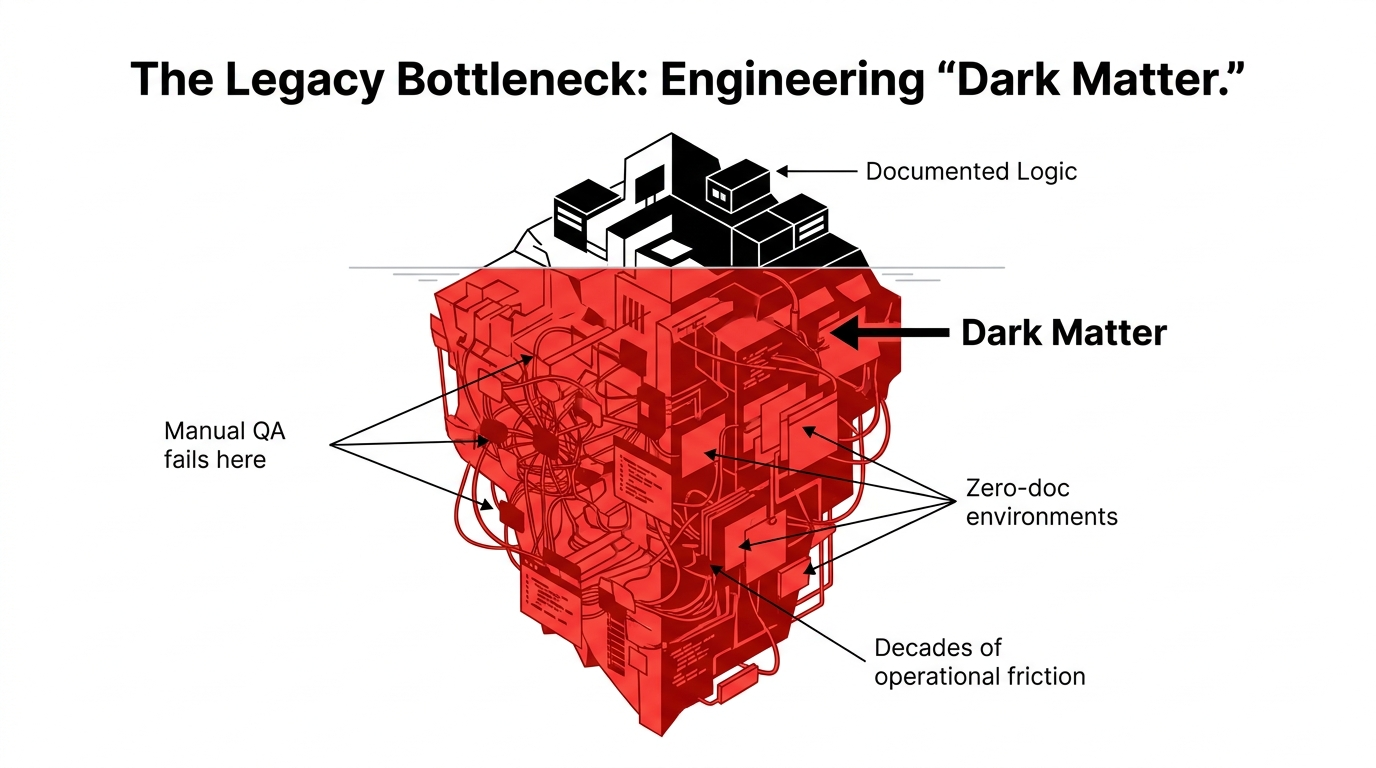
The slide's iceberg metaphor is useful because it changes the unit of analysis. The problem is not only "missing documentation." It is a mismatch between the system as described and the system as executed.
This is where manual QA becomes fragile. A tester can know that a flow fails, yet still be unable to describe the exact runtime conditions that produced the failure. Zero-documentation environments make this worse because the system's specification is effectively encoded in behavior rather than text.
A modernization program therefore needs to recover three classes of truth:
- Structural truth — services, APIs, queues, databases, UI surfaces, and dependencies.
- Behavioral truth — what the system actually does along realistic execution paths.
- Operational truth — environment constraints, timing, data conditions, and integration behavior that influence outcomes.
2. The Agentic Turn: From Copilots to Swarms
A single agent can be useful for local reasoning, but the presentation frames single-agent systems as constrained by context limits, hallucination risk, and the difficulty of carrying every specialization at once. The proposed alternative is a swarm: multiple purpose-built agents coordinated around shared state.
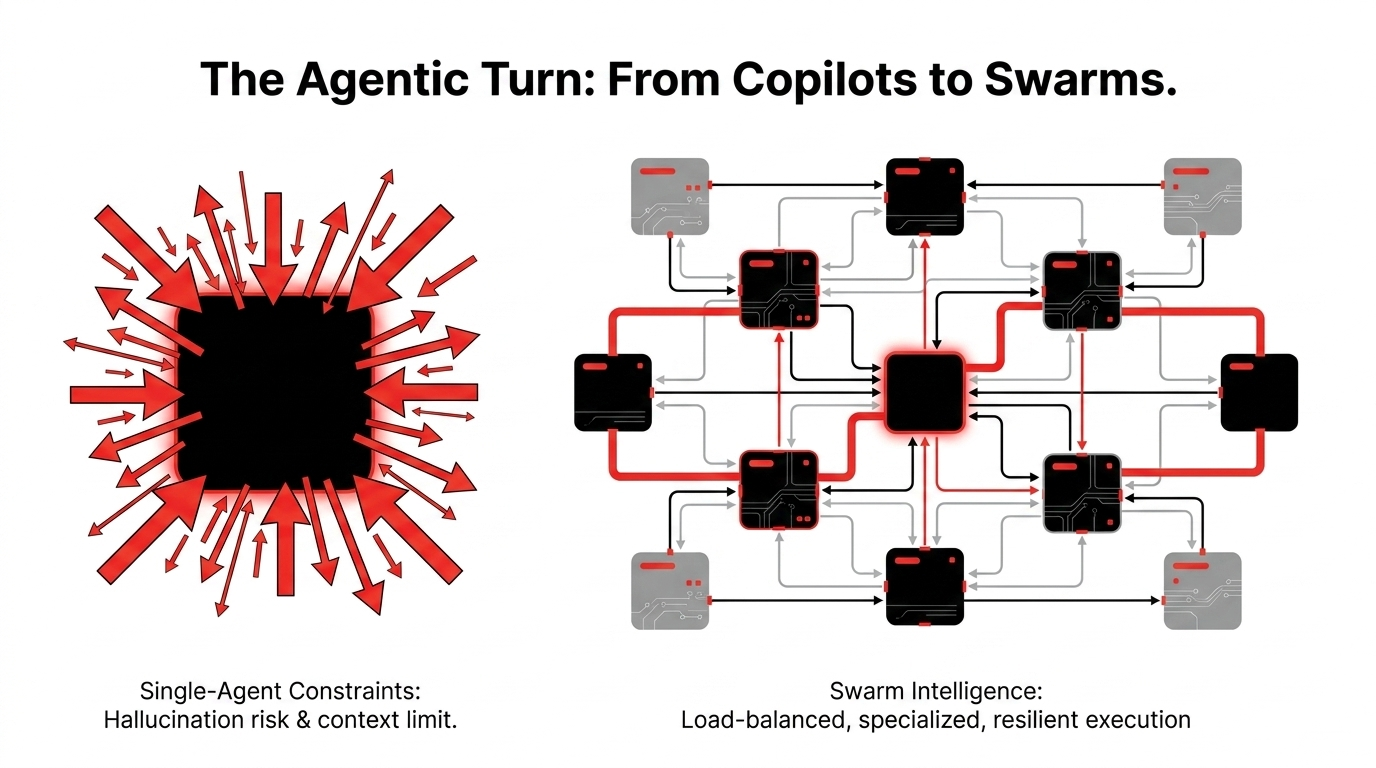
The important architectural shift is not simply "more agents." It is separation of concerns plus orchestration. One agent can specialize in environment discovery, another in modification, another in test generation, and another in diagnosis. That creates several engineering advantages:
- failures can be localized to a role rather than to a monolithic reasoning process;
- tasks can be routed to the agent best suited to the current state;
- independent agents can challenge or validate one another's outputs;
- work can be parallelized where dependencies permit;
- context can remain narrower and more relevant per specialist.
The swarm model also changes how resilience is designed. Instead of assuming a single reasoning thread must stay correct from beginning to end, the system can recover by re-routing work, re-running a specialist, or using execution evidence to force a correction.
3. Orchestrating the Swarm with a Blackboard Architecture
The swarm needs a coordination mechanism that is more durable than agent-to-agent chat. The presentation proposes a blackboard architecture: a shared memory state that specialists read from and write to under a supervisory control shell.
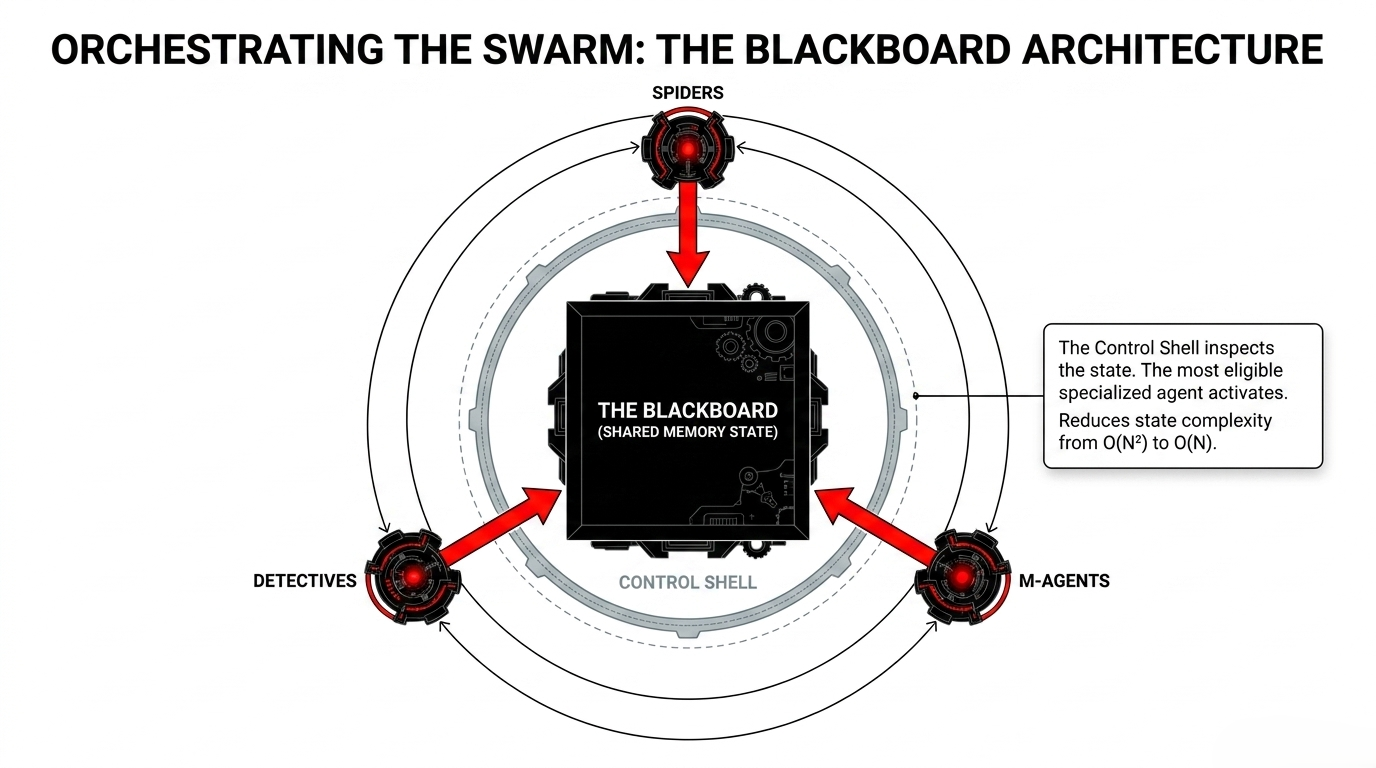
The blackboard acts as the system's working model of the task. It can hold discovered requirements, execution evidence, hypotheses, proposed code changes, test results, unresolved defects, and provenance. Specialists do not need to maintain every possible peer-to-peer conversation because the shared state becomes the integration surface.
This design is especially important in long-running engineering workflows. Agent messages are transient; state must be inspectable, versioned, and attributable if the process is expected to produce production-grade evidence.
The slide describes a control shell that inspects state and activates the most eligible specialized agent. It also presents a complexity claim—reducing coordination from O(N²) to O(N)—as a design rationale. Whether that asymptotic simplification holds in a specific implementation depends on how dependencies and subscriptions are modeled, but the underlying architectural benefit is clear: centralized state can avoid an explosion of direct coordination links.
4. Requirements Archaeology via System Spiders
Before an autonomous SDLC can modify a legacy system safely, it needs to discover what the system already does. The "system spider" concept treats QA and integration environments as observable surfaces from which requirements can be reconstructed.
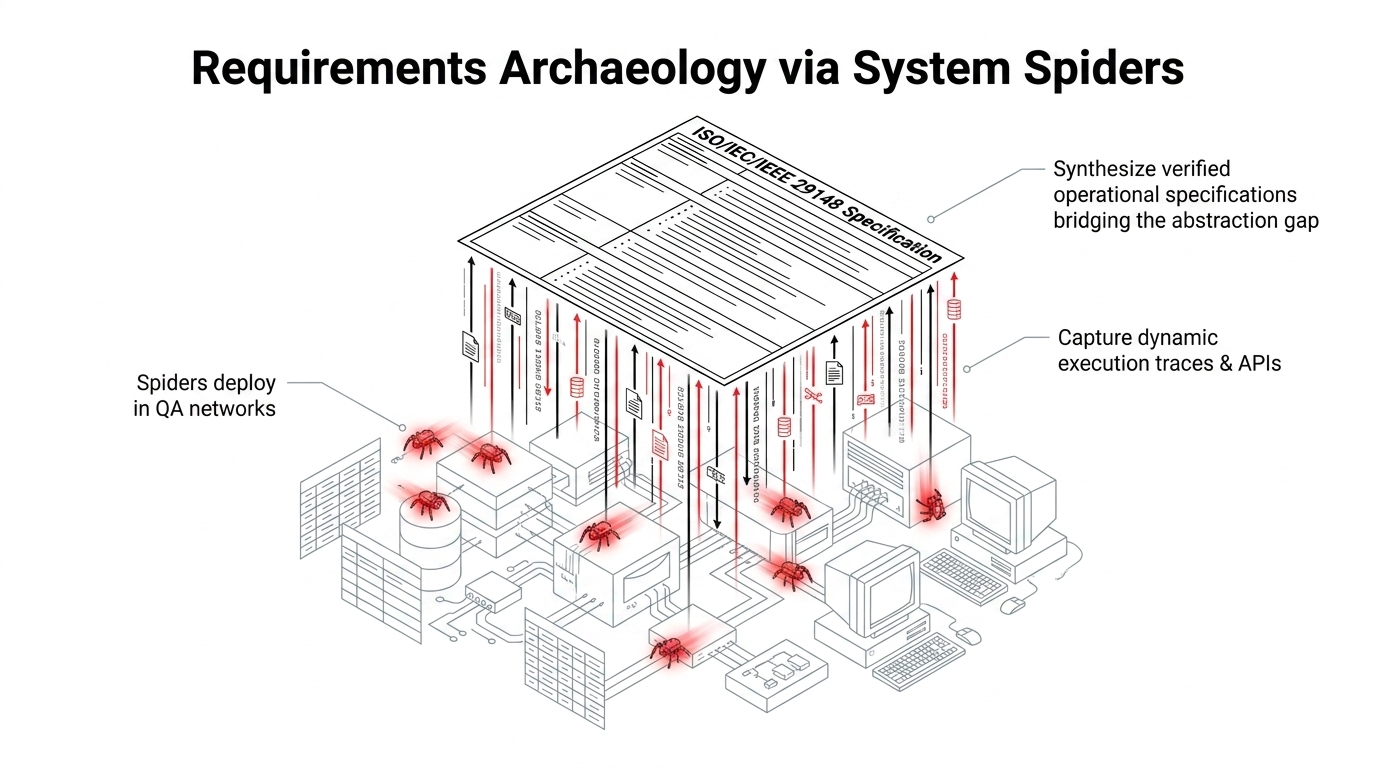
A spider in this architecture is not merely a web crawler. It is an instrumented discovery agent that explores behavior and records evidence. Useful outputs can include:
- reachable UI states and transitions;
- API contracts observed during execution;
- request/response relationships;
- dependency ordering;
- environment configuration assumptions;
- data constraints;
- error paths and recovery behavior;
- execution traces that reveal hidden coupling.
The presentation connects those observations to ISO/IEC/IEEE 29148-style specifications. The engineering idea is to bridge the abstraction gap by synthesizing human-readable requirements from runtime evidence while preserving a link back to the observations that justify them.
That link matters more than polished prose. A reconstructed requirement without evidence is another document that can drift. A reconstructed requirement with traceable execution support can be challenged, re-run, and updated.
5. The QA Environment as Ground Truth
Production contains the most authentic behavior, but it also contains privacy, security, reliability, and change-control constraints. The presentation therefore elevates the QA environment into a critical middle layer: realistic enough to expose behavior, controlled enough to permit active experimentation.
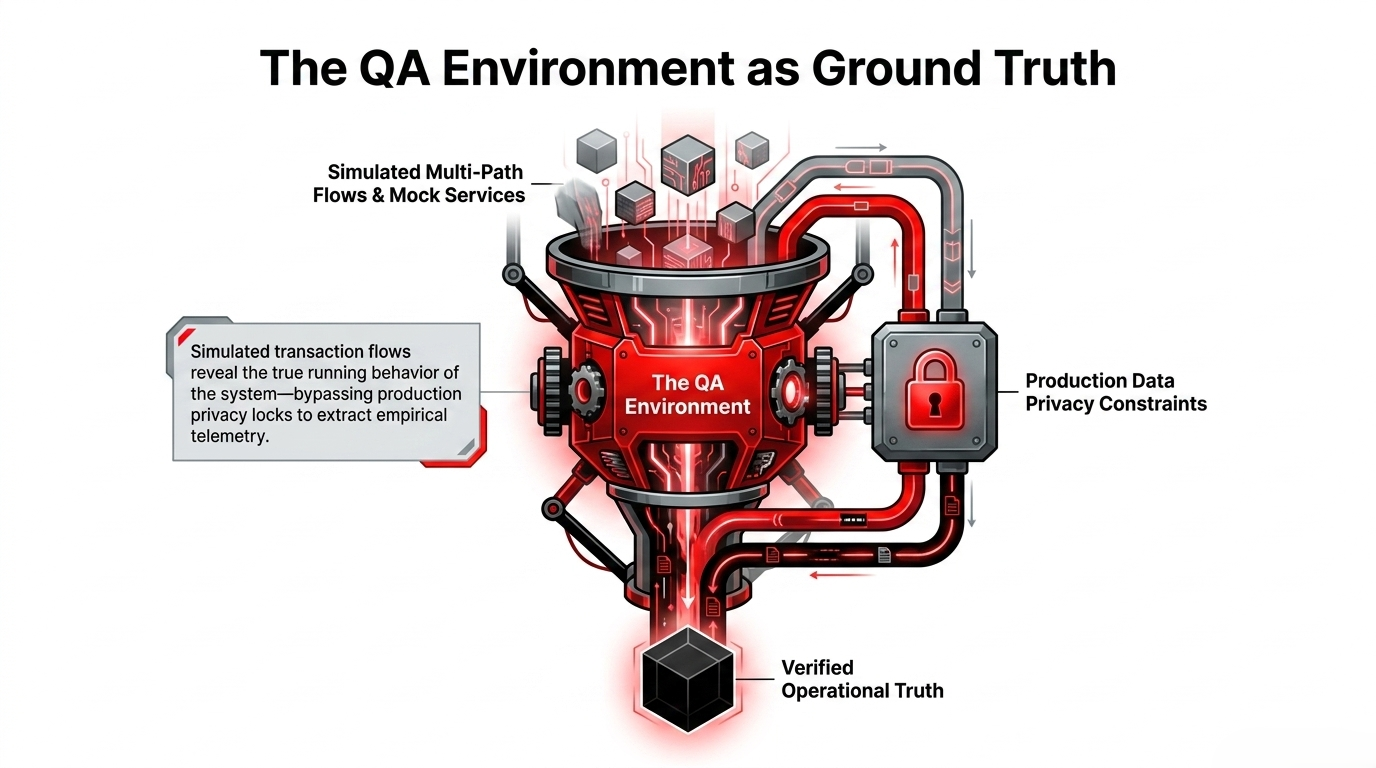
This is the core of environment-aware engineering. Instead of asking an agent to infer what code should do from static text alone, the system asks the environment what the code actually does under representative flows.
A production-like QA environment can provide:
- simulated multi-path transaction flows;
- mock services for unavailable or risky dependencies;
- reproducible data fixtures;
- constrained access to production-derived data patterns;
- telemetry that would be inappropriate to gather through invasive production experimentation.
The slide's "verified operational truth" should be understood as a design objective: conclusions are accepted only when they survive execution against the controlled environment.
6. Environment-in-the-Loop: Build, Execute, Validate
Environment-in-the-Loop (EITL) is the mechanism that closes the gap between generation and evidence. The presentation divides responsibility among three agent roles:
- M-Agent — rewrites or modifies code.
- E-Agent — builds and executes in a controlled sandbox.
- T-Agent — validates behavior and generates or refines tests.
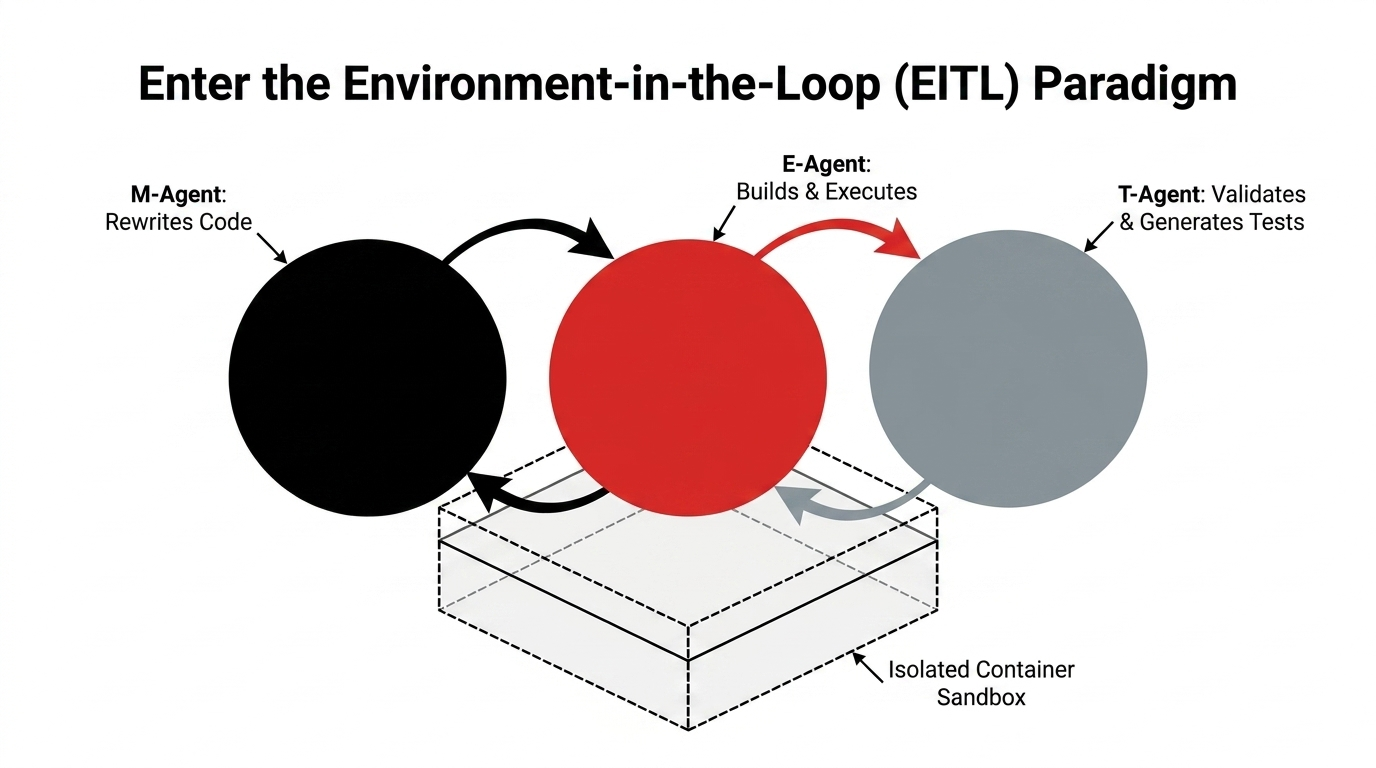
The sandbox is essential. Autonomy without isolation turns a reasoning error into an infrastructure incident. The environment boundary constrains what the agents can execute, what data they can access, and which effects can escape.
The loop then becomes:
- propose a code or configuration change;
- materialize a fresh or resettable environment;
- build and execute;
- capture deterministic evidence;
- validate expected behavior;
- route failures back to the appropriate specialist;
- repeat until the acceptance condition is satisfied or an escalation threshold is reached.
EITL turns the runtime into an active participant in reasoning. The environment does not "understand" the task, but it can reject invalid assumptions with high authority.
7. The E-Agent as the Central Execution Hub
Within the EITL loop, the E-Agent is the bridge from suggestions to evidence. It provisions the sandbox, configures the toolchain, compiles or builds the application, executes the workload, and captures logs.
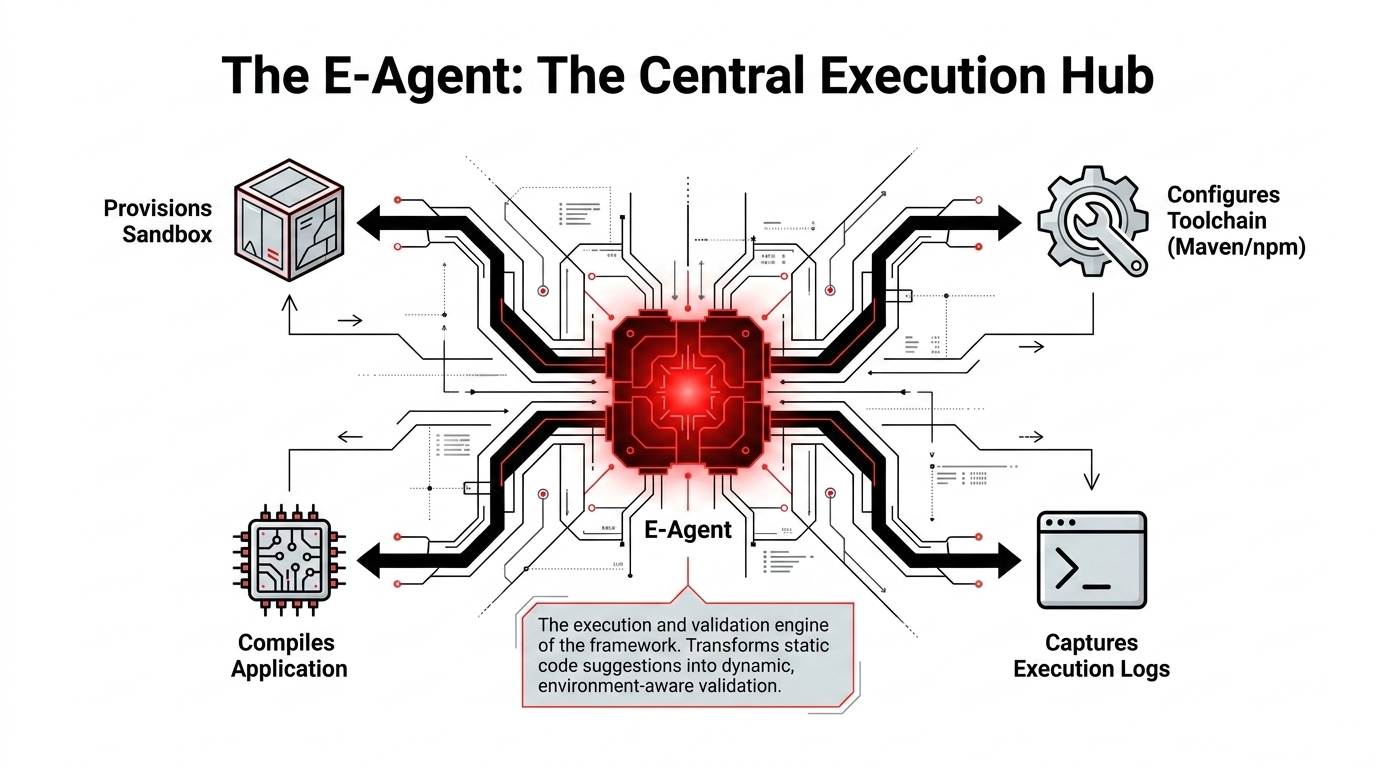
This role should be deliberately boring in one sense: execution needs deterministic contracts. The E-Agent may use language-model reasoning to interpret failures, but the actual build, test, shell, dependency, and artifact operations should be explicit and reproducible.
A production implementation should capture at least:
- exact source revision or patch set;
- environment image or dependency lock state;
- toolchain versions;
- commands executed;
- exit codes;
- stdout/stderr and structured logs;
- produced artifacts;
- test results and coverage signals;
- timestamps and correlation identifiers.
That evidence is what allows subsequent agents—and human reviewers—to distinguish a real defect from a bad hypothesis, a broken environment, or a transient dependency.
8. Reflexion: A Closed-Loop Self-Correction Mechanism
Execution is only useful if failure changes what the system does next. The presentation's reflexion loop begins with runtime error parsing, routes semantic failures back to a modification agent, and then iterates through verification until a clean exit condition is reached.
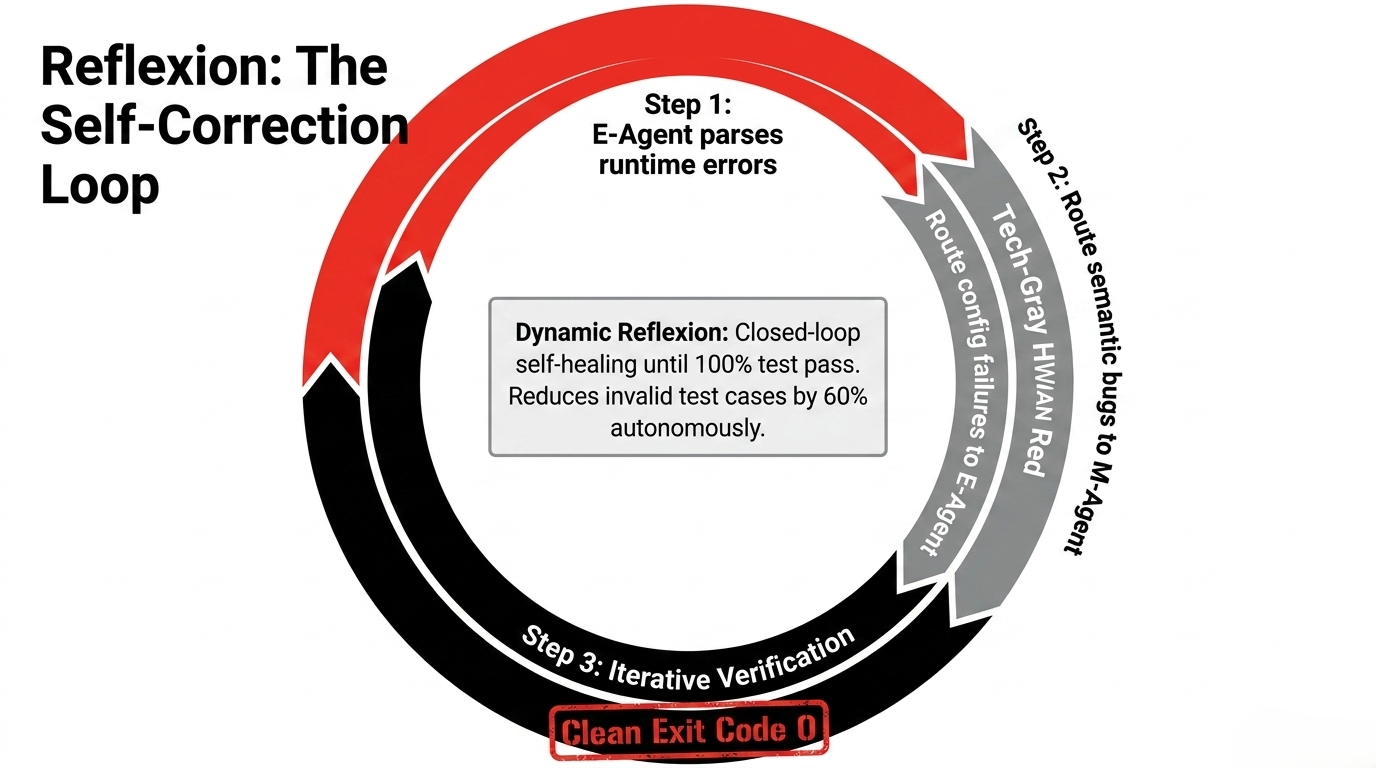
A robust self-correction loop should avoid treating "test failed" as sufficient diagnosis. It needs a structured failure taxonomy, for example:
- compile or dependency failure;
- environment provisioning failure;
- selector or UI drift;
- API contract mismatch;
- authorization or policy failure;
- deterministic functional defect;
- nondeterministic or flaky behavior;
- invalid test assumption;
- missing fixture or data precondition.
The presentation includes quantitative claims about autonomous reduction of invalid tests and completion at full pass. Those figures should be treated as claims shown in the source material, not independently verified benchmarks. The architectural lesson does not depend on the exact percentage: repair must be evidence-driven and bounded by explicit acceptance criteria.
9. Agentic QA as an Orchestrated Pipeline
The QA-specific pipeline shown in the presentation breaks autonomous testing into five purpose-built stages: UI crawl, API discovery, plain-English translation, execution, and defect reporting, all routed by a supervisory agent.
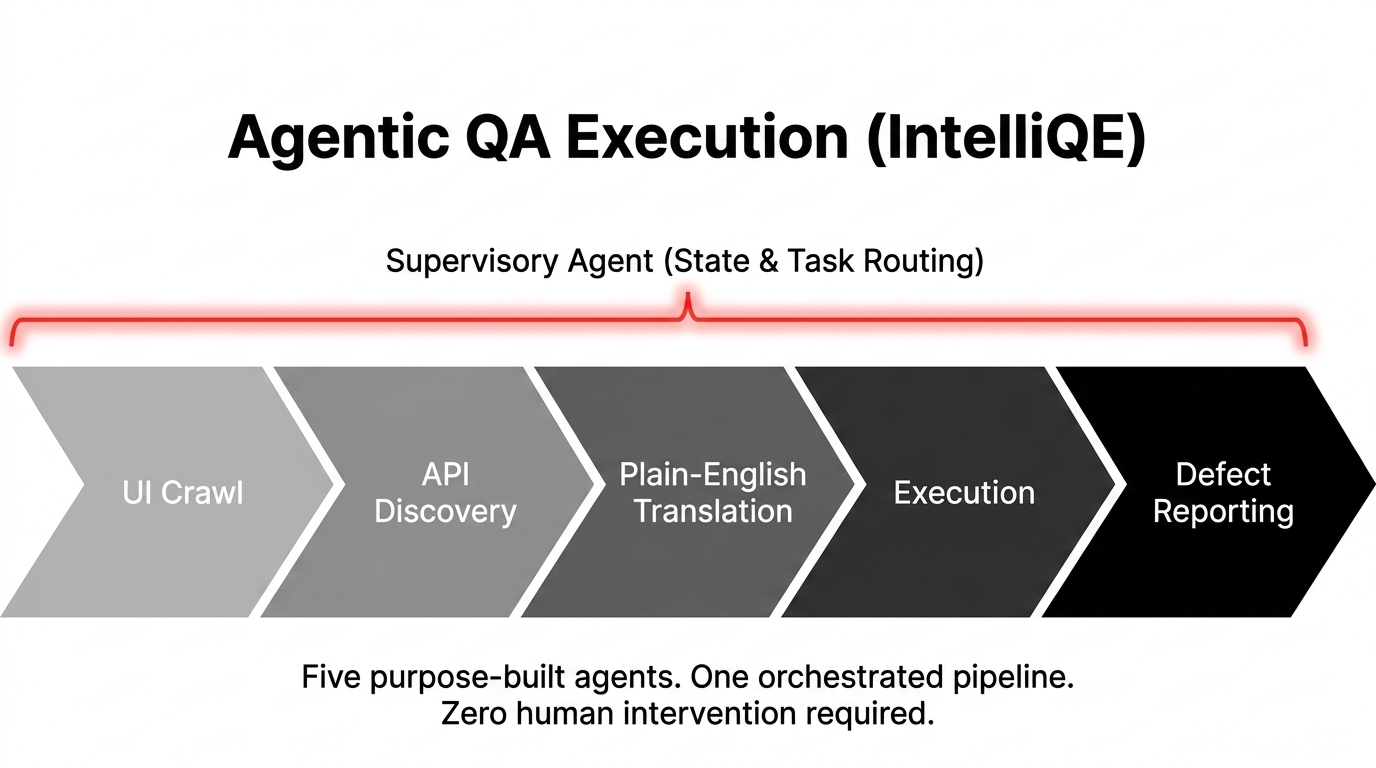
This decomposition is valuable because each stage produces an artifact that can be inspected independently.
UI crawl discovers reachable states and interactive elements. API discovery observes backend surfaces and relationships. Plain-English translation turns discovered behavior into readable intents or scenarios. Execution converts those scenarios into machine-verifiable checks. Defect reporting packages evidence for downstream triage.
The slide states that the pipeline can operate without human intervention. In enterprise practice, that level of autonomy should be a configurable operating mode, not an assumption. Some classes of change can be fully automated; others should require approval gates based on risk, data sensitivity, blast radius, or policy.
10. Self-Healing QA and Selector Drift
UI automation often fails because selectors encode accidental structure rather than stable intent. A DOM refactor can break a test even when the user-visible behavior remains correct. The presentation proposes same-cycle healing: analyze the changed DOM, identify the intended element, repair the selector, and continue execution.
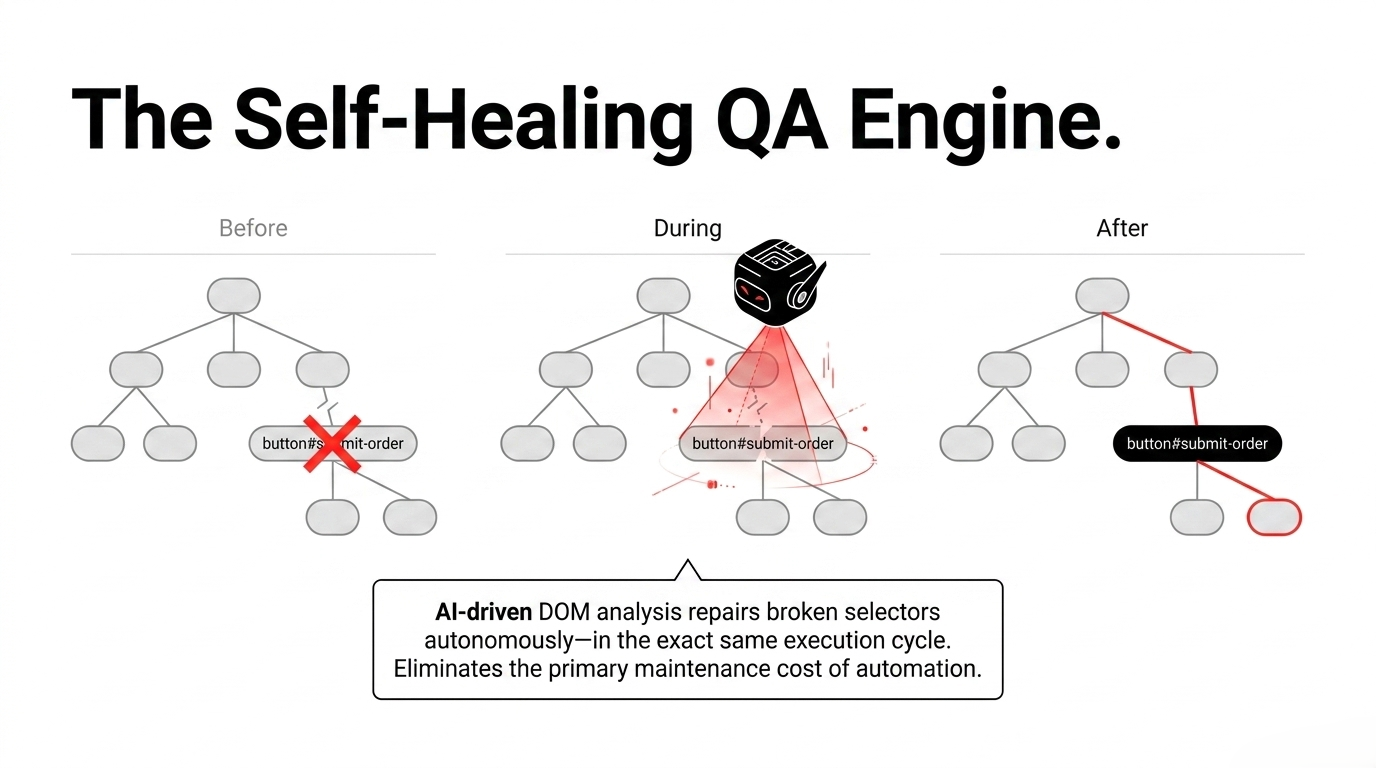
Self-healing is powerful, but it has a dangerous failure mode: a test can "heal" itself onto the wrong element and produce a false pass.
A safe healing mechanism therefore needs confidence and evidence. Useful checks include:
- semantic label similarity;
- accessibility role and name;
- relative structural position;
- nearby stable attributes;
- event behavior after interaction;
- visual or state transition confirmation;
- historical mapping to the previous selector;
- bounded edit distance between old and new locator strategies.
Healing should be auditable. The system should record what changed, why it believed the replacement was equivalent, and which validation proved that equivalence.
11. Continuous Traceability from Code to Requirement to Test
Autonomous engineering becomes much more valuable when every change remains connected to the requirement it implements and the execution evidence that proves it.
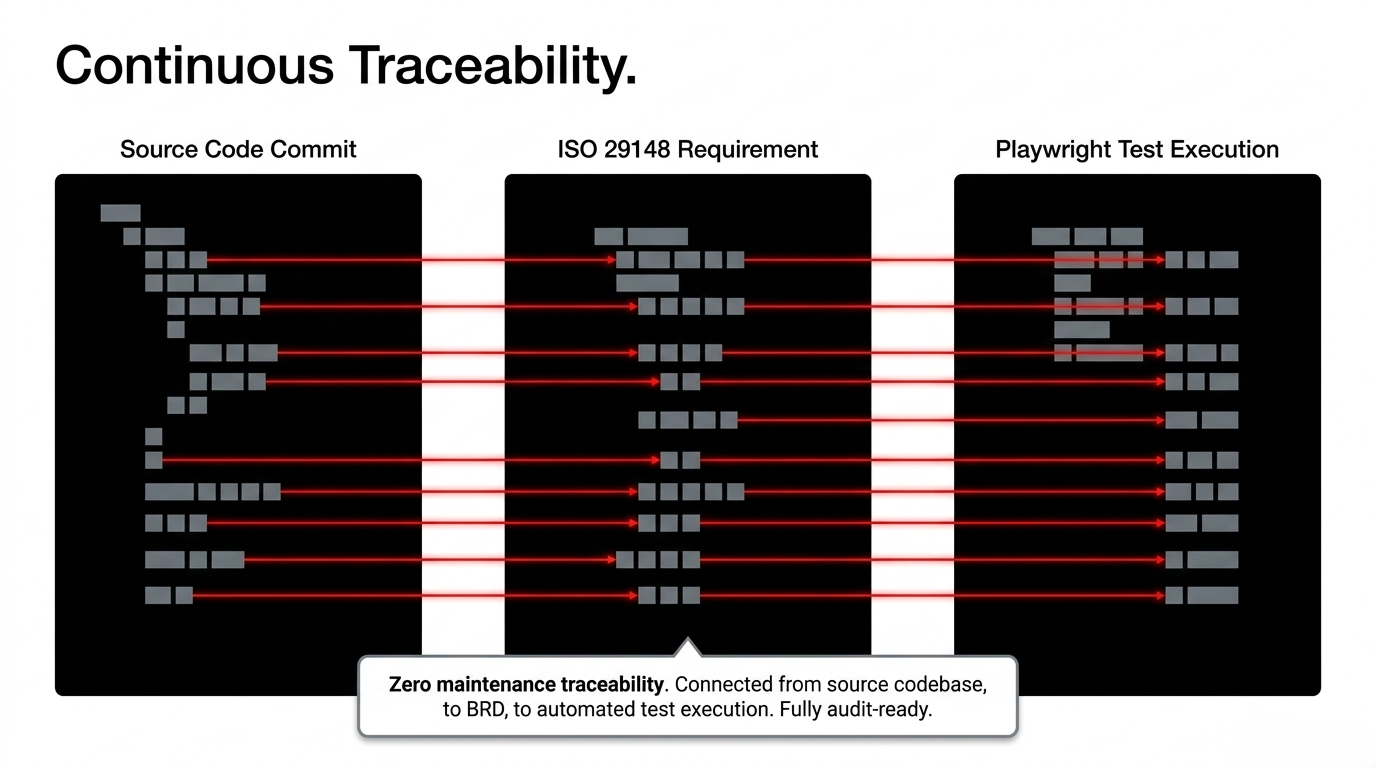
The presentation depicts a chain from source code commit to ISO 29148 requirement to Playwright test execution. The deeper principle is bidirectional traceability.
Given a failing test, engineers should be able to identify the relevant requirement and code changes. Given a requirement, they should be able to find the tests that verify it. Given a commit, they should be able to see which requirement changed and which evidence justified the merge.
This can be implemented as a trace graph rather than a flat report. Each node represents a versioned artifact—commit, requirement, test, environment snapshot, defect, approval—and each edge records the relationship and provenance.
That graph becomes the audit spine of the autonomous SDLC.
12. The Architectural Shift: From Assistance to Closed-Loop Execution
The comparison slide positions traditional QA, single-agent copilots, and agentic swarms as distinct execution paradigms.
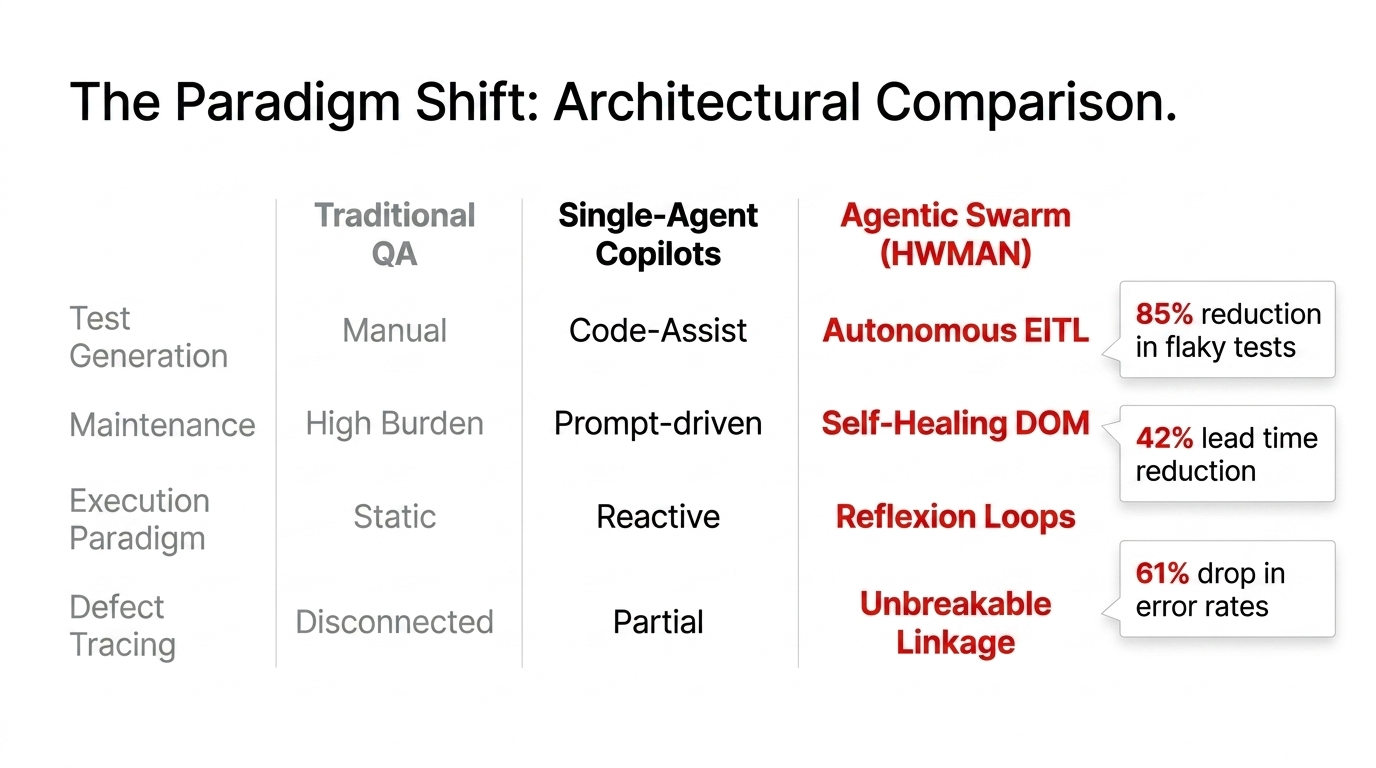
Traditional automation is typically static and maintenance-heavy. Copilots improve authoring speed but remain prompt-driven and reactive. The swarm architecture moves the center of gravity toward continuous execution, reflexion, self-healing, and linked evidence.
The slide also presents percentage improvements for flaky tests, lead time, and error rates. These should be read as source claims requiring independent validation in the target environment. A trustworthy engineering program would establish its own baseline, define each metric precisely, run controlled comparisons, and record confidence intervals or at minimum sample sizes and test conditions.
The architectural comparison is still useful without accepting the metrics at face value: the strongest difference is not "AI writes more tests," but that the entire QA lifecycle becomes a closed loop with execution feedback.
13. Enterprise Guardrails: Maximum Autonomy Inside Explicit Boundaries
An autonomous SDLC is only credible if it can state exactly what agents are allowed to do. The presentation places the swarm inside enterprise guardrails: RBAC, PII masking, zero data egress, boundary isolation, and human-in-the-loop validation gates.
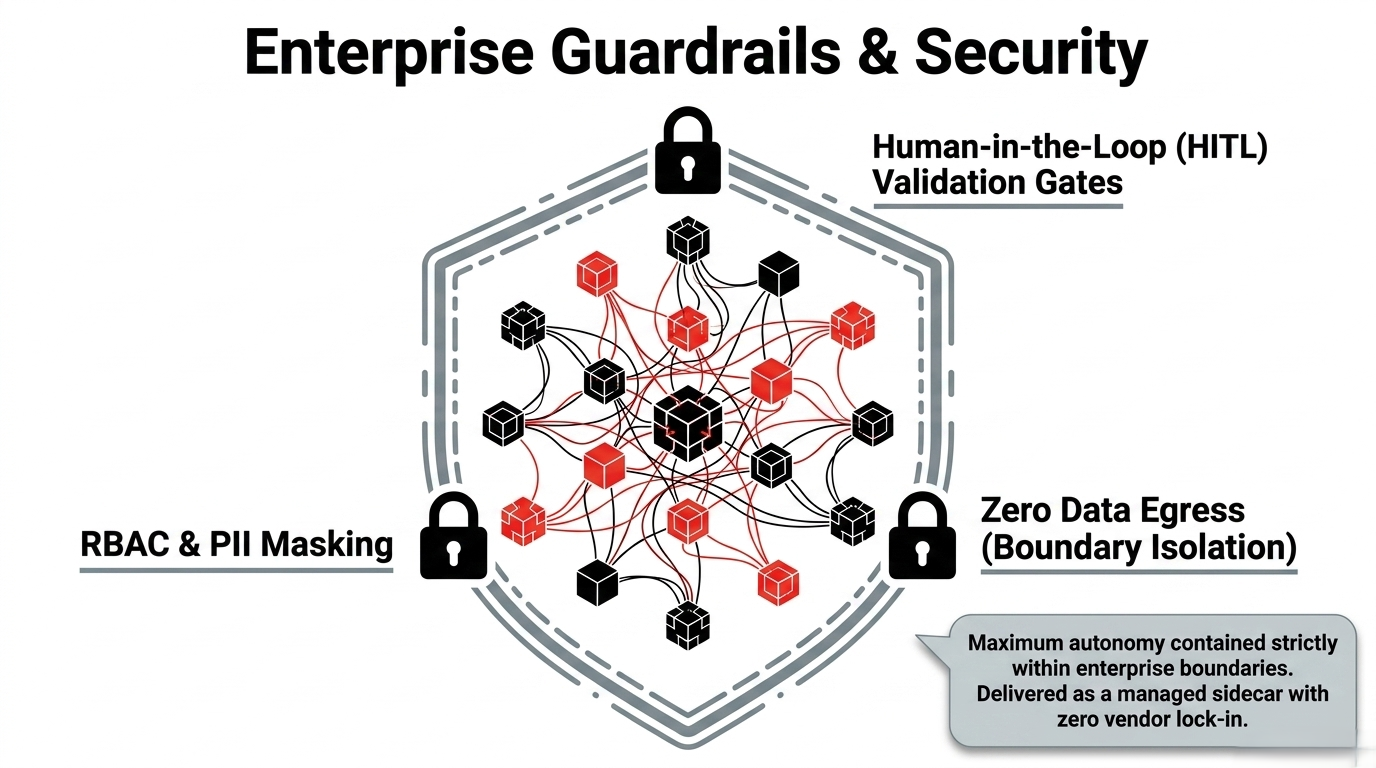
These controls should be enforced by infrastructure, not merely prompt instructions.
RBAC limits which identities can invoke which tools and environments. PII masking reduces exposure of sensitive data before it enters model context or logs. Boundary isolation restricts network egress and prevents unauthorized cross-environment access. Human validation gates introduce explicit approvals for high-impact actions.
A practical risk policy can classify actions by blast radius:
- read-only discovery may run autonomously;
- test generation and sandbox execution may run autonomously within isolated environments;
- code modification may be allowed on feature branches with policy checks;
- merge, deployment, schema migration, permission changes, or production data access may require approval.
The goal is not the absence of humans. It is purposeful human involvement where judgment, accountability, or irreversible risk justifies it.
Engineering Principles
The architecture ultimately depends on several principles:
-
Execution evidence outranks plausible reasoning
Generated suggestions remain hypotheses until the environment confirms them. -
Shared state should be explicit and inspectable
A blackboard or equivalent state model prevents critical context from being trapped in transient agent conversations. -
Specialize agents around bounded responsibilities
Discovery, modification, execution, validation, and reporting should have distinct contracts and failure modes. -
Autonomy must be sandboxed and policy-constrained
Security boundaries, RBAC, data controls, and approval gates are part of the architecture rather than post-processing. -
Every autonomous action should leave a trace
Requirements, code, tests, environment state, failures, repairs, and approvals need durable provenance. -
Self-healing must be validated, not merely convenient
A repaired selector or generated fix is safe only when independent evidence confirms behavioral equivalence. -
Metrics need local verification
Performance claims from a presentation are starting hypotheses. Production adoption requires organization-specific baselines and measured outcomes.
Final Synthesis
The complete model is a continuous loop from archaeology to execution. System spiders observe legacy behavior and reconstruct operational specifications. Those specifications enter a shared state model where specialized agents can reason over them. Modification agents propose changes, the E-Agent materializes and executes them in controlled environments, and validation agents turn runtime behavior into test evidence. Failures feed reflexion loops; successful runs feed traceability; governance controls determine which actions may proceed automatically.
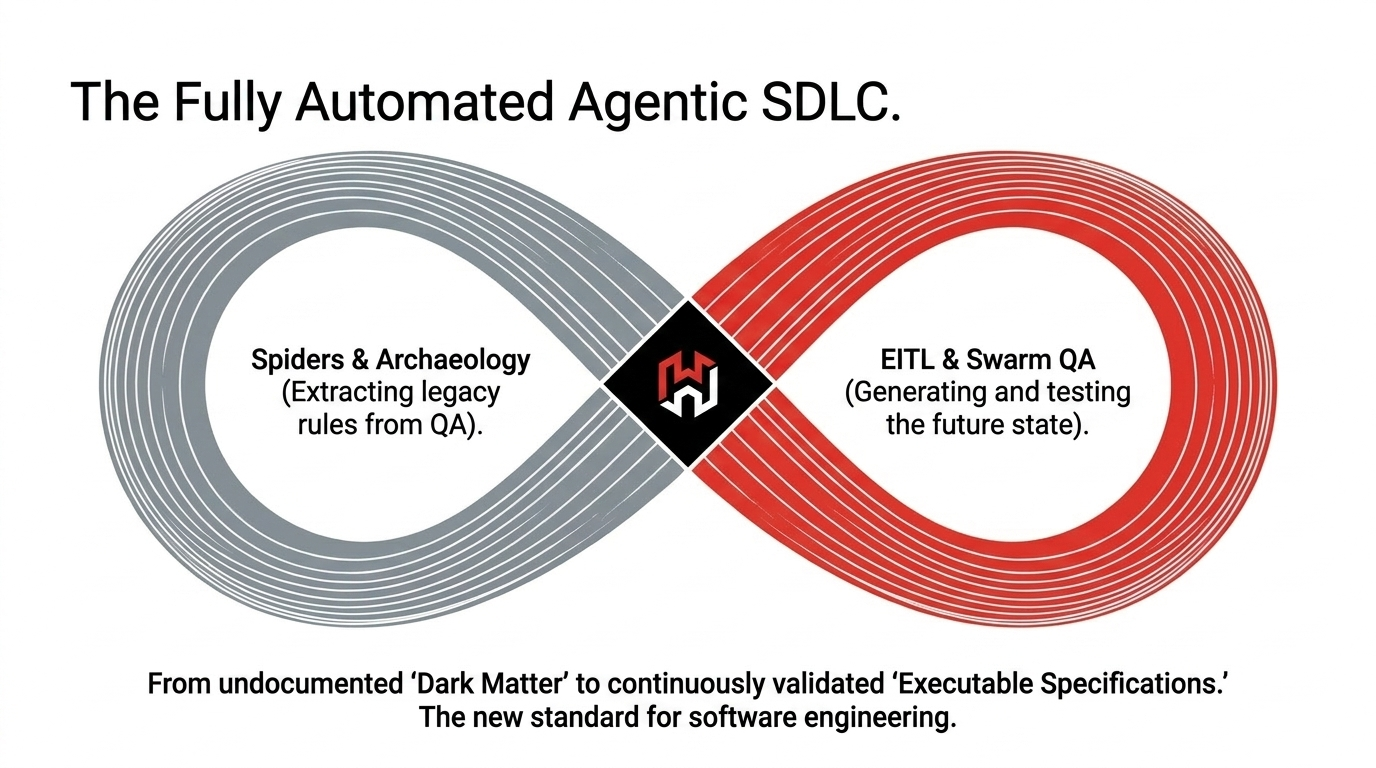
The final infinity-loop diagram captures the architecture well: one side extracts the past, the other generates and validates the future. The center is not a language model. The center is the continuous relationship between discovered behavior and executable evidence.
The production-ready system combines:
- Deterministic foundation — versioned source, reproducible builds, stable toolchains, and isolated execution.
- Testing layer — crawlers, generated scenarios, Playwright or equivalent runners, and evidence-rich defect reporting.
- Agent layer — specialized discovery, modification, execution, testing, and supervisory agents coordinated through shared state.
- Security and governance — RBAC, PII handling, egress restrictions, policy checks, and approval gates.
- Observability layer — execution logs, trace IDs, environment snapshots, artifacts, confidence signals, and repair history.
- Production outcome — continuously maintained executable specifications that remain linked to the behavior they are intended to preserve.
Closing Thought
The hardest part of autonomous software engineering is not generating code. It is establishing a feedback system that can distinguish a plausible change from a correct one.
When the environment becomes part of the loop, autonomy can be measured in evidence rather than confidence.