
Engineering Agentic Certainty: A QA Blueprint for Production-Ready AI Agents
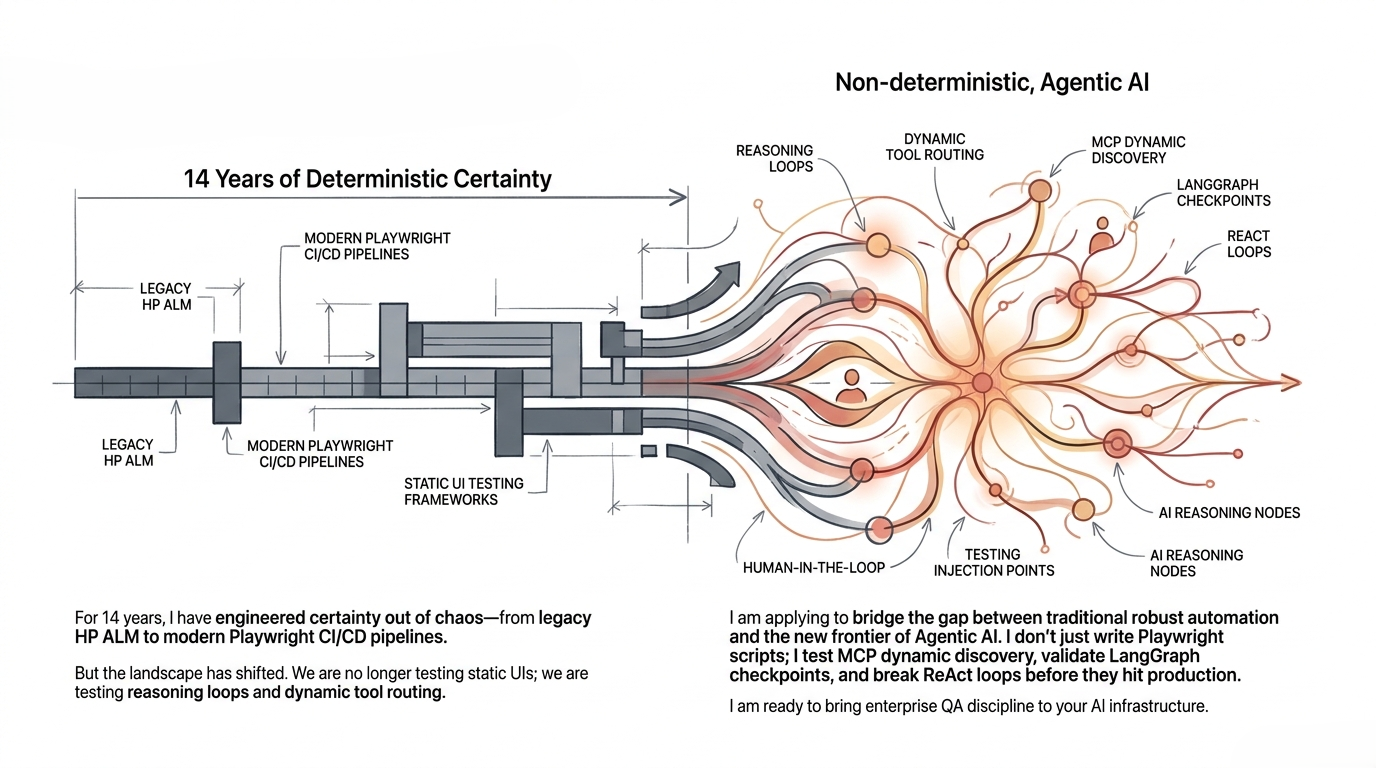
That work started in deterministic systems. Legacy HP ALM suites. Enterprise test automation. Selenium, Cypress, Playwright, Appium, TOSCA, Ranorex. CI/CD pipelines where an expected input should produce an expected result, and a failed assertion should tell you exactly what broke.
Agentic AI changes the shape of that problem.
The system is no longer only executing a predefined path. It can reason, route dynamically, discover tools, call external resources, persist state, delegate work to other agents, loop, recover, and choose different valid paths for the same user request.
That does not make QA less important.
It makes QA an infrastructure problem.
The central idea of this article is simple:
You cannot test non-deterministic AI without a disciplined deterministic foundation.
The goal is not to force an agent to behave like a script. The goal is to build enough control, instrumentation, checkpoints, guardrails, and semantic evaluation around the agent that its behavior can be trusted in production.
This is how I think about engineering that certainty.
1. Start With the Deterministic Foundation
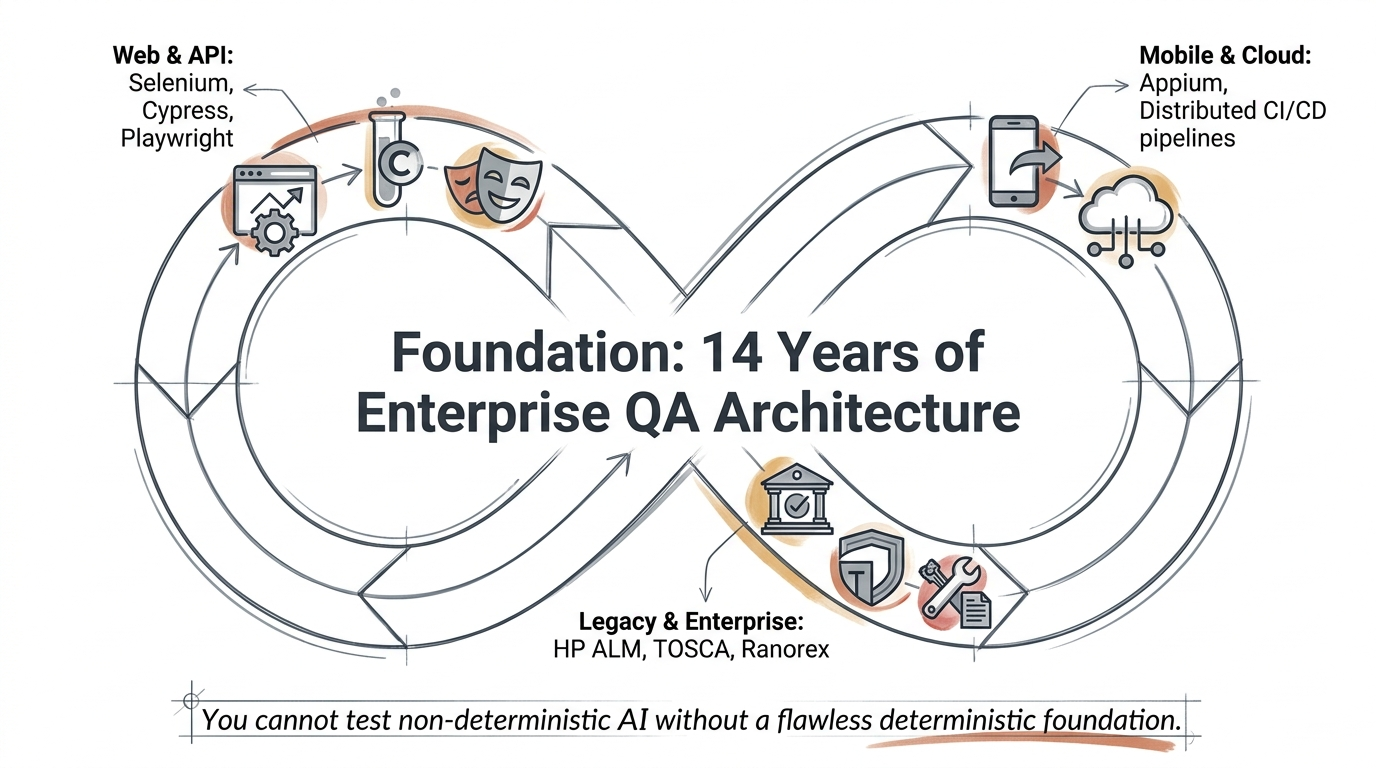
Agentic testing does not replace enterprise QA. It sits on top of it.
The foundation still includes the disciplines that made traditional automation reliable:
- Web and API: Selenium, Cypress, Playwright
- Mobile and cloud: Appium and distributed CI/CD pipelines
- Legacy and enterprise: HP ALM, TOSCA, Ranorex
- Release discipline: repeatable environments, controlled data, traceable failures, deterministic assertions
These systems teach an important habit: never accept "it usually works" as proof.
In deterministic automation, the test engineer controls the path. A browser element exists or it does not. An API returns the expected schema or it does not. A deployment gate passes or it does not.
Agentic systems require the same rigor, but the assertion surface moves.
Instead of validating only a static DOM or a fixed API response, we may need to validate:
- which tool an agent selected
- why a route was taken
- whether context survived a checkpoint
- whether delegation preserved the original intent
- whether a loop terminated safely
- whether the final answer is semantically acceptable even when the wording differs
The deterministic foundation gives us the machinery. Agentic QA changes what we point that machinery at.
2. The Shift: From Scripted Flow to Behavioral Validation
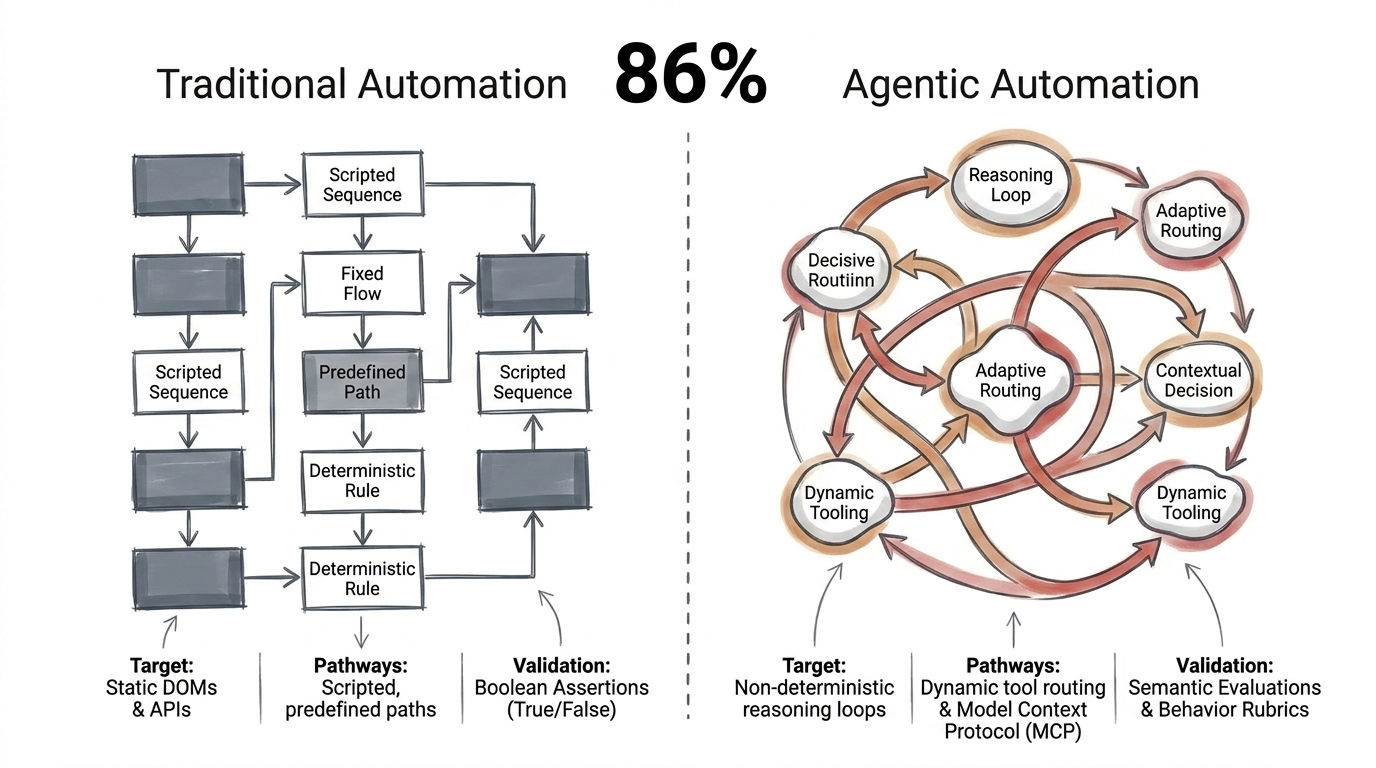
Traditional automation is path-oriented.
A test script usually follows something like:
- start from a known state
- execute a scripted sequence
- follow a predefined path
- apply deterministic rules
- assert true or false
That model works because the system under test is expected to behave predictably.
Agentic automation is different. The target is often a reasoning loop rather than a page or endpoint. The pathway can involve dynamic tool routing, contextual decisions, model calls, external resources, and multiple valid intermediate states.
The validation strategy therefore changes too.
A production-grade agent needs at least two layers of QA:
- Deterministic assertions for things that must be exact: schemas, permissions, checkpoints, tool contracts, state transitions, timeouts, approval gates
- Semantic evaluations for things that are allowed to vary: answer quality, reasoning behavior, relevance, task completion, policy adherence, contextual fidelity
This distinction matters.
If every AI behavior is reduced to a boolean string comparison, the test suite becomes brittle. If everything is handed to an LLM evaluator, the test suite becomes vague.
The engineering challenge is deciding which parts of the system must be exact and which parts must be evaluated behaviorally.
That boundary is where modern AI QA begins.
3. Test the Agent Topology, Not Just the Final Answer
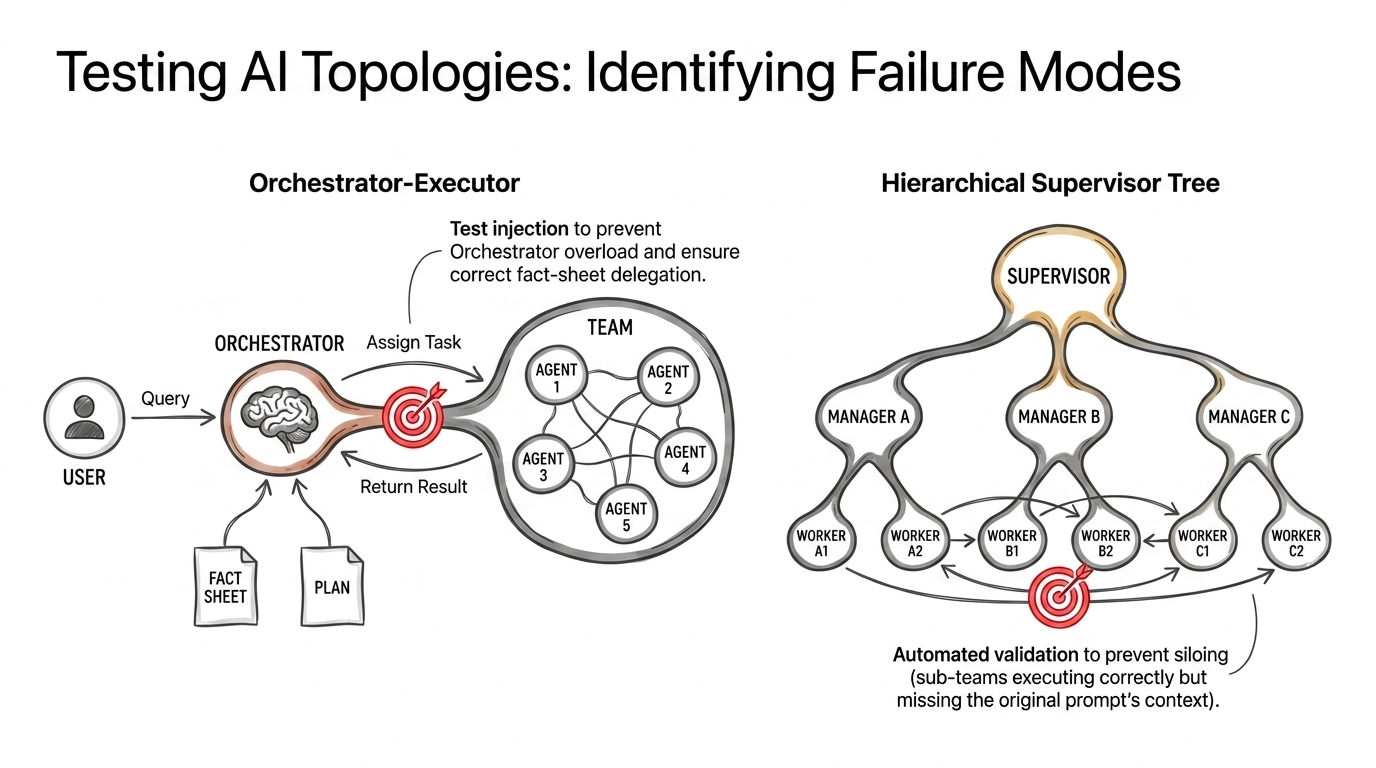
The topology of an agent system creates its own failure modes.
A single model with one tool behaves differently from an orchestrator managing a team. A hierarchical supervisor behaves differently from a conversational group of agents. The QA strategy must follow the architecture.
Orchestrator-executor systems
In an orchestrator-executor pattern, a central component receives the user request, builds or interprets a plan, and assigns work to a team of agents.
The obvious test is whether the final result is correct.
That is not enough.
You also need test injection points around orchestration behavior:
- Did the orchestrator assign the correct task?
- Did the worker receive the right fact sheet and plan?
- Was work delegated to the correct specialist?
- Did the orchestrator become overloaded or repeatedly re-plan the same task?
- Did the returned result preserve the original objective?
A multi-agent system can produce a plausible final answer while hiding a broken delegation path underneath it.
Hierarchical supervisor trees
A supervisor tree adds another class of risk: siloed correctness.
A manager can delegate to a worker correctly. The worker can complete its local task correctly. And the overall system can still fail because the sub-team drifted away from the original prompt.
That is why validation must cross hierarchy boundaries.
The test should ask not only, "Did Worker B2 do its job?" but also, "Did Worker B2's output still serve the user's original intent after passing through the supervisor and manager layers?"
In agentic QA, local correctness is not the same as system correctness.
4. Validate MCP as a Contract Boundary
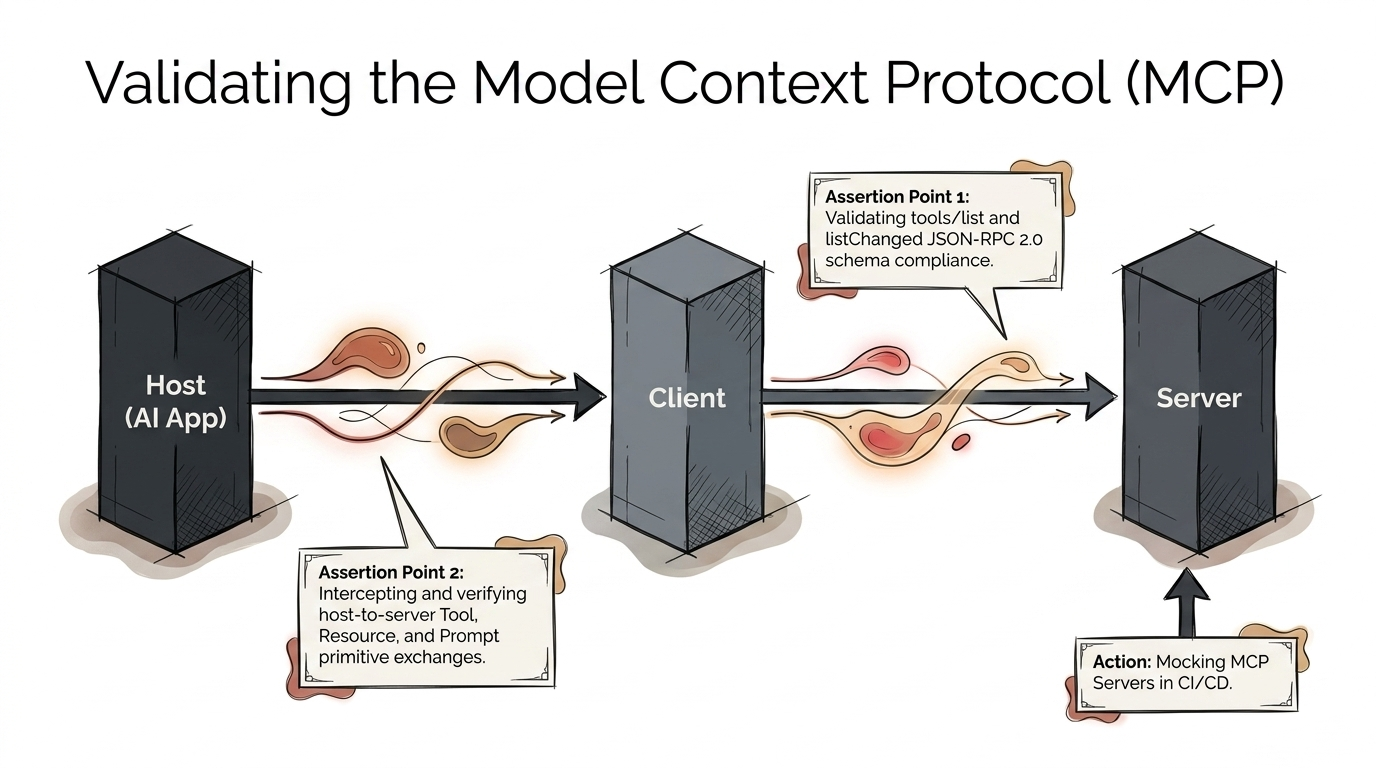
The Model Context Protocol (MCP) introduces a clean architectural boundary for tools, resources, and prompts. That boundary is also an excellent place to test.
The slide architecture suggests three practical layers of validation.
Assertion point 1: protocol and schema behavior
Validate discovery behavior such as tools/list and listChanged, including the expected JSON-RPC 2.0 structure.
This is deterministic territory.
A schema either conforms or it does not. A notification is emitted correctly or it is not. A malformed tool definition should fail before it becomes an agent reasoning problem.
Assertion point 2: host-to-server exchanges
Intercept and verify the messages moving between the host, client, and server.
That includes exchanges related to:
- tools
- resources
- prompts
This layer is useful because an agent may appear to make a bad decision when the real fault is a corrupted, missing, or incorrectly shaped capability description.
CI/CD action: mock MCP servers
A strong pipeline should not depend on every live integration being available during every test run.
Mocking MCP servers in CI/CD allows the test suite to inject controlled responses, malformed responses, slow responses, missing tools, permission failures, and version changes.
The principle is the same one enterprise QA has always used: make external uncertainty reproducible before production makes it expensive.
5. Dynamic Skill Registries Need Guardrails
Static automation knows its dependencies before it runs.
Agentic systems may discover capabilities at runtime.
That changes the risk model.
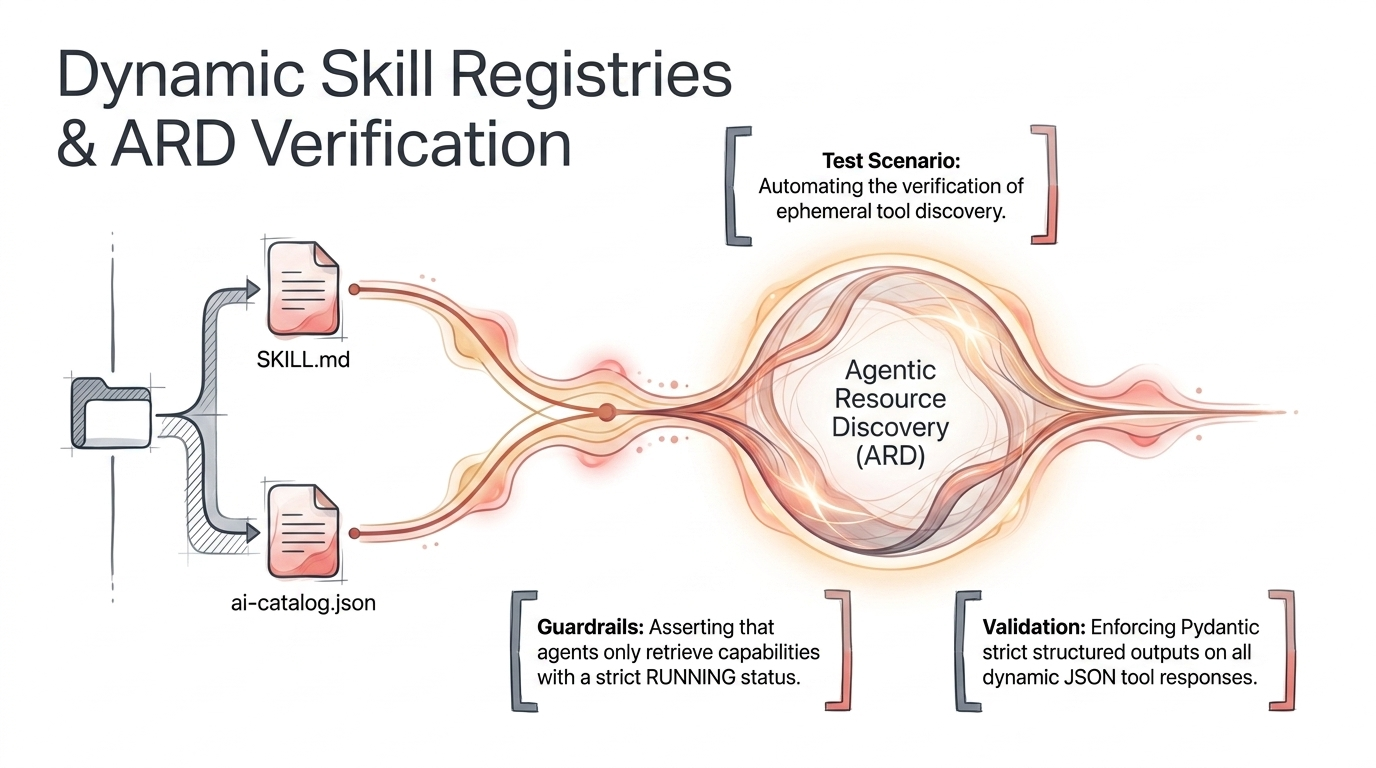
The architecture shown here uses artifacts such as SKILL.md and ai-catalog.json to feed an Agentic Resource Discovery (ARD) layer. The testing target is not only the skill itself. It is the discovery process.
A test suite for dynamic skill registries should cover three things.
1. Discovery correctness
Can the agent find the right capability when it becomes available?
Can it avoid stale or irrelevant capabilities?
Can it handle a registry changing during execution?
2. Registry guardrails
The proposed guardrail is explicit: agents should only retrieve capabilities with a strict RUNNING status.
That should be an assertion, not a convention.
If a skill is disabled, degraded, staging-only, or otherwise unavailable, the agent must not improvise its way into using it.
3. Structured tool outputs
Dynamic JSON tool responses need schema enforcement.
The slide proposes strict structured validation with Pydantic. The broader QA principle is that dynamically discovered tools must still return machine-verifiable outputs before those outputs are trusted by the next reasoning step.
Dynamic discovery should increase capability, not reduce control.
6. Every Orchestration Framework Has a Different QA Surface
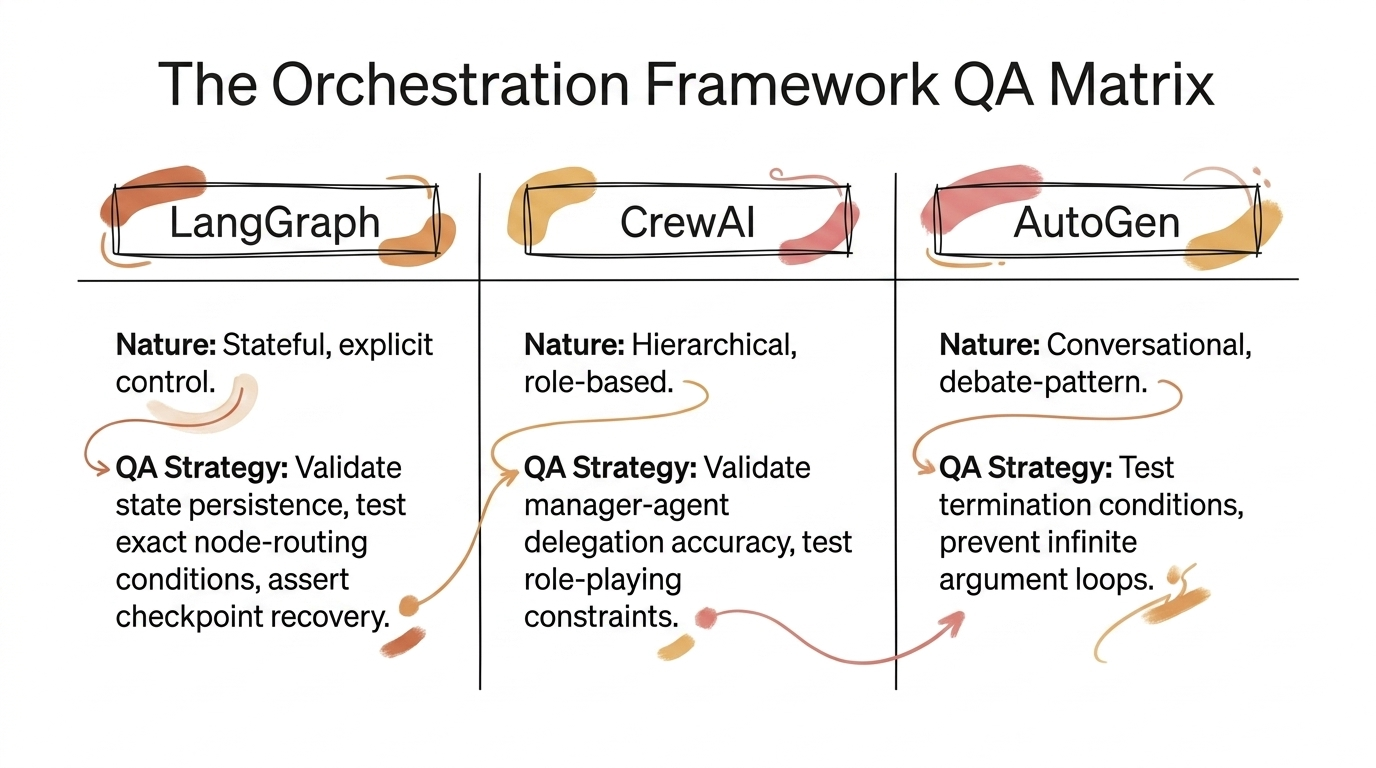
There is no universal "agent framework test."
The framework's control model determines what can fail.
LangGraph: stateful, explicit control
For a stateful graph, test the graph as a state machine.
Focus on:
- state persistence
- exact node-routing conditions
- checkpoint creation
- checkpoint recovery
- resume behavior after interruption
The most dangerous defect is often not a bad model response. It is the system resuming from the wrong state or taking the wrong edge after recovery.
CrewAI: hierarchical, role-based
For hierarchical role-based orchestration, the main QA surface is delegation.
Validate:
- manager-to-agent assignment accuracy
- whether a task reaches the right role
- whether agents respect role boundaries
- whether role-playing constraints survive multi-step execution
A worker that produces a useful answer outside its assigned role can still represent a governance failure.
AutoGen: conversational, debate-pattern
Conversational agent systems create a different problem: termination.
Test:
- stop conditions
- maximum turns
- repeated arguments
- circular handoffs
- failure to converge
A multi-agent debate can look intelligent while consuming time, tokens, and money without moving closer to a result.
Different frameworks need different assertions because their failure modes are structural.
7. Break the Reasoning Loop Before It Breaks Production
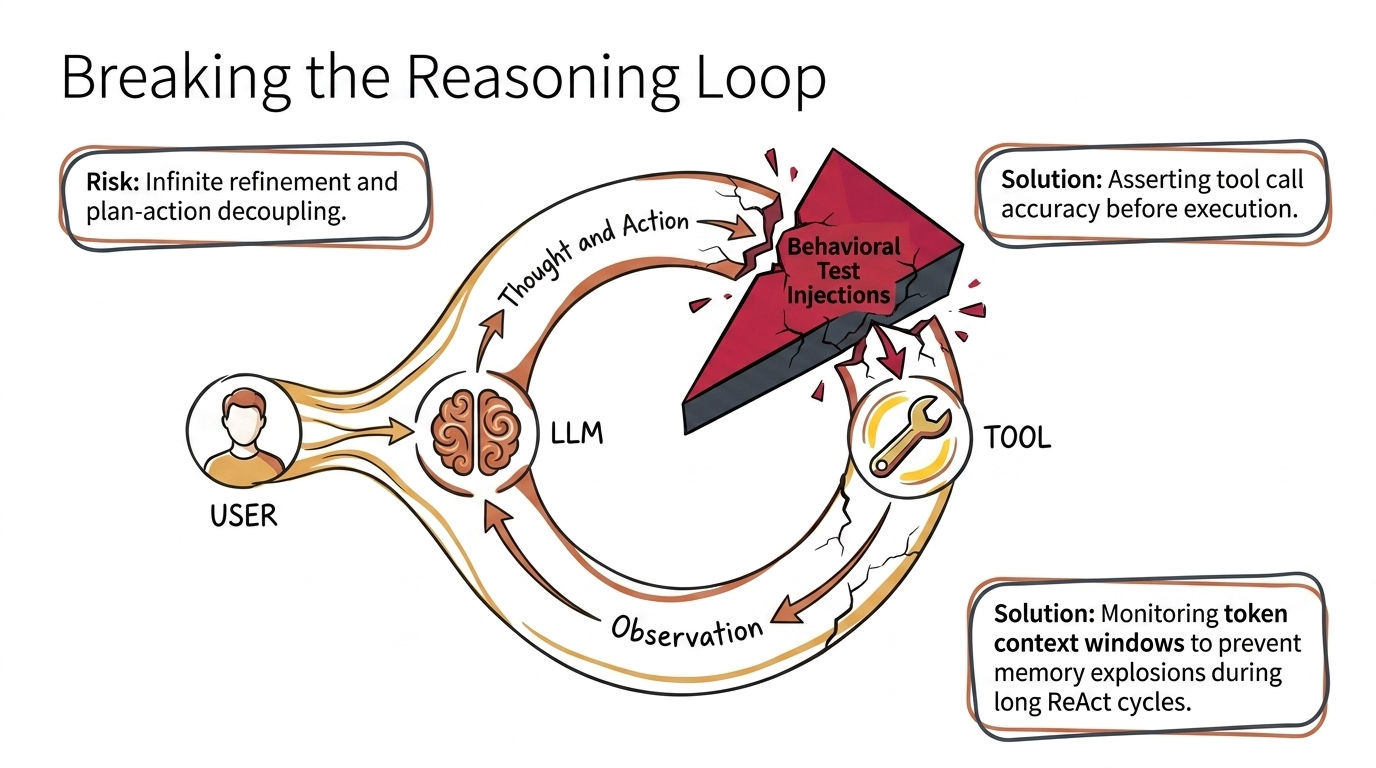
ReAct-style systems alternate between thought, action, tool use, and observation.
That loop is powerful because it allows an agent to react to what it discovers.
It is also a production risk.
Two failure modes deserve explicit tests.
Risk 1: plan-action decoupling
The model can continue refining a plan while the actual tool calls drift away from that plan.
A useful injection point is before execution.
Validate tool-call accuracy before the tool is allowed to run:
- Is this the intended tool?
- Are the arguments structurally valid?
- Does the call still match the current plan?
- Is the operation permitted in the current context?
This turns a reasoning trace into an enforceable control point.
Risk 2: infinite refinement
An agent can keep observing, reconsidering, and acting without converging.
The test suite should monitor:
- iteration count
- repeated tool calls
- repeated semantic states
- token growth
- context-window pressure
- elapsed time
A production agent needs a stopping policy just as much as it needs a reasoning policy.
The most expensive loop is the one that technically never throws an exception.
8. Combine Playwright With LLM Evaluators
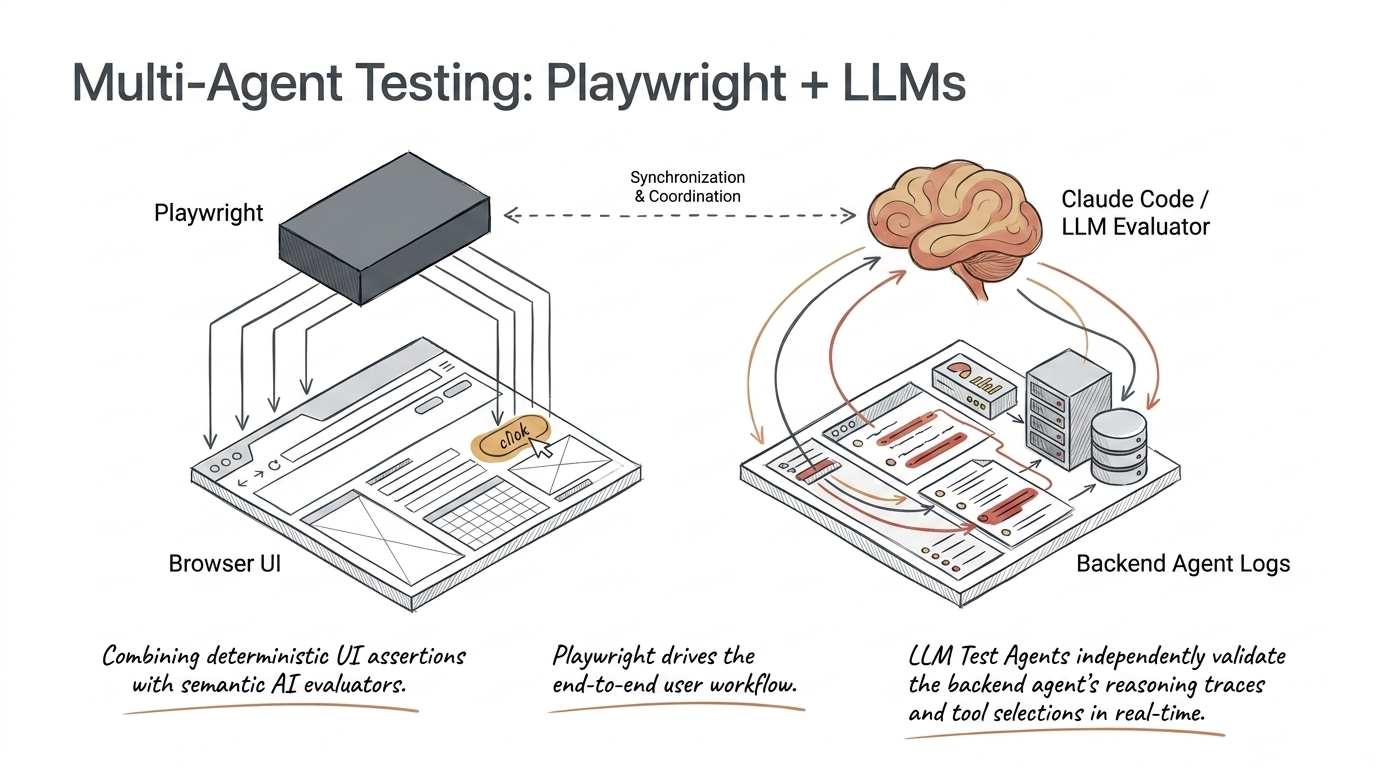
One of the most practical architectures is a hybrid test system.
Let Playwright drive the deterministic end-to-end workflow through the browser. At the same time, let an LLM-based evaluator inspect the agent behavior behind the interface.
That creates two synchronized views of the same user journey.
Frontend view
Playwright verifies things such as:
- the user can complete the workflow
- the expected controls appear
- browser state changes correctly
- forms and navigation behave as expected
- deterministic UI assertions pass
Backend agent view
An independent evaluator inspects:
- reasoning traces
- selected tools
- routing decisions
- backend agent logs
- whether the agent's behavior remains aligned with the user request
The value is not that an LLM replaces Playwright.
The value is that deterministic UI evidence and semantic agent evidence can be correlated in the same test run.
A browser can tell you that the final screen looks correct.
An evaluator can tell you that the system arrived there through an unsafe or nonsensical path.
Production confidence requires both.
9. State, Memory, and Context Must Be Testable Assets
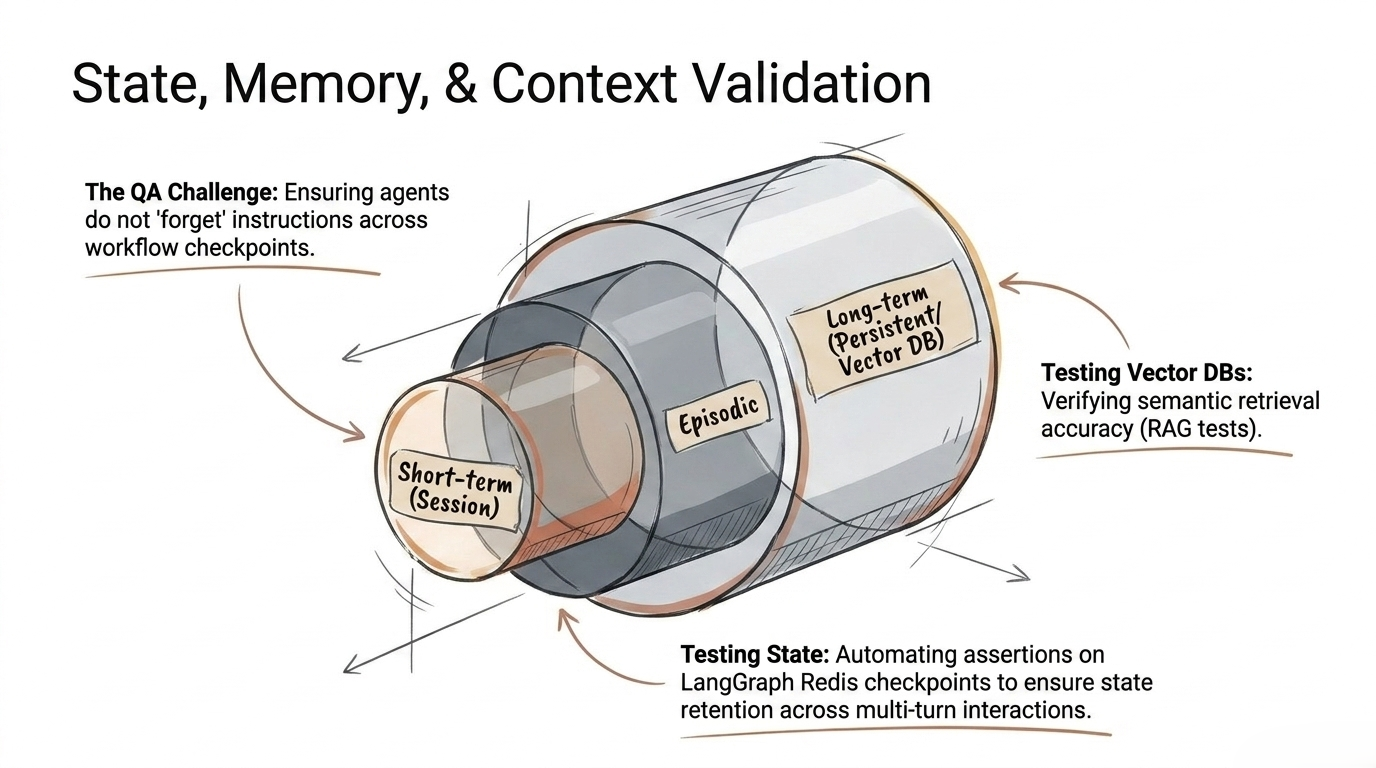
An agent that forgets is not merely inconvenient. It can become incorrect, unsafe, or inconsistent.
The memory architecture in the slide separates context into layers:
- short-term / session memory
- episodic memory
- long-term persistent memory / vector database
Each layer needs its own tests.
Short-term state
The immediate challenge is instruction retention.
If a user establishes a constraint early in a multi-turn workflow, does the agent still honor it after several tool calls and checkpoints?
Checkpointed state
For graph-based systems, checkpoints need direct assertions.
The slide specifically proposes testing LangGraph Redis checkpoints to ensure state retention across multi-turn interactions.
Useful cases include:
- pause and resume
- crash and recover
- restart from checkpoint
- retry a failed node
- verify no duplicate side effects occur after recovery
Long-term retrieval
Vector databases introduce a semantic retrieval problem.
A RAG test should ask whether the right memory was retrieved, not merely whether some memory was returned.
That means measuring retrieval relevance, context contamination, stale memory, and whether persistent memory incorrectly overrides the user's current instruction.
Memory must be observable, resettable, reproducible, and testable.
If it cannot be inspected, it cannot be trusted.
10. Human-in-the-Loop Must Be an Enforced Gate
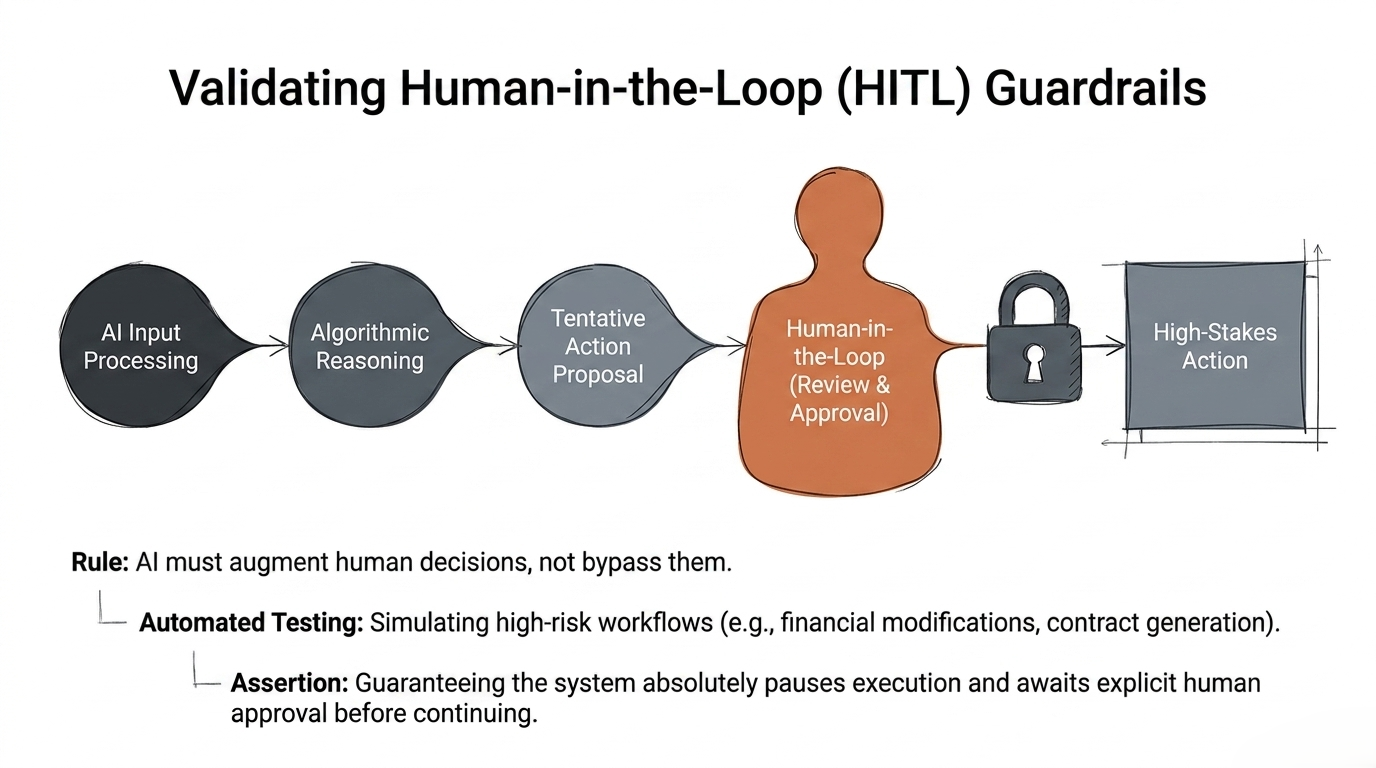
Human-in-the-loop (HITL) is often described as a product feature.
For high-stakes workflows, it should be treated as a control boundary.
The rule in the slide is clear:
AI must augment human decisions, not bypass them.
The test case is not simply whether an approval button exists.
The assertion is stronger:
The system must absolutely pause execution and wait for explicit human approval before continuing.
That means testing negative paths as aggressively as the happy path.
Simulate workflows involving high-risk actions such as financial modifications or contract generation, then verify:
- the tentative action is created but not executed
- the system enters an approval-required state
- no downstream tool can bypass that state
- timeouts do not silently convert into approval
- retries do not duplicate the pending action
- rejection terminates or safely reroutes the workflow
A human checkpoint that can be skipped under pressure is not a guardrail.
It is decoration.
11. Security Testing Means Least Privilege Plus Injection Resistance
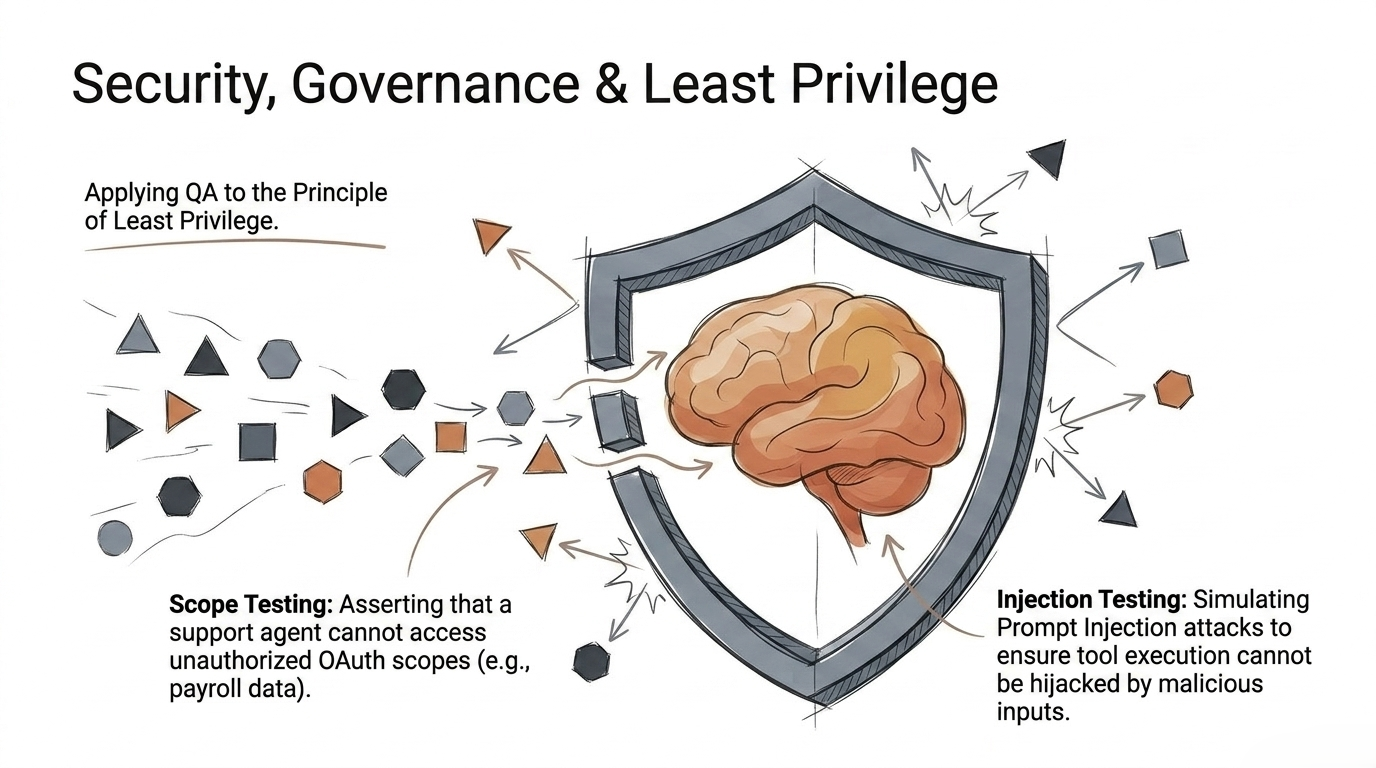
Agentic systems connect language models to real capabilities.
That makes authorization part of QA.
The principle is least privilege: an agent should only have the access required for the current task.
Scope testing
The example in the slide is an OAuth boundary.
A support agent should not be able to access an unauthorized payroll scope just because the user asks persuasively or a tool happens to expose it.
Test scope boundaries directly:
- allowed scope
- denied scope
- expired credentials
- privilege changes during execution
- cross-agent credential leakage
Prompt-injection testing
Tool use creates another attack surface.
A malicious input can attempt to redirect the agent away from its intended task and toward an unauthorized action.
Injection testing should verify that tool execution cannot be hijacked by untrusted instructions embedded in user input, retrieved content, or tool responses.
The key principle is separation of concerns:
language can suggest an action; authorization must independently decide whether that action is allowed.
A model should never be the final security boundary for its own tool access.
12. Test the Telemetry, Not Just the Agent
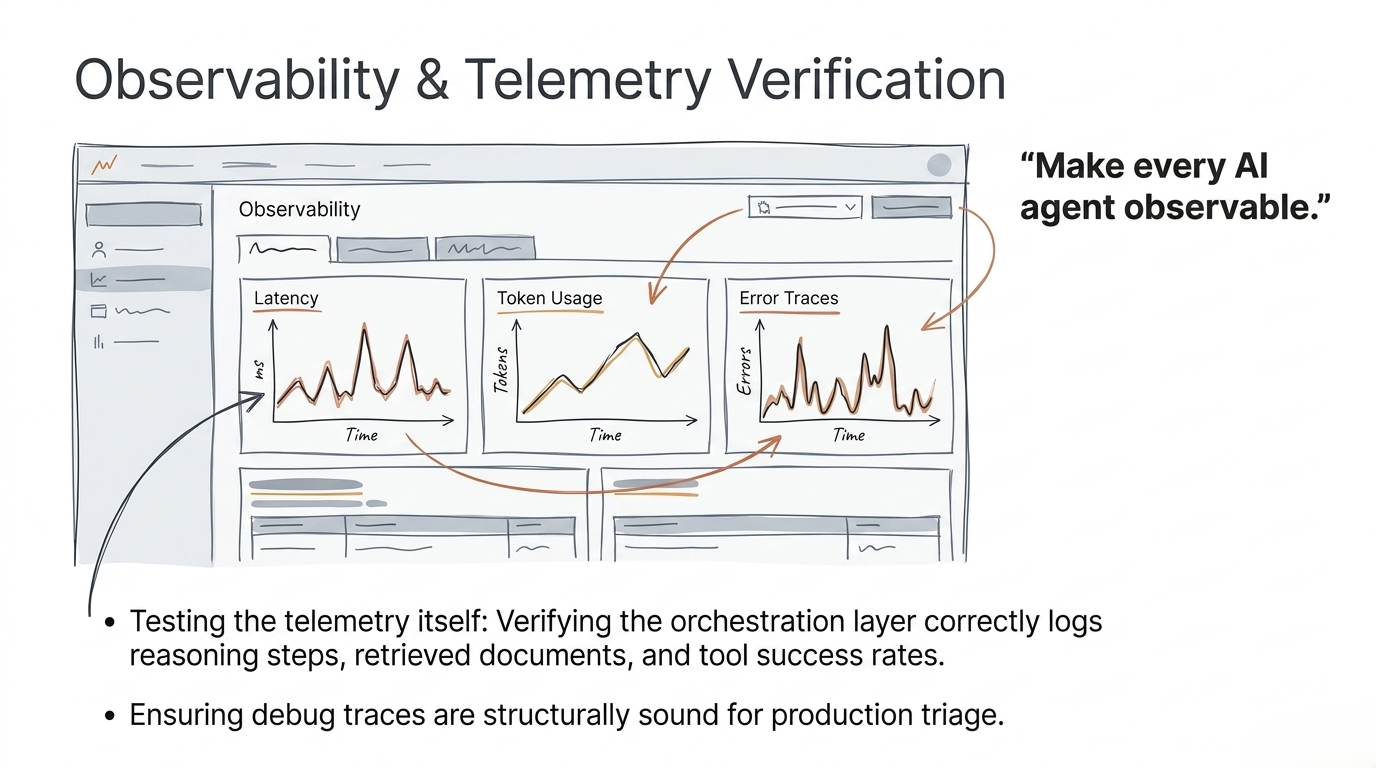
When an agent fails in production, the worst possible outcome is: "We cannot tell why."
Every agent should be observable.
The telemetry layer should capture enough evidence to reconstruct the run, including the kinds of signals shown in the slide:
- latency
- token usage
- error traces
- reasoning steps or structured reasoning events
- retrieved documents
- tool success and failure rates
But observability itself can fail.
That is why the telemetry pipeline needs QA too.
Verify that:
- expected events are emitted
- event order is structurally sound
- identifiers correlate across model, tool, and workflow spans
- errors are not swallowed
- sensitive values are not leaked into logs
- production debug traces contain enough context for triage
A dashboard is not evidence of observability.
A reproducible trace from user request to model decision to tool call to final outcome is.
13. Build the Production-Ready AI Pipeline
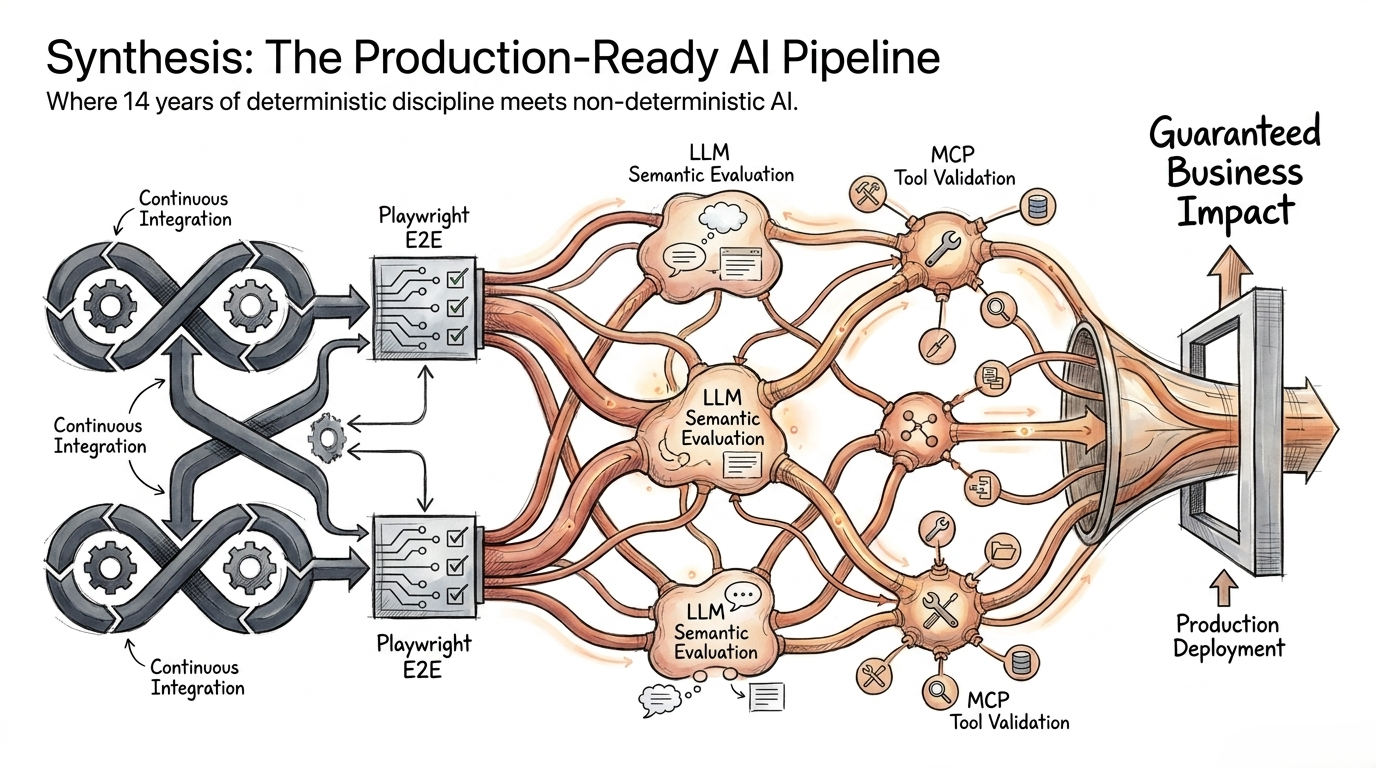
The production architecture is not "LLM plus prompt."
It is a layered pipeline where traditional QA and agentic evaluation reinforce each other.
The synthesis in the slide combines:
- Continuous integration
- Playwright end-to-end testing
- LLM semantic evaluation
- MCP tool validation
- production deployment gates
- business-impact validation
The important idea is not the exact drawing.
It is the direction of control.
Deterministic tests verify what must never vary. Semantic evaluators inspect the behavior that is expected to vary. MCP checks verify the tool boundary. Observability connects the evidence. CI/CD turns all of it into a repeatable release decision.
This is how agentic AI stops being a demo and starts becoming infrastructure.
A practical release gate
Before an agentic system reaches production, I would want evidence across all of these layers:
- [ ] deterministic UI and API checks pass
- [ ] routing and delegation behavior has been exercised
- [ ] reasoning loops have hard termination controls
- [ ] MCP schemas and exchanges are validated
- [ ] dynamic tool discovery is constrained by registry state
- [ ] tool outputs pass strict structured validation
- [ ] checkpoint recovery preserves state correctly
- [ ] long-term retrieval returns relevant context
- [ ] HITL approval gates cannot be bypassed
- [ ] OAuth and tool scopes enforce least privilege
- [ ] prompt-injection cases cannot hijack execution
- [ ] telemetry can reconstruct failures end to end
- [ ] semantic evaluations meet defined behavior rubrics
That checklist is not about eliminating non-determinism.
It is about containing it inside an engineered system.
14. What Changes for QA Engineers
The role of QA does not disappear when software starts reasoning.
It expands.
The next generation of QA architecture needs people who can move between two worlds:
- deterministic automation and probabilistic behavior
- test scripts and orchestration graphs
- browser assertions and semantic rubrics
- API schemas and tool discovery
- checkpoint recovery and memory validation
- security scopes and prompt injection
- telemetry and model behavior
The job is no longer only to ask, "Did the feature work?"
The questions become:
- Did the agent choose an acceptable path?
- Did it stay inside its authority?
- Did it preserve context?
- Did it know when to stop?
- Did it ask for a human when the risk required one?
- Can we explain what happened after the fact?
- Can we reproduce the failure in CI?
That is an architecture discipline, not a prompt-engineering trick.
Final Synthesis
For years, enterprise QA engineered certainty by constraining systems around known inputs, known pathways, and known assertions.
Agentic AI removes some of that predictability, but it does not remove the need for evidence.
The production-ready pattern is a hybrid:
-
Deterministic control
Schemas, permissions, checkpoints, tool contracts, approval gates, timeouts, CI/CD -
Behavioral validation
Semantic evaluation, routing quality, context retention, delegation accuracy, reasoning-loop health -
Operational observability
Traces, latency, token usage, retrieved context, tool outcomes, failure reconstruction -
Governance by design
Least privilege, human approvals, strict capability discovery, injection resistance
The future of AI quality is not about pretending an agent will always take the same path.
It is about engineering a system where different paths still remain safe, testable, observable, recoverable, and accountable.
Closing Line
Do not ship an agent because the demo was impressive.
Ship it when the architecture can explain its decisions, constrain its tools, preserve its state, stop its loops, respect its humans, and prove what happened in production.
Let's design AI infrastructure, not AI demos.