
Designing AI Infrastructure, Not Demos
The 2026 agentic enterprise requires a different architectural standard.
Building an impressive AI demo is relatively easy. Building an agentic system that can survive production traffic, changing business rules, security reviews, operational failures, upgrades, and real financial consequences is much harder.
The core engineering challenge is no longer simply choosing a capable language model. It is designing an ecosystem in which intelligence is composable, controlled, observable, secure, and connected to deterministic infrastructure.
The architectural shift is straightforward: move away from monolithic assistants that try to understand and execute everything, and toward specialized agents operating inside a governed production system.
1. Divide Responsibilities
Specialized agents reduce complexity by narrowing responsibility.
Instead of building one oversized assistant that simultaneously understands finance, operations, support, sales, and customer systems, divide the environment into bounded capabilities. Each agent can then operate against a smaller domain, clearer interfaces, and more focused operational expectations.
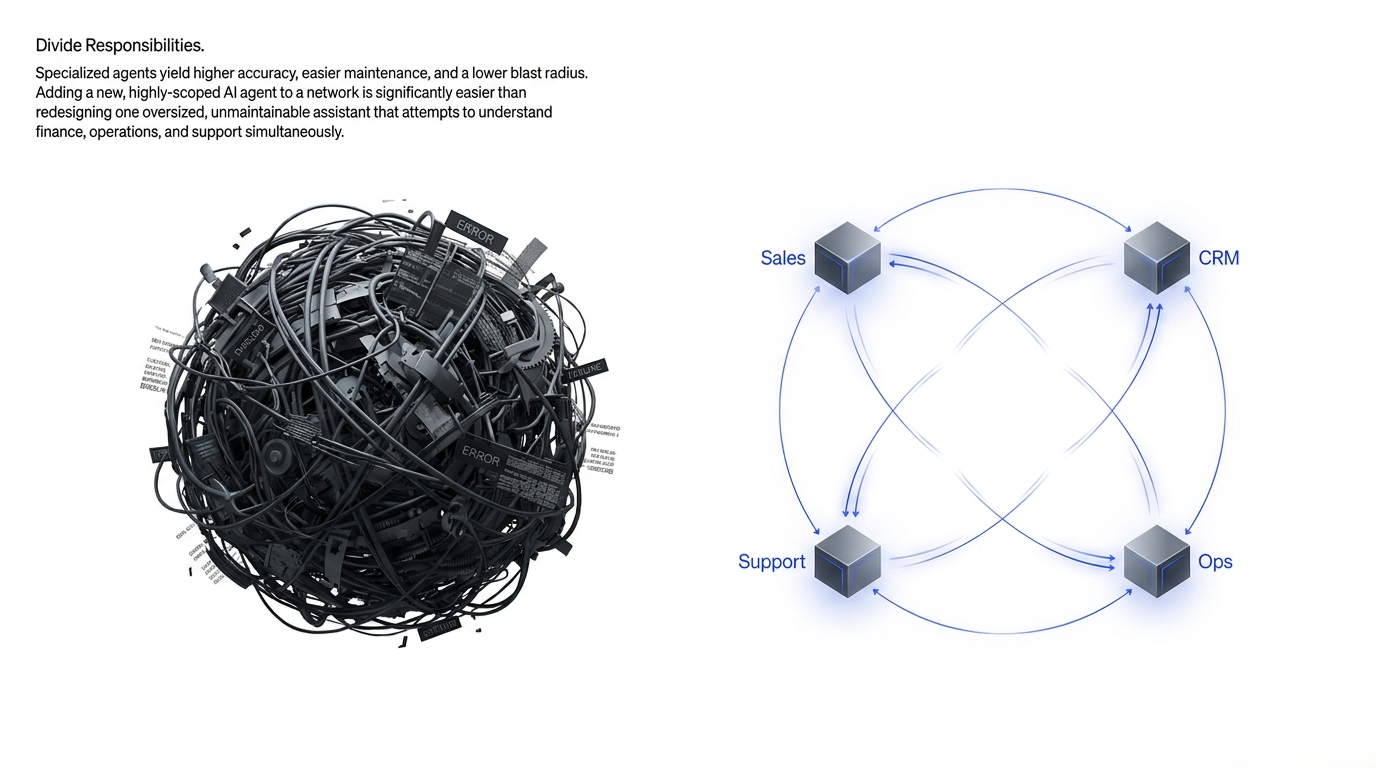
This structure improves accuracy, maintainability, and fault isolation. A failure in one capability should not require redesigning the entire system.
A network of focused agents also makes architectural evolution easier. New capabilities can be introduced as separate components rather than forcing a central intelligence layer to continuously absorb new prompts, policies, schemas, and tools.
The result is a lower blast radius and a system that can evolve incrementally.
2. Build a Centralized Intelligence Core
Specialization does not mean every agent should maintain its own disconnected interpretation of organizational knowledge.
Agents require a unified grounding layer that gives them access to trusted context.
A hybrid retrieval mechanism can combine structured graph queries with semantic search over unstructured information. The graph layer supports skill matching, relationships, and explicit business entities. Semantic retrieval supports documents, descriptions, historical content, and less structured knowledge.
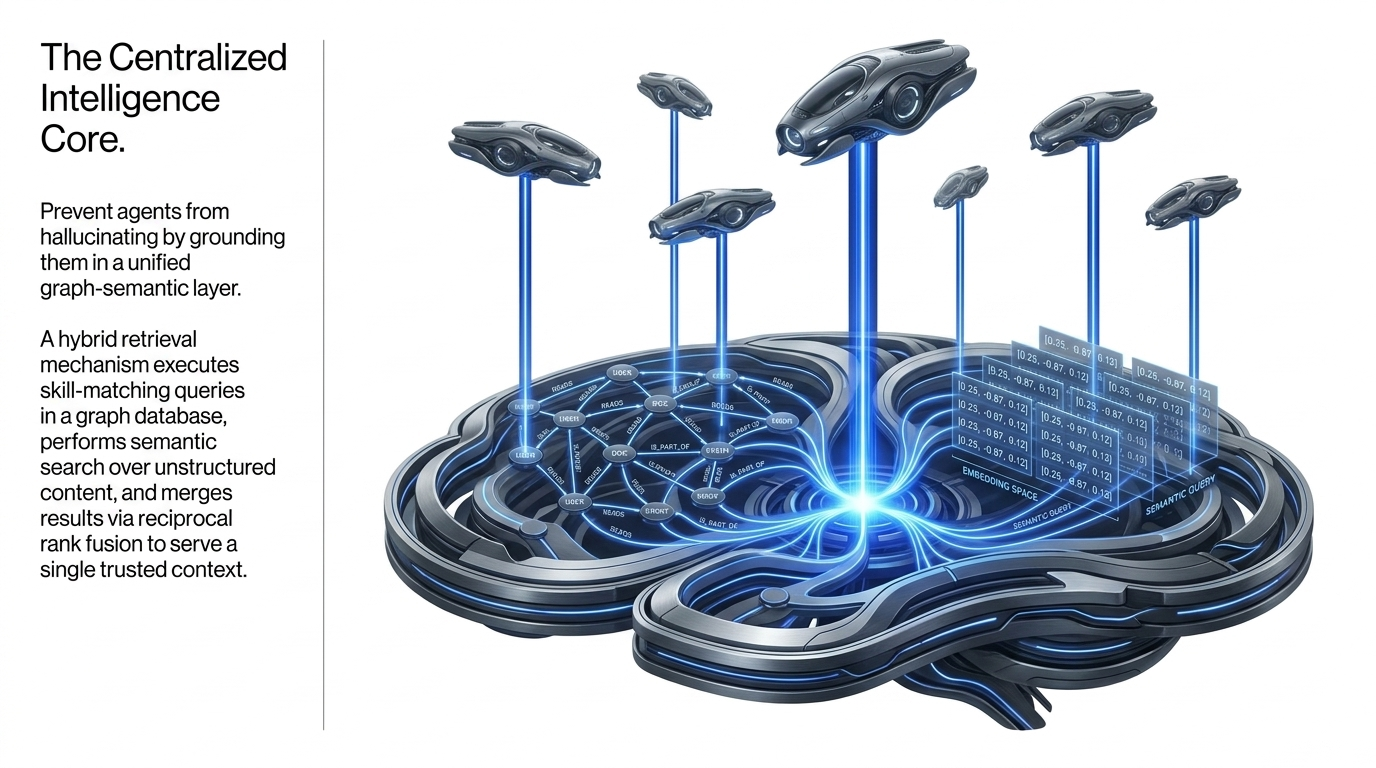
The outputs can then be merged into a single ranked context before being passed to an agent.
This creates a shared semantic foundation while keeping individual agents specialized.
The important distinction is that the centralized component is not necessarily a single agent controlling everything. It is a common intelligence and retrieval substrate that improves consistency across the broader system.
3. Maintain a Strict Boundary Between Thinking and Doing
One of the most important production boundaries is the separation between reasoning and execution.
The reasoning layer should interpret objectives, evaluate rules, plan actions, and decide what should happen.
The tool layer should perform deterministic operations.
Key considerations include:
- Reasoning can be probabilistic; execution should be predictable.
- Business APIs should expose explicit schemas, constraints, and failure modes.
- Agents should invoke tools rather than embed operational logic directly inside prompts.
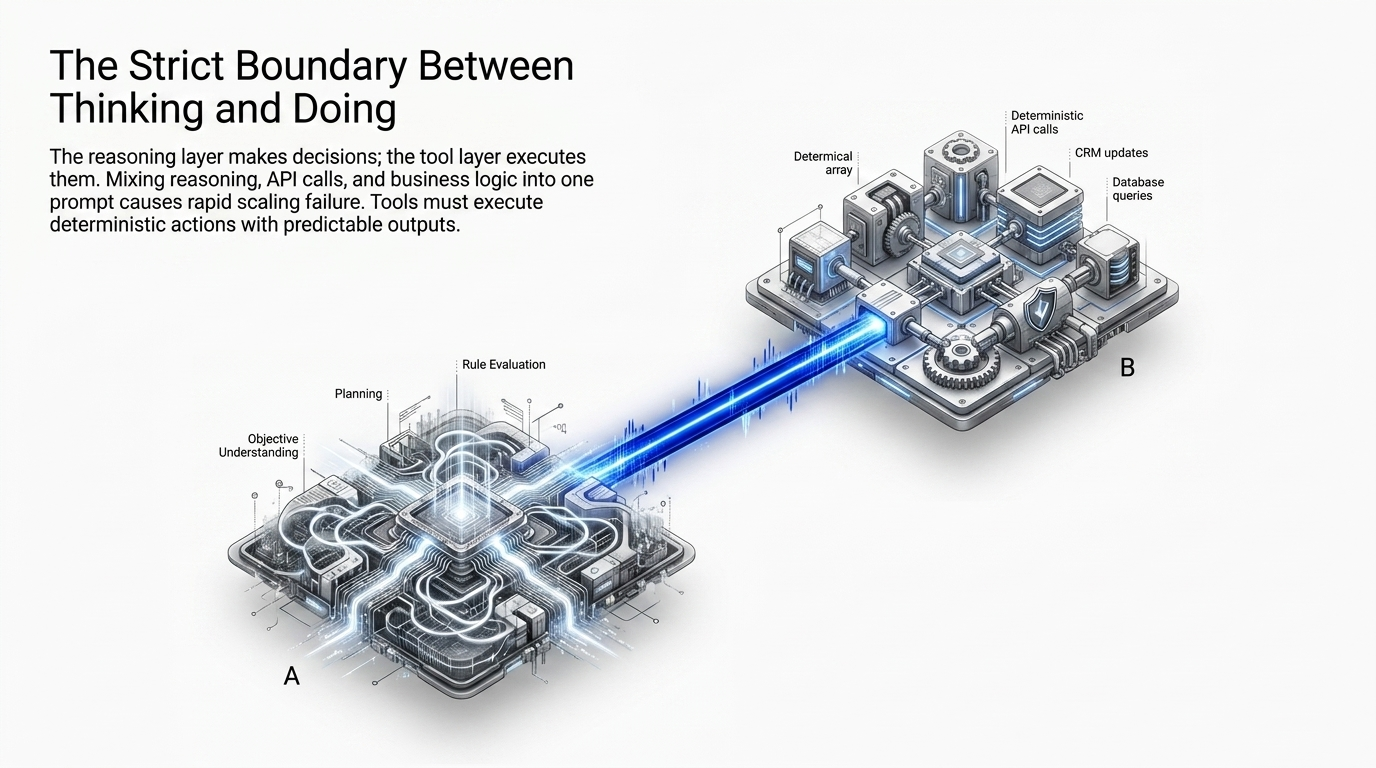
Mixing reasoning, API calls, database behavior, and business logic into one opaque prompt may work during experimentation, but it creates serious production risks.
Deterministic tool boundaries make actions testable, auditable, retryable, and governable.
An agent can decide that a CRM record should be updated. The CRM tool should define exactly how that update occurs.
4. Use Manifest-Driven Contracts
Capabilities should be packaged as discrete, self-describing units.
A skill should explain what it is, when it can be activated, which inputs it accepts, which outputs it produces, and how execution occurs.
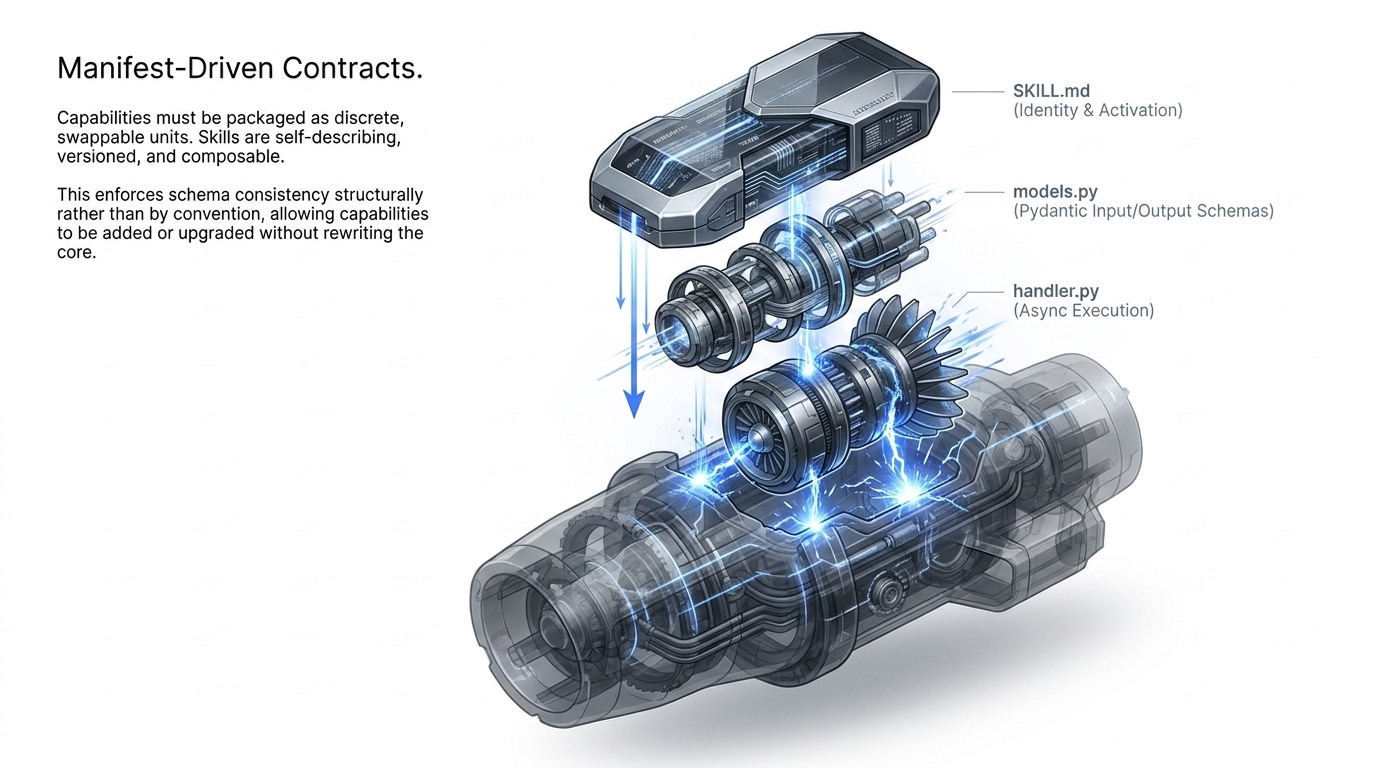
A practical capability package may separate these concerns into components such as:
SKILL.mdfor identity, capability description, and activation.models.pyfor structured input and output schemas.handler.pyfor deterministic or asynchronous execution.
This structure enforces consistency through contracts instead of convention.
It also allows capabilities to be versioned, upgraded, replaced, and composed without forcing changes across the entire agent platform.
The major failure mode to avoid is an ecosystem of loosely defined tools whose semantics exist only in prompts or developer memory.
Validation should confirm schema compatibility, contract versioning, permission requirements, execution behavior, and backward compatibility.
5. Discover Tools Dynamically
Loading every available tool into every model interaction is inefficient.
Large tool catalogs consume context tokens, increase ambiguity, and can reduce tool-selection quality.
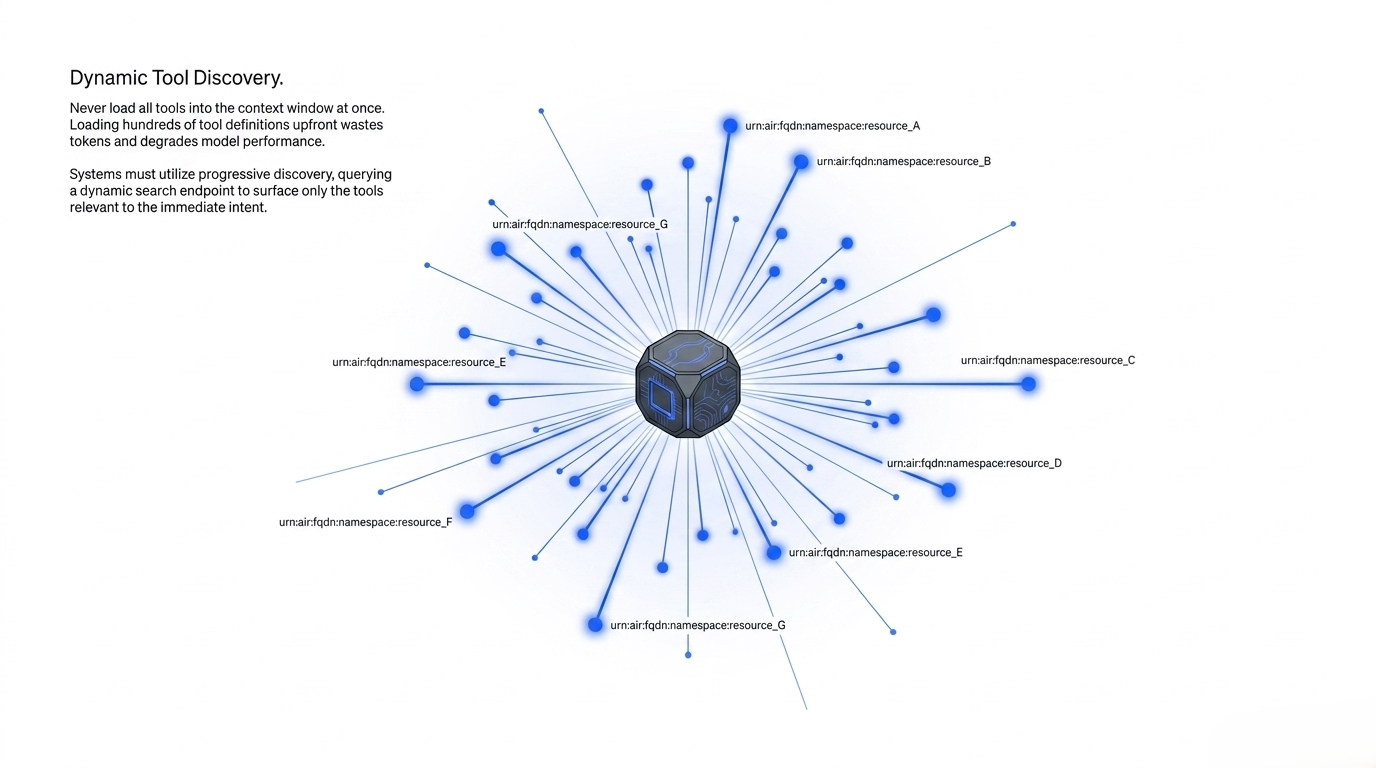
A better architecture uses progressive discovery.
The agent begins with intent and retrieves only the capabilities relevant to the immediate task. A dynamic search layer can resolve capability identifiers, metadata, namespaces, or semantic descriptions before presenting a small candidate set to the reasoning model.
This approach treats the tool registry as infrastructure rather than prompt content.
The system can support hundreds or thousands of capabilities without requiring every interaction to carry every tool definition.
6. Manage State Transitions Safely
Production infrastructure needs lifecycle scaffolding.
Capabilities will be installed, activated, upgraded, migrated, disabled, and removed. Those transitions must be explicit.
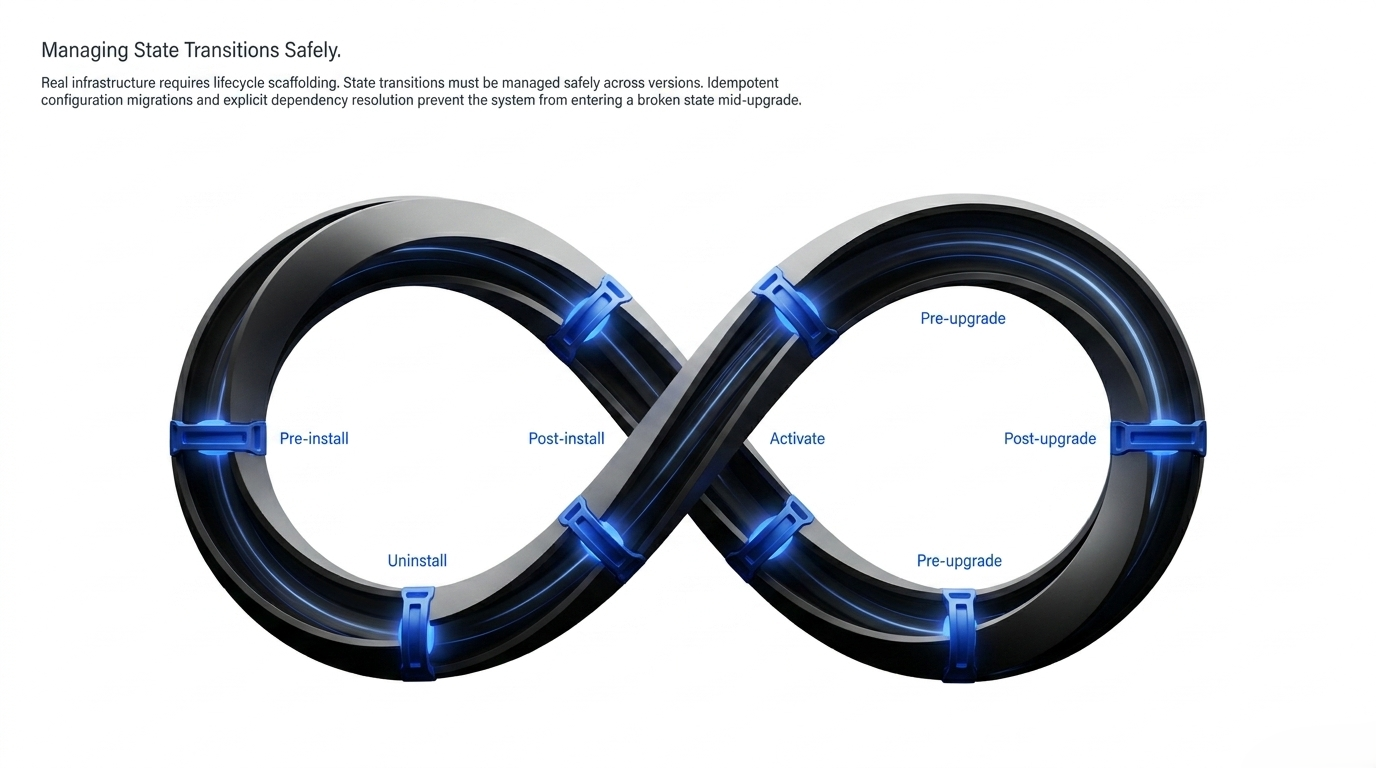
Lifecycle operations should be idempotent whenever possible. Repeating an installation, activation, or migration step should not leave the environment in an inconsistent state.
Dependency resolution must also be explicit.
Before an upgrade, the system should understand which schemas, configurations, capabilities, credentials, or downstream services depend on the component being changed.
State management is not secondary operational work. It is part of the agent architecture itself.
7. Choose the Right Orchestration Topology
Different orchestration frameworks optimize for different workflow styles.
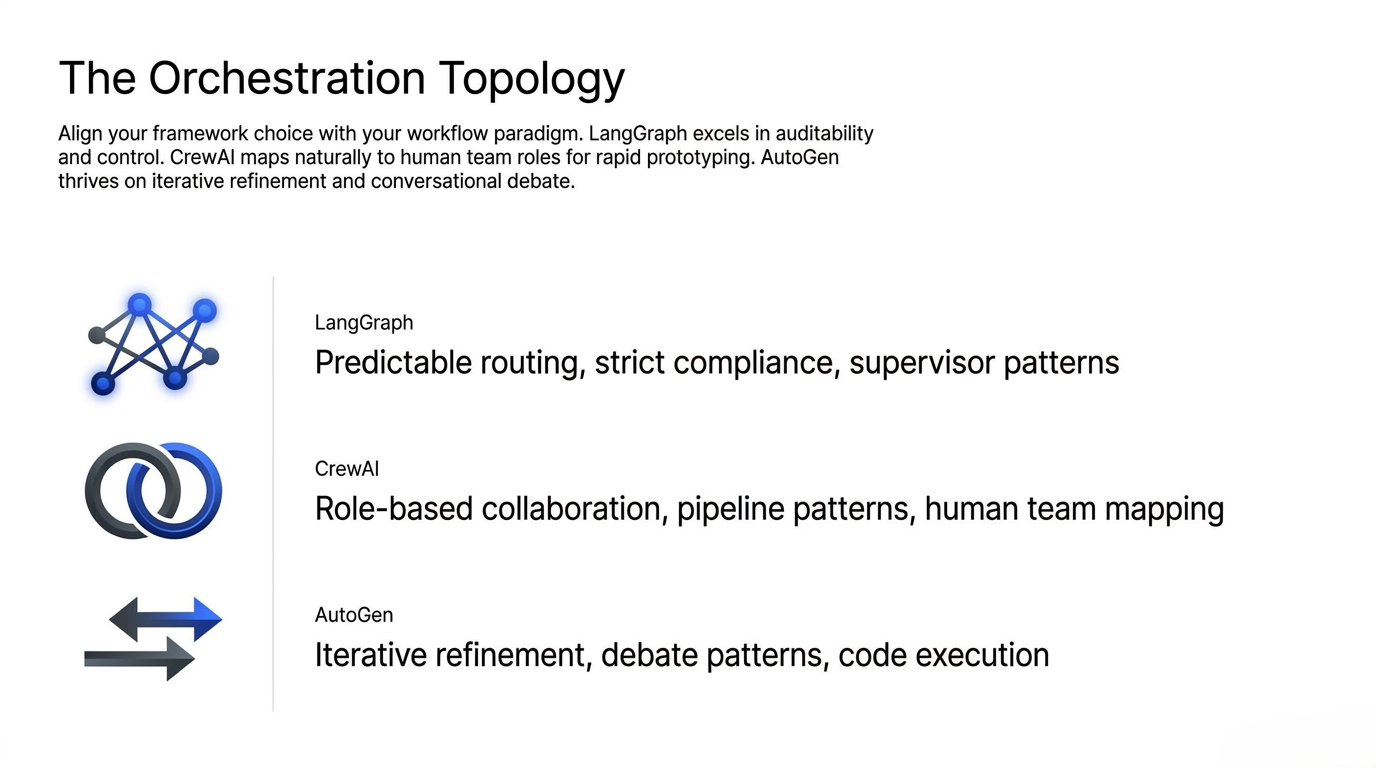
LangGraph is well suited to predictable routing, supervisor patterns, control, and auditable state transitions.
CrewAI maps naturally to role-oriented collaboration, pipeline-style coordination, and structures that resemble human teams.
AutoGen is oriented toward iterative interaction, debate, conversational refinement, and code-oriented execution patterns.
The important engineering decision is not selecting the framework with the largest feature list.
The framework should match the workflow topology.
If strict compliance and traceability dominate, predictable graph execution may be the priority. If agents mirror specialized organizational roles, role-driven collaboration may be more natural. If iterative reasoning is central to the task, conversational multi-agent patterns may fit better.
8. Prevent Token Exhaustion at Scale
Unchecked context accumulation destroys efficiency.
Appending the entire history of every previous input, output, observation, tool result, and intermediate reasoning artifact causes context to expand continuously.

At small scale, this may look harmless.
At production scale, it increases latency, token consumption, retrieval noise, and the probability that important information becomes buried inside irrelevant history.
Robust orchestration should selectively retain information that is relevant to the next decision.
This may include current goals, validated facts, active constraints, recent tool outputs, state variables, and compact summaries of previous work.
Context should behave like engineered state, not an endlessly growing transcript.
9. Align Autonomy With Risk
Autonomy should be determined by operational risk.
High-stakes actions require stronger approval and supervision than repetitive, low-risk execution.
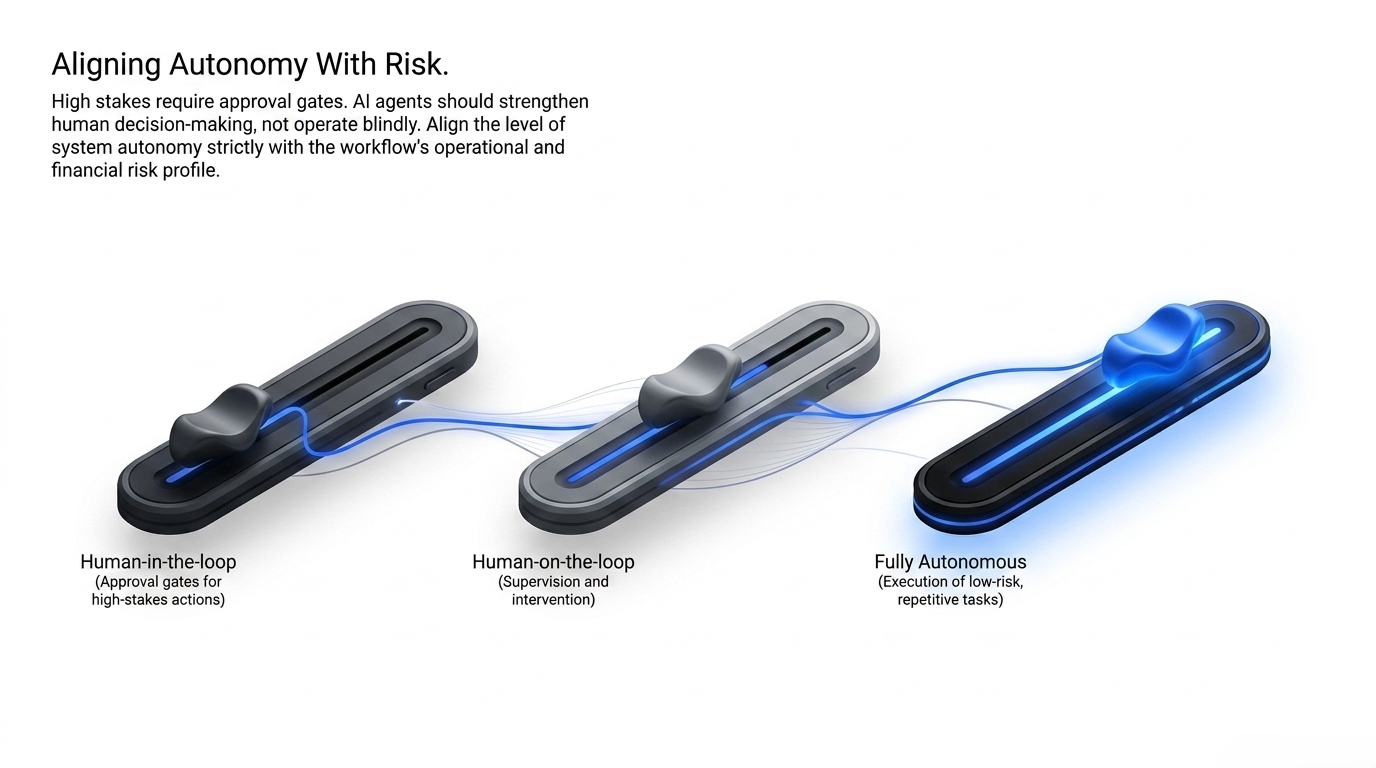
A useful operating model has three broad levels.
Human-in-the-loop systems require explicit approval before high-impact actions execute.
Human-on-the-loop systems operate with supervision and provide intervention points.
Fully autonomous systems execute bounded, low-risk, repetitive tasks without requiring continuous approval.
The objective is not maximum autonomy.
The objective is appropriate autonomy.
Agentic systems should strengthen human decision-making where consequences are significant and automate aggressively where behavior is sufficiently bounded and reversible.
10. Enforce Capability-Scoped Governance
Agents should never receive broad credentials simply because they may need to perform one narrow operation.
The principle of least privilege should be enforced at the capability level.
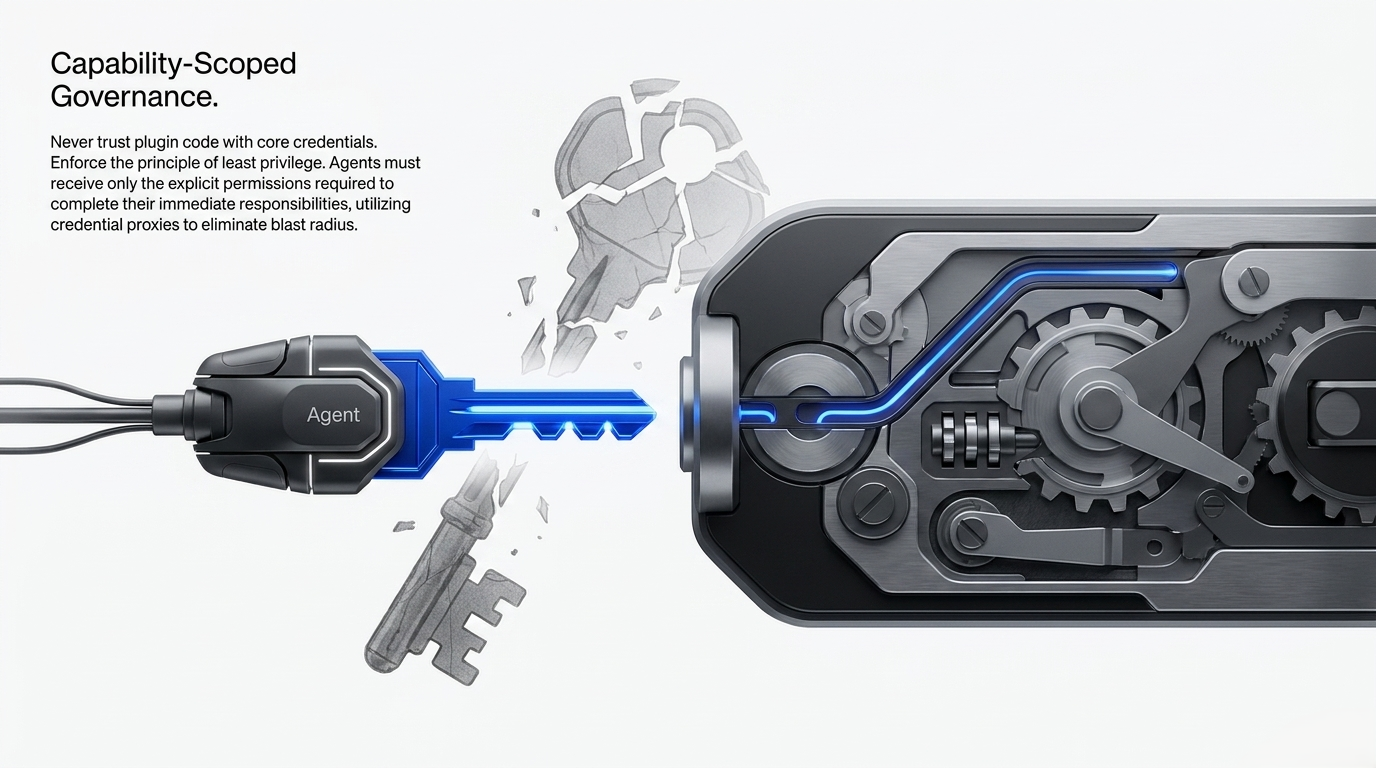
Each agent should receive only the permissions required to perform its immediate responsibility.
Credential proxies or equivalent authorization layers can issue narrowly scoped access without exposing core credentials directly to plugin or agent code.
This limits blast radius.
A compromised capability should not automatically provide access to unrelated databases, financial systems, infrastructure, or administrative services.
Security boundaries should be architectural primitives rather than prompt-level instructions.
11. Build a Glass Box, Not a Black Box
If a system cannot be observed, it cannot be operated reliably.
Production agent infrastructure needs visibility into how requests move through reasoning, knowledge retrieval, tools, APIs, and downstream services.

Observability should capture information such as:
- Agent reasoning stages.
- Tool invocation and responses.
- Knowledge retrieval behavior.
- API latency and failures.
- State transitions.
- Outcome quality.
- Cost and token usage.
- Escalations and human approvals.
Technical traces should also connect to measurable business outcomes.
An agent workflow should not be considered successful merely because a model completed a response.
Success may mean a qualified pipeline event, shorter resolution time, accurate system updates, lower operational cost, or better process throughput.
The architecture must expose enough evidence to connect execution with those outcomes.
Engineering Principles
The architecture ultimately depends on several principles:
-
Specialize responsibilities
Keep agents narrow enough that their behavior, permissions, tools, and operational boundaries can be understood. -
Separate reasoning from execution
Allow models to make decisions while deterministic services perform real-world operations. -
Treat capabilities as contracts
Package tools and skills with explicit manifests, schemas, lifecycle behavior, and versioning. -
Govern every boundary
Use least privilege, approval gates, scoped credentials, and explicit autonomy levels. -
Engineer context and observability
Retain only useful state and ensure every important action can be inspected, measured, and diagnosed.
Final Synthesis
The long-term competitive advantage of enterprise AI will not come from deploying isolated assistants.
It will come from connecting specialized intelligence, trusted knowledge, deterministic tools, orchestration, governance, lifecycle management, and observability into one integrated operating environment.
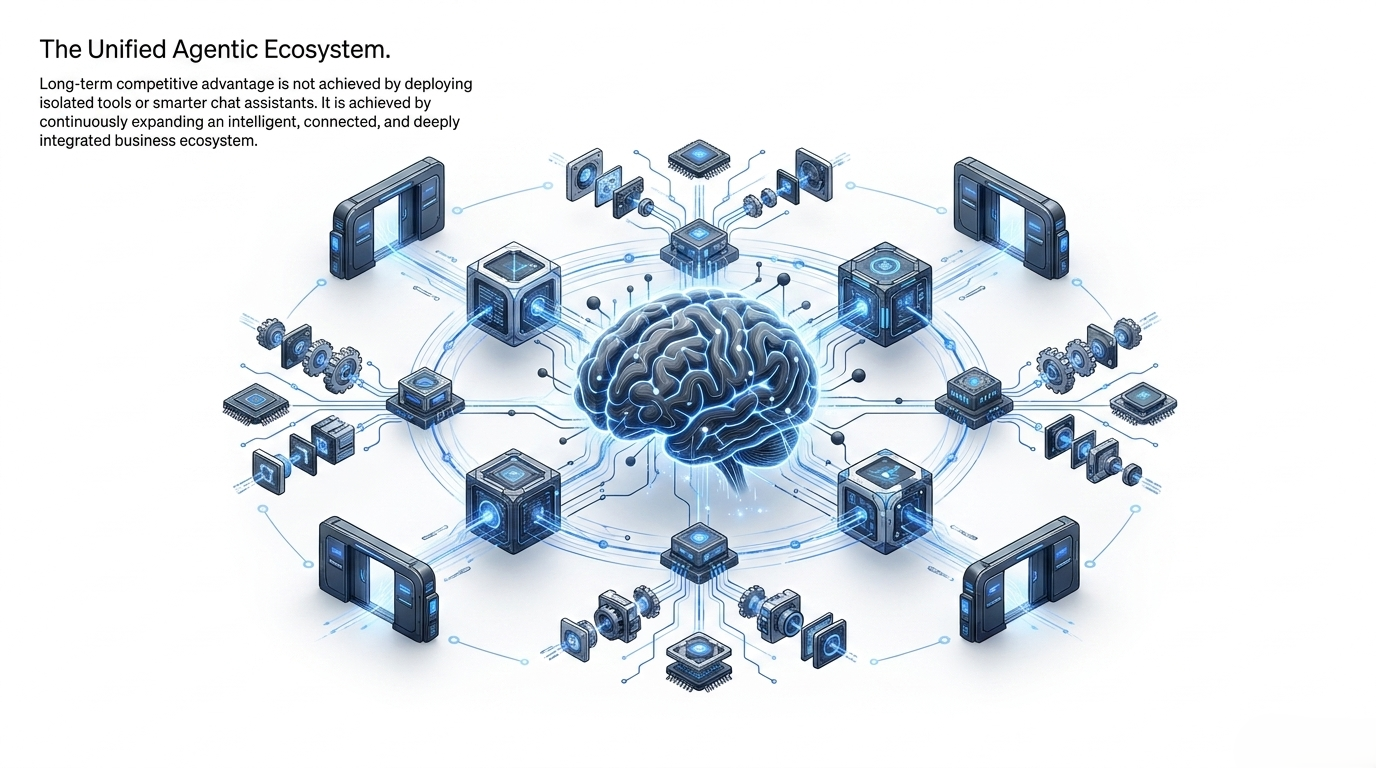
A production-ready agentic ecosystem combines specialized reasoning components around a shared intelligence layer while keeping execution, permissions, lifecycle behavior, and operational telemetry explicit.
The production-ready system combines:
- Deterministic foundation: Typed services, APIs, lifecycle operations, and predictable execution boundaries.
- Testing layer: Contract validation, schema tests, integration tests, migration tests, and failure-mode verification.
- Agent or AI layer: Specialized agents, selective context, hybrid retrieval, orchestration, and dynamic tool discovery.
- Security and governance: Least privilege, credential proxies, approval gates, and risk-aligned autonomy.
- Observability layer: Traces, metrics, latency, model behavior, tool outcomes, cost, and business-impact measurement.
- Production outcome: A resilient ecosystem that can evolve without becoming an unmaintainable monolithic assistant.
Closing Thought
The transition from AI demos to AI infrastructure happens when intelligence stops being treated as a self-contained application and starts being treated as one component inside a disciplined engineering system.
Models will continue to improve. Tools will change. Frameworks will evolve.
The durable advantage is the architecture around them.
Do not design assistants that happen to use infrastructure. Design infrastructure that can safely support intelligence.