
Beyond Retrieval: The CAG Paradigm in AI Regression Testing
Retrieval-augmented generation is a natural fit when the problem is finding the right fragments of a large, changing corpus. It is a weaker fit when correctness depends on relationships that must survive intact: database schemas, API contracts, typed constraints, test fixtures, dependency rules, and multi-step execution semantics.
That distinction matters in AI regression testing. A model that generates a plausible test from a semantically similar chunk can still be wrong if the chunk omits a foreign key, a companion table, a required enum, a tool precondition, or the state transition that gives the test meaning. The central engineering problem is therefore not just relevance. It is structural fidelity under limited context, changing code, and non-deterministic model behavior.
The source material frames Cache-Augmented Generation (CAG) as a response: preload a stable body of high-value context, reuse its cached model state, and reserve retrieval for what actually changes. The strongest production design is not “CAG everywhere.” It is a tiered architecture that caches the core and retrieves the diffs.
1. Why RAG Fragments Structural Integrity
RAG pipelines usually divide source material into chunks, embed those chunks, and retrieve a subset at inference time. That mechanism optimizes for local semantic relevance. Structural systems, however, are defined by non-local relationships.
A database test may require a table definition, its foreign-key target, a check constraint, a trigger, a fixture convention, and the expected downstream behavior. If those elements land in different chunks, similarity search has to reconstruct the relationship indirectly. Missing even one bridge can turn a valid-looking test into an invalid one.
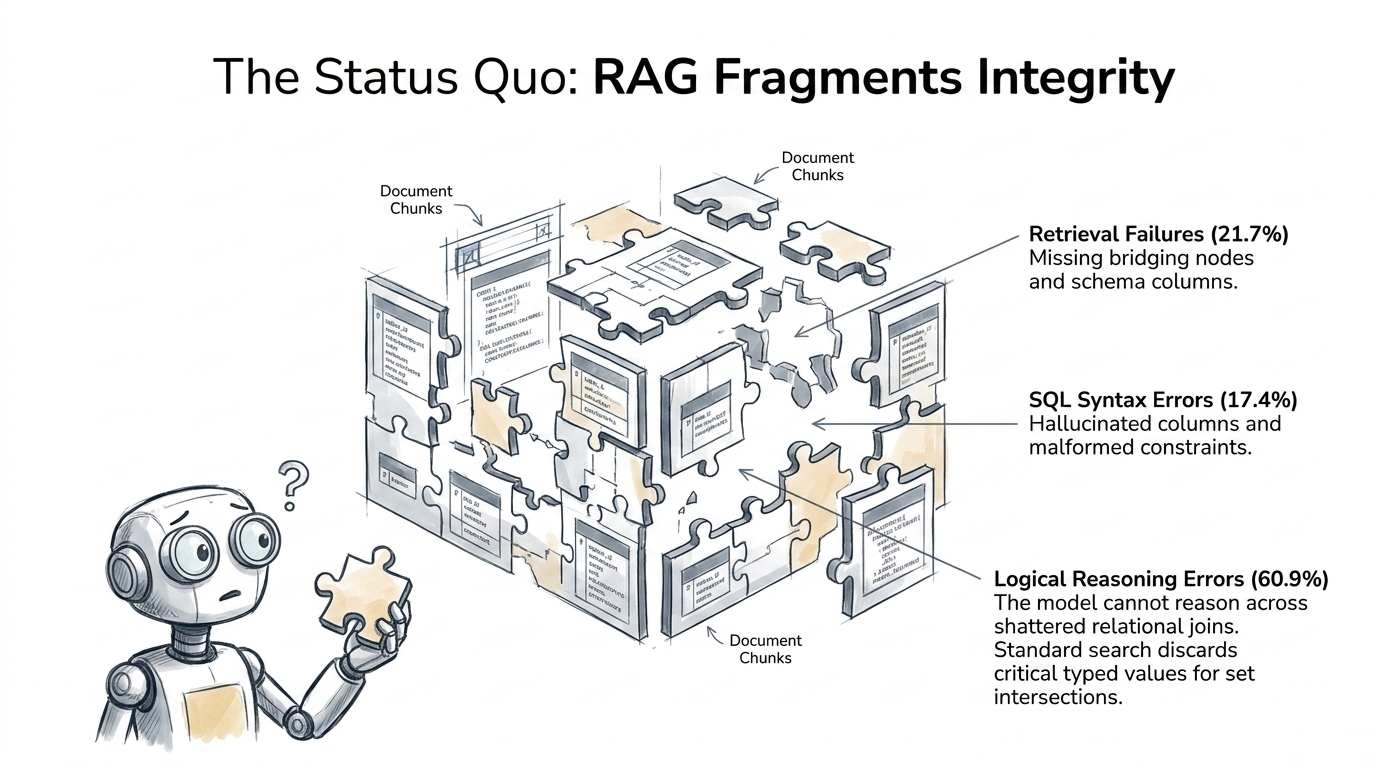
The illustrated failure breakdown attributes errors to retrieval omissions, malformed SQL, and especially logical reasoning failures caused by shattered relational joins. The exact percentages should be read as results from the source material rather than universal rates, but the failure classes are broadly important:
- Retrieval failures occur when the required bridge or schema element never enters context.
- Syntax and schema errors appear when the model fills gaps with plausible but nonexistent columns or malformed constraints.
- Logical errors happen when individually relevant fragments do not provide enough information to reconstruct the full relation.
The engineering lesson is simple: a retrieval system can be semantically accurate and still be structurally incomplete.
2. Multi-Field Queries Expose the Weakness
Single-field questions are forgiving because the required information is often localized. Multi-field queries are not. They force the model to reason across tables, constraints, types, joins, and values that may be distributed throughout the corpus.
The source material illustrates this with a sharp decline in execution accuracy as a query spans more fields. A one-field case is shown at 88%, a two-field case at 32%, and a three-field case at 10% for the referenced model setup.
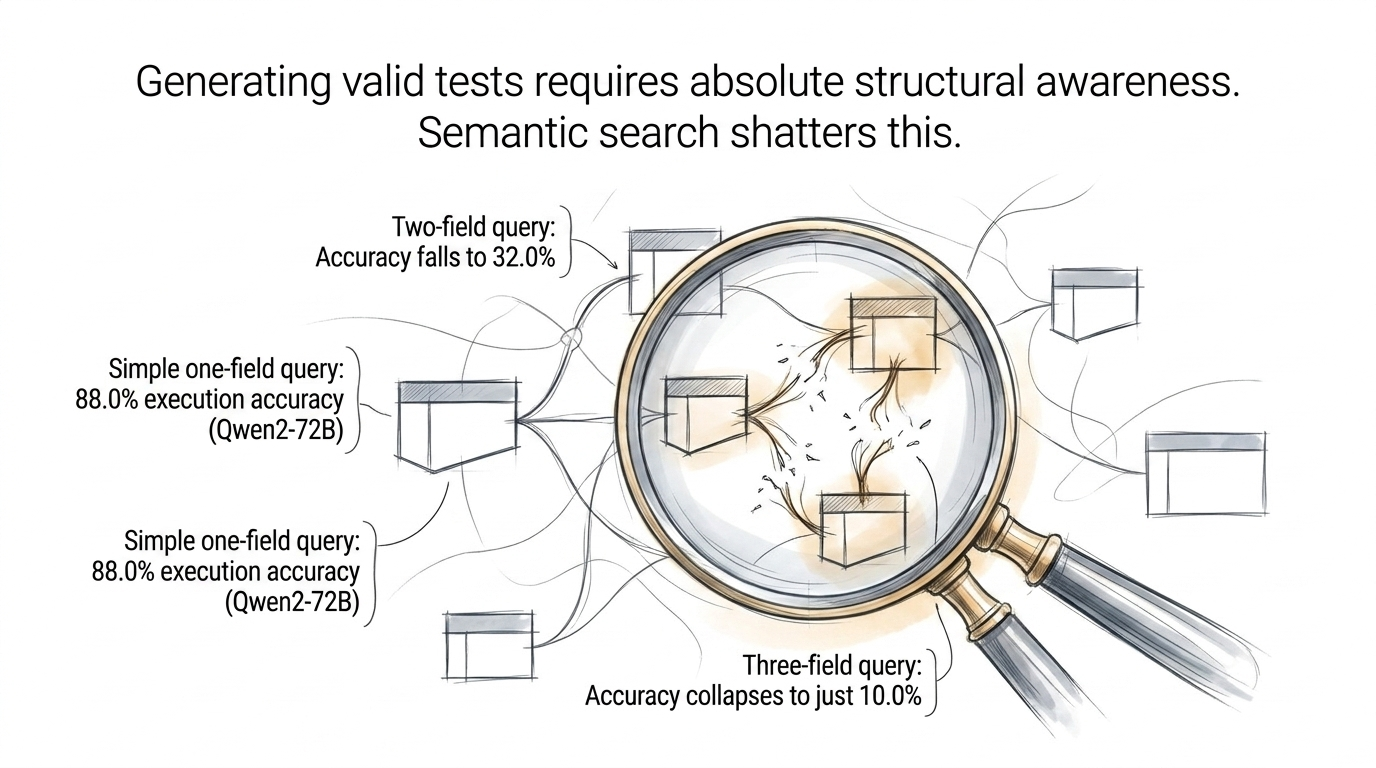
The important point is not the specific benchmark number. It is the shape of the failure. Complexity rises relationally, not just lexically. Adding another field can introduce a new join path, a new set intersection, another constraint, or a hidden dependency that no single retrieved chunk contains.
For regression-test generation, this means semantic retrieval alone is a brittle foundation for tasks such as:
- generating valid multi-table fixtures,
- synthesizing queries against typed schemas,
- creating tool calls with dependent parameters,
- replaying stateful workflows,
- and checking behavior across several system boundaries.
When validity depends on the graph, the model needs the graph.
3. CAG: Preload the Entire Stable Schema
CAG changes the question from “Which chunks should I fetch now?” to “Which stable knowledge should already be present?”
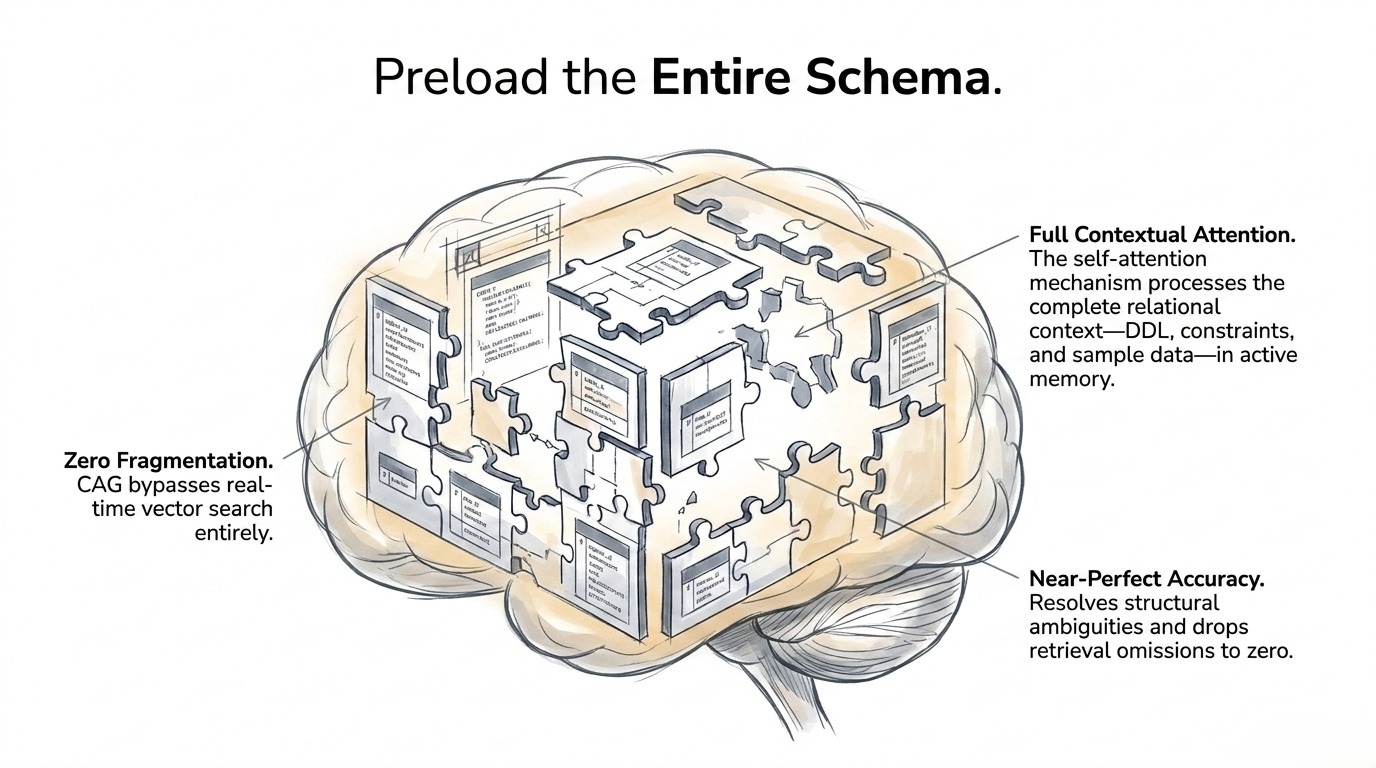
The source architecture preloads the complete relational environment—DDL, constraints, representative data, APIs, or other foundational definitions—into model context and reuses the cached state across requests. In this mode, there is no real-time vector search for the stable core.
This has two effects. First, it removes retrieval omission as a failure mode for the cached material. Second, it gives self-attention access to the complete set of relationships at once.
That distinction is especially valuable when generation must satisfy hard structural preconditions. If a model needs to know that orders.customer_id references customers.id, that an API call requires a specific enum, or that a fixture must satisfy a uniqueness constraint, preserving the full context can be more reliable than trying to recover those facts through nearest-neighbor search.
CAG is therefore best understood as a context placement strategy: move stable, reusable knowledge into a persistent prefilled context so the model can reason over it without reconstructing it on every request.
4. KV Caching Moves Heavy Work Offline
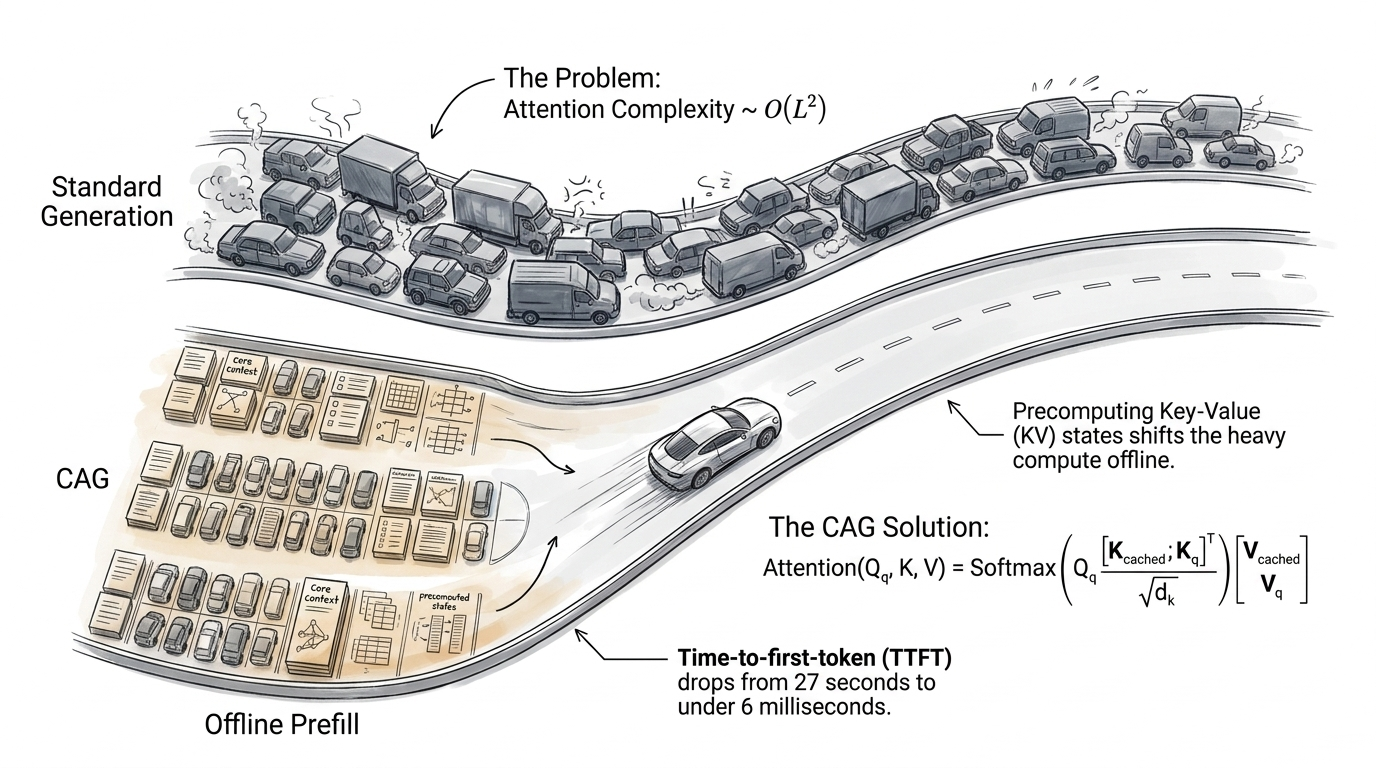
Transformers pay a large cost to process long prefixes. The source material describes CAG as precomputing and reusing key-value states for the stable prefix instead of repeatedly evaluating the same tokens.
The highway metaphor captures the operational effect. Standard generation repeatedly sends the full context through the same expensive path. A cached prefix moves the heavy setup work offline, leaving the live request to process only the new query and attend to the cached state.
The exact latency improvement shown in the source—from tens of seconds to milliseconds for time-to-first-token—depends on model, provider, hardware, cache implementation, and prefix size. It should not be treated as a universal guarantee. The mechanism, however, is the key production insight:
If a large prefix is identical across many requests, repeated full-prefix evaluation is wasted work.
For test systems, good cache candidates include:
- database schemas and constraints,
- stable API specifications,
- tool definitions,
- canonical policy rules,
- standard test libraries,
- fixed fixtures,
- and durable architectural contracts.
The more frequently those elements are reused, the more attractive caching becomes.
5. RAG and CAG Optimize Different Failure Modes
RAG and CAG are not interchangeable implementations of the same idea. They optimize different dimensions.
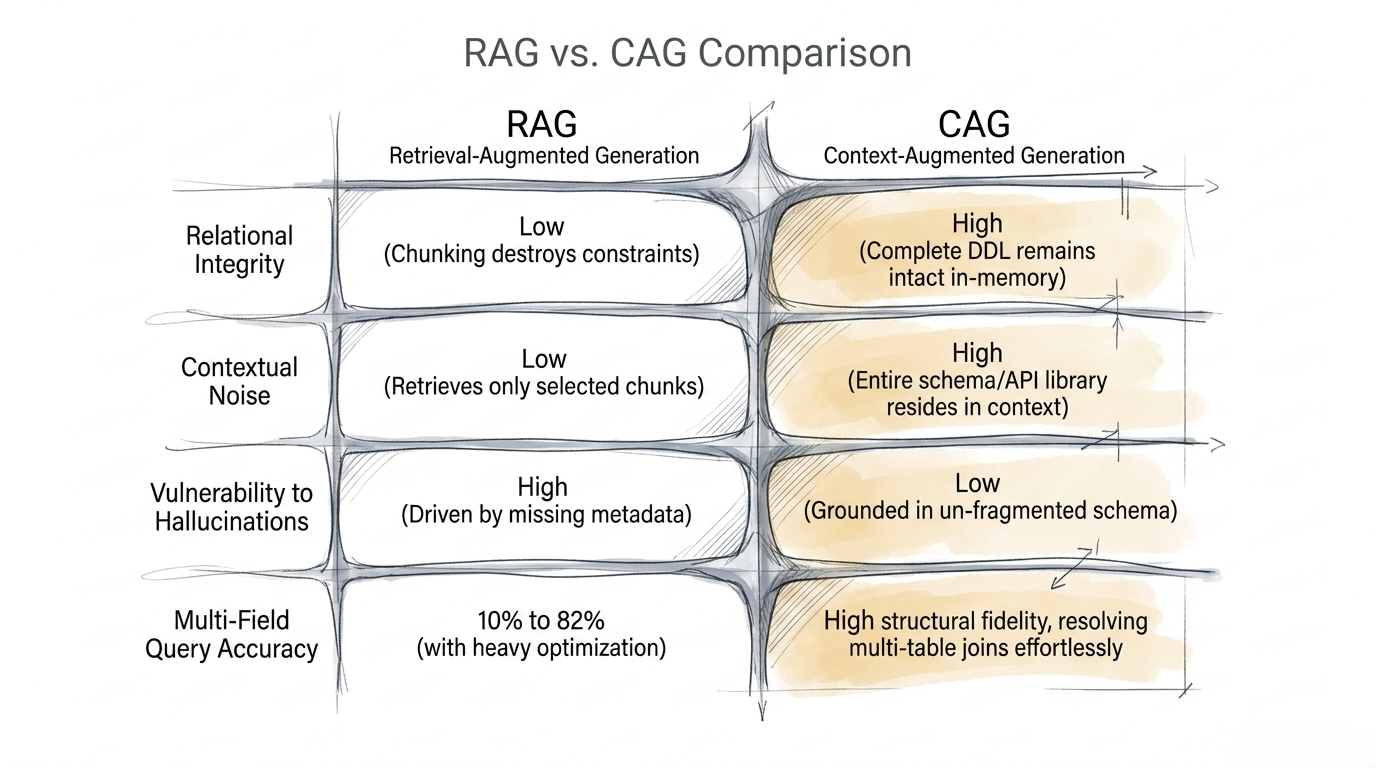
The comparison in the source emphasizes four engineering differences.
Relational integrity. RAG can break constraints across chunk boundaries. CAG preserves the complete cached structure.
Contextual focus. RAG injects only selected chunks, which keeps the prompt smaller but can omit critical neighbors. CAG keeps a larger stable environment resident, reducing omission at the cost of more context.
Hallucination exposure. With RAG, missing metadata can invite the model to fill gaps. CAG reduces this particular risk when the missing information is part of the cached core.
Multi-field reasoning. RAG may require heavy retrieval tuning to assemble enough related evidence. CAG gives the model direct access to the structural whole.
This is why the choice should be made from system properties rather than fashion. Use retrieval when freshness and unbounded scale dominate. Use caching when a bounded, stable corpus must remain internally coherent.
6. Prompt Caching Changes the Cost Model
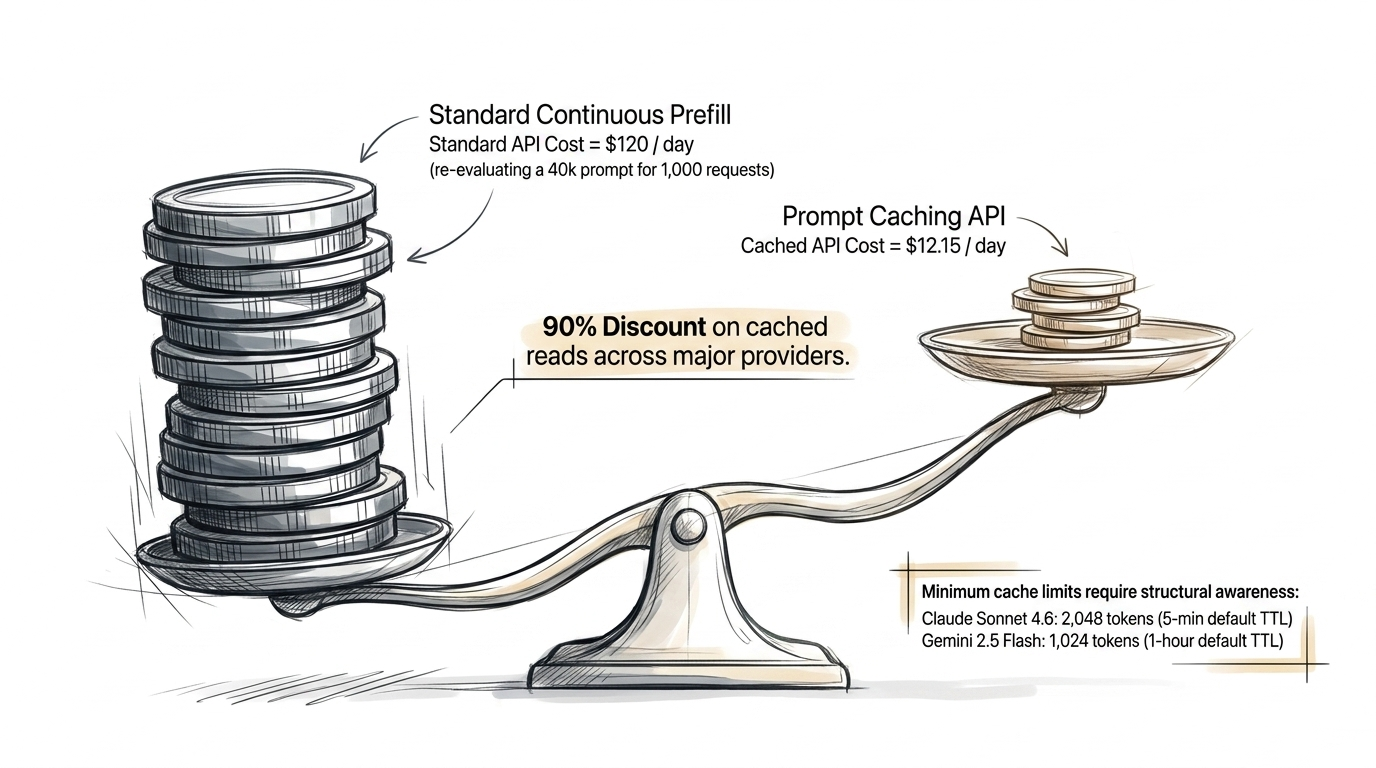
A CAG architecture only becomes practical if cached prefixes are materially cheaper than recomputing them. The source material highlights prompt-caching APIs that discount repeated reads of a stable prefix.
The illustrated example compares a continuously re-evaluated large prompt with a cached equivalent and shows a large daily cost reduction. Those values are workload- and provider-specific, but they expose the right cost model:
Total cost is not just tokens per request. It is stable-prefix tokens multiplied by reuse frequency.
A useful economic analysis should separate:
- Initial cache-write or prefill cost
- Cached-read cost
- Uncached suffix cost
- Cache hit rate
- Time-to-live and eviction behavior
- Minimum cacheable prefix size
- Invalidation frequency when the stable core changes
This also introduces an architectural constraint: cache lifetime becomes part of application behavior. If a provider evicts a cached prefix after a short TTL, the system may need deliberate keepalive traffic or a cache-refresh strategy. That is not an implementation footnote; it is part of reliability and cost planning.
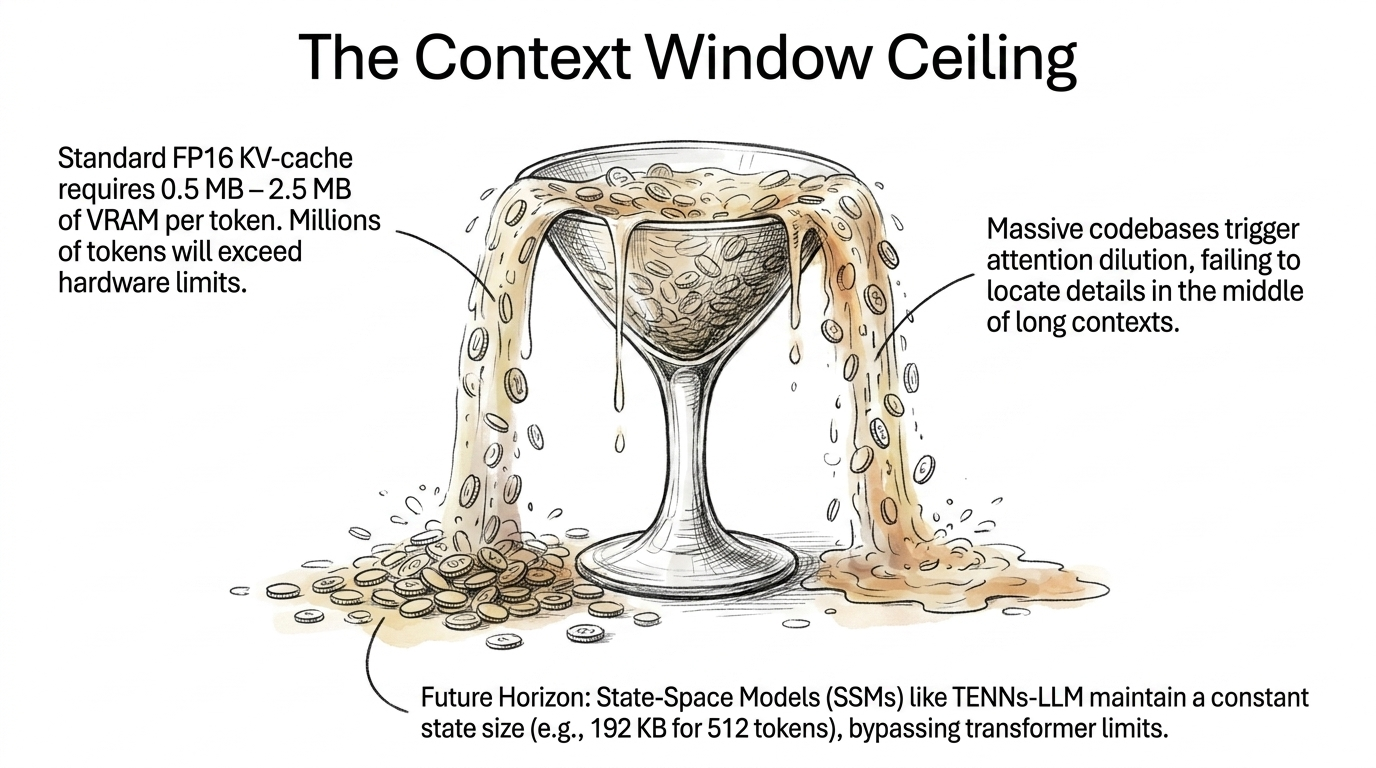
7. The Context Window Is Still a Ceiling
CAG does not eliminate context limits. It changes how the context is populated and reused.
The source material calls out two ceilings: memory consumption for transformer KV caches and attention dilution in very long contexts.
The first ceiling is physical. Larger cached sequences consume more accelerator memory. The exact per-token memory figure in the source depends heavily on model size, layer count, precision, and cache format, but the direction is unavoidable: a larger cached prefix occupies more memory.
The second ceiling is cognitive. Even when a context fits, models may become worse at locating details buried in very long sequences. A million-token context is not automatically a million-token working set with uniform effective attention.
This leads to an important design rule: do not turn CAG into “load everything forever.” Cache the smallest stable context that preserves the relationships the task actually needs.
The source also points toward state-space approaches as a future direction for reducing state growth. Whether or not a specific architecture becomes dominant, the systems principle is durable: long-lived model state must become cheaper if persistent context is going to scale far beyond current transformer limits.
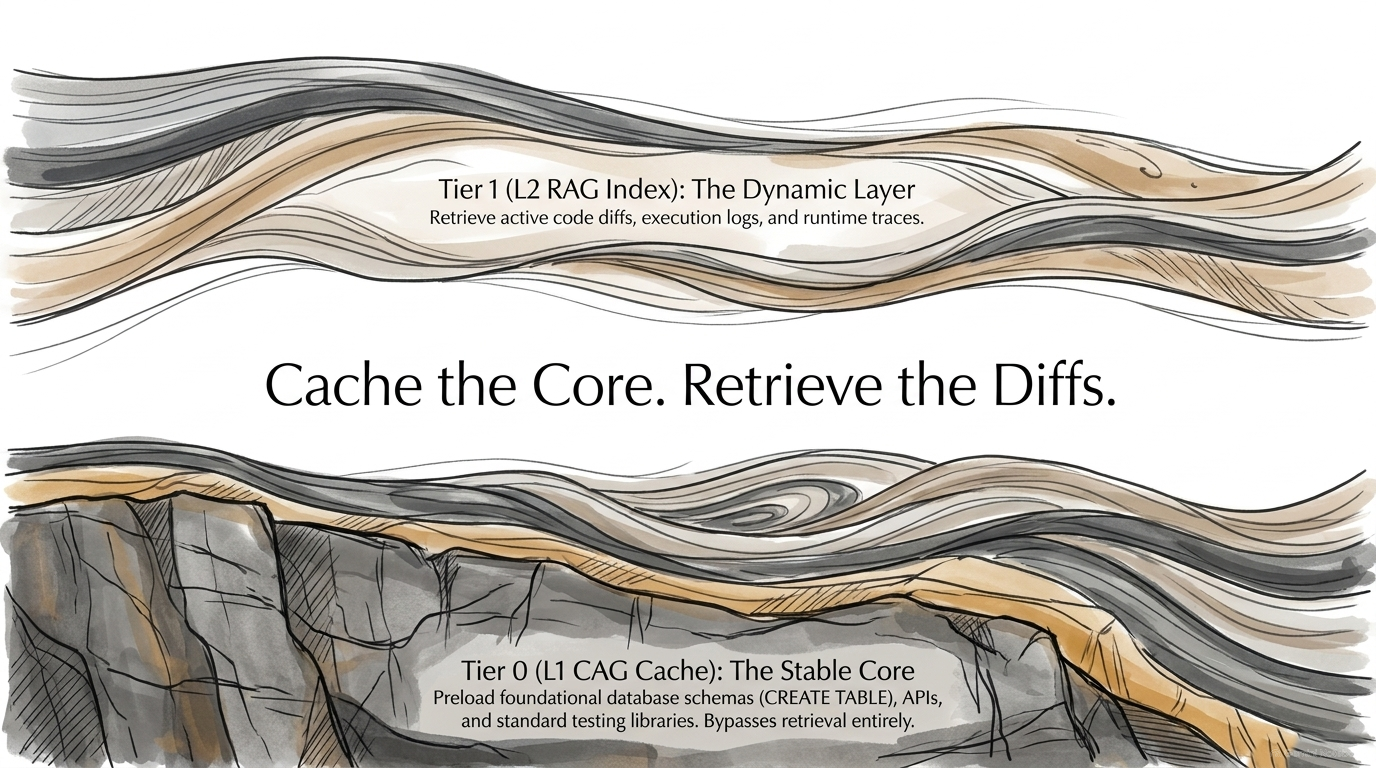
8. The Tiered Architecture: Cache the Core, Retrieve the Diffs
The most practical design in the source material is hybrid.
Tier 0 is the stable core: schemas, API definitions, standard test libraries, durable policies, and other material whose relationships must remain intact. This layer is a natural fit for CAG.
Tier 1 is dynamic evidence: active code diffs, execution logs, traces, recent incidents, and runtime artifacts. This layer changes too quickly to be baked into a long-lived cached prefix, so retrieval remains appropriate.
The resulting request path looks like this:
- Start from the cached stable prefix.
- Detect what has changed or what is request-specific.
- Retrieve only the dynamic material required for the current task.
- Append that material as a small live suffix.
- Generate and evaluate against the combined context.
This architecture avoids a false choice between integrity and freshness. It preserves the stable relationships that should never be fragmented while retaining RAG's strength on volatile evidence.
9. Scaling the Cached Core Without Loading the Universe
Even a tiered design needs mechanisms to control footprint and cache lifetime. The source material proposes several.
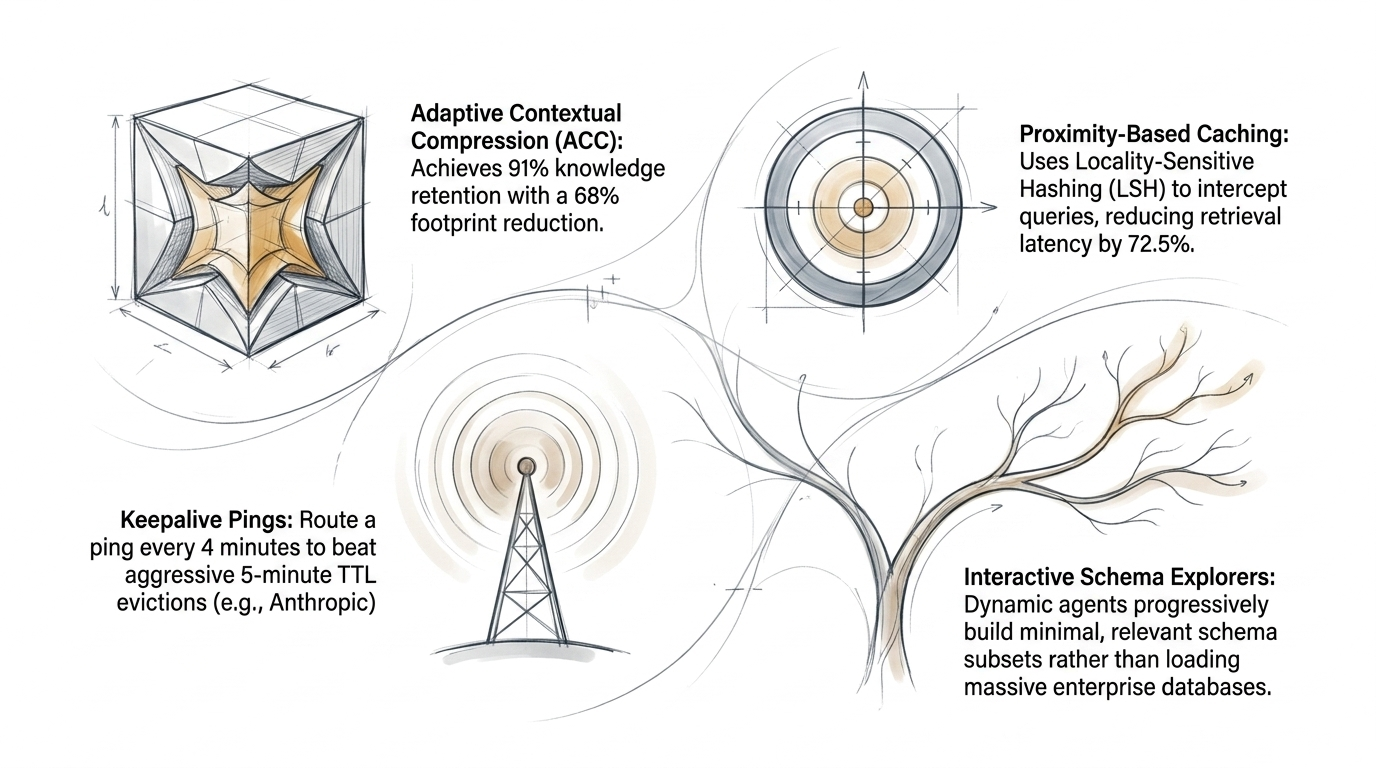
Adaptive contextual compression aims to preserve the highest-value structural knowledge while reducing the cached footprint. In practice, this should be conservative: compression is useful only if it does not erase constraints or relationships that determine validity.
Proximity-based caching can route similar requests toward reusable cached states, reducing unnecessary re-prefill work. The key is to define similarity around stable prefix structure, not merely topical resemblance.
Keepalive requests can protect short-lived provider caches from eviction when reuse is frequent enough to justify it. They should be governed by measured cache-hit economics rather than sent blindly.
Interactive schema explorers suggest a different path for very large systems: begin with a minimal stable core, then let an agent expand the schema context deliberately as it discovers which regions are relevant.
These techniques turn CAG from a single-prompt trick into a cache-management problem. Production systems need explicit policies for creation, reuse, invalidation, eviction, and observability.
10. Choose CAG, RAG, or Hybrid Based on Size and Drift
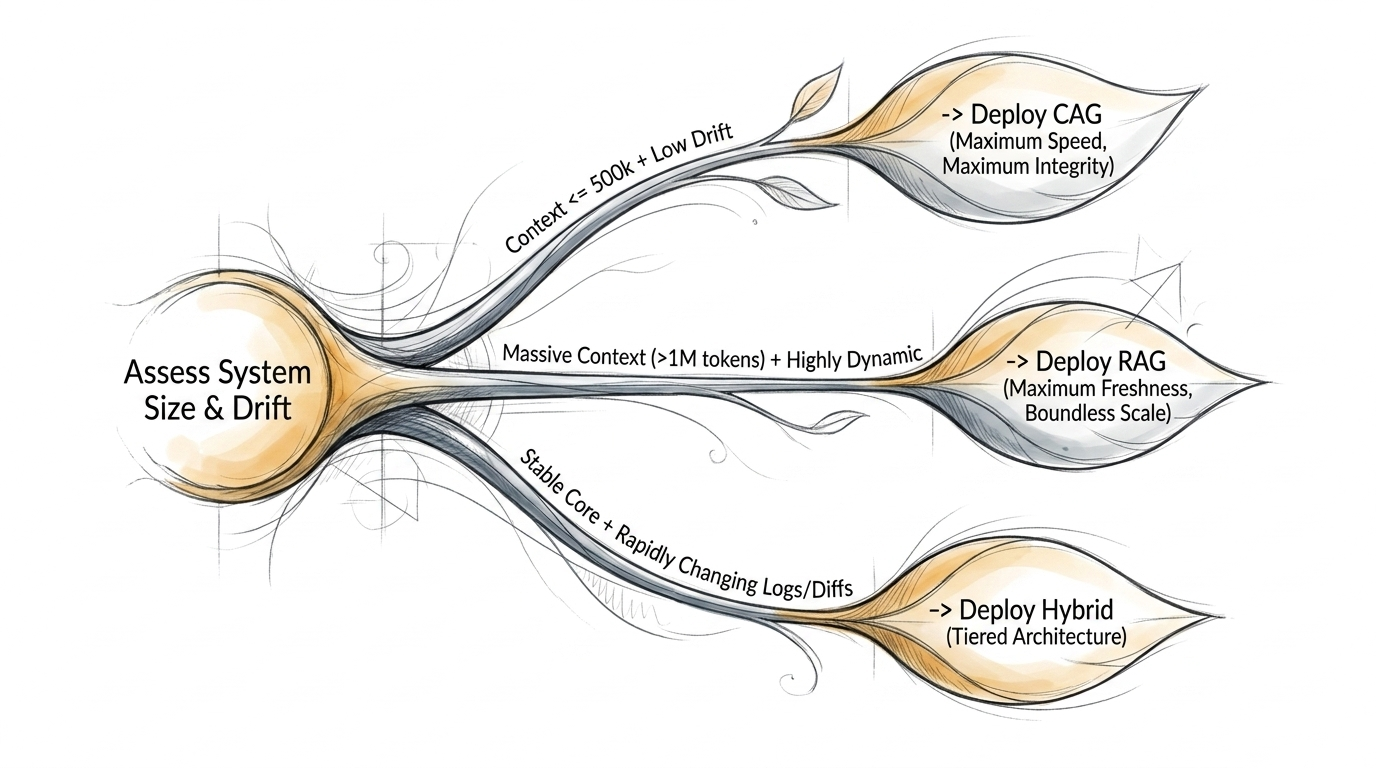
The source decision tree uses two variables: context size and rate of change.
A useful version of that decision rule is:
- Bounded context + low drift: prefer CAG when structural fidelity is more important than retrieval flexibility.
- Massive context + high drift: prefer RAG because freshness and scale dominate.
- Stable core + rapidly changing evidence: use a hybrid tier, caching the core and retrieving the changes.
The size thresholds shown in the diagram are illustrative, not universal. Actual breakpoints depend on model context windows, provider cache limits, hardware, latency SLOs, and how much of the stable core is genuinely necessary for the task.
The architectural question is not “How many tokens do we have?” It is “Which knowledge must remain complete, and which knowledge must remain fresh?”
11. Regression Testing Needs Generation Plus Adversarial Search
Preserving context solves only part of the testing problem. A system also needs to generate useful cases and explore failure boundaries.
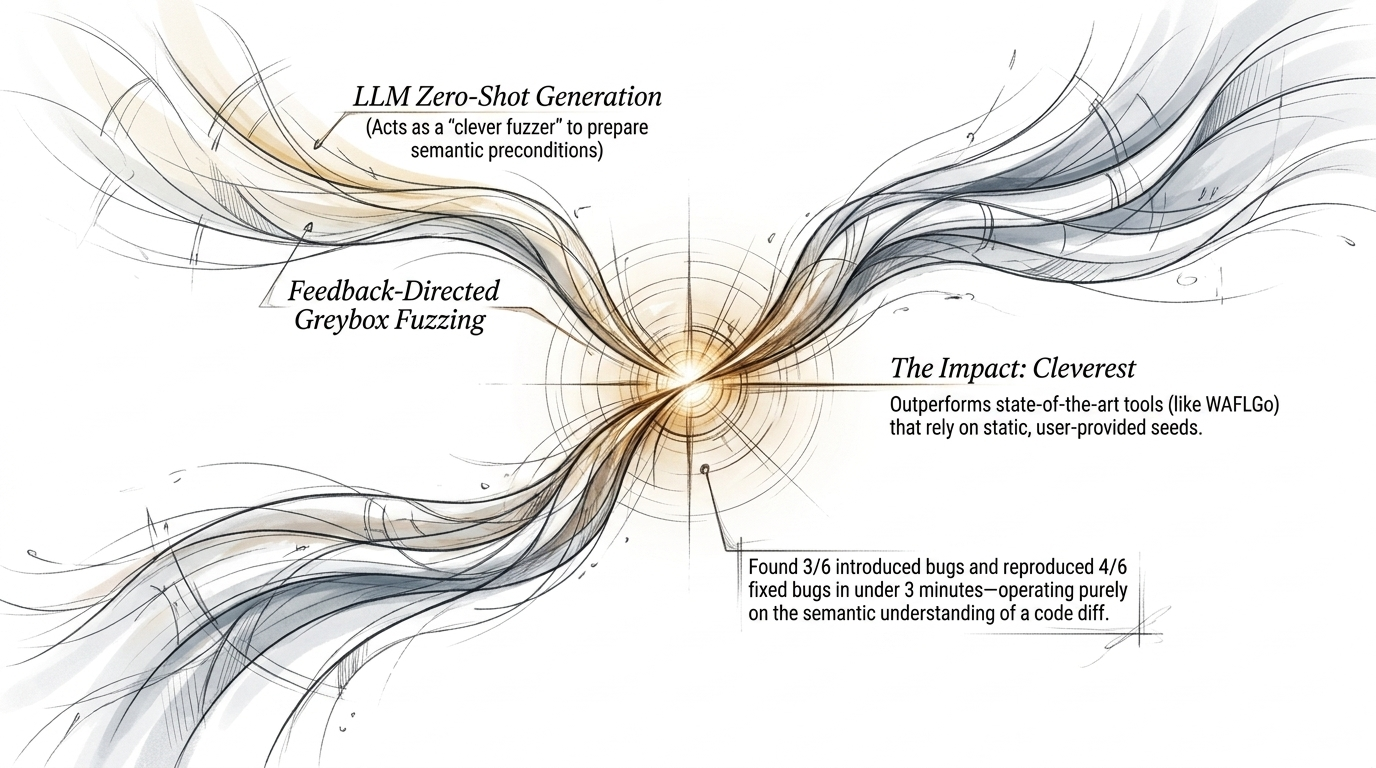
The source material combines zero-shot LLM generation with feedback-directed greybox fuzzing.
The LLM acts as a semantic precondition generator: it proposes inputs, states, or sequences that make sense for the code change. The fuzzer then explores mutations and execution feedback around those seeds.
This division of labor is powerful because each component does what it is good at:
- the model understands intent, API meaning, data semantics, and code-diff context;
- the fuzzer searches the local behavioral space and follows concrete execution feedback.
The example reports finding several introduced bugs and reproducing several fixed bugs in minutes. Those results belong to the illustrated experiment, not a general guarantee, but they show the pattern worth preserving: use the model to make tests meaningful, then use execution feedback to make them hard to fool.
12. A New Testing Contract: Assert Behavior, Preserve Structure, Scale Dynamically
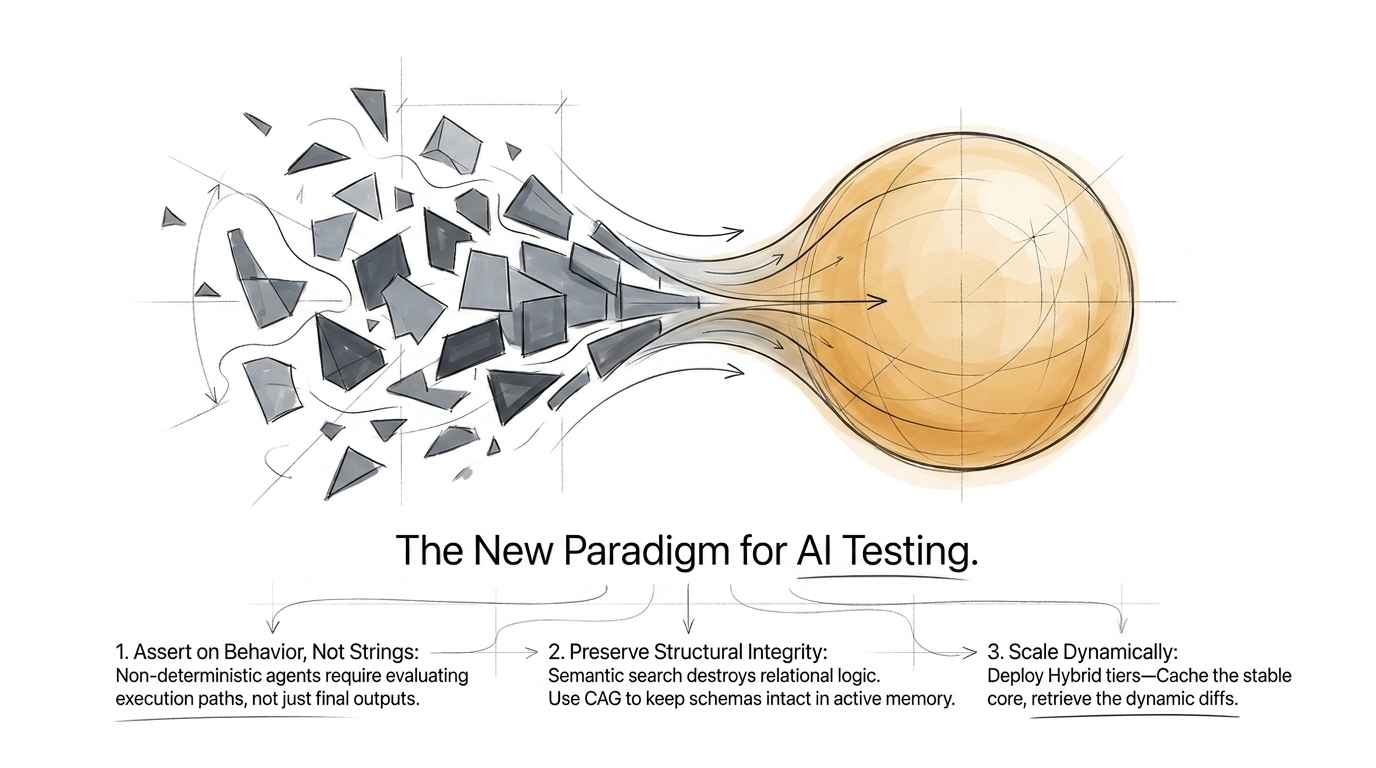
AI-assisted testing becomes more reliable when the contract shifts away from literal output matching.
The source synthesizes three principles.
Assert behavior, not strings. Non-deterministic agents can produce different wording while taking the same correct action. Tests should inspect tool selection, arguments, state transitions, permissions, database effects, and externally visible outcomes.
Preserve structural integrity. When a test depends on schema or protocol relationships, keep those relationships intact in active model context instead of reconstructing them from fragments.
Scale dynamically. Do not force all information into one context strategy. Cache stable foundations and retrieve volatile diffs.
This is the core shift from prompt testing to system testing. The unit under evaluation is no longer a generated sentence. It is an execution path through an AI-enabled system.
13. Close the Loop With Traces, Replay, and Release Gates
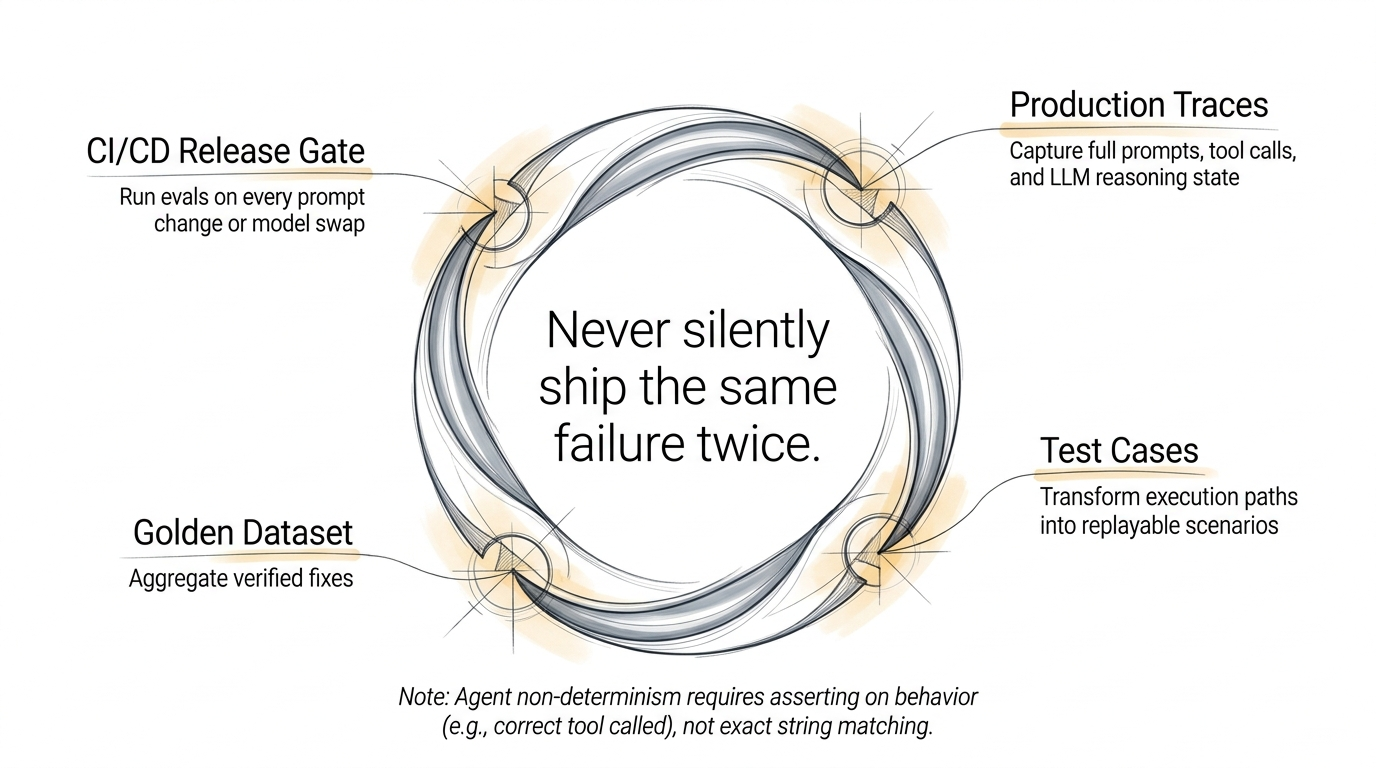
A production regression system must remember failures.
The source describes a closed loop with four components.
Production traces capture the information needed to explain a failure: prompts, tool calls, model decisions, state, and relevant environment.
Test cases convert those traces into replayable scenarios. A replay should preserve the conditions that mattered while removing incidental noise.
Golden datasets aggregate verified fixes so once a failure is understood, it becomes a permanent regression case.
CI/CD release gates run those evaluations when prompts, tools, code, models, or policies change.
The resulting rule is operationally valuable: never silently ship the same failure twice.
For AI systems, the assertions inside that loop should target behavior. Exact string equality is often the wrong oracle. Better checks include whether the right tool was called, whether the arguments were valid, whether state changed correctly, whether safety constraints held, and whether the final outcome satisfied the task.
Engineering Principles
The architecture ultimately depends on several principles:
-
Preserve relationships before optimizing relevance
If a task fails when a constraint or join disappears, keep the relational core intact instead of relying on semantic reconstruction. -
Cache what is stable; retrieve what changes
Stable schemas and contracts deserve persistent context. Logs, traces, diffs, and recent events belong in the dynamic layer. -
Treat cache policy as production infrastructure
Prefix creation, TTLs, invalidation, hit rate, cost, and memory footprint require observability and explicit ownership. -
Test execution semantics, not model wording
AI regression tests should evaluate actions, state transitions, tool usage, constraints, and effects. -
Turn every verified incident into a replayable asset
Production failures should flow into a golden dataset and then into automated release gates.
Final Synthesis
CAG is most useful when the system has a bounded, reusable, structurally dense core. RAG remains essential when the system must search a very large or rapidly changing evidence space. AI regression testing often needs both.
A production architecture can therefore treat context as two different classes of state:
- a cached foundation containing schemas, APIs, test conventions, and durable contracts;
- a retrieved delta containing code changes, logs, traces, and request-specific evidence.
The model reasons over both. The testing system then validates the resulting execution path, stores verified failures as replayable cases, and runs them again at each release boundary.
The production-ready system combines:
- Deterministic foundation: stable schemas, constraints, API contracts, and test primitives
- Testing layer: replayable scenarios, fuzzing, behavioral assertions, and golden datasets
- Agent or AI layer: cached structural context plus retrieved runtime evidence
- Security and governance: explicit tool permissions, constraint validation, and controlled test data
- Observability layer: prompts, tool calls, traces, cache behavior, and failure attribution
- Production outcome: faster repeated context use without sacrificing the structural knowledge required for valid tests
The key architectural move is not replacing retrieval everywhere. It is assigning each kind of knowledge to the mechanism that preserves its most important property.
Closing Thought
The more an AI system depends on relationships, the less acceptable it becomes to reconstruct those relationships from fragments at the moment of failure.
Cache the core. Retrieve the diffs. Test the behavior.